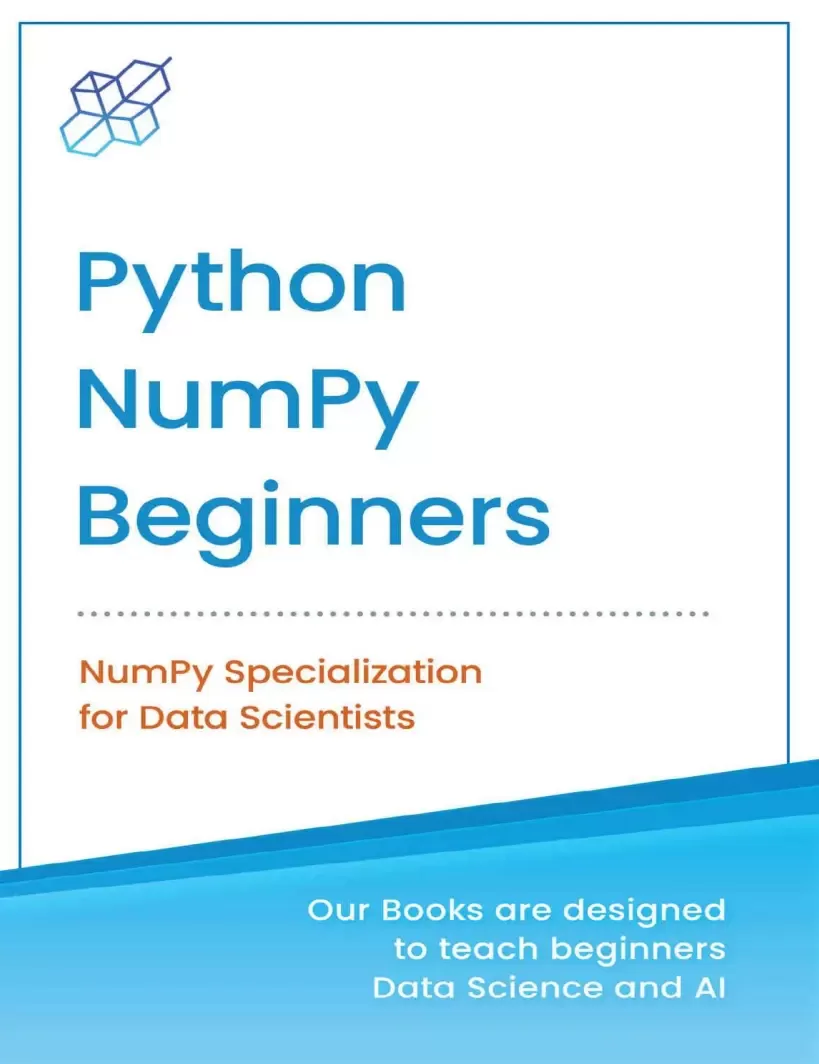
Python NumPy for Beginners: NumPy Specialization for Data Science
Оглавление⌄
Title Page....2 Copyright....3 How to Contact Us....4 About the Publisher....5 AI Publishing Is Searching for Authors Like You....7 Table of Contents....8 Preface....13 Book Approach....14 Who Is This Book For?....15 How to Use This Book?....16 About the Author....18 Get in Touch With Us....19 Download the PDF version....20 Warning....21 Chapter 1: Introduction....22 1.1. What Is NumPy?....23 1.2. Environment Setup and Installation....25 1.2.1. Windows Setup....25 1.2.2. Mac Setup....32 1.2.3. Linux Setup....40 1.2.4. Using Google Colab Cloud Environment....43 1.2.5. Writing Your First Program....48 1.3. Python Crash Course....54 1.3.1. Python Syntax....54 1.3.2. Python Variables and Data Types....60 1.3.3. Python Operators....63 1.3.4. Conditional Statements....79 1.3.5. Iteration Statements....88 1.3.6. Functions....94 1.3.7. Objects and Classes....100 Exercise 1.1....105 Exercise 1.2....106 Chapter 2: NumPy Basics....107 2.1. Introduction to NumPy Arrays....108 2.2. NumPy Data Types....109 2.3. Creating NumPy Arrays....120 2.3.1. Using Array Method....120 2.3.2. Using Arrange Method....124 2.3.3. Using Ones Method....128 2.3.4. Using Zeros Method....132 2.3.5. Using Eyes Method....136 2.3.6. Using Random Method....138 2.4. Printing NumPy Arrays....145 2.5. Adding Items in a NumPy Array....160 2.6. Removing Items from a NumPy Array....171 Exercise 2.1....180 Exercise 2.2....181 Chapter 3: NumPy Array Manipulation....182 3.1. Sorting NumPy Arrays....183 3.1.1. Sorting Numeric Arrays....183 3.1.2. Sorting Text Arrays....185 3.1.3. Sorting Boolean Arrays....187 3.1.4. Sorting 2-D Arrays....189 3.1.5. Sorting in Descending Order....191 3.2. Reshaping NumPy Arrays....194 3.2.1. Reshaping from Lower to Higher Dimensions....194 3.2.2. Reshaping from Higher to Lower Dimensions....202 3.3. Indexing and Slicing NumPy Arrays....209 3.4. Broadcasting NumPy Arrays....224 3.5. Copying NumPy Arrays....233 3.6. NumPy I/O Operations....238 3.6.1. Saving a NumPy Array....238 3.6.2. Loading a NumPy Array....240 Exercise 3.1....245 Exercise 3.2....246 Chapter 4: NumPy Tips and Tricks....247 4.1. Statistical Operations with NumPy....248 4.1.1. Finding the Mean....248 4.1.2. Finding the Median....252 4.1.3. Finding the Max and Min Values....256 4.1.4. Finding Standard Deviation....264 4.1.5. Finding Correlations....268 4.2. Getting Unique Items and Counts....271 4.3. Reversing a NumPy Array....280 4.4. Importing and Exporting CSV Files....285 4.4.1. Saving a NumPy File as CSV....285 4.4.2. Loading CSV Files into NumPy Arrays....289 4.5. Plotting NumPy Arrays with Matplotlib....292 Exercise 4.1....300 Exercise 4.2....301 Chapter 5: Arithmetic and Linear Algebra Operations with NumPy....302 5.1. Arithmetic Operations with NumPy....303 5.1.1. Finding Square Roots....303 5.1.2. Finding Logs....305 5.1.3. Finding Exponents....307 5.1.4. Finding Sine and Cosine....309 5.2. NumPy for Linear Algebra Operations....312 5.2.1. Finding the Matrix Dot Product....312 5.2.2. Element-wise Matrix Multiplication....314 5.2.3. Finding the Matrix Inverse....316 5.2.4. Finding the Matrix Determinant....318 5.2.5. Finding the Matrix Trace....320 5.2.6. Solving a System of Linear Equations with Python....322 Exercise 5.1....329 Exercise 5.2....330 Chapter 6: Implementing a Deep Neural Network with NumPy....331 6.1. Neural Network with a Single Output....332 6.1.1. Feed Forward....338 6.1.2. Backpropagation....338 6.1.3. Implementation with NumPy Library....340 6.2. Neural Network with Multiple Outputs....354 6.2.1. Feed Forward....360 6.2.2. Backpropagation....361 6.2.3. Implementation with NumPy Library....362 Exercise 6.1....370 Exercise 6.2....371 Appendix: Working with Jupyter Notebook....373 Exercise Solutions....388 Exercise 1.1....389 Exercise 1.2....390 Exercise 2.1....391 Exercise 2.2....393 Exercise 3.1....395 Exercise 3.2....397 Exercise 4.1....399 Exercise 4.2....401 Exercise 5.1....403 Exercise 5.2....404 Exercise 6.1....406 Exercise 6.2....408 From the Same Publisher....412 Back Cover....417
Описание
Коротко и по делу о том, что важно знать про python.
Python is doubtless the most versatile programming language.
But are you serious enough about becoming proficient in Python?
If yes, then you need to become a master in the two essential Python libraries—NumPy and Pandas. You simply can’t overlook this truth.
In data science, NumPy and Pandas are by far the most widely used Python libraries. The main features of these libraries are powerful data analysis tools and easy-to-use structures.
This book is refreshingly different, as there’s a lot for you to do than mere reading. Python NumPy for Beginners presents you with a hands-on, simple approach to learning Python fast. Each theoretical concept you cover is followed by practical examples, making it easier to master the concept.
The author has gone to great lengths to ensure what you learn sticks. The step-by-step layout of this book simplifies your learning. You have short exercises at the end of each one of the 11 chapters to test your knowledge of the theoretical concepts you have learned.
Then there’s a crash course in Python in the second half of the first chapter. This book presents you with:A strong foundation in NumPy.A deep understanding of fundamental and intermediate topics.The essentials of coding in Python.Links to reference materials related to the topics you study.Quick access to external files to practice and learn advanced concepts of NumPy.A Resources folder containing all the datasets used in the book.The Focus of the Book Is on Learning by DoingIn this learning by doing book, you start with Python installation in the very first chapter. In the second chapter, you jump straight to NumPy. You can also get fast access to the datasets used in this book. Right through the book, you’ll use Jupyter Notebook to write code.
They have been meticulously designed to help you understand new concepts easily. The book is loaded with self-explanatory scripts, graphs, and images. Hence, this book is the best choice for self-study, even if you are proficient in Python.
You can tackle new data science problems confidently and develop workable solutions in the real world. Finally, you can rely on this learning by doing book to achieve your Python career goals faster.
This book will help you to quickly master the following topics:Environment Setup and Python Crash CourseNumPy BasicsNumPy Array ManipulationNumPy Tips and TricksArithmetic and Linear Algebra Operations with NumPyImplementing a Deep Neural Network with NumPyWorking with Jupyter Notebook
Если материал оказался полезен — сохраните страницу.
Поделиться
Частые вопросы
Можно ли скачать «Python NumPy for Beginners: NumPy Specialization for Data Science» бесплатно?
Да, «Python NumPy for Beginners: NumPy Specialization for Data Science» доступна для бесплатного скачивания на нашем сайте в формате PDF. Ссылка на файл находится на этой странице.
В каком формате и какого размера файл?
Книга предоставляется в формате PDF, размер файла 1,9 МБ.
Кто автор и когда вышла книга?
автор — AI Publishing, издательство Independent publishing, год выпуска 2021, 417 страниц.
О чём книга «Python NumPy for Beginners: NumPy Specialization for Data Science»?
Python is doubtless the most versatile programming language.But are you serious enough about becoming proficient in Python?If yes, then you need to become a master in the two essential Python libraries—NumPy and Pandas.
Похожие материалы
 Big Data Analytics
 Exploratory Data Analysis with Python Cookbook: Over 50 recipes to analyze, visualize, and extract insights from structured and unstructured data
 Наука о данных: Базовый курс
 Learning Spark: Lightning-Fast Data Analytics. 2 Ed
 Data Science. Наука о данных с нуля. 2 изд
 Mathematical Statistics with Applications in R. 3 Ed
 Рекомендательные системы на практике
 Анализ данных в науке и технике