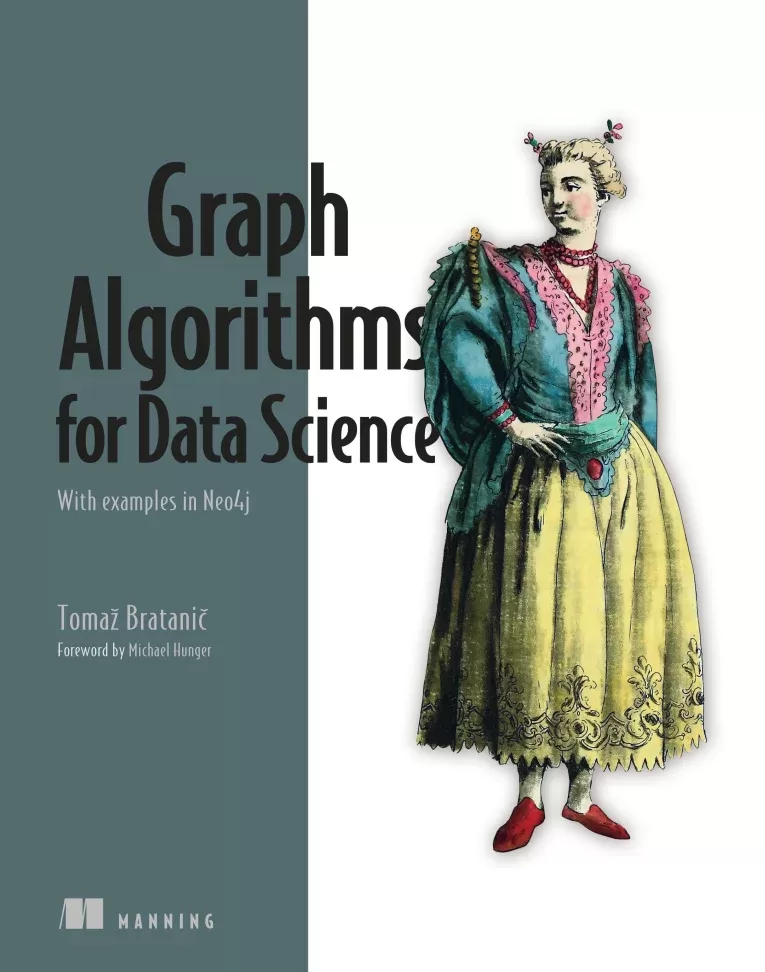
Graph Algorithms for Data Science: With examples in Neo4j
Оглавление⌄
Graph Algorithms for Data Science....1 brief contents....5 contents....7 foreword....13 preface....15 acknowledgments....17 about this book....18 Who should read this book....18 How this book is organized....18 About the code....20 liveBook discussion forum....20 about the author....21 about the cover illustration....22 Part 1—Introduction to graphs....23 1 Graphs and network science: An introduction....25 1.1 Understanding data through relationships....30 1.2 How to spot a graph-shaped problem....33 1.2.1 Self-referencing relationships....34 1.2.2 Pathfinding networks....35 1.2.3 Bipartite graphs....36 1.2.4 Complex networks....37 Summary....38 2 Representing network structure: Designing your first graph model....40 2.1 Graph terminology....43 2.1.1 Directed vs. undirected graph....43 2.1.2 Weighted vs. unweighted graphs....44 2.1.3 Bipartite vs. monopartite graphs....45 2.1.4 Multigraph vs. simple graph....46 2.1.5 A complete graph....47 2.2 Network representations....47 2.2.1 Labeled-property graph model....48 2.3 Designing your first labeled-property graph model....51 2.3.1 Follower network....52 2.3.2 User–tweet network....54 2.3.3 Retweet network....58 2.3.4 Representing graph schema....61 2.4 Extracting knowledge from text....63 2.4.1 Links....64 2.4.2 Hashtags....66 2.4.3 Mentions....70 2.4.4 Final Twitter social network schema....72 Summary....74 Part 2—Network analysis....75 3 Your first steps with Cypher query language....77 3.1 Cypher query language clauses....79 3.1.1 CREATE clause....79 3.1.2 MATCH clause....82 3.1.3 WITH clause....86 3.1.4 SET clause....87 3.1.5 REMOVE clause....89 3.1.6 DELETE clause....89 3.1.7 MERGE clause....92 3.2 Importing CSV files with Cypher....95 3.2.1 Clean up the database....95 3.2.2 Twitter graph model....96 3.2.3 Unique constraints....97 3.2.4 LOAD CSV clause....98 3.2.5 Importing the Twitter social network....99 3.3 Solutions to exercises....105 Summary....108 4 Exploratory graph analysis....109 4.1 Exploring the Twitter network....110 4.2 Aggregating data with Cypher query language....112 4.2.1 Time aggregations....117 4.3 Filtering graph patterns....119 4.4 Counting subqueries....123 4.5 Multiple aggregations in sequence....124 4.6 Solutions to exercises....127 Summary....129 5 Introduction to social network analysis....131 5.1 Follower network....134 5.1.1 Node degree distribution....137 5.2 Introduction to the Neo4j Graph Data Science library....142 5.2.1 Graph catalog and native projection....143 5.3 Network characterization....144 5.3.1 Weakly connected component algorithm....145 5.3.2 Strongly connected components algorithm....149 5.3.3 Local clustering coefficient....152 5.4 Identifying central nodes....156 5.4.1 PageRank algorithm....156 5.4.2 Personalized PageRank algorithm....160 5.4.3 Dropping the named graph....162 5.5 Solutions to exercises....163 Summary....164 6 Projecting monopartite networks....166 6.1 Translating an indirect multihop path into a direct relationship....171 6.1.1 Cypher projection....172 6.2 Retweet network characterization....174 6.2.1 Degree centrality....174 6.2.2 Weakly connected components....178 6.3 Identifying the most influential content creators....181 6.3.1 Excluding self-loops....181 6.3.2 Weighted PageRank variant....181 6.3.3 Dropping the projected in-memory graph....183 6.4 Solutions to exercises....184 Summary....185 7 Inferring co-occurrence networks based on bipartite networks....187 7.1 Extracting hashtags from tweets....195 7.2 Constructing the co-occurrence network....199 7.2.1 Jaccard similarity coefficient....201 7.2.2 Node similarity algorithm....202 7.3 Characterization of the co-occurrence network....210 7.3.1 Node degree centrality....210 7.3.2 Weakly connected components....211 7.4 Community detection with the label propagation algorithm....212 7.5 Identifying community representatives with PageRank....215 7.5.1 Dropping the projected in-memory graphs....217 7.6 Solutions to exercises....217 Summary....218 8 Constructing a nearest neighbor similarity network....220 8.1 Feature extraction....224 8.1.1 Motifs and graphlets....226 8.1.2 Betweenness centrality....229 8.1.3 Closeness centrality....230 8.2 Constructing the nearest neighbor graph....232 8.2.1 Evaluating features....232 8.2.2 Inferring the similarity network....234 8.3 User segmentation with the community detection algorithm....235 8.4 Solutions to exercises....237 Summary....239 Part 3—Graph machine learning....241 9 Node embeddings and classification....243 9.1 Node embedding models....246 9.1.1 Homophily vs. structural roles approach....247 9.1.2 Inductive vs. transductive embedding models....249 9.2 Node classification task....249 9.2.1 Defining a connection to a Neo4j database....251 9.2.2 Importing a Twitch dataset....252 9.3 The node2vec algorithm....254 9.3.1 The word2vec algorithm....254 9.3.2 Random walks....257 9.3.3 Calculate node2vec embeddings....259 9.3.4 Evaluating node embeddings....260 9.3.5 Training a classification model....264 9.3.6 Evaluating predictions....265 9.4 Solutions to exercises....267 Summary....267 10 Link prediction....269 10.1 Link prediction workflow....271 10.2 Dataset split....275 10.2.1 Time-based split....276 10.2.2 Random split....277 10.2.3 Negative samples....280 10.3 Network feature engineering....281 10.3.1 Network distance....282 10.3.2 Preferential attachment....284 10.3.3 Common neighbors....286 10.3.4 Adamic–Adar index....286 10.3.5 Clustering coefficient of common neighbors....288 10.4 Link prediction classification model....289 10.4.1 Missing values....291 10.4.2 Training the model....291 10.4.3 Evaluating the model....292 10.5 Solutions to exercises....293 Summary....294 11 Knowledge graph completion....296 11.1 Knowledge graph embedding model....301 11.1.1 Triple....301 11.1.2 TransE....302 11.1.3 TransE limitations....303 11.2 Knowledge graph completion....305 11.2.1 Hetionet....306 11.2.2 Dataset split....309 11.2.3 Train a PairRE model....309 11.2.4 Drug application predictions....310 11.2.5 Explaining predictions....311 11.3 Solutions to exercises....313 Summary....314 12 Constructing a graph using natural language processing techniques....315 12.1 Coreference resolution....319 12.2 Named entity recognition....319 12.2.1 Entity linking....320 12.3 Relation extraction....321 12.4 Implementation of information extraction pipeline....322 12.4.1 SpaCy....323 12.4.2 Corefence resolution....323 12.4.3 End-to-end relation extraction....325 12.4.4 Entity linking....327 12.4.5 External data enrichment....330 12.5 Solutions to exercises....330 Summary....331 appendix—The Neo4j environment....332 A.1 Cypher query language....333 A.2 Neo4j installation....333 A.2.1 Neo4j Desktop installation....333 A.2.2 Neo4j Docker installation....338 A.2.3 Neo4j Aura....338 A.3 Neo4j Browser configuration....338 references....340 index....345 Symbols....345 Numerics....345 A....345 B....345 C....345 D....346 E....346 F....347 G....347 H....348 I....348 J....348 K....348 L....348 M....349 N....349 O....350 P....350 Q....350 R....350 S....351 T....351 U....352 V....352 W....352
Описание
Коротко и по делу о том, что важно знать про data.
This book explores the most important algorithms and techniques for graphs in data science, with concrete advice on implementation and deployment. Graphs are the natural way to represent and understand connected data. You don’t need any graph experience to start benefiting from this insightful guide. These powerful graph algorithms are explained in clear, jargon-free text and illustrations that makes them easy to apply to your own projects.
It’s filled with fascinating and fun projects, demonstrating the ins-and-outs of graphs. In Graph Algorithms for Data Science you will learn:Labeled-property graph modelingConstructing a graph from structured data such as CSV or SQLNLP techniques to construct a graph from unstructured dataCypher query language syntax to manipulate data and extract insightsSocial network analysis algorithms like PageRank and community detectionHow to translate graph structure to a ML model input with node embedding modelsUsing graph features in node classification and link prediction workflowsGraph Algorithms for Data Science is a hands-on guide to working with graph-based data in applications like machine learning, fraud detection, and business data analysis. You’ll gain practical skills by analyzing Twitter, building graphs with NLP techniques, and much more.Foreword by Michael Hunger.
Graphs are an efficient way to identify and explore the significant relationships naturally occurring within a dataset. About the technologyA graph, put simply, is a network of connected data. This book presents the most important algorithms for graph data science with examples from machine learning, business applications, natural language processing, and more.
In it, you’ll learn to apply graph algorithms like PageRank, community detection/clustering, and knowledge graph models by putting each new algorithm to work in a hands-on data project. About the bookGraph Algorithms for Data Science shows you how to construct and analyze graphs from structured and unstructured data. This cutting-edge book also demonstrates how you can create graphs that optimize input for AI models using node embedding.
What's insideCreating knowledge graphsNode classification and link prediction workflowsNLP techniques for graph constructionAbout the readerFor data scientists who know machine learning basics. Examples use the Cypher query language, which is explained in the book.
Если материал оказался полезен — сохраните страницу.
Поделиться
Частые вопросы
Можно ли скачать «Graph Algorithms for Data Science: With examples in Neo4j» бесплатно?
Да, «Graph Algorithms for Data Science: With examples in Neo4j» доступна для бесплатного скачивания на нашем сайте в формате PDF. Ссылка на файл находится на этой странице.
В каком формате и какого размера файл?
Книга предоставляется в формате PDF, размер файла 4,7 МБ.
Кто автор и когда вышла книга?
автор — Bratanic Tomaž, издательство Manning Publications Co., год выпуска 2024, 353 страниц.
О чём книга «Graph Algorithms for Data Science: With examples in Neo4j»?
Graphs are the natural way to represent and understand connected data.
Похожие материалы
 Big Data Analytics
 Exploratory Data Analysis with Python Cookbook: Over 50 recipes to analyze, visualize, and extract insights from structured and unstructured data
 Наука о данных: Базовый курс
 Learning Spark: Lightning-Fast Data Analytics. 2 Ed
 Data Science. Наука о данных с нуля. 2 изд
 Mathematical Statistics with Applications in R. 3 Ed
 Рекомендательные системы на практике
 Анализ данных в науке и технике