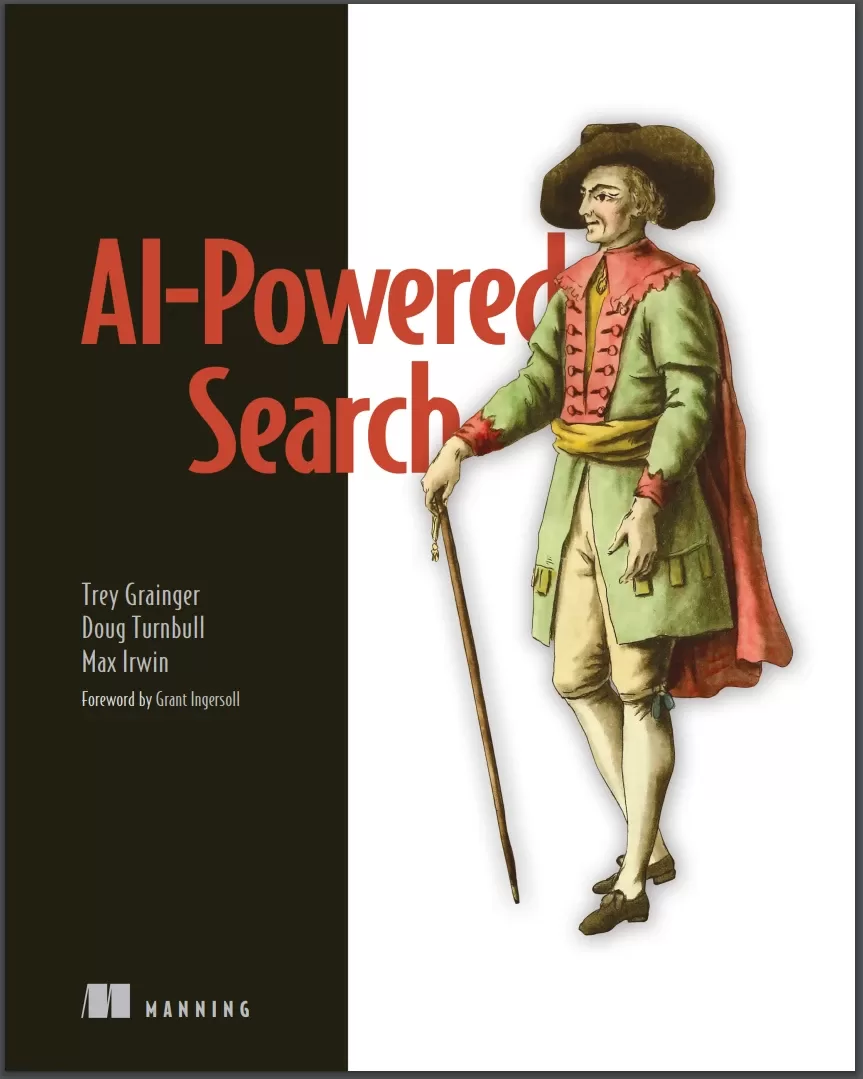
AI-Powered Search
Оглавление⌄
AI-Powered Search....1 brief contents....6 contents....7 foreword....15 preface....17 acknowledgments....19 about this book....21 Who should read this book....22 How this book is organized: A road map....22 About the code....24 liveBook discussion forum....26 Other online resources....26 about the authors....28 about the cover illustration....30 Part 1 Modern search relevance....32 1 Introducing AI-powered search....34 1.1 What is AI-powered search?....36 1.2 Understanding user intent....39 1.2.1 What is a search engine?....40 1.2.2 What do recommendation engines offer?....41 1.2.3 The personalization spectrum between search and recommendations....42 1.2.4 Semantic search and knowledge graphs....43 1.2.5 Understanding the dimensions of user intent....44 1.3 How does AI-powered search work?....46 1.3.1 The core search foundation....47 1.3.2 Reflected intelligence through feedback loops....47 1.3.3 Signals boosting, collaborative filtering, and learning to rank....48 1.3.4 Content and domain intelligence....50 1.3.5 Generative AI and retrieval augmented generation....51 1.3.6 Curated vs. black-box AI....52 1.3.7 Architecture for an AI-powered search engine....53 Summary....54 2 Working with natural language....56 2.1 The myth of unstructured data....57 2.1.1 Types of unstructured data....58 2.1.2 Data types in traditional structured databases....59 2.1.3 Joins, fuzzy joins, and entity resolution in unstructured data....60 2.2 The structure of natural language....64 2.3 Distributional semantics and embeddings....66 2.4 Modeling domain-specific knowledge....71 2.5 Challenges in natural language understanding for search....74 2.5.1 The challenge of ambiguity (polysemy)....74 2.5.2 The challenge of understanding context....75 2.5.3 The challenge of personalization....75 2.5.4 Challenges interpreting queries vs. documents....76 2.5.5 Challenges interpreting query intent....76 2.6 Content + signals: The fuel powering AI-powered search....77 Summary....79 3 Ranking and content-based relevance....80 3.1 Scoring query and document vectors with cosine similarity....81 3.1.1 Mapping text to vectors....82 3.1.2 Calculating similarity between dense vector representations....83 3.1.3 Calculating similarity between sparse vector representations....84 3.1.4 Term frequency: Measuring how well documents match a term....86 3.1.5 Inverse document frequency: Measuring the importance of a term in the query....91 3.1.6 TF-IDF: A balanced weighting metric for text-based relevance....92 3.2 Controlling the relevance calculation....93 3.2.1 BM25: The industry standard default text-similarity algorithm....93 3.2.2 Functions, functions, everywhere!....98 3.2.3 Choosing multiplicative vs. additive boosting for relevance functions....101 3.2.4 Differentiating matching (filtering) vs. ranking (scoring) of documents....103 3.2.5 Logical matching: Weighting the relationships between terms in a query....103 3.2.6 Separating concerns: Filtering vs. scoring....105 3.3 Implementing user and domain-specific relevance ranking....107 Summary....108 4 Crowdsourced relevance....109 4.1 Working with user signals....110 4.1.1 Content vs. signals vs. models....110 4.1.2 Setting up our product and signals datasets (RetroTech)....112 4.1.3 Exploring the signals data....115 4.1.4 Modeling users, sessions, and requests....117 4.2 Introducing reflected intelligence....118 4.2.1 What is reflected intelligence?....118 4.2.2 Popularized relevance through signals boosting....120 4.2.3 Personalized relevance through collaborative filtering....125 4.2.4 Generalized relevance through learning to rank....127 4.2.5 Other reflected intelligence models....128 4.2.6 Crowdsourcing from content....129 Summary....130 Part 2 Learning domain-specific intent....132 5 Knowledge graph learning....134 5.1 Working with knowledge graphs....135 5.2 Using our search engine as a knowledge graph....137 5.3 Automatically extracting knowledge graphs from content....137 5.3.1 Extracting arbitrary relationships from text....138 5.3.2 Extracting hyponyms and hypernyms from text....140 5.4 Learning intent by traversing semantic knowledge graphs....143 5.4.1 What is a semantic knowledge graph?....143 5.4.2 Indexing the datasets....144 5.4.3 Structure of an SKG....145 5.4.4 Calculating edge weights to measure the relatedness of nodes....147 5.4.5 Using SKGs for query expansion....151 5.4.6 Using SKGs for content-based recommendations....155 5.4.7 Using SKGs to model arbitrary relationships....158 5.5 Using knowledge graphs for semantic search....160 Summary....161 6 Using context to learn domain-specific language....162 6.1 Classifying query intent....163 6.2 Query-sense disambiguation....166 6.3 Learning related phrases from query signals....171 6.3.1 Mining query logs for related queries....172 6.3.2 Finding related queries through product interactions....177 6.4 Phrase detection from user signals....181 6.4.1 Treating queries as entities....182 6.4.2 Extracting entities from more complex queries....183 6.5 Misspellings and alternative representations....183 6.5.1 Learning spelling corrections from documents....184 6.5.2 Learning spelling corrections from user signals....185 6.6 Pulling it all together....190 Summary....190 7 Interpreting query intent through semantic search....192 7.1 The mechanics of query interpretation....193 7.2 Indexing and searching on a local reviews dataset....195 7.3 An end-to-end semantic search example....199 7.4 Query interpretation pipelines....201 7.4.1 Parsing a query for semantic search....201 7.4.2 Enriching a query for semantic search....210 7.4.3 Sparse lexical and expansion models....215 7.4.4 Transforming a query for semantic search....218 7.4.5 Searching with a semantically enhanced query....219 Summary....221 Part 3 Reflected intelligence....222 8 Signals-boosting models....224 8.1 Basic signals boosting....225 8.2 Normalizing signals....226 8.3 Fighting signal spam....228 8.3.1 Using signal spam to manipulate search results....229 8.3.2 Combating signal spam through user-based filtering....231 8.4 Combining multiple signal types....233 8.5 Time decays and short-lived signals....235 8.5.1 Handling time-insensitive signals....236 8.5.2 Handling time-sensitive signals....236 8.6 Index-time vs. query-time boosting: Balancing scale vs. flexibility....239 8.6.1 Tradeoffs when using query-time boosting....239 8.6.2 Implementing index-time signals boosting....241 8.6.3 Tradeoffs when implementing index-time boosting....243 Summary....246 9 Personalized search....247 9.1 Personalized search vs. recommendations....248 9.1.1 Personalized queries....250 9.1.2 User-guided recommendations....251 9.2 Recommendation algorithm approaches....251 9.2.1 Content-based recommenders....251 9.2.2 Behavior-based recommenders....253 9.2.3 Multimodal recommenders....254 9.3 Implementing collaborative filtering....255 9.3.1 Learning latent user and item features through matrix factorization....255 9.3.2 Implementing collaborative filtering with Alternating Least Squares....259 9.3.3 Personalizing search results with recommendation boosting....265 9.4 Personalizing search using content-based embeddings....269 9.4.1 Generating content-based latent features....269 9.4.2 Implementing categorical guardrails for personalization....272 9.4.3 Integrating embedding-based personalization into search results....277 9.5 Challenges with personalizing search results....282 Summary....283 10 Learning to rank for generalizable search relevance....285 10.1 What is LTR?....286 10.1.1 Moving beyond manual relevance tuning....286 10.1.2 Implementing LTR in the real world....287 10.2 Step 1: A judgment list, starting with the training data....290 10.3 Step 2: Feature logging and engineering....291 10.3.1 Storing features in a modern search engine....292 10.3.2 Logging features from our search engine corpus....293 10.4 Step 3: Transforming LTR to a traditional machine learning problem....295 10.4.1 SVMrank: Transforming ranking to binary classification....296 10.4.2 Transforming our LTR training task to binary classification....298 10.5 Step 4: Training (and testing!) the model....306 10.5.1 Turning a separating hyperplane’s vector into a scoring function....306 10.5.2 Taking the model for a test drive....307 10.5.3 Validating the model....308 10.6 Steps 5 and 6: Upload a model and search....310 10.6.1 Deploying and using the LTR model....310 10.6.2 A note on LTR performance....313 10.7 Rinse and repeat....314 Summary....314 11 Automating learning to rank with click models....316 11.1 (Re)creating judgment lists from signals....318 11.1.1 Generating implicit, probabilistic judgments from signals....318 11.1.2 Training an LTR model using probabilistic judgments....320 11.1.3 Click-Through Rate: Your first click model....321 11.1.4 Common biases in judgments....325 11.2 Overcoming position bias....326 11.2.1 Defining position bias....326 11.2.2 Position bias in RetroTech data....326 11.2.3 Simplified dynamic Bayesian network: A click model that overcomes position bias....328 11.3 Handling confidence bias: Not upending your model due to a few lucky clicks....333 11.3.1 The low-confidence problem in click data....334 11.3.2 Using a beta prior to model confidence probabilistically....335 11.4 Exploring your training data in an LTR system....342 Summary....343 12 Overcoming ranking bias through active learning....345 12.1 Our automated LTR engine in a few lines of code....348 12.1.1 Turning clicks into training data (chapter 11 in one line of code)....348 12.1.2 Model training and evaluation in a few function calls....349 12.2 A/B testing a new model....351 12.2.1 Taking a better model out for a test drive....351 12.2.2 Defining an A/B test in the context of automated LTR....352 12.2.3 Graduating the better model into an A/B test....353 12.2.4 When “good” models go bad: What we can learn from a failed A/B test....354 12.3 Overcoming presentation bias: Knowing when to explore vs. exploit....356 12.3.1 Presentation bias in the RetroTech training data....357 12.3.2 Beyond the ad hoc: Thoughtfully exploring with a Gaussian process....358 12.3.3 Examining the outcome of our explorations....365 12.4 Exploit, explore, gather, rinse, repeat: A robust automated LTR loop....367 Summary....369 Part 4 The search frontier....370 13 Semantic search with dense vectors....372 13.1 Representation of meaning through embeddings....373 13.2 Search using dense vectors....374 13.2.1 A brief refresher on sparse vectors....375 13.2.2 A conceptual dense vector search engine....375 13.3 Getting text embeddings by using a Transformer encoder....379 13.3.1 What is a Transformer?....379 13.3.2 Openly available pretrained Transformer models....382 13.4 Applying Transformers to search....382 13.4.1 Using the Stack Exchange outdoors dataset....383 13.4.2 Fine-tuning and the Semantic Text Similarity Benchmark....385 13.4.3 Introducing the SBERT Transformer library....386 13.5 Natural language autocomplete....389 13.5.1 Getting noun and verb phrases for our nearest-neighbor vocabulary....390 13.5.2 Getting embeddings....392 13.5.3 ANN search....396 13.5.4 ANN index implementation....398 13.6 Semantic search with LLM embeddings....400 13.6.1 Getting titles and their embeddings....401 13.6.2 Creating and searching the nearest-neighbor index....402 13.7 Quantization and representation learning for more efficient vector search....405 13.7.1 Scalar quantization....407 13.7.2 Binary quantization....412 13.7.3 Product quantization....414 13.7.4 Matryoshka Representation Learning....417 13.7.5 Combining multiple vector search optimization approaches....420 13.8 Cross-encoders vs. bi-encoders....422 Summary....426 14 Question answering with a fine-tuned large language model....427 14.1 Question-answering overview....428 14.1.1 How a question-answering model works....428 14.1.2 The retriever-reader pattern....433 14.2 Constructing a question-answering training dataset....436 14.2.1 Gathering and cleaning a question-answering dataset....437 14.2.2 Creating the silver set: Automatically labeling data from a pretrained model....438 14.2.3 Human-in-the-loop training: Manually correcting the silver set to produce a golden set....441 14.2.4 Formatting the golden set for training, testing, and validation....442 14.3 Fine-tuning the question-answering model....444 14.3.1 Tokenizing and shaping our labeled data....445 14.3.2 Configuring the model trainer....447 14.3.3 Performing training and evaluating loss....449 14.3.4 Holdout validation and confirmation....449 14.4 Building the reader with the new fine-tuned model....450 14.5 Incorporating the retriever: Using the question-answering model with the search engine....452 14.5.1 Step 1: Querying the retriever....452 14.5.2 Step 2: Inferring answers from the reader model....453 14.5.3 Step 3: Reranking the answers....454 14.5.4 Step 4: Returning results by combining the retriever, reader, and reranker....454 Summary....456 15 Foundation models and emerging search paradigms....457 15.1 Understanding foundation models....458 15.1.1 What qualifies as a foundation model?....459 15.1.2 Training vs. fine-tuning vs. prompting....459 15.2 Generative search....462 15.2.1 Retrieval augmented generation....464 15.2.2 Results summarization using foundation models....466 15.2.3 Data generation using foundation models....469 15.2.4 Evaluating generative output....472 15.2.5 Constructing your own metric....474 15.2.6 Algorithmic prompt optimization....476 15.3 Multimodal search....478 15.3.1 Common modes for multimodal search....478 15.3.2 Implementing multimodal search....480 15.4 Other emerging AI-powered search paradigms....485 15.4.1 Conversational and contextual search....485 15.4.2 Agent-based search....487 15.5 Hybrid search....487 15.5.1 Reciprocal rank fusion....488 15.5.2 Other hybrid search algorithms....494 15.6 Convergence of contextual technologies....496 15.7 All the above, please!....497 Summary....498 appendix A Running the code examples....500 A.1 Overall structure of code examples....500 A.2 Pulling the source code....501 A.3 Building and running the code....501 A.4 Working with Jupyter....503 A.5 Working with Docker....504 appendix B Supported search engines and vector databases....505 B.1 Supported engines....505 B.2 Swapping out the engine....505 B.3 The engine and collection abstractions....506 B.4 Adding support for additional engines....507 index....510 A....510 B....510 C....511 D....511 E....512 F....512 G....512 H....513 I....513 J....513 K....513 L....513 M....514 N....514 O....515 P....515 Q....515 R....516 S....516 T....518 U....518 V....518 W....519 AI-Powered Search - back....520
Описание
Ниже — практический обзор по теме «search».
AI-Powered Search is an in-depth guide to building intelligent search systems you can be proud of. Delivering effective search is one of the biggest challenges you can face as an engineer. It covers the critical tools you need to automate ongoing relevance improvements within your search applications.
Inside you’ll learn modern, data-science-driven search techniques like:Semantic search using dense vector embeddings from foundation modelsRetrieval augmented generation (RAG)Question answering and summarization combining search and LLMsFine-tuning transformer-based LLMsPersonalized search based on user signals and vector embeddingsCollecting user behavioral signals and building signals boosting modelsSemantic knowledge graphs for domain-specific learningSemantic query parsing, query-sense disambiguation, and query intent classificationImplementing machine-learned ranking models (Learning to Rank)Building click models to automate machine-learned rankingGenerative search, hybrid search, multimodal search, and the search frontierAI-Powered Search will help you build the kind of highly intelligent search applications demanded by modern users. Whether you’re enhancing your existing search engine or building from scratch, you’ll learn how to deliver an
AI-powered service that can continuously learn from every content update, user interaction, and the hidden semantic relationships in your content. You’ll learn both how to enhance your AI systems with search and how to integrate large language models (LLMs) and other foundation models to massively accelerate the capabilities of your search technology.Foreword by Grant Ingersoll.
Much, much more. About the technologyModern search is more than keyword matching. Search that learns from user interactions, interprets intent, and takes advantage of AI tools like large language models (LLMs) can deliver highly targeted and relevant results. This book shows you how to up your search game using state-of-the-art AI algorithms, techniques, and tools.
About the bookAI-Powered Search teaches you to create a search that understands natural language and improves automatically the more it is used. As you work through dozens of interesting and relevant examples, you’ll learn powerful AI-based techniques like semantic search on embeddings, question answering powered by LLMs, real-time personalization, and Retrieval Augmented Generation (RAG).
What's insideSparse lexical and embedding-based semantic searchQuestion answering, RAG, and summarization using LLMsPersonalized search and signals boosting modelsLearning to Rank, multimodal, and hybrid searchAbout the readerFor software developers and data scientists familiar with the basics of search engine technology.
Если материал оказался полезен — сохраните страницу.
Поделиться
Частые вопросы
Можно ли скачать «AI-Powered Search» бесплатно?
Да, «AI-Powered Search» доступна для бесплатного скачивания на нашем сайте в формате PDF. Ссылка на файл находится на этой странице.
В каком формате и какого размера файл?
Книга предоставляется в формате PDF, размер файла 6,7 МБ.
Кто автор и когда вышла книга?
автор — Grainger Trey , Irwin Max , Turnbull Doug, издательство Manning Publications Co., год выпуска 2025, 520 страниц.
О чём книга «AI-Powered Search»?
Delivering effective search is one of the biggest challenges you can face as an engineer.
Похожие материалы
 Big Data Analytics
 Exploratory Data Analysis with Python Cookbook: Over 50 recipes to analyze, visualize, and extract insights from structured and unstructured data
 Наука о данных: Базовый курс
 Learning Spark: Lightning-Fast Data Analytics. 2 Ed
 Data Science. Наука о данных с нуля. 2 изд
 Mathematical Statistics with Applications in R. 3 Ed
 Рекомендательные системы на практике
 Анализ данных в науке и технике