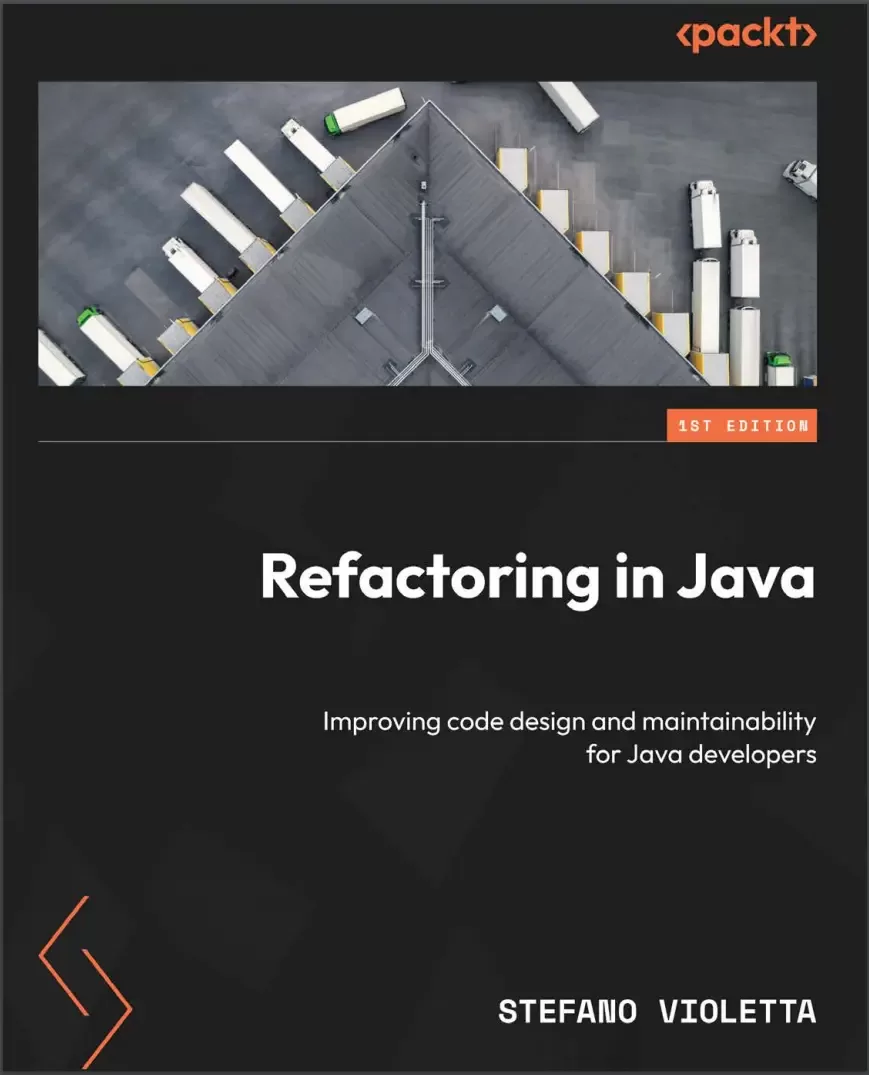
Refactoring in Java: Improving code design and maintainability for Java developers
Оглавление⌄
Cover....1 Title Page....2 Copyright and Credits....3 Contributors....5 Table of Contents....8 Preface....14 Part 1: Introduction to Refactoring....20 Chapter 1: What is Refactoring?....22 What do we mean by refactoring?....23 Refactoring and clean code....24 Misconceptions about refactoring....24 Why you should consider refactoring....26 Improving the design of your software....27 Maintainability and scalability....27 Understanding, avoiding, and fixing bugs....28 Faster development....28 When you should refactor....29 The “Rule of Three”....29 Preparatory refactoring for smooth feature implementation....29 Refactoring for bug fixing....30 Comprehension refactoring....30 The “Boy Scout Rule”....30 Planned refactoring....31 Long-term refactoring and “Branch by Abstraction”....31 Refactoring in a code review....34 What you should refactor....34 Impact analysis....35 Risk assessment....36 Value estimation....37 Prioritization matrix....37 Further considerations....38 Refactor or rewrite?....39 Summary....40 Further reading....40 Chapter 2: Good Coding Habits....42 Characteristics of good code....43 Good code is readable....43 Good code is reliable....44 Good code is hard to misuse....45 Good code is modular....48 Good code is reusable....54 Clean Code....56 Why Clean Code?....57 Some principles of Clean Code....58 Write SOLID code....60 Single responsibility principle....61 Open-closed principle....62 Liskov substitution principle....64 Interface segregation principle....65 Dependency inversion principle....66 Side effects and mutability....67 The builder pattern....70 Causes of bad code....71 Deadlines....72 The Broken Window theory....73 No code review process....73 Insufficient domain or technical knowledge....74 Summary....74 Further reading....75 Part 2: Essence of Refactoring and Good Code....76 Chapter 3: Code Smells....78 Duplicated code....80 Long methods....81 Replace temporary variables with query methods....82 Parameter object....83 Replace a function or method with a command....83 Decompose conditionals....84 Split loops....85 Large classes....86 Switches....89 Primitive Obsession....91 Middle man....92 Message chains....93 Feature envy methods....94 Divergent change....95 Shotgun Surgery....97 God object....99 Summary....100 Further reading....100 Chapter 4: Testing....102 Why you should test (often)....103 Identifying and fixing defects....103 Ensuring quality and reliability....104 Customer satisfaction....105 Compliance and standards....105 Security....106 Integration and compatibility....107 Confidence and peace of mind....107 Unit testing....108 JUnit framework....110 Integration testing....112 Mockito....113 Contract testing....114 Be safe – checking and improving your test coverage....115 What is test coverage?....115 A Java code coverage tool – JaCoCo....116 Test-driven development....121 Advantages of TDD....123 Summary....124 Further reading....124 Chapter 5: Refactoring Techniques....126 Writing better methods....127 Extract Method....128 Inline Method....129 Extract and inline variables....131 Combining a function into a class....132 Moving features between objects....133 Moving a method or field....133 Moving statements into/from methods....135 Hiding delegates....135 Removing dead code....137 Organizing data....138 Field encapsulation....138 Replacing primitives with objects....141 Replacing type code with subclasses....143 Simplifying conditional logic....144 Returning a special case instead of null....144 Using polymorphism instead of conditions....146 Removing duplicated conditions....147 Guard clauses....148 Simplifying method calls....150 Avoiding side effects....150 Removing setter methods....151 Using generalization....153 Pull up field....153 Push down field....154 Pull up method....155 Push down method....156 Template method....157 Using enums instead of constants....159 Summary....162 Further reading....162 Chapter 6: Metaprogramming....164 What is metaprogramming?....164 Exploring compile-time metaprogramming tools....166 Lombok....166 MapStruct....177 Exploring runtime metaprogramming tools....180 Reflection....180 Weighing the pros and cons of metaprogramming....183 Summary....185 Further reading....185 Chapter 7: Static and Dynamic Analysis....186 What is static analysis?....186 Code errors or bad practices....187 Security....189 Cyclomatic complexity....190 Exception (mis)handling....192 Automated static analysis tools....193 What is dynamic analysis?....196 Debugging....197 Profiling....197 Fuzzing....199 Symbolic execution....201 Taint tracking....203 Summary....205 Further reading....206 Part 3: Further Learning....208 Chapter 8: Crafting Quality Every Day....210 Code versioning....210 Graph structure....211 Local VCSs....214 Centralized VCSs....215 Distributed VCSs....215 Branching strategies....216 Best practices....222 Code formatting and style....223 Indentation....224 Braces and whitespaces....225 Line length and wrapping....225 Comments and documentation....227 Naming conventions....228 Automated tools....229 Code reviews....231 Email pass-arounds....233 Code review automation tools....234 In-person (or remote) teamwork reviews....234 Pair programming....235 Advantages....235 Disadvantages....236 Styles of pair programming....237 Time management....238 Documentation....239 Requirements....239 Architecture documentation....240 Technical documentation....241 Good practices for documentation....247 A hard dose of reality....248 The importance of knowing what you’re doing....249 Summary....250 Further reading....250 Chapter 9: Beyond Code – Mastering Software Architecture....252 What is an architecture?....252 Development....253 Deployment....253 System operation....254 Maintenance....254 Architectural patterns....255 Layered architecture....255 Microservices....257 Event-driven architecture....260 Reactive architecture....263 Monolith to microservices....266 Bad smells in the microservices architecture....269 Shared persistence....269 Shared libraries....271 Direct communication....273 Summary....277 Further reading....277 Index....278 Other Books You May Enjoy....289
Описание
Ниже — практический обзор по теме «refactoring».
Refactoring in Java serves as an indispensable guide to enhancing your codebase's quality and maintainability.
You'll explore testing methodologies, essential refactoring techniques, and metaprogramming, as well as designing a good architecture. The book begins by helping you get to grips with refactoring fundamentals, including cultivating good coding habits and identifying red flags. The chapters clearly explain how to refactor and improve your code using real-world examples and proven techniques. You'll discover best practices to ensure efficient code improvement so that you can navigate complexities with ease. Part two equips you with the ability to recognize code smells, prioritize tasks, and employ automated refactoring tools, testing frameworks, and code analysis tools. In part three, the book focuses on continuous learning, daily practices enhancing coding proficiency, and a holistic view of the architecture. You'll get practical tips to mitigate risks during refactoring, along with guidance on measuring impact to ensure that you become an efficient software craftsperson.
By the end of this book, you'll be able to avoid unproductive programming or architecturing, detect red flags, and propose changes to improve the maintainability of your codebase.
The book is ideal for experienced Java enthusiasts, quality assurance engineers, and codebase maintainers as it provides practical insights, real-world examples, and essential patterns. What You Will Learn:Recognize and address common issues in your codeFind out how to determine which improvements are most importantImplement techniques such as using polymorphism instead of conditionsEfficiently leverage tools for streamlining refactoring processesEnhance code reliability through effective testing practicesDevelop the skills needed for clean and readable code presentationGet to grips with the tools you need for thorough code examinationApply best practices for a more efficient coding workflowWho this book is for:This book is for Java developers, software architects, and technical leads looking for a comprehensive guide to advancing their skills in software design and refactoring. Development managers who want to foster clean coding practices by using best practices for efficient workflows will also find this book useful.
На этом основные моменты по теме закрыты.
Поделиться
Частые вопросы
Можно ли скачать «Refactoring in Java: Improving code design and maintainability for Java developers» бесплатно?
Да, «Refactoring in Java: Improving code design and maintainability for Java developers» доступна для бесплатного скачивания на нашем сайте в формате PDF. Ссылка на файл находится на этой странице.
В каком формате и какого размера файл?
Книга предоставляется в формате PDF, размер файла 1,9 МБ.
Кто автор и когда вышла книга?
автор — Violetta Stefano, издательство Packt Publishing Limited, год выпуска 2023, 292 страниц.
О чём книга «Refactoring in Java: Improving code design and maintainability for Java developers»?
Refactoring in Java serves as an indispensable guide to enhancing your codebase's quality and maintainability.The book begins by helping you get to grips with refactoring fundamentals, including cultivating good coding habits and identifyin
Похожие материалы
 Гид Java-разработчика
 Quick Java
 Java Programming Made Easy: Unlock Your Coding Potential from Scratch
 Core Java: Made Simple
 Learning Java: An Introduction to Real-World Programming with Java. 6 Ed
 Functional Programming in Java: Harness the Power of Streams and Lambda Expressions. 2 Ed
 Основы программирования с Java
 Pro Spring 6: An In-Depth Guide to the Spring Framework. 6 Ed