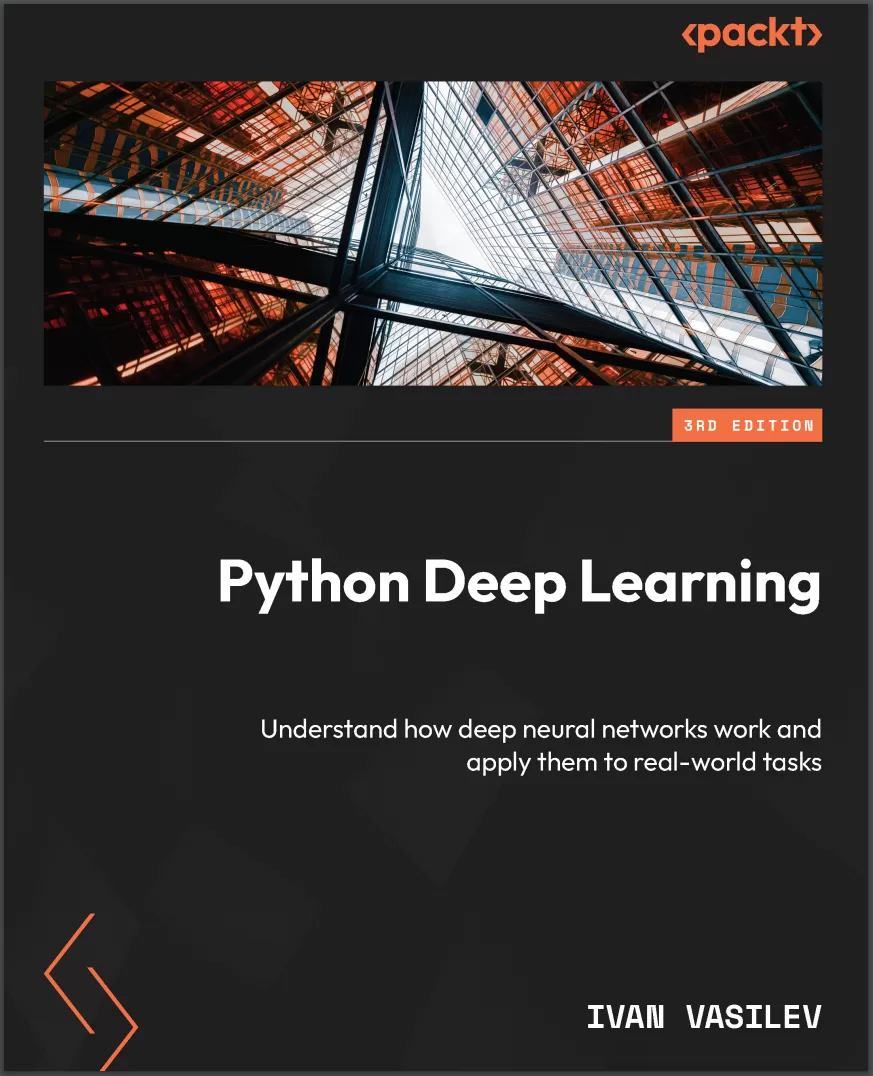
Python Deep Learning: Understand how deep neural networks work and apply them to real-world tasks. 3 Ed
Оглавление⌄
Cover....1 Title Page....2 Copyright and Credit....3 Contributors ....4 Table of Contents....6 Preface....12 Part 1: Introduction to Neural Networks....18 Chapter 1: Machine Learning – an Introduction....20 Technical requirements....20 Introduction to ML....21 Different ML approaches....22 Supervised learning....22 Unsupervised learning....28 Reinforcement learning....32 Components of an ML solution....35 Neural networks....38 Introducing PyTorch....39 Summary....43 Chapter 2: Neural Networks....44 Technical requirements....44 The need for NNs....45 The math of NNs....45 Linear algebra....46 An introduction to probability....50 Differential calculus....56 An introduction to NNs....58 Units – the smallest NN building block....59 Layers as operations....61 Multi-layer NNs....63 Activation functions....64 The universal approximation theorem....66 Training NNs....69 GD....69 Backpropagation....73 A code example of an NN for the XOR function....75 Summary....81 Chapter 3: Deep Learning Fundamentals....82 Technical requirements....82 Introduction to DL....83 Fundamental DL concepts....84 Feature learning....85 The reasons for DL’s popularity....86 Deep neural networks....87 Training deep neural networks....88 Improved activation functions....89 DNN regularization....93 Applications of DL....96 Introducing popular DL libraries....99 Classifying digits with Keras....99 Classifying digits with PyTorch....103 Summary....106 Part 2: Deep Neural Networks for Computer Vision....108 Chapter 4: Computer Vision with Convolutional Networks....110 Technical requirements....111 Intuition and justification for CNNs....111 Convolutional layers....112 A coding example of the convolution operation....115 Cross-channel and depthwise convolutions....117 Stride and padding in convolutional layers....120 Pooling layers....121 The structure of a convolutional network....123 Classifying images with PyTorch and Keras....124 Convolutional layers in deep learning libraries....124 Data augmentation....124 Classifying images with PyTorch....125 Classifying images with Keras....128 Advanced types of convolutions....130 1D, 2D, and 3D convolutions....130 1×1 convolutions....131 Depthwise separable convolutions....131 Dilated convolutions....132 Transposed convolutions....133 Advanced CNN models....136 Introducing residual networks....137 Inception networks....140 Introducing Xception....145 Squeeze-and-Excitation Networks....146 Introducing MobileNet....147 EfficientNet....149 Using pre-trained models with PyTorch and Keras....150 Summary....151 Chapter 5: Advanced Computer Vision Applications....152 Technical requirements....153 Transfer learning (TL)....153 Transfer learning with PyTorch....155 Transfer learning with Keras....158 Object detection....162 Approaches to object detection....163 Object detection with YOLO....165 Object detection with Faster R-CNN....170 Introducing image segmentation....176 Semantic segmentation with U-Net....177 Instance segmentation with Mask R-CNN....179 Image generation with diffusion models....182 Introducing generative models....183 Denoising Diffusion Probabilistic Models....184 Summary....187 Part 3: Natural Language Processing and Transformers....188 Chapter 6: Natural Language Processing and Recurrent Neural Networks....190 Technical requirements....191 Natural language processing....191 Tokenization....192 Introducing word embeddings....197 Word2Vec....199 Visualizing embedding vectors....203 Language modeling....204 Introducing RNNs....206 RNN implementation and training....209 Backpropagation through time....211 Vanishing and exploding gradients....214 Long-short term memory....216 Gated recurrent units....220 Implementing text classification....221 Summary....226 Chapter 7: The Attention Mechanism and Transformers....228 Technical requirements....228 Introducing seq2seq models....229 Understanding the attention mechanism....231 Bahdanau attention....231 Luong attention....234 General attention....235 Transformer attention....237 Implementing TA....241 Building transformers with attention....244 Transformer encoder....245 Transformer decoder....248 Putting it all together....251 Decoder-only and encoder-only models....253 Bidirectional Encoder Representations from Transformers....253 Generative Pre-trained Transformer....258 Summary....261 Chapter 8: Exploring Large Language Models in Depth....262 Technical requirements....263 Introducing LLMs....263 LLM architecture....264 LLM attention variants....264 Prefix decoder....271 Transformer nuts and bolts....272 Models....275 Training LLMs....276 Training datasets....277 Pre-training properties....280 FT with RLHF....285 Emergent abilities of LLMs....287 Introducing Hugging Face Transformers....289 Summary....293 Chapter 9: Advanced Applications of Large Language Models....294 Technical requirements....294 Classifying images with Vision Transformer....295 Using ViT with Hugging Face Transformers....297 Understanding the DEtection TRansformer....299 Using DetR with Hugging Face Transformers....303 Generating images with stable diffusion....305 Autoencoder....306 Conditioning transformer....307 Diffusion model....309 Using stable diffusion with Hugging Face Transformers....310 Exploring fine-tuning transformers....313 Harnessing the power of LLMs with LangChain....315 Using LangChain in practice....316 Summary....319 Part 4: Developing and Deploying Deep Neural Networks....320 Chapter 10: Machine Learning Operations (MLOps)....322 Technical requirements....323 Understanding model development....323 Choosing an NN framework....323 PyTorch versus TensorFlow versus JAX....323 Open Neural Network Exchange....324 Introducing TensorBoard....329 Developing NN models for edge devices with TF Lite....333 Mixed-precision training with PyTorch....336 Exploring model deployment....337 Deploying NN models with Flask....337 Building ML web apps with Gradio....339 Summary....342 Index....344 Other Books You May Enjoy....359
Описание
Ниже — практический обзор по теме «neural».
Master effective navigation of neural networks, including convolutions and transformers, to tackle computer vision and NLP tasks using Python
This makes it challenging to navigate and hard to understand without solid foundations. Key FeaturesUnderstand the theory, mathematical foundations and the structure of deep neural networksBecome familiar with transformers, large language models, and convolutional networksLearn how to apply them on various computer vision and natural language processing problems Purchase of the print or Kindle book includes a free PDF eBookBook DescriptionThe field of deep learning has developed rapidly in the past years and today covers broad range of applications. This book will guide you from the basics of neural networks to the state-of-the-art large language models in use today.
The first part of the book introduces the main machine learning concepts and paradigms. It covers the mathematical foundations, the structure, and the training algorithms of neural networks and dives into the essence of deep learning.
The second part of the book introduces convolutional networks for computer vision. We'll learn how to solve image classification, object detection, instance segmentation, and image generation tasks.
The third part focuses on the attention mechanism and transformers - the core network architecture of large language models. We'll discuss new types of advanced tasks, they can solve, such as chat bots and text-to-image generation.
You'll have the ability to develop new models or adapt existing ones to solve your tasks. By the end of this book, you'll have a thorough understanding of the inner workings of deep neural networks. You'll also have sufficient understanding to continue your research and stay up to date with the latest advancements in the field.
What you will learnEstablish theoretical foundations of deep neural networksUnderstand convolutional networks and apply them in computer vision applicationsBecome well versed with natural language processing and recurrent networksExplore the attention mechanism and transformersApply transformers and large language models for natural language and computer visionImplement coding examples with PyTorch, Keras, and Hugging Face TransformersUse MLOps to develop and deploy neural network modelsWho this book is forThis book is for software developers/engineers, students, data scientists, data analysts, machine learning engineers, statisticians, and anyone interested in deep learning. Prior experience with Python programming is a prerequisite.
На этом основные моменты по теме закрыты.
Поделиться
Частые вопросы
Можно ли скачать «Python Deep Learning: Understand how deep neural networks work and apply them to real-world tasks. 3 Ed» бесплатно?
Да, «Python Deep Learning: Understand how deep neural networks work and apply them to real-world tasks. 3 Ed» доступна для бесплатного скачивания на нашем сайте в формате PDF. Ссылка на файл находится на этой странице.
В каком формате и какого размера файл?
Книга предоставляется в формате PDF, размер файла 6,0 МБ.
Кто автор и когда вышла книга?
автор — Vasilev Ivan, издательство Packt Publishing Limited, год выпуска 2023, 362 страниц.
О чём книга «Python Deep Learning: Understand how deep neural networks work and apply them to real-world tasks. 3 Ed»?
Master effective navigation of neural networks, including convolutions and transformers, to tackle computer vision and NLP tasks using PythonKey FeaturesUnderstand the theory, mathematical foundations and the structure of deep neural networ
Похожие материалы
 Основы программирования на Python
 Python для детей. Самоучитель по программированию
 Python. Сборник упражнений. Введение в язык Python с задачами и решениями
 Структуры данных в Python: начальный курс
 Python за 7 дней. Краткий курс для начинающих
 Python in a Nutshell: A Desktop Quick Reference. 4 Ed
 Python for Microcontrollers: Getting Started with MicroPython
 Programming with MicroPython