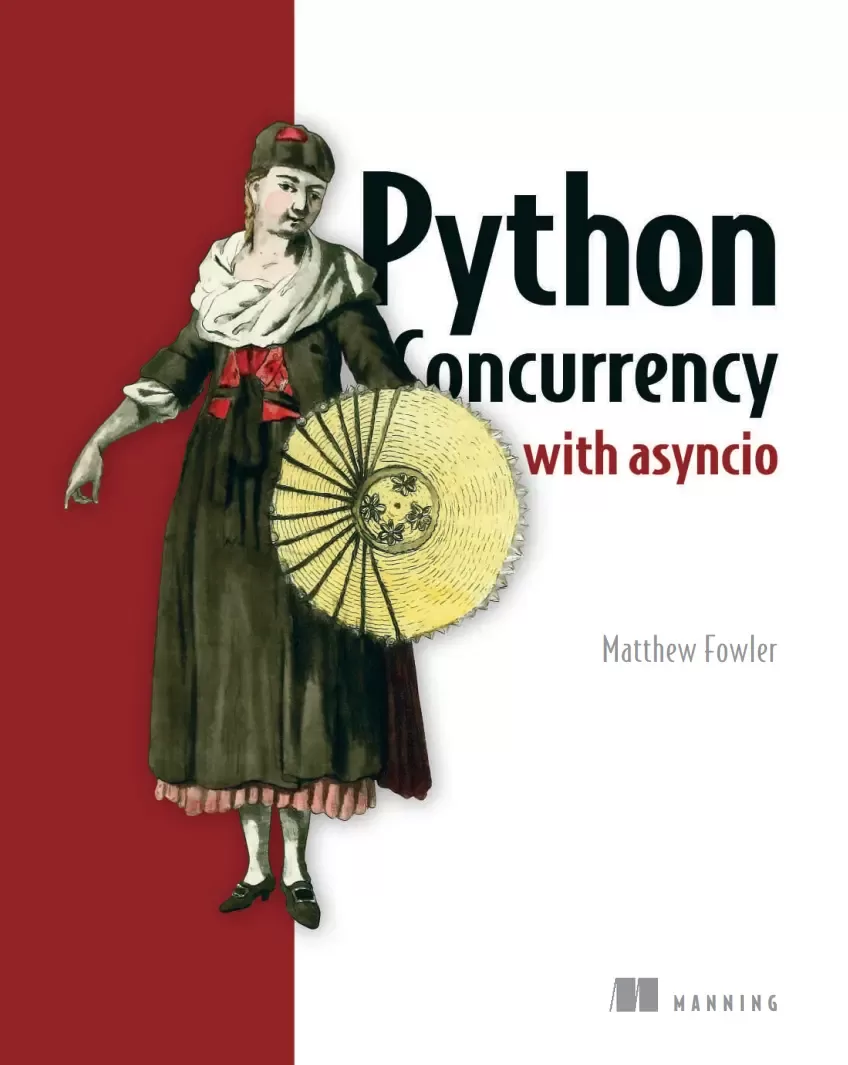
Python Concurrency with asyncio
Оглавление⌄
Python Concurrency with asyncio....1 contents....7 preface....13 acknowledgments....15 about this book....16 Who should read this book?....16 How this book is organized: A road map....17 About the code....18 liveBook discussion forum....18 about the author....19 about the cover illustration....20 1 Getting to know asyncio....21 1.1 What is asyncio?....22 1.2 What is I/O-bound and what is CPU-bound?....23 1.3 Understanding concurrency, parallelism, and multitasking....24 1.3.1 Concurrency....24 1.3.2 Parallelism....25 1.3.3 The difference between concurrency and parallelism....26 1.3.4 What is multitasking?....27 1.3.5 The benefits of cooperative multitasking....27 1.4 Understanding processes, threads, multithreading, and multiprocessing....28 1.4.1 Process....28 1.4.2 Thread....28 1.5 Understanding the global interpreter lock....32 1.5.1 Is the GIL ever released?....35 1.5.2 asyncio and the GIL....37 1.6 How single-threaded concurrency works....37 1.6.1 What is a socket?....37 1.7 How an event loop works....40 Summary....42 2 asyncio basics....43 2.1 Introducing coroutines....44 2.1.1 Creating coroutines with the async keyword....44 2.1.2 Pausing execution with the await keyword....46 2.2 Introducing long-running coroutines with sleep....47 2.3 Running concurrently with tasks....50 2.3.1 The basics of creating tasks....50 2.3.2 Running multiple tasks concurrently....51 2.4 Canceling tasks and setting timeouts....53 2.4.1 Canceling tasks....54 2.4.2 Setting a timeout and canceling with wait_for....55 2.5 Tasks, coroutines, futures, and awaitables....57 2.5.1 Introducing futures....57 2.5.2 The relationship between futures, tasks, and coroutines....59 2.6 Measuring coroutine execution time with decorators....60 2.7 The pitfalls of coroutines and tasks....62 2.7.1 Running CPU-bound code....62 2.7.2 Running blocking APIs....64 2.8 Accessing and manually managing the event loop....65 2.8.1 Creating an event loop manually....66 2.8.2 Accessing the event loop....66 2.9 Using debug mode....67 2.9.1 Using asyncio.run....67 2.9.2 Using command-line arguments....67 2.9.3 Using environment variables....68 Summary....69 3 A first asyncio application....70 3.1 Working with blocking sockets....71 3.2 Connecting to a server with Telnet....73 3.2.1 Reading and writing data to and from a socket....74 3.2.2 Allowing multiple connections and the dangers of blocking....76 3.3 Working with non-blocking sockets....77 3.4 Using the selectors module to build a socket event loop....81 3.5 An echo server on the asyncio event loop....84 3.5.1 Event loop coroutines for sockets....84 3.5.2 Designing an asyncio echo server....85 3.5.3 Handling errors in tasks....87 3.6 Shutting down gracefully....89 3.6.1 Listening for signals....89 3.6.2 Waiting for pending tasks to finish....90 Summary....94 4 Concurrent web requests....95 4.1 Introducing aiohttp....96 4.2 Asynchronous context managers....97 4.2.1 Making a web request with aiohttp....99 4.2.2 Setting timeouts with aiohttp....101 4.3 Running tasks concurrently, revisited....102 4.4 Running requests concurrently with gather....104 4.4.1 Handling exceptions with gather....106 4.5 Processing requests as they complete....108 4.5.1 Timeouts with as_completed....110 4.6 Finer-grained control with wait....112 4.6.1 Waiting for all tasks to complete....112 4.6.2 Watching for exceptions....114 4.6.3 Processing results as they complete....116 4.6.4 Handling timeouts....119 4.6.5 Why wrap everything in a task?....120 Summary....121 5 Non-blocking database drivers....122 5.1 Introducing asyncpg....123 5.2 Connecting to a Postgres database....123 5.3 Defining a database schema....124 5.4 Executing queries with asyncpg....127 5.5 Executing queries concurrently with connection pools....129 5.5.1 Inserting random SKUs into the product database....130 5.5.2 Creating a connection pool to run queries concurrently....133 5.6 Managing transactions with asyncpg....138 5.6.1 Nested transactions....139 5.6.2 Manually managing transactions....140 5.7 Asynchronous generators and streaming result sets....142 5.7.1 Introducing asynchronous generators....143 5.7.2 Using asynchronous generators with a streaming cursor....144 Summary....147 6 Handling CPU-bound work....148 6.1 Introducing the multiprocessing library....149 6.2 Using process pools....151 6.2.1 Using asynchronous results....152 6.3 Using process pool executors with asyncio....153 6.3.1 Introducing process pool executors....153 6.3.2 Process pool executors with the asyncio event loop....154 6.4 Solving a problem with MapReduce using asyncio....156 6.4.1 A simple MapReduce example....157 6.4.2 The Google Books Ngram dataset....159 6.4.3 Mapping and reducing with asyncio....160 6.5 Shared data and locks....165 6.5.1 Sharing data and race conditions....166 6.5.2 Synchronizing with locks....169 6.5.3 Sharing data with process pools....171 6.6 Multiple processes, multiple event loops....174 Summary....178 7 Handling blocking work with threads....179 7.1 Introducing the threading module....180 7.2 Using threads with asyncio....184 7.2.1 Introducing the requests library....184 7.2.2 Introducing thread pool executors....185 7.2.3 Thread pool executors with asyncio....187 7.2.4 Default executors....188 7.3 Locks, shared data, and deadlocks....189 7.3.1 Reentrant locks....191 7.3.2 Deadlocks....193 7.4 Event loops in separate threads....195 7.4.1 Introducing Tkinter....196 7.4.2 Building a responsive UI with asyncio and threads....198 7.5 Using threads for CPU-bound work....205 7.5.1 Multithreading with hashlib....205 7.5.2 Multithreading with NumPy....208 Summary....210 8 Streams....211 8.1 Introducing streams....212 8.2 Transports and protocols....212 8.3 Stream readers and stream writers....216 8.4 Non-blocking command-line input....218 8.4.1 Terminal raw mode and the read coroutine....222 8.5 Creating servers....229 8.6 Creating a chat server and client....231 Summary....236 9 Web applications....237 9.1 Creating a REST API with aiohttp....238 9.1.1 What is REST?....238 9.1.2 aiohttp server basics....239 9.1.3 Connecting to a database and returning results....240 9.1.4 Comparing aiohttp with Flask....246 9.2 The asynchronous server gateway interface....248 9.2.1 How does ASGI compare to WSGI?....248 9.3 ASGI with Starlette....250 9.3.1 A REST endpoint with Starlette....250 9.3.2 WebSockets with Starlette....251 9.4 Django asynchronous views....255 9.4.1 Running blocking work in an asynchronous view....260 9.4.2 Using async code in synchronous views....262 Summary....263 10 Microservices....264 10.1 Why microservices?....265 10.1.1 Complexity of code....265 10.1.2 Scalability....266 10.1.3 Team and stack independence....266 10.1.4 How can asyncio help?....266 10.2 Introducing the backend-for-frontend pattern....266 10.3 Implementing the product listing API....268 10.3.1 User favorite service....268 10.3.2 Implementing the base services....269 10.3.3 Implementing the backend-for-frontend service....273 10.3.4 Retrying failed requests....278 10.3.5 The circuit breaker pattern....281 Summary....285 11 Synchronization....287 11.1 Understanding single-threaded concurrency bugs....288 11.2 Locks....292 11.3 Limiting concurrency with semaphores....296 11.3.1 Bounded semaphores....298 11.4 Notifying tasks with events....300 11.5 Conditions....305 Summary....309 12 Asynchronous queues....310 12.1 Asynchronous queue basics....311 12.1.1 Queues in web applications....317 12.1.2 A web crawler queue....320 12.2 Priority queues....323 12.3 LIFO queues....329 Summary....331 13 Managing subprocesses....332 13.1 Creating a subprocess....333 13.1.1 Controlling standard output....335 13.1.2 Running subprocesses concurrently....338 13.2 Communicating with subprocesses....342 Summary....345 14 Advanced asyncio....347 14.1 APIs with coroutines and functions....348 14.2 Context variables....350 14.3 Forcing an event loop iteration....351 14.4 Using different event loop implementations....353 14.5 Creating a custom event loop....354 14.5.1 Coroutines and generators....355 14.5.2 Generator-based coroutines are deprecated....355 14.5.3 Custom awaitables....357 14.5.4 Using sockets with futures....360 14.5.5 A task implementation....362 14.5.6 Implementing an event loop....363 14.5.7 Implementing a server with a custom event loop....366 Summary....368 index....369 A....369 B....370 C....370 D....371 E....372 F....372 G....372 H....372 I....372 J....373 K....373 L....373 M....373 N....373 O....373 P....373 Q....374 R....374 S....374 T....375 U....375 V....376 W....376
Описание
Ниже — практический обзор по теме «asyncio».
Learn how to speed up slow Python code with concurrent programming and the cutting-edge asyncio library.
It can also be very slow compared to lower-level languages. Use coroutines and tasks alongside async/await syntax to run code concurrentlyBuild web APIs and make concurrency web requests with aiohttpRun thousands of SQL queries concurrentlyCreate a map-reduce job that can process gigabytes of data concurrentlyUse threading with asyncio to mix blocking code with asyncio codePython is flexible, versatile, and easy to learn. Python Concurrency with asyncio teaches you how to boost Python's performance by applying a variety of concurrency techniques. The book covers using asyncio with the entire Python concurrency landscape, including multiprocessing and multithreading. You'll learn how the complex-but-powerful asyncio library can achieve concurrency with just a single thread and use asyncio's APIs to run multiple web requests and database queries simultaneously.
Th e asyncio library was built to solve these problems by making it easy to divide and schedule tasks. About the technologyIt’s easy to overload standard Python and watch your programs slow to a crawl. It seamlessly handles multiple operations concurrently, leading to apps that are lightning fast and scalable.
Hard-to-grok concurrency topics are broken down into simple flowcharts that make it easy to see how your tasks are running. About the bookPython Concurrency with asyncio introduces asynchronous, parallel, and concurrent programming through hands-on Python examples. You’ll learn how to overcome the limitations of Python using asyncio to speed up slow web servers and microservices. You’ll even combine asyncio with traditional multiprocessing techniques for huge improvements to performance.
What's insideBuild web APIs and make concurrency web requests with aiohttpRun thousands of SQL queries concurrentlyCreate a map-reduce job that can process gigabytes of data concurrentlyUse threading with asyncio to mix blocking code with asyncio codeAbout the readerFor intermediate Python programmers. No previous experience of concurrency required.
Файл доступен для загрузки ниже.
Поделиться
Частые вопросы
Можно ли скачать «Python Concurrency with asyncio» бесплатно?
Да, «Python Concurrency with asyncio» доступна для бесплатного скачивания на нашем сайте в формате PDF. Ссылка на файл находится на этой странице.
В каком формате и какого размера файл?
Книга предоставляется в формате PDF, размер файла 3,0 МБ.
Кто автор и когда вышла книга?
автор — Fowler Matthew, издательство Manning Publications Co., год выпуска 2022, 378 страниц.
О чём книга «Python Concurrency with asyncio»?
Learn how to speed up slow Python code with concurrent programming and the cutting-edge asyncio library.Use coroutines and tasks alongside async/await syntax to run code concurrentlyBuild web APIs and make concurrency web requests with aioh
Похожие материалы
 Основы программирования на Python
 Python для детей. Самоучитель по программированию
 Python. Сборник упражнений. Введение в язык Python с задачами и решениями
 Структуры данных в Python: начальный курс
 Python за 7 дней. Краткий курс для начинающих
 Python in a Nutshell: A Desktop Quick Reference. 4 Ed
 Python for Microcontrollers: Getting Started with MicroPython
 Programming with MicroPython