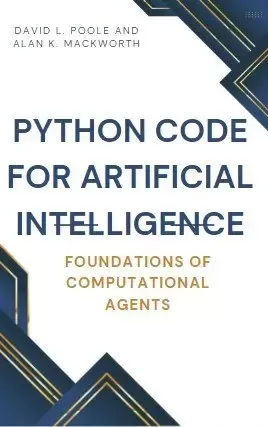
Python code for Artificial Intelligence. Foundations of Computational Agents. 3 Ed
Оглавление⌄
1 Python for Artificial Intelligence 9 1.1 Why Python? 9 1.2 Getting Python 10 1.3 Running Python 10 1.4 Pitfalls 11 1.5 Features of Python 11 1.5.1 f-strings 11 1.5.2 Lists, Tuples, Sets, Dictionaries and Comprehensions 12 1.5.3 Functions as first-class objects 13 1.5.4 Generators 14 1.6 Useful Libraries 16 1.6.1 Timing Code 16 1.6.2 Plotting: Matplotlib 16 1.7 Utilities 18 1.7.1 Display 18 1.7.2 Argmax 19 1.7.3 Probability 20 1.8 Testing Code 21 2 Agent Architectures and Hierarchical Control 25 2.1 Representing Agents and Environments 25 2.2 Paper buying agent and environment 27 2.2.1 The Environment 27 2.2.2 The Agent 29 2.2.3 Plotting 29 2.3 Hierarchical Controller 31 2.3.1 Environment 31 2.3.2 Body 32 2.3.3 Middle Layer 34 2.3.4 Top Layer 35 2.3.5 Plotting 36 3 Searching for Solutions 41 3.1 Representing Search Problems 41 3.1.1 Explicit Representation of Search Graph 43 3.1.2 Paths 45 3.1.3 Example Search Problems 47 3.2 Generic Searcher and Variants 53 3.2.1 Searcher 53 3.2.2 GUI for Tracing Search 55 3.2.3 Frontier as a Priority Queue 59 3.2.4 A* Search 60 3.2.5 Multiple Path Pruning 62 3.3 Branch-and-bound Search 64 4 Reasoning with Constraints 69 4.1 Constraint Satisfaction Problems 69 4.1.1 Variables 69 4.1.2 Constraints 70 4.1.3 CSPs 71 4.1.4 Examples 74 4.2 A Simple Depth-first Solver 83 4.3 Converting CSPs to Search Problems 84 4.4 Consistency Algorithms 86 4.4.1 Direct Implementation of Domain Splitting 89 4.4.2 Consistency GUI 91 4.4.3 Domain Splitting as an interface to graph searching 93 4.5 Solving CSPs using Stochastic Local Search 95 4.5.1 Any-conflict 97 4.5.2 Two-Stage Choice 98 4.5.3 Updatable Priority Queues 101 4.5.4 Plotting Run-Time Distributions 102 4.5.5 Testing 103 4.6 Discrete Optimization 105 4.6.1 Branch-and-bound Search 106 5 Propositions and Inference 109 5.1 Representing Knowledge Bases 109 5.2 Bottom-up Proofs (with askables) 112 5.3 Top-down Proofs (with askables) 114 5.4 Debugging and Explanation 115 5.5 Assumables 119 5.6 Negation-as-failure 122 6 Deterministic Planning 125 6.1 Representing Actions and Planning Problems 125 6.1.1 Robot Delivery Domain 126 6.1.2 Blocks World 128 6.2 Forward Planning 130 6.2.1 Defining Heuristics for a Planner 132 6.3 Regression Planning 135 6.3.1 Defining Heuristics for a Regression Planner 137 6.4 Planning as a CSP 138 6.5 Partial-Order Planning 142 7 Supervised Machine Learning 149 7.1 Representations of Data and Predictions 150 7.1.1 Creating Boolean Conditions from Features 153 7.1.2 Evaluating Predictions 155 7.1.3 Creating Test and Training Sets 157 7.1.4 Importing Data From File 157 7.1.5 Augmented Features 160 7.2 Generic Learner Interface 162 7.3 Learning With No Input Features 163 7.3.1 Evaluation 165 7.4 Decision Tree Learning 167 7.5 Cross Validation and Parameter Tuning 171 7.6 Linear Regression and Classification 175 7.7 Boosting 181 7.7.1 Gradient Tree Boosting 184 8 Neural Networks and Deep Learning 187 8.1 Layers 187 8.1.1 Linear Layer 188 8.1.2 ReLU Layer 190 8.1.3 Sigmoid Layer 190 8.2 Feedforward Networks 191 8.3 Improved Optimization 193 8.3.1 Momentum 193 8.3.2 RMS-Prop 193 8.4 Dropout 194 8.4.1 Examples 195 9 Reasoning with Uncertainty 2019 Reasoning with Uncertainty 201 9.1 Representing Probabilistic Models 201 9.2 Representing Factors 201 9.3 Conditional Probability Distributions 203 9.3.1 Logistic Regression 203 9.3.2 Noisy-or 204 9.3.3 Tabular Factors and Prob 205 9.3.4 Decision Tree Representations of Factors 206 9.4 Graphical Models 208 9.4.1 Showing Belief Networks 209 9.4.2 Example Belief Networks 210 9.5 Inference Methods 216 9.5.1 Showing Posterior Distributions 217 9.6 Naive Search 218 9.7 Recursive Conditioning 220 9.8 Variable Elimination 224 9.9 Stochastic Simulation 227 9.9.1 Sampling from a Discrete Distribution 227 9.9.2 Sampling Methods for Belief Network Inference 229 9.9.3 Rejection Sampling 229 9.9.4 Likelihood Weighting 230 9.9.5 Particle Filtering 231 9.9.6 Examples 233 9.9.7 Gibbs Sampling 234 9.9.8 Plotting Behavior of Stochastic Simulators 236 9.10 Hidden Markov Models 238 9.10.1 Exact Filtering for HMMs 240 9.10.2 Localization 241 9.10.3 Particle Filtering for HMMs 244 9.10.4 Generating Examples 246 9.11 Dynamic Belief Networks 247 9.11.1 Representing Dynamic Belief Networks 247 9.11.2 Unrolling DBNs 250 9.11.3 DBN Filtering 251 10 Learning with Uncertainty 253 10.1 Bayesian Learning 253 10.2 K-means 257 10.3 EM 261 11 Causality 267 11.1 Do Questions 267 11.2 Counterfactual Example 269 11.2.1 Firing Squad Example 271 12 Planning with Uncertainty 275 12.1 Decision Networks 275 12.1.1 Example Decision Networks 277 12.1.2 Decision Functions 283 12.1.3 Recursive Conditioning for Decision Networks 284 12.1.4 Variable Elimination for Decision Networks 287 12.2 Markov Decision Processes 289 12.2.1 Problem Domains 291 12.2.2 Value Iteration 299 12.2.3 Value Iteration GUI for Grid Domains 300 12.2.4 Asynchronous Value Iteration 302 13 Reinforcement Learning 307 13.1 Representing Agents and Environments 307 13.1.1 Environments 307 13.1.2 Agents 308 13.1.3 Simulating an Environment-Agent Interaction 309 13.1.4 Party Environment 310 13.1.5 Environment from a Problem Domain 311 13.1.6 Monster Game Environment 312 13.2 Q Learning 315 13.2.1 Exploration Strategies 317 13.2.2 Testing Q-learning 318 13.3 Q-learning with Experience Replay 320 13.4 Stochastic Policy Learning Agent 322 13.5 Model-based Reinforcement Learner 324 13.6 Reinforcement Learning with Features 327 13.6.1 Representing Features 328 13.6.2 Feature-based RL Learner 331 13.7 GUI for RL 334 14 Multiagent Systems 339 14.1 Minimax 339 14.1.1 Creating a Two-player Game 339 14.1.2 Minimax and α-β Pruning 342 14.2 Multiagent Learning 344 14.2.1 Simulating Multiagent Interaction with an Environment 344 14.2.2 Example Games 346 14.2.3 Testing Games and Environments 347 15 Individuals and Relations 349 15.1 Representing Datalog and Logic Programs 349 15.2 Unification 351 15.3 Knowledge Bases 352 15.4 Top-down Proof Procedure 354 15.5 Logic Program Example 356 16 Knowledge Graphs and Ontologies 359 16.1 Triple Store 359 16.2 Integrating Datalog and Triple Store 362 17 Relational Learning 365 17.1 Collaborative Filtering 365 17.1.1 Plotting 369 17.1.2 Loading Rating Sets from Files and Websites 372 17.1.3 Ratings of Top Items and Users 373 17.2 Relational Probabilistic Models 375 18 Version History 381 Bibliography 383 Index 385
Описание
Коротко и по делу о том, что важно знать про libraries.
AIPython contains runnable code for the book Artificial Intelligence, foundations of computational agents, 3rd Edition[Poole and Mackworth, 2023]. It has the following design goals
AIPython is not a replacement for welldesigned libraries, or optimized tools. Readability is more important than efficiency, although the asymptotic complexity is not compromised. Think of it like a model of an engine made of glass, so you can see the inner workings; don’t expect it to power a big truck, but it lets you see how a metal engine can power a truck.
A reader only needs to understand Python. It uses as few libraries as possible. Libraries hide details that we make explicit. The only library used is matplotlib for plotting and drawing
На этом основные моменты по теме закрыты.
Поделиться
Частые вопросы
Можно ли скачать «Python code for Artificial Intelligence. Foundations of Computational Agents. 3 Ed» бесплатно?
Да, «Python code for Artificial Intelligence. Foundations of Computational Agents. 3 Ed» доступна для бесплатного скачивания на нашем сайте в формате PDF. Ссылка на файл находится на этой странице.
В каком формате и какого размера файл?
Книга предоставляется в формате PDF, размер файла 1,9 МБ.
Кто автор и когда вышла книга?
автор — Mackworth Alan K , Poole David L, издательство Самиздат, год выпуска 2024, 390 страниц.
О чём книга «Python code for Artificial Intelligence. Foundations of Computational Agents. 3 Ed»?
AIPython contains runnable code for the book Artificial Intelligence, foundations of computational agents, 3rd Edition[Poole and Mackworth, 2023].
Похожие материалы
 Основы программирования на Python
 Python для детей. Самоучитель по программированию
 Python. Сборник упражнений. Введение в язык Python с задачами и решениями
 Структуры данных в Python: начальный курс
 Python за 7 дней. Краткий курс для начинающих
 Python in a Nutshell: A Desktop Quick Reference. 4 Ed
 Python for Microcontrollers: Getting Started with MicroPython
 Programming with MicroPython