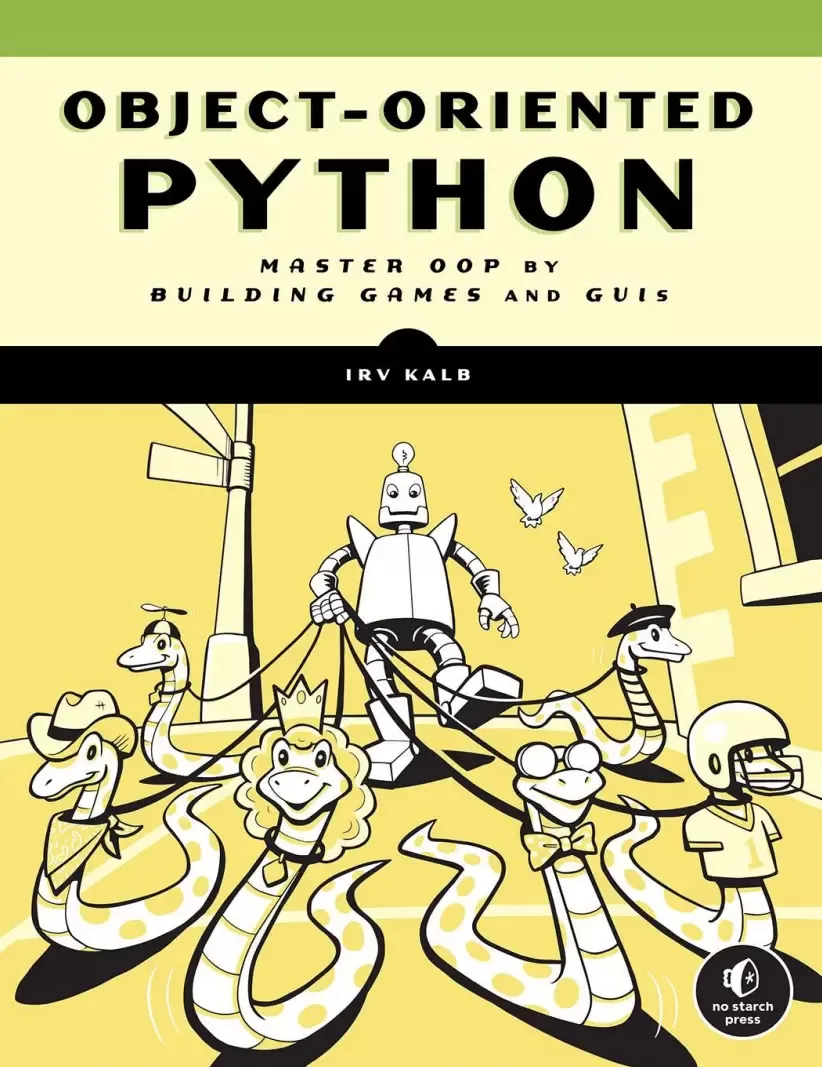
Object-Oriented Python: Master OOP by Building Games and GUIs
Оглавление⌄
Title Page....13 Copyright....14 Dedication....16 About the Author....17 Acknowledgments....18 Introduction....20 Who Is This Book For?....22 Python Version(s) and Installation....22 How Will I Explain OOP?....24 What’s in the Book....24 Development Environments....27 Widgets and Example Games....27 Part I: Introducing Object-oriented Programming....29 Chapter 1: Procedural Python Examples....30 Higher or Lower Card Game....31 Representing the Data....31 Implementation....32 Reusable Code....35 Bank Account Simulations....35 Analysis of Required Operations and Data....36 Implementation 1—Single Account Without Functions....36 Implementation 2—Single Account with Functions....39 Implementation 3—Two Accounts....42 Implementation 4—Multiple Accounts Using Lists....44 Implementation 5—List of Account Dictionaries....47 Common Problems with Procedural Implementation....50 Object-Oriented Solution—First Look at a Class....51 Summary....52 Chapter 2: Modeling Physical Objects with Object-Oriented Programming....54 Building Software Models of Physical Objects....55 State and Behavior: Light Switch Example....55 Classes, Objects, and Instantiation....60 Writing a Class in Python....61 Scope and Instance Variables....63 Differences Between Functions and Methods....65 Creating an Object from a Class....65 Calling Methods of an Object....67 Creating Multiple Instances from the Same Class....68 Python Data Types Are Implemented as Classes....70 Definition of an Object....71 Building a Slightly More Complicated Class....71 Representing a More Complicated Physical Object as a Class....74 Passing Arguments to a Method....80 Multiple Instances....82 Initialization Parameters....84 Classes in Use....86 OOP as a Solution....87 Summary....88 Chapter 3: Mental Models of Objects and the Meaning of “self”....89 Revisiting the DimmerSwitch Class....89 High-Level Mental Model #1....91 A Deeper Mental Model #2....92 What Is the Meaning of “self”?....97 Summary....101 Chapter 4: Managing Multiple Objects....103 Bank Account Class....103 Importing Class Code....106 Creating Some Test Code....108 Creating Multiple Accounts....108 Multiple Account Objects in a List....111 Multiple Objects with Unique Identifiers....113 Building an Interactive Menu....116 Creating an Object Manager Object....118 Building the Object Manager Object....120 Main Code That Creates an Object Manager Object....123 Better Error Handling with Exceptions....126 try and except....126 The raise Statement and Custom Exceptions....127 Using Exceptions in Our Bank Program....128 Account Class with Exceptions....128 Optimized Bank Class....130 Main Code That Handles Exceptions....132 Calling the Same Method on a List of Objects....134 Interface vs. Implementation....136 Summary....136 Part II: Graphical User interfaces with Pygame....138 Chapter 5: Introduction to Pygame....139 Installing Pygame....140 Window Details....141 The Window Coordinate System....142 Pixel Colors....147 Event-Driven Programs....148 Using Pygame....150 Bringing Up a Blank Window....151 Drawing an Image....155 Detecting a Mouse Click....158 Handling the Keyboard....162 Creating a Location-Based Animation....167 Using Pygame rects....170 Playing Sounds....174 Playing Sound Effects....174 Playing Background Music....175 Drawing Shapes....177 Reference for Primitive Shapes....180 Summary....183 Chapter 6: Object-Oriented Pygame....184 Building the Screensaver Ball with OOP Pygame....184 Creating a Ball Class....185 Using the Ball Class....187 Creating Many Ball Objects....189 Creating Many, Many Ball Objects....191 Building a Reusable Object-Oriented Button....192 Building a Button Class....193 Main Code Using a SimpleButton....196 Creating a Program with Multiple Buttons....198 Building a Reusable Object-Oriented Text Display....200 Steps to Display Text....200 Creating a SimpleText Class....201 Demo Ball with SimpleText and SimpleButton....203 Interface vs. Implementation....205 Callbacks....206 Creating a Callback....207 Using a Callback with SimpleButton....208 Summary....211 Chapter 7: Pygame GUI Widgets....213 Passing Arguments into a Function or Method....213 Positional and Keyword Parameters....215 Additional Notes on Keyword Parameters....216 Using None as a Default Value....218 Choosing Keywords and Default Values....219 Default Values in GUI Widgets....220 The pygwidgets Package....220 Setting Up....222 Overall Design Approach....222 Adding an Image....224 Adding Buttons, Checkboxes, and Radio Buttons....225 Text Output and Input....229 Other pygwidgets Classes....232 pygwidgets Example Program....233 The Importance of a Consistent API....234 Summary....235 Part III: Encapsulation, Polymorphism, and Inheritance....236 Chapter 8: Encapsulation....237 Encapsulation with Functions....237 Encapsulation with Objects....238 Objects Own Their Data....239 Interpretations of Encapsulation....240 Direct Access and Why You Should Avoid It....240 Strict Interpretation with Getters and Setters....246 Safe Direct Access....248 Making Instance Variables More Private....249 Implicitly Private....249 More Explicitly Private....250 Decorators and @property....251 Encapsulation in pygwidgets Classes....256 A Story from the Real World....257 Abstraction....258 Summary....262 Chapter 9: Polymorphism....263 Sending Messages to Real-World Objects....264 A Classic Example of Polymorphism in Programming....264 Example Using Pygame Shapes....266 The Square Shape Class....267 The Circle and Triangle Shape Classes....269 The Main Program Creating Shapes....272 Extending a Pattern....274 pygwidgets Exhibits Polymorphism....275 Polymorphism for Operators....276 Magic Methods....277 Comparison Operator Magic Methods....278 A Rectangle Class with Magic Methods....280 Main Program Using Magic Methods....282 Math Operator Magic Methods....285 Vector Example....285 Creating a String Representation of Values in an Object....288 A Fraction Class with Magic Methods....291 Summary....295 Chapter 10: Inheritance....297 Inheritance in Object-Oriented Programming....298 Implementing Inheritance....300 Employee and Manager Example....301 Base Class: Employee....301 Subclass: Manager....302 Test Code....305 The Client’s View of a Subclass....306 Real-World Examples of Inheritance....308 InputNumber....308 DisplayMoney....312 Example Usage....315 Multiple Classes Inheriting from the Same Base Class....319 Abstract Classes and Methods....324 How pygwidgets Uses Inheritance....329 Class Hierarchy....332 The Difficulty of Programming with Inheritance....334 Summary....335 Chapter 11: Managing Memory Used by Objects....337 Object Lifetime....337 Reference Count....338 Garbage Collection....346 Class Variables....346 Class Variable Constants....347 Class Variables for Counting....348 Putting It All Together: Balloon Sample Program....349 Module of Constants....353 Main Program Code....354 Balloon Manager....357 Balloon Class and Objects....360 Managing Memory: Slots....364 Summary....367 Part IV: Using OOP in Game Development....368 Chapter 12: Card Games....370 The Card Class....371 The Deck Class....374 The Higher or Lower Game....377 Main Program....377 Game Object....379 Testing with __name__....383 Other Card Games....385 Blackjack Deck....385 Games with Unusual Card Decks....385 Summary....386 Chapter 13: Timers....387 Timer Demonstration Program....388 Three Approaches for Implementing Timers....389 Counting Frames....389 Timer Event....390 Building a Timer by Calculating Elapsed Time....392 Installing pyghelpers....394 The Timer Class....395 Displaying Time....398 CountUpTimer....399 CountDownTimer....403 Summary....404 Chapter 14: Animation....405 Building Animation Classes....405 SimpleAnimation Class....406 SimpleSpriteSheetAnimation Class....411 Merging Two Classes....417 Animation Classes in pygwidgets....417 Animation Class....418 SpriteSheetAnimation Class....420 Common Base Class: PygAnimation....422 Example Animation Program....423 Summary....425 Chapter 15: Scenes....427 The State Machine Approach....427 A pygame Example with a State Machine....430 A Scene Manager for Managing Many Scenes....438 A Demo Program Using a Scene Manager....439 The Main Program....442 Building the Scenes....444 A Typical Scene....448 Rock, Paper, Scissors Using Scenes....450 Communication Between Scenes....455 Requesting Information from a Target Scene....456 Sending Information to a Target Scene....457 Sending Information to All Scenes....457 Testing Communications Among Scenes....458 Implementation of the Scene Manager....458 run() Method....460 Main Methods....462 Communication Between Scenes....463 Summary....465 Chapter 16: Full Game: Dodger....467 Modal Dialogs....467 Yes/No and Alert Dialogs....468 Answer Dialogs....472 Building a Full Game: Dodger....475 Game Overview....475 Implementation....476 Extensions to the Game....500 Summary....501 Chapter 17: Design Patterns and Wrap-Up....502 Model View Controller....502 File Display Example....503 Statistical Display Example....504 Advantages of the MVC Pattern....510 Wrap-Up....512 Index....514
Описание
Коротко и по делу о том, что важно знать про object.
You’ll cover the basics of building classes and creating objects, and put theory into practice using the pygame package with clear examples that help visualize the object-oriented style. Object-Oriented Python is an intuitive and thorough guide to mastering object-oriented programming from the ground up. You’ll explore the key concepts of object-oriented programming — encapsulation, polymorphism, and inheritance — and learn not just how to code with objects, but the absolute best practices for doing so. The book covers two fully functional Python code packages that will speed up development of graphical user interface (GUI) programs in Python. Finally, you’ll bring it all together by building a complex video game, complete with full animations and sounds.
Если материал оказался полезен — сохраните страницу.
Поделиться
Частые вопросы
Можно ли скачать «Object-Oriented Python: Master OOP by Building Games and GUIs» бесплатно?
Да, «Object-Oriented Python: Master OOP by Building Games and GUIs» доступна для бесплатного скачивания на нашем сайте в формате PDF. Ссылка на файл находится на этой странице.
В каком формате и какого размера файл?
Книга предоставляется в формате PDF, размер файла 2,4 МБ.
Кто автор и когда вышла книга?
автор — Kalb Irv, издательство No Starch Press, Inc., год выпуска 2022, 541 страниц.
О чём книга «Object-Oriented Python: Master OOP by Building Games and GUIs»?
Object-Oriented Python is an intuitive and thorough guide to mastering object-oriented programming from the ground up.
Похожие материалы
 Основы программирования на Python
 Python для детей. Самоучитель по программированию
 Python. Сборник упражнений. Введение в язык Python с задачами и решениями
 Структуры данных в Python: начальный курс
 Python за 7 дней. Краткий курс для начинающих
 Python in a Nutshell: A Desktop Quick Reference. 4 Ed
 Python for Microcontrollers: Getting Started with MicroPython
 Programming with MicroPython