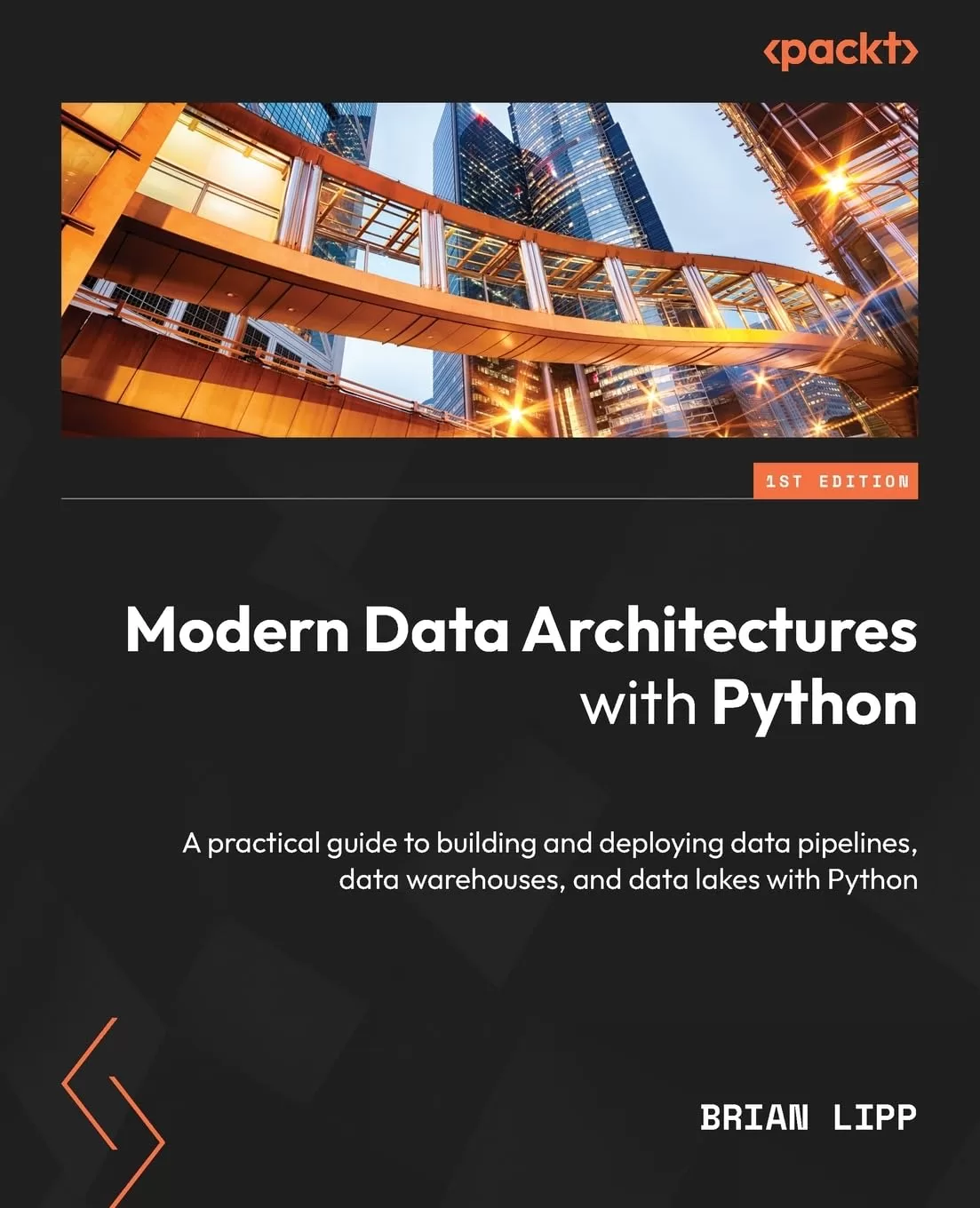
Modern Data Architectures with Python: A modern approach to building data ecosystems
Оглавление⌄
CoverTitle PageCopyrightContentsAcronymsAbout the AuthorsForewordPrefaceAcknowledgmentsPart I IntroductionChapter 1 Evolution of Mobile Networks1.1 Introduction1.2 6G Mobile Communication Networks1.2.1 6G as Envisioned Today1.3 Key Driving Trends Toward 6G1.4 6G Requirements/Vision1.4.1 6G Development TimelineReferencesChapter 2 Key 6G Technologies2.1 Radio Network Technologies2.2 AI/ML/FL2.3 DLT/Blockchain2.4 Edge Computing2.5 Quantum Communication2.6 Other New Technologies2.6.1 Visible Light Communications2.6.2 Large Intelligent Surfaces2.6.3 Compressive Sensing2.6.4 Zero‐Touch Network and Service Management2.6.5 Efficient Energy Transfer and HarvestingReferencesChapter 3 6G Security Vision3.1 Overview of 6G Security Vision3.1.1 New 6G Requirements3.2 6G Security Vision and KPIs3.2.1 Security Threat Landscape for 6G ArchitectureReferencesPart II Security in 6G ArchitectureChapter 4 6G Device Security4.1 Overview of 6G Devices4.2 6G Device Security Challenges4.2.1 Growth of Data Collection4.2.2 Cloud Connectivity4.2.3 Device Capacity4.2.4 Ultrasaturated Devices4.3 Addressing Device Security in 6GReferencesChapter 5 Open RAN and RAN‐Core Convergence5.1 Introduction5.2 Open RAN Architecture5.3 Threat Vectors and Security Risks Associated with Open RAN5.3.1 Threat Taxonomy5.3.2 Risks Related to the Process5.3.2.1 Prerequisites5.3.2.2 General Regulations5.3.2.3 Privacy5.3.2.4 People5.3.3 Risks Related to the Technology5.3.3.1 Open Source Software5.3.3.2 Radio/Open Interface5.3.3.3 Intelligence5.3.3.4 Virtualization5.3.4 Global Risks5.4 Security Benefits of Open RAN5.4.1 Open RAN specific5.4.1.1 Full Visibility5.4.1.2 Selection of Best Modules5.4.1.3 Diversity5.4.1.4 Modularity5.4.1.5 Enforcement of Security Controls5.4.1.6 Open Interfaces5.4.1.7 Open Source Software5.4.1.8 Automation5.4.1.9 Open Standards5.4.2 V‐RAN Specific5.4.2.1 Isolation5.4.2.2 Increased Scalability for Security Management5.4.2.3 Control Trust5.4.2.4 Less Dependency Between hardware [HW] and SW5.4.2.5 Private Network5.4.2.6 More Secure Storage of Key Material5.4.3 5G Networks Related5.4.3.1 Edge Oriented5.4.3.2 Simpler Security Model5.5 ConclusionReferencesChapter 6 Edge Intelligence*6.1 Overview of Edge Intelligence6.2 State‐of‐the‐Art Related to 5G6.2.1 Denial of Service (DOS)6.2.2 Man‐in‐the‐Middle (MitM) Attack6.2.3 Privacy Leakage6.3 State‐of‐the‐Art Related to 6G6.3.1 Training Dataset Manipulation6.3.2 Interception of Private Information6.3.3 Attacks on Learning Agents6.4 Edge Computing Security in Autonomous Driving6.5 Future and ChallengesReferencesChapter 7 Specialized 6G Networks and Network Slicing7.1 Overview of 6G Specialized Networks7.2 Network Slicing in 6G7.2.1 Trust in Network Slicing7.2.2 Privacy Aspects in Network Slicing7.2.3 Solutions for Privacy and Trust in NSReferencesChapter 8 Industry 5.0*8.1 Introduction8.2 Motivations Behind the Evolution of Industry 5.08.3 Key Features of Industry 5.08.3.1 Smart Additive Manufacturing8.3.2 Predictive Maintenance8.3.3 Hyper Customization8.3.4 Cyber‐Physical Cognitive Systems8.4 Security of Industry 5.08.4.1 Security Issues of Industry 5.08.5 Privacy of Industry 5.0ReferencesPart III Security in 6G Use CasesChapter 9 Metaverse Security in 6G9.1 Overview of Metaverse9.2 What Is Metaverse?9.2.1 Metaverse Architecture9.2.2 Key Characteristics of Metaverse9.2.3 Role of 6G in Metaverse9.3 Security Threats in Metaverse9.4 Countermeasures for Metaverse Security Threats9.5 New Trends in Metaverse SecurityChapter 10 Society 5.0 and Security*10.1 Industry and Society Evolution10.1.1 Industry 4.010.1.2 Society 5.010.2 Technical Enablers and Challenges10.2.1 Dependable Wireless Connectivity10.2.1.1 New Spectrum and Extreme Massive MIMO10.2.1.2 In‐X Subnetworks10.2.1.3 Semantic Communication10.2.2 Integrated Communication, Control, Computation, and Sensing10.2.2.1 CoCoCo10.2.2.2 JCAS10.2.3 Intelligence Everywhere10.2.4 Energy Harvesting and Transfer10.2.4.1 Energy Harvesting10.2.4.2 Wireless Power Transfer10.3 Security in Society 5.0ReferencesChapter 11 6G‐Enabled Internet of Vehicles11.1 Overview of V2X Communication and IoV11.2 IoV Use Cases11.3 Connected Autonomous Vehicles (CAV)11.4 Unmanned Aerial Vehicles in Future IoV11.5 Security Landscape for IoV11.5.1 Security Threats11.5.2 Security RequirementsReferencesChapter 12 Smart Grid 2.0 Security*12.1 Introduction12.2 Evolution of SG 2.012.3 Smart Grid 2.012.3.1 Comparison of Smart Grids 1.0 and 2.012.4 Role of 6G in SG 2.012.5 Security Challenges of SG 2.012.5.1 Physical Attacks12.5.2 Software Attacks12.5.3 Network Attacks12.5.4 Attacks to the Controller12.5.5 Encryption‐Related Attacks12.5.6 AI‐ and ML‐Related Attacks12.5.7 Stability and Reliability of Power Supply12.5.8 Secure and Transparent Energy Trading Among Prosumers and Consumers12.5.9 Efficient and Reliable Communication Topology for Information and Control Signal Exchange12.6 Privacy Issues of SG2.012.7 Trust Management12.8 Security and Privacy Standardization on SG 2.0ReferencesPart IV Privacy in 6G VisionChapter 13 6G Privacy*13.1 Introduction13.2 Privacy Taxonomy13.3 Privacy in Actions on Data13.3.1 Information Collection13.3.2 Information Processing13.3.3 Information Dissemination13.3.4 Invasion13.4 Privacy Types for 6G13.4.1 Data13.4.2 Actions and Personal Behavior13.4.3 Image and Video13.4.4 Communication13.4.5 Location13.5 6G Privacy Goals13.5.1 Ensure of Privacy‐Protected Big Data13.5.2 Privacy Guarantees for Edge Networks13.5.3 Achieving Balance Between Privacy and Performance of Services13.5.4 Standardization of Privacy in Technologies, and Applications13.5.5 Balance the Interests in Privacy Protection in Global Context13.5.6 Achieving Proper Utilization of Interoperability and Data Portability13.5.7 Quantifying Privacy and Privacy Violations13.5.7.1 Achieving Privacy Protected AI‐Driven Automated Network Management Operations13.5.8 Getting Explanations of AI Actions for Privacy RequirementsReferencesChapter 14 6G Privacy Challenges and Possible Solution*14.1 Introduction14.2 6G Privacy Challenges and Issues14.2.1 Advanced 6G Applications with New Privacy Requirements14.2.2 Privacy Preservation Limitations for B5G/6G Control and Orchestration Layer14.2.3 Privacy Attacks on AI Models14.2.4 Privacy Requirements in Cloud Computing and Storage Environments14.2.5 Privacy Issues in Edge Computing and Edge AI14.2.6 Cost on Privacy Enhancements14.2.7 Limited Availability of Explainable AI (XAI) Techniques14.2.8 Ambiguity in Responsibility of Data Ownership14.2.9 Data Communication Confidentiality Issues14.2.10 Private Data Access Limitations14.2.11 Privacy Differences Based on Location14.2.12 Lack of Understanding of Privacy Rights and Threats in General Public14.2.13 Difficulty in Defining Levels and Indicators for Privacy14.2.13.1 Proper Evaluation of Potential Privacy Leakages from Non‐personal Data14.3 Privacy Solutions for 6G14.3.1 Privacy‐Preserving Decentralized AI14.3.2 Edge AI14.3.3 Intelligent Management with Privacy14.3.4 XAI for Privacy14.3.5 Privacy Measures for Personally Identifiable Information14.3.6 Blockchain‐Based Solutions14.3.7 Lightweight and Quantum Resistant Encryption Mechanisms14.3.8 Homomorphic Encryption14.3.9 Privacy‐Preserving Data Publishing Techniques14.3.9.1 Syntactic Anonymization14.3.9.2 Differential Privacy14.3.10 Privacy by Design and Privacy by Default14.3.11 Regulation of Government, Industry, and Consumer14.3.12 Other Solutions14.3.12.1 Location Privacy Considerations14.3.12.2 Personalized Privacy14.3.12.3 Fog Computing PrivacyReferencesChapter 15 Legal Aspects and Security Standardization15.1 Legal15.2 Security Standardization15.2.1 ETSI15.2.2 ITU‐T15.2.3 3GPP15.2.4 NIST15.2.5 IETF15.2.6 5G PPP15.2.7 NGMN15.2.8 IEEEReferencesPart V Security in 6G TechnologiesChapter 16 Distributed Ledger Technologies (DLTs) and Blockchain*16.1 Introduction16.2 What Is Blockchain16.2.1 Types of Blockchain16.3 What Is Smart Contracts16.4 Salient Features of Blockchain16.5 Key Security Challenges Which Blockchain Can Solve16.5.1 Role of Blockchain16.6 Key Privacy Challenges Which Blockchain Can Solve16.6.1 Key Challenges16.6.2 Role of Blockchain16.7 Threat Landscape of Blockchain16.8 Possible Solutions to Secure 6G BlockchainsReferencesChapter 17 AI/ML for 6G Security*17.1 Overview of 6G Intelligence17.2 AI for 6G Security17.3 Use of AI to Identify/Mitigate Pre‐6G Security Issues17.4 AI to Mitigate Security Issues of 6G Architecture17.5 AI to Mitigate Security Issues of 6G Technologies17.6 Security Issues in AI17.7 Using AI to Attack 6GReferencesChapter 18 Role of Explainable AI in 6G Security*18.1 What Is Explainable AI (XAI)18.1.1 Terminologies of XAI18.1.2 Taxonomy of XAI18.1.3 XAI Methods18.2 Use of XAI for 6G18.3 XAI for 6G Security18.3.1 XAI for 6G Devices and IoT Security18.3.2 XAI for 6G RAN18.3.3 XAI for 6G Edge18.3.4 XAI for 6G Core and Backhaul18.3.5 XAI for 6G Network Automation18.4 New Security Issues of XAI18.4.1 Increased Vulnerability to Adversarial ML Attacks18.4.2 Difficulty to Design Secure ML Applications18.4.3 New Attack Vector and TargetReferencesChapter 19 Zero Touch Network and Service Management (ZSM) Security19.1 Introduction19.1.1 Need of Zero‐Touch Network and Service Management19.1.2 Importance of ZSM for 5G and Beyond19.2 ZSM Reference Architecture19.2.1 Components19.2.1.1 Management Services19.2.1.2 Management Functions19.2.1.3 Management Domains19.2.1.4 The E2E Service Management Domain19.2.1.5 Integration Fabric19.2.1.6 Data Services19.3 Security Aspects19.3.1 ML/AI‐Based Attacks19.3.1.1 White‐Box Attack19.3.1.2 Black‐Box Attack19.3.2 Open API Security Threats19.3.2.1 Parameter Attacks19.3.3 Intent‐Based Security Threats19.3.3.1 Data Exposure19.3.3.2 Tampering19.3.4 Automated Closed‐Loop Network‐Based Security Threats19.3.4.1 MITM Attack19.3.4.2 Deception Attacks19.3.5 Threats Due to Programmable Network Technologies19.3.6 Possible Threats on ZSM Framework ArchitectureReferencesChapter 20 Physical Layer Security*20.1 Introduction20.2 Physical Layer Security Background20.2.1 PLS Fundamentals20.2.2 PLS Approaches20.2.2.1 Confidentiality (Edgar)20.2.2.2 Physical Layer Authentication20.2.2.3 Secret Key Generation20.3 The Prospect of PLS in 6G20.3.1 Application Scenarios of PLS in 6G20.3.2 6G Technologies and PLS20.3.2.1 IRS20.3.2.2 Unmanned Aerial Vehicles20.3.3 Cell‐Free mMIMO20.3.4 Visible Light Communication (VLC)20.3.5 Terahertz Communication20.3.6 Joint Communications and SensingReferencesChapter 21 Quantum Security and Postquantum Cryptography*21.1 Overview of 6G and Quantum Computing21.2 Quantum Computing21.3 Quantum Security21.3.1 Quantum Key Distribution21.3.2 Information‐Theoretic Security21.4 Postquantum Cryptography21.4.1 Background21.4.2 PQC Methods21.4.3 PQC Standardization21.4.4 Challenges with PQC21.4.5 Future Directions of PQC21.4.6 6G and PQCReferencesPart VI Concluding RemarksChapter 22 Concluding RemarksIndexEULA
Описание
В этом материале разберём тему: data.
Data is present in every business and working environment. People are constantly trying to understand and use data better.
This book has three different intended readerships:Engineers: Engineers building data products and infrastructure can benefit from understanding how to build modern open data platformsAnalysts: Analysts who want to understand data better and use it to make critical decisions will benefit from understanding how to better interact with itManagers: Decision makers who write the checks and consume data often need to understand data platforms from a high level better, which is incredibly important
Если материал оказался полезен — сохраните страницу.
Поделиться
Частые вопросы
Можно ли скачать «Modern Data Architectures with Python: A modern approach to building data ecosystems» бесплатно?
Да, «Modern Data Architectures with Python: A modern approach to building data ecosystems» доступна для бесплатного скачивания на нашем сайте в формате PDF. Ссылка на файл находится на этой странице.
В каком формате и какого размера файл?
Книга предоставляется в формате PDF, размер файла 3,0 МБ.
Кто автор и когда вышла книга?
автор — Lipp Brian, издательство Packt Publishing Limited, год выпуска 2023, 318 страниц.
О чём книга «Modern Data Architectures with Python: A modern approach to building data ecosystems»?
Data is present in every business and working environment.
Похожие материалы
 Основы программирования на Python
 Python для детей. Самоучитель по программированию
 Python. Сборник упражнений. Введение в язык Python с задачами и решениями
 Структуры данных в Python: начальный курс
 Python за 7 дней. Краткий курс для начинающих
 Python in a Nutshell: A Desktop Quick Reference. 4 Ed
 Python for Microcontrollers: Getting Started with MicroPython
 Programming with MicroPython