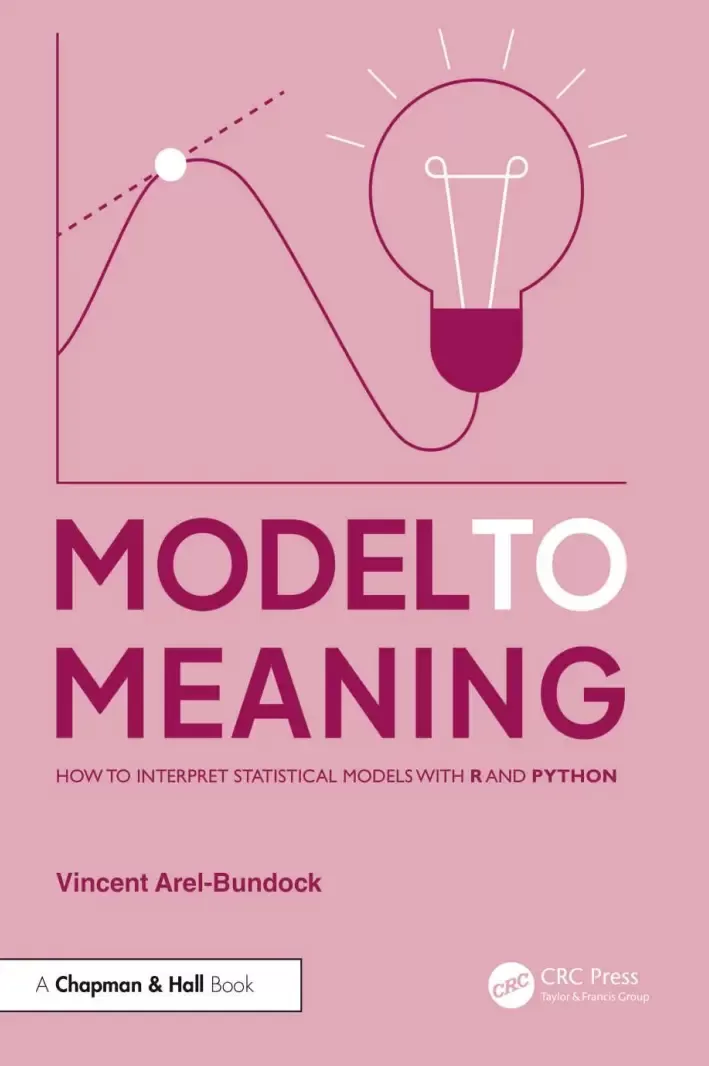
Model to Meaning: How to Interpret Statistical Models with R and Python
Оглавление⌄
Cover....1 Half Title....2 Title Page....3 Copyright Page....4 Contents....5 Author....9 1. Who is this book for?....11 1.1. The big picture....11 1.2. Software....13 1.3. Documentation....14 1.4. Data....15 I. Interpretation....17 2. Models and meaning ....19 2.1. Why fit a model?....19 2.2. What is your estimand?....23 2.3. Making sense of parameter estimates....25 3. Conceptual framework ....27 3.1. Quantity....28 3.2. Predictors....33 3.3. Aggregation....39 3.4. Uncertainty....40 3.5. Test....41 3.6. Summary....42 II. Quantities and tests....47 4. Hypothesis and equivalence tests ....49 4.1. Null hypothesis....52 4.2. Equivalence....57 4.3. Summary....60 5. Predictions ....62 5.1. Quantity....63 5.2. Predictors....66 5.3. Aggregation....72 5.4. Uncertainty....75 5.5. Test....76 5.6. Visualization....80 5.7. Summary....86 6. Counterfactual comparisons ....89 6.1. Quantity....90 6.2. Predictors....95 6.3. Aggregation....103 6.4. Uncertainty....108 6.5. Test....108 6.6. Visualization....110 6.7. Summary....112 7. Slopes ....115 7.1. Quantity....116 7.2. Predictors....122 7.3. Aggregation....124 7.4. Uncertainty....125 7.5. Test....126 7.6. Visualization....127 7.7. Summary....129 III. Case studies....133 8. Causal inference with G-computation ....135 8.1. Treatment effects: ATE, ATT, ATU....136 8.2. Conditional treatment effects: CATE....144 9. Experiments ....146 9.1. Regression adjustment....146 9.2. Factorial experiments....148 10. Interactions and polynomials ....153 10.1. Multiplicative interactions....154 10.2. Polynomial regression....172 11. Categorical and ordinal outcomes ....177 11.1. Predictions....179 11.2. Counterfactual comparisons....183 12. Multilevel regression with poststratification ....185 12.1. Multilevel models....186 12.2. Frequentist....187 12.3. Bayesian....189 12.4. Poststratification....196 13. Machine learning ....200 13.1. tidymodels and mlr3....200 13.2. Predictions....202 13.3. Counterfactual comparisons....205 14. Uncertainty ....207 14.1. Delta method....207 14.2. Bootstrap....216 14.3. Simulation....218 14.4. Conformal prediction....220 IV. Back matter....229 Appendix I: Online content ....231 Appendix II: Python ....232 1. Who is this book for?....232 3. Conceptual framework....233 4. Hypothesis and equivalence tests....234 5. Predictions....235 6. Counterfactual comparisons....238 7. Slopes....242 8. Causal inference with G-computation....244 9. Experiments....245 10. Interactions and polynomials....246 13. Machine learning....248 Roadmap....250 Bibliography....251 Index....261
Описание
Ниже — практический обзор по теме «that».
To make sense of it, data analysts routinely fit sophisticated statistical or machine learning models. Our world is complex. Interpreting the results produced by such models can be challenging, and researchers often struggle to communicate their findings to colleagues and stakeholders. It is a practical guide for anyone who needs to translate model outputs into accurate insights that are accessible to a wide audience. Model to Meaning is a book designed to bridge that gap.
Based on this framework, the book proposes a consistent workflow that can be applied to (almost) any statistical or machine learning model. Features:Presents a simple and powerful conceptual framework to interpret the results from a wide variety of statistical or machine learning models.Features in-depth case studies covering topics such as causal inference, experiments, interactions, categorical variables, multilevel regression, weighting, and machine learning.Includes extensive practical examples in both R and Python using the marginal effects software.Accompanied by comprehensive online documentation, tutorials, and bonus case studies.Model to Meaning introduces a simple and powerful conceptual framework to help analysts describe the statistical quantities that can shed light on their research questions, estimate those quantities, and communicate the results clearly and rigorously. Readers will learn how to transform complex parameter estimates into quantities that are readily interpretable, intuitive, and understandable.
Written for data scientists, researchers, and students, the book speaks to newcomers seeking practical skills, and to experienced analysts who are ready to adopt new tools and rethink entrenched habits. It offers useful ideas, concrete workflows, powerful software, and detailed case studies, presented using real-world data and code examples.
Если материал оказался полезен — сохраните страницу.
Поделиться
Частые вопросы
Можно ли скачать «Model to Meaning: How to Interpret Statistical Models with R and Python» бесплатно?
Да, «Model to Meaning: How to Interpret Statistical Models with R and Python» доступна для бесплатного скачивания на нашем сайте в формате PDF. Ссылка на файл находится на этой странице.
В каком формате и какого размера файл?
Книга предоставляется в формате PDF, размер файла 4,2 МБ.
Кто автор и когда вышла книга?
автор — Arel-Bundock Vincent, издательство CRC Press is an imprint of Taylor & Francis Group, LLC, год выпуска 2026, 262 страниц.
О чём книга «Model to Meaning: How to Interpret Statistical Models with R and Python»?
Our world is complex.
Похожие материалы
 Основы программирования на Python
 Python для детей. Самоучитель по программированию
 Python. Сборник упражнений. Введение в язык Python с задачами и решениями
 Структуры данных в Python: начальный курс
 Python за 7 дней. Краткий курс для начинающих
 Python in a Nutshell: A Desktop Quick Reference. 4 Ed
 Python for Microcontrollers: Getting Started with MicroPython
 Programming with MicroPython