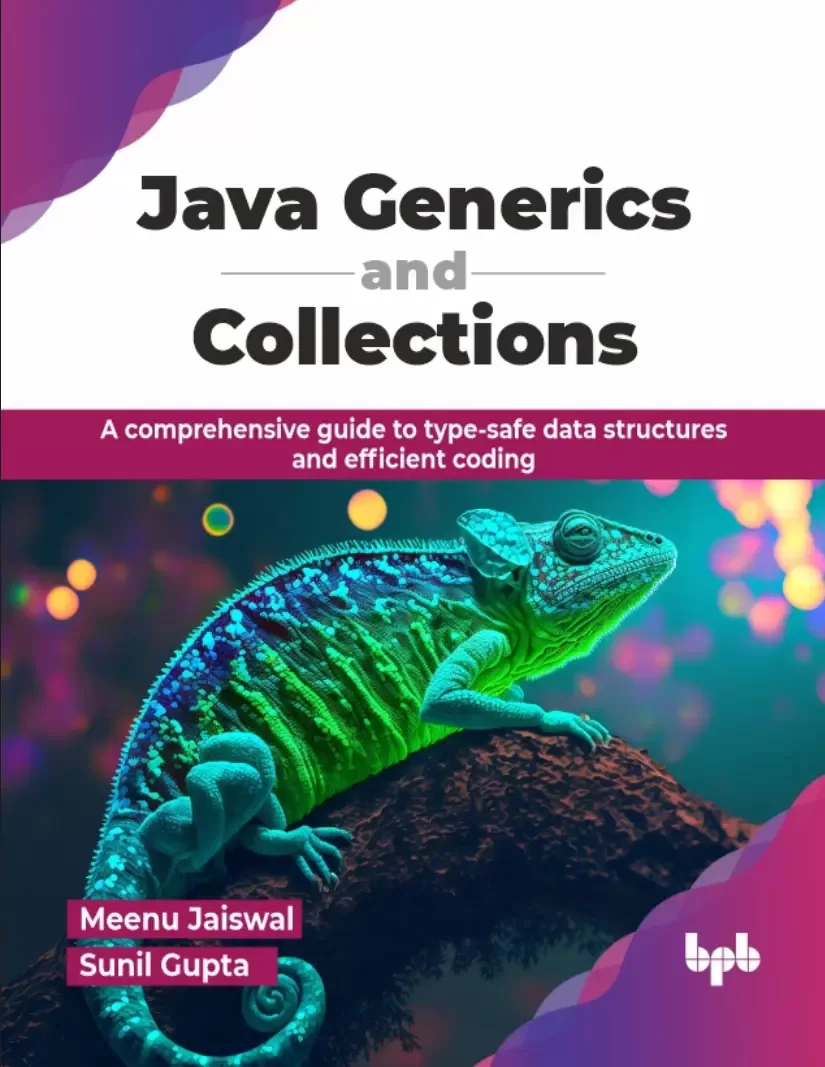
Java Generics and Collections: A comprehensive guide to type-safe data structures and efficient coding
Оглавление⌄
Cover....2 Title Page....3 Copyright Page....4 Dedication Page....5 About the Authors....6 About the Reviewers....7 Acknowledgements....9 Preface....10 Table of Contents....15 1. Introduction to Generics....25 Introduction....25 Structure....25 Objectives....26 Generics....26 Background....26 Benefits of generics....27 Basic syntax of generics....30 Defining parameterized types....30 Syntax overview....31 Generic classes....31 Generic methods....32 Bounded type parameters....33 Wildcard types....35 Defining generic classes....36 Using generic methods....37 Generics with constructors....38 No explicit type parameter on the constructor....39 Conclusion....39 Exercise....40 Answers....41 2. Bounded Types....44 Introduction....44 Structure....44 Objectives....45 Upper bounds....45 Lower bounds....46 Key differences between upper and lower bounds....49 Wildcards....50 Best practice....53 Bounded type parameters....53 Examples of bounded types in practice....54 Conclusion....62 Exercise....62 Answers....64 3. Generics in Collections....66 Introduction....66 Structure....66 Objectives....67 Overview of Java Collections Framework....67 Applying generics to List....69 Wildcards in generic lists....70 Applying generics to Set....75 Wildcards in generic sets....76 Applying generics to Map....78 Wildcards in generic maps....79 Common pitfalls and best practices....82 Type erasure in generics....86 Impact of type erasure....87 Conclusion....89 Exercise....89 Answers....91 4. Introduction to Collections Framework....94 Introduction....94 Structure....94 Objectives....94 Overview of Java Collections Framework....94 Collections hierarchy....95 Collection interface....95 Key methods in the collection interface....96 Key methods in collections....98 Iterable interface and iterators....101 Iterator interface....101 Understanding the enhanced for loop in Java....102 Using Lambdas for iteration....103 Nested classes in collections....103 Empty collections....103 Singleton collections....103 Synchronized collections....104 Checked collections....104 Immutable collections....105 Wrapper class....106 Conclusion....108 Exercise....108 Answers....109 5. List Interface and Implementations....111 Introduction....111 Structure....111 Objectives....112 List interface....112 ArrayList implementation....115 Use cases for ArrayList....117 Performance considerations....117 Custom implementation of ArrayList....119 LinkedList implementation....121 Internal structure of LinkedList....122 Performance considerations for LinkedList....125 Custom LinkedList implementation....126 Vector implementation....130 Synchronization in lists....133 Collections.synchronizedList()....133 CopyOnWriteArrayList....134 Unmodifiable collections....135 Checked collections....136 Advantages of using checked collections....137 Conclusion....137 Exercise....138 Answers....139 6. Map Interface and Implementations....142 Introduction....142 Structure....142 Objectives....143 Map interface....143 HashMap implementation....145 Internal structure of HashMap....146 Constructors in HashMap....150 LinkedHashMap implementation....151 Internal structure of LinkedHashMap....151 Constructors in LinkedHashMap....153 TreeMap implementation....153 Internal structure of TreeMap....154 Constructors in TreeMap....157 Common methods in TreeMap....157 Hashtable implementation....158 Internal working of Hashtable....159 Constructors in Hashtable....159 Comparing Map implementations....161 Performance considerations....162 Common use cases for Maps....163 Synchronization in Maps....164 Generic algorithms for Maps....165 Conclusion....166 Exercise....166 Answers....168 7. Set Interface and Implementations....171 Introduction....171 Structure....171 Objectives....172 Set interface....172 HashSet implementation....173 Internal structure of HashSet....174 Constructors in HashSet....174 LinkedHashSet implementation....175 Internal structure of LinkedHashSet....175 Constructors in LinkedHashSet....176 TreeSet implementation....177 Internal structure of TreeSet....178 Eligibility requirements for elements in TreeSet....179 Constructors in TreeSet....180 Common methods in TreeSet....180 Comparison of HashSet, LinkedHashSet and TreeSet....181 Java 8 enhancements for the Set interface....182 Performance considerations....183 Synchronization in Sets....183 Generic algorithms for Sets....184 Conclusion....185 Exercise....186 Answers....188 8. Queue and Deque Interfaces....190 Introduction....190 Structure....190 Objectives....191 Queue interface....191 Characteristics of Queue interface....192 PriorityQueue implementation....193 Internal structure of PriorityQueue....194 Deque interface....198 Common use cases....198 Key methods in Deque interface....198 Using Deque as both Queue and Stack....199 ArrayDeque implementation....201 Internal structure....201 Constructors....204 Common use cases of ArrayDeque....205 Implementing a Stack....205 Implementing Queue....206 Sliding window or fixed buffer....206 LinkedList as a Queue....207 Using LinkedList as a Queue....208 Using LinkedList as a Deque....208 Synchronization in Queues and Deques....209 Using concurrent collections....209 Wrapping with Synchronized Collections....210 BlockingQueue and BlockingDeque....211 ArrayDeque vs. LinkedList vs. PriorityQueue....211 Conclusion....212 Exercise....212 Answers....214 9. Utility Classes....216 Introduction....216 Structure....216 Objectives....217 Collections utility class....217 Sorting and reversing a List....218 Sorting and searching with collections....219 Sorting a List....219 Sorting with natural order....220 Sorting with custom comparator....220 Searching a List....221 Binary search with custom comparator....221 Modifying collections with Collections....222 Reversing a List....222 Shuffling elements....223 Filling a List with a value....223 Replacing all occurrences of a value....223 Copying one List into another....224 Arrays utility class....224 Sorting an Array....225 Searching in an Array....225 Filling an Array....226 Comparing Arrays....226 Copying Arrays....226 Working with Arrays and Collections....227 Converting an Array to a List....227 Using collection methods on Arrays....228 Wrapper class....228 Synchronization utilities....230 Making a List synchronized....231 Synchronized Set and Map....231 Unmodifiable collections....232 Predefined empty collections....234 Checked collections....237 Conclusion....238 Exercise....239 Answers....240 10. Best Practices with Generics and Collections....242 Introduction....242 Structure....242 Objectives....243 Writing type-safe code with generics....243 Avoiding common pitfalls with generics....246 Efficient use of collections....250 Designing collections-based APIs....251 Performance considerations....253 Synchronization best practices....255 Using generic algorithms....257 Conclusion....258 Exercise....259 Answers....261 11. Real-world Applications....263 Introduction....263 Structure....263 Objectives....264 Case studies....264 Practical examples....278 Common usage patterns....282 Solving typical problems....284 Best practices in real-world scenarios....285 Conclusion....286 Exercise....286 Answers....288 12. Future Trends and Next Steps....290 Introduction....290 Structure....290 Objectives....291 Recent advancements in Java generics....291 Future updates in collections....295 Trends in Java development....298 Staying updated with Java innovations....301 Future of generics and collections....304 Conclusion....308 Exercise....308 Answers....310 Index....313
Описание
Ниже — практический обзор по теме «collections».
Generics are essential for type safety and maximizing code reusability, making your applications less prone to runtime errors. Java generics and the Collections Framework are at the heart of writing efficient, type-safe, and scalable Java applications. If you want to write code that is not only clean but also performs at its best, mastering these concepts is non-negotiable. This book is your go-to guide for unlocking the full potential of generics and collections, helping you write code that stands out.
You will explore key Java collections like Sets, Lists, Queues, and Maps by learning the best use cases and implementation techniques for each. This book systematically breaks down the entire subject, beginning with generic classes and methods before exploring advanced bounded types and wildcards. You will also tackle thread safety, performance optimization, and extending collections to solve real-world problems efficiently. Furthermore, you will learn about Queue and Deque structures, synchronization techniques, utility classes for sorting and searching, and applying generic algorithms.
By the end of this book, you will be more than just a proficient Java developer; you will be a master of generics and collections. Whether you are optimizing applications, designing robust data structures, or ensuring thread-safe environments, you’ll have the skills to build fast, efficient, and maintainable code with confidence.
What you will learnApply generics for type safety in classes, methods, and constructors.Work with Java collections like Lists, Maps, and Queues.Explore wildcards, subtyping, and bounded types in generics.Learn to optimize performance and ensure thread safety.Extend and customize collections for real-world use cases.Navigate the collections hierarchy using iterable, collection, and wrapper classes.Who this book is forThis book is for individuals who are looking to improve their use of Java generics and the Collections Framework to write efficient and reusable code. It is specifically designed for backend developers, software engineers, technical architects, and technical leads working on Java-based applications.
На этом основные моменты по теме закрыты.
Поделиться
Частые вопросы
Можно ли скачать «Java Generics and Collections: A comprehensive guide to type-safe data structures and efficient coding» бесплатно?
Да, «Java Generics and Collections: A comprehensive guide to type-safe data structures and efficient coding» доступна для бесплатного скачивания на нашем сайте в формате PDF. Ссылка на файл находится на этой странице.
В каком формате и какого размера файл?
Книга предоставляется в формате PDF, размер файла 1,5 МБ.
Кто автор и когда вышла книга?
автор — Gupta Sunil , Jaiswal Meenu, издательство BPB Publications, год выпуска 2026, 318 страниц.
О чём книга «Java Generics and Collections: A comprehensive guide to type-safe data structures and efficient coding»?
Java generics and the Collections Framework are at the heart of writing efficient, type-safe, and scalable Java applications.
Похожие материалы
 Гид Java-разработчика
 Quick Java
 Java Programming Made Easy: Unlock Your Coding Potential from Scratch
 Core Java: Made Simple
 Learning Java: An Introduction to Real-World Programming with Java. 6 Ed
 Functional Programming in Java: Harness the Power of Streams and Lambda Expressions. 2 Ed
 Основы программирования с Java
 Pro Spring 6: An In-Depth Guide to the Spring Framework. 6 Ed