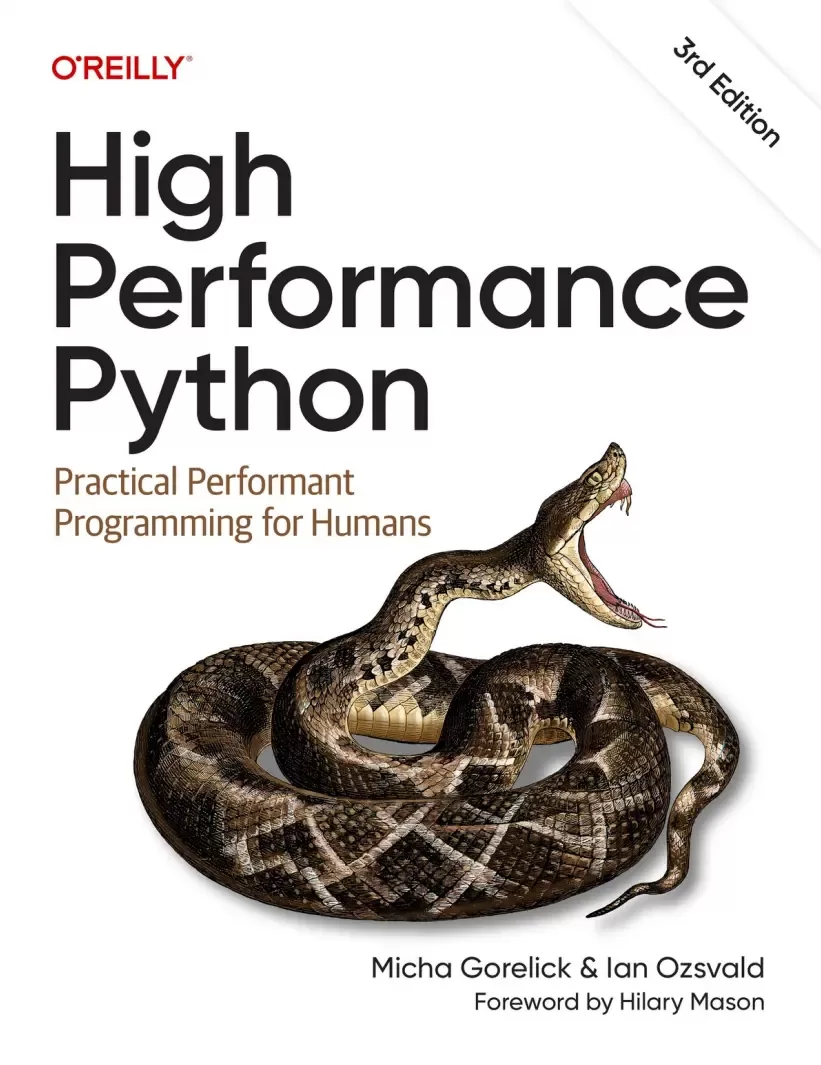
High Performance Python: Practical Performant Programming for Humans. 3 Ed
Оглавление⌄
Foreword....6 Preface....9 Who This Book Is For....9 Who This Book Is Not For....11 What You’ll Learn....11 Python 3....12 License....14 How to Make an Attribution....14 Using Code Examples....15 Errata and Feedback....16 Conventions Used in This Book....16 O’Reilly Online Learning....17 How to Contact Us....18 Acknowledgments....19 1. Understanding Performant Python....21 The Fundamental Computer System....22 Computing Units....23 Memory Units....29 Communications Layers....33 Idealized Computing Versus the Python Virtual Machine....36 Idealized Computing....38 Python’s Virtual Machine....40 So Why Use Python?....45 How to Be a Highly Performant Programmer....49 Good Working Practices....51 Optimizing for the Team Rather than the Code Block....56 The Remote Performant Programmer....59 Some Thoughts on Good Notebook Practice....60 Your Work....62 The Future of Python....63 Where Did the GIL Go?....64 Does Python Have a JIT?....65 Wrap-Up....67 2. Profiling to Find Bottlenecks....69 Profiling Efficiently....70 Introducing the Julia Set....74 Calculating the Full Julia Set....80 Simple Approaches to Timing—print and a Decorator....86 Simple Timing Using the Unix time Command....93 Using the cProfile Module....96 Visualizing cProfile Output with SnakeViz....106 Using line_profiler for Line-by-Line Measurements....108 Using memory_profiler to Diagnose Memory Usage....119 Combining CPU and Memory Profiling with Scalene....129 Introspecting an Existing Process with PySpy....133 VizTracer for an Interactive Time-Based Call Stack....135 Bytecode: Under the Hood....139 Using the dis Module to Examine CPython Bytecode....140 Digging into Bytecode Specialization with Specialist....143 Different Approaches, Different Complexity....145 Unit Testing During Optimization to Maintain Correctness....150 No-op @profile Decorator....151 Strategies to Profile Your Code Successfully....157 Wrap-Up....160 3. Lists and Tuples....162 A More Efficient Search....167 Lists Versus Tuples....172 Lists as Dynamic Arrays....175 Tuples as Static Arrays....182 Wrap-Up....186 4. Dictionaries and Sets....188 How Do Dictionaries and Sets Work?....194 Inserting and Retrieving....195 Deletion....203 Resizing....203 Hash Functions and Entropy....206 Wrap-Up....215 5. Iterators and Generators....218 Iterators for Infinite Series....227 Lazy Generator Evaluation....230 Wrap-Up....238 6. Matrix and Vector Computation....240 Introduction to the Problem....241 Aren’t Python Lists Good Enough?....250 Problems with Allocating Too Much....253 Memory Fragmentation....259 Understanding perf....263 Making Decisions with perf’s Output....268 Enter numpy....270 Applying numpy to the Diffusion Problem....275 Memory Allocations and In-Place Operations....281 Selective Optimizations: Finding What Needs to Be Fixed....288 numexpr: Making In-Place Operations Faster and Easier....293 Graphics Processing Units (GPUs)....297 Dynamic Graphs: PyTorch....299 GPU Speed and Numerical Precision....304 GPU-Specific Operations....310 Basic GPU Profiling....315 Performance Considerations of GPUs....320 When to Use GPUs....323 Deep Learning Performance Considerations....326 A Cautionary Tale: Verify “Optimizations” (scipy)....334 Lessons from Matrix Optimizations....337 Wrap-Up....344 7. Pandas, Dask, and Polars....348 Pandas....350 Pandas’s Internal Model....351 Arrow and NumPy....354 Applying a Function to Many Rows of Data....356 Numba to Compile NumPy for Pandas....373 Building from Partial Results Rather than Concatenating....376 There’s More Than One (and Possibly a Faster) Way to Do a Job....378 Advice for Effective Pandas Development....381 Dask for Distributed Data Structures and DataFrames....384 Diagnostics....387 Parallel Pandas with Dask....389 Parallelized apply with Swifter on Dask....393 Polars for Fast DataFrames....395 Wrap-Up....397 8. Compiling to C....398 What Sort of Speed Gains Are Possible?....400 JIT Versus AOT Compilers....403 Why Does Type Information Help the Code Run Faster?....404 Using a C Compiler....406 Reviewing the Julia Set Example....407 Cython....408 Compiling a Pure Python Version Using Cython....409 pyximport....413 Cython Annotations to Analyze a Block of Code....414 Adding Some Type Annotations....419 Cython and numpy....427 Parallelizing the Solution with OpenMP on One Machine....432 Numba....436 PyPy....441 Garbage Collection Differences....443 Running PyPy and Installing Modules....444 A Summary of Speed Improvements....447 When to Use Each Technology....449 Foreign Function Interfaces....453 ctypes....455 cffi....460 f2py....465 CPython Extensions: C....471 CPython Extensions: Rust....479 Wrap-Up....487 9. Asynchronous I/O....489 Introduction to Asynchronous Programming....492 How Does async/await Work?....499 Serial Web Crawler....501 Asynchronous Web Crawler....505 Shared CPU–I/O Workload....514 Serial CPU Workload....515 Batched CPU Workload....518 Fully Asynchronous CPU Workload....524 Wrap-Up....531 10. The multiprocessing Module....534 An Overview of the multiprocessing Module....540 Estimating Pi Using the Monte Carlo Method....543 Estimating Pi Using Processes and Threads....546 Using Python Objects....546 Replacing multiprocessing with Joblib....561 Random Numbers in Parallel Systems....568 Using numpy....569 Finding Prime Numbers....574 Queues of Work....584 Asynchronously Adding Jobs to the Queue....591 Verifying Primes Using Interprocess Communication....594 Serial Solution....600 Naive Pool Solution....601 A Less Naive Pool Solution....604 Using manager.Value as a Flag....606 Using Redis as a Flag....610 Using RawValue as a Flag....615 Using mmap as a Flag....617 Using mmap as a Flag Redux....619 Sharing numpy Data with multiprocessing....623 Synchronizing File and Variable Access....637 File Locking....638 Locking a Value....646 Wrap-Up....652 11. Clusters and Job Queues....655 Benefits of Clustering....657 Drawbacks of Clustering....658 $462 Million Wall Street Loss Through Poor Cluster Upgrade Strategy....661 Skype’s 24-Hour Global Outage....662 Common Cluster Designs....664 How to Start a Clustered Solution....665 Ways to Avoid Pain When Using Clusters....667 Two Clustering Solutions....669 Using IPython Parallel to Support Research....670 Message Brokering for Cluster Efficiency....676 Other Clustering Tools to Look At....683 Docker....684 Docker’s Performance....685 Advantages of Docker....692 Wrap-Up....694 12. Using Less RAM....696 Objects for Primitives Are Expensive....698 The array Module Stores Many Primitive Objects Cheaply....701 Using Less RAM in NumPy with NumExpr....706 Understanding the RAM Used in a Collection....713 Bytes Versus Unicode....717 Efficiently Storing Lots of Text in RAM....719 Trying These Approaches on 11 Million Tokens....721 Modeling More Text with scikit-learn’s FeatureHasher....737 Introducing DictVectorizer and FeatureHasher....738 Comparing DictVectorizer and FeatureHasher on a Real Problem....743 SciPy’s Sparse Matrices....746 Tips for Using Less RAM....751 Probabilistic Data Structures....752 Very Approximate Counting with a 1-Byte Morris Counter....755 K-Minimum Values....761 Bloom Filters....767 LogLog Counter....778 Real-World Example....786 Wrap-Up....792 13. Lessons from the Field....795 Developing a High Performance Machine Learning Algorithm....796 High Performance Computing in Journalism....801 Lessons from the Field of Cyber Reinsurance....813 Python in Quant Finance....832 Maintain Flexibility to Achieve High Performance....839 Streamlining Feature Engineering Pipelines with Feature-engine (2020)....845 Highly Performant Data Science Teams (2020)....856 Numba (2020)....863 Optimizing Versus Thinking (2020)....876 Making Deep Learning Fly with RadimRehurek.com (2014)....882 Large-Scale Social Media Analysis at Smesh (2014)....891 Index....900 About the Authors....981
Описание
Ниже — практический обзор по теме «python».
This practical book shows you how to locate performance bottlenecks and significantly speed up your code in high-data-volume programs. Your Python code may run correctly, but what if you need it to run faster? By explaining the fundamental theory behind design choices, this expanded edition of High Performance Python helps experienced Python programmers gain a deeper understanding of Python's implementation.
Or build a system that scales up beyond RAM limits or with a GPU? How do you take advantage of multicore architectures or compilation? Authors Micha Gorelick and Ian Ozsvald reveal concrete solutions to many issues and include war stories from companies that use high-performance Python for GenAI data extraction, productionized machine learning, and more.
Get a better grasp of NumPy, Cython, and profilersLearn how Python abstracts the underlying computer architectureUse profiling to find bottlenecks in CPU time and memory usageWrite efficient programs by choosing appropriate data structuresSpeed up matrix and vector computationsProcess DataFrames quickly with Pandas, Dask, and PolarsSpeed up your neural networks and GPU computationsUse tools to compile Python down to machine codeManage multiple I/O and computational operations concurrentlyConvert multiprocessing code to run on local or remote clusters
Если материал оказался полезен — сохраните страницу.
Поделиться
Частые вопросы
Можно ли скачать «High Performance Python: Practical Performant Programming for Humans. 3 Ed» бесплатно?
Да, «High Performance Python: Practical Performant Programming for Humans. 3 Ed» доступна для бесплатного скачивания на нашем сайте в формате PDF. Ссылка на файл находится на этой странице.
В каком формате и какого размера файл?
Книга предоставляется в формате PDF, размер файла 4,9 МБ.
Кто автор и когда вышла книга?
автор — Gorelick Micha , Ozsvald Ian, издательство O’Reilly Media, Inc., год выпуска 2025, 984 страниц.
О чём книга «High Performance Python: Practical Performant Programming for Humans. 3 Ed»?
Your Python code may run correctly, but what if you need it to run faster?
Похожие материалы
 Основы программирования на Python
 Python для детей. Самоучитель по программированию
 Python. Сборник упражнений. Введение в язык Python с задачами и решениями
 Структуры данных в Python: начальный курс
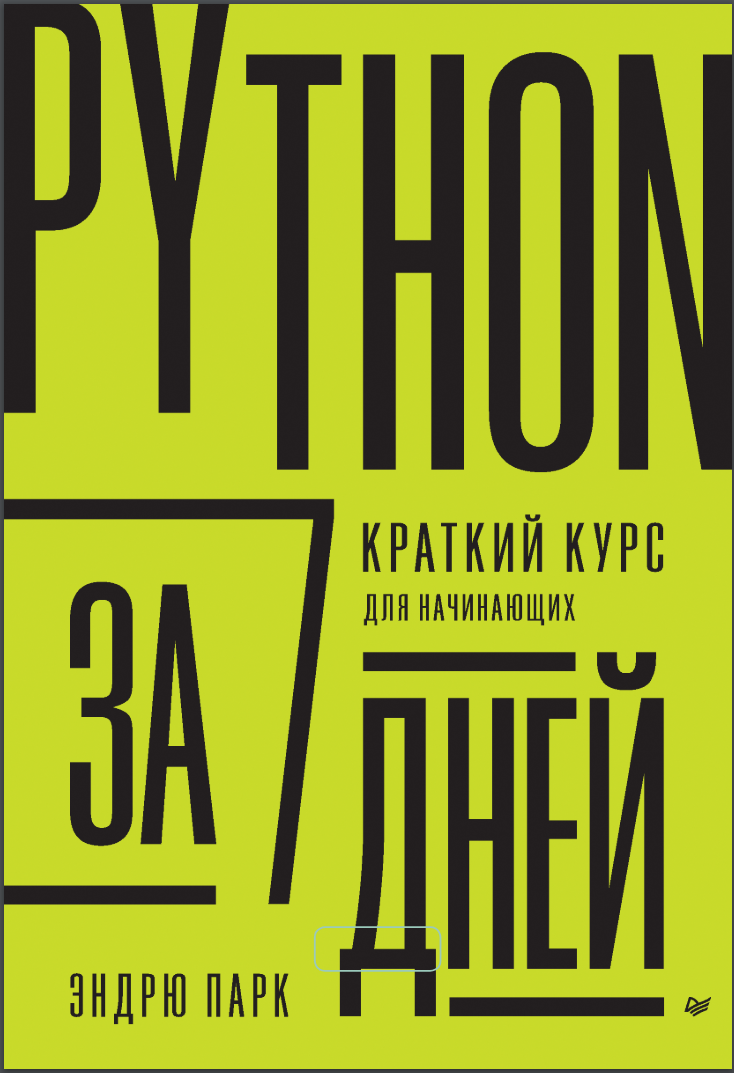 Python за 7 дней. Краткий курс для начинающих
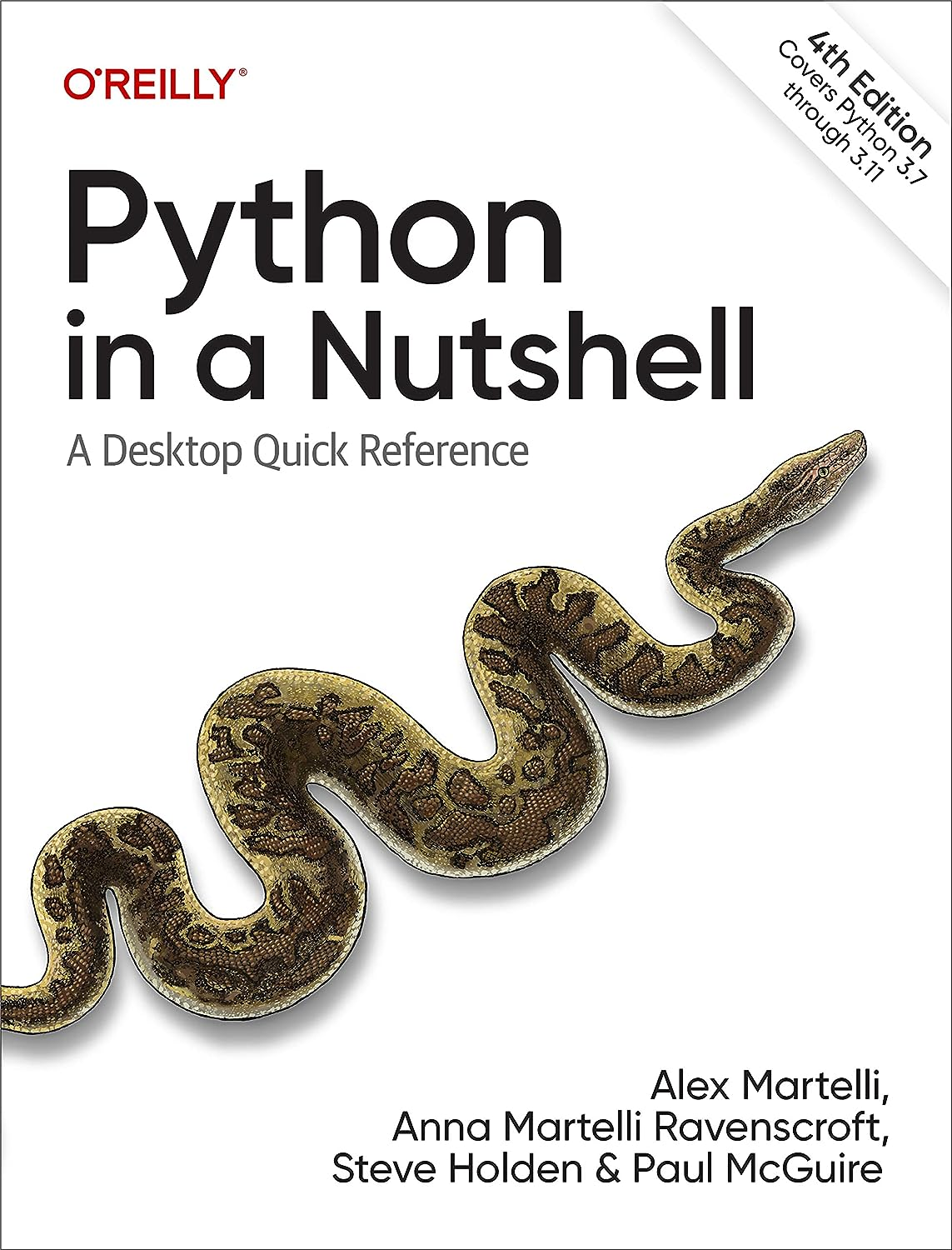 Python in a Nutshell: A Desktop Quick Reference. 4 Ed
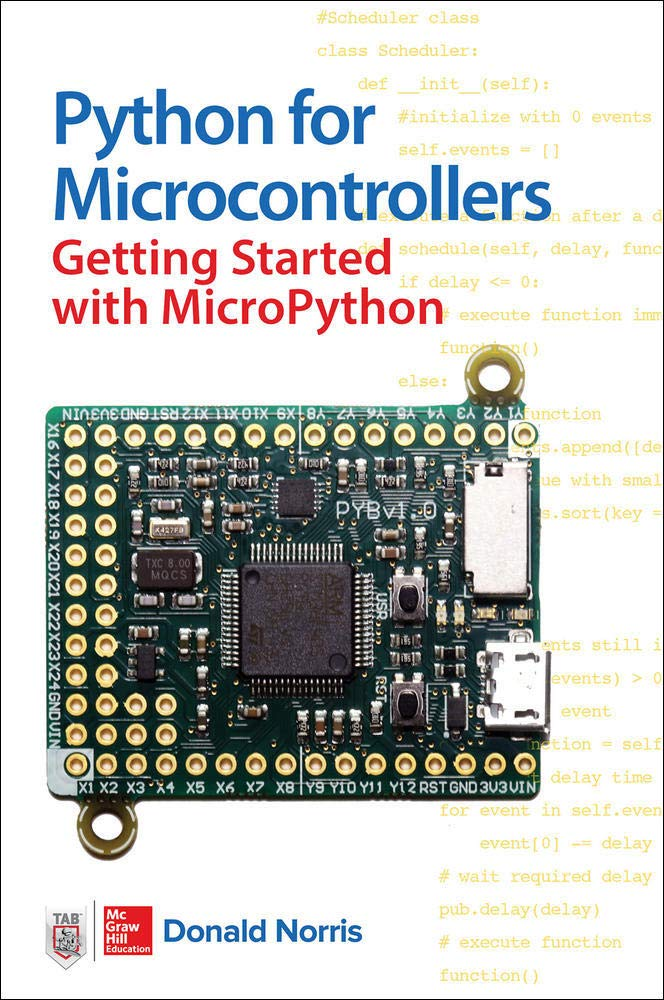 Python for Microcontrollers: Getting Started with MicroPython
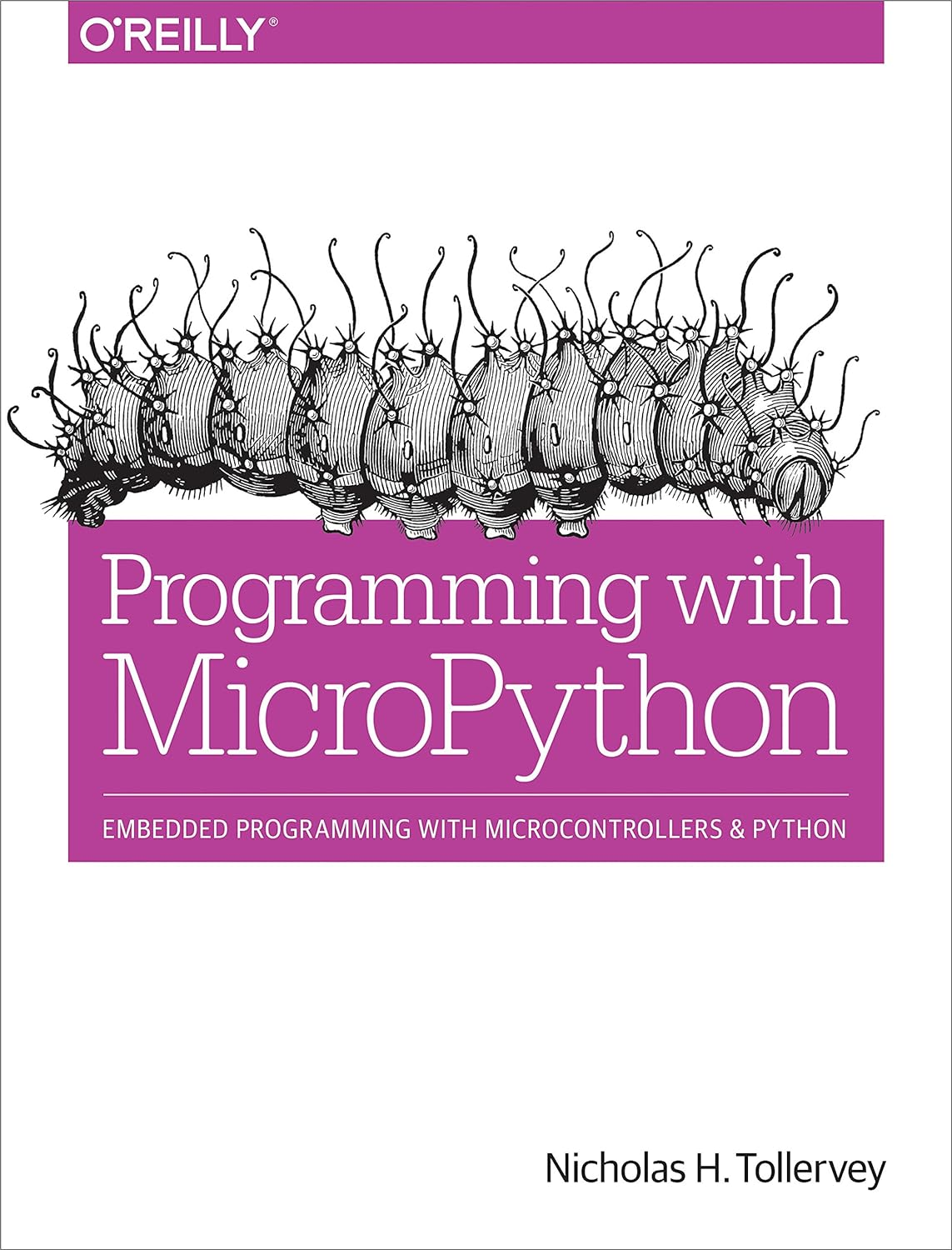 Programming with MicroPython