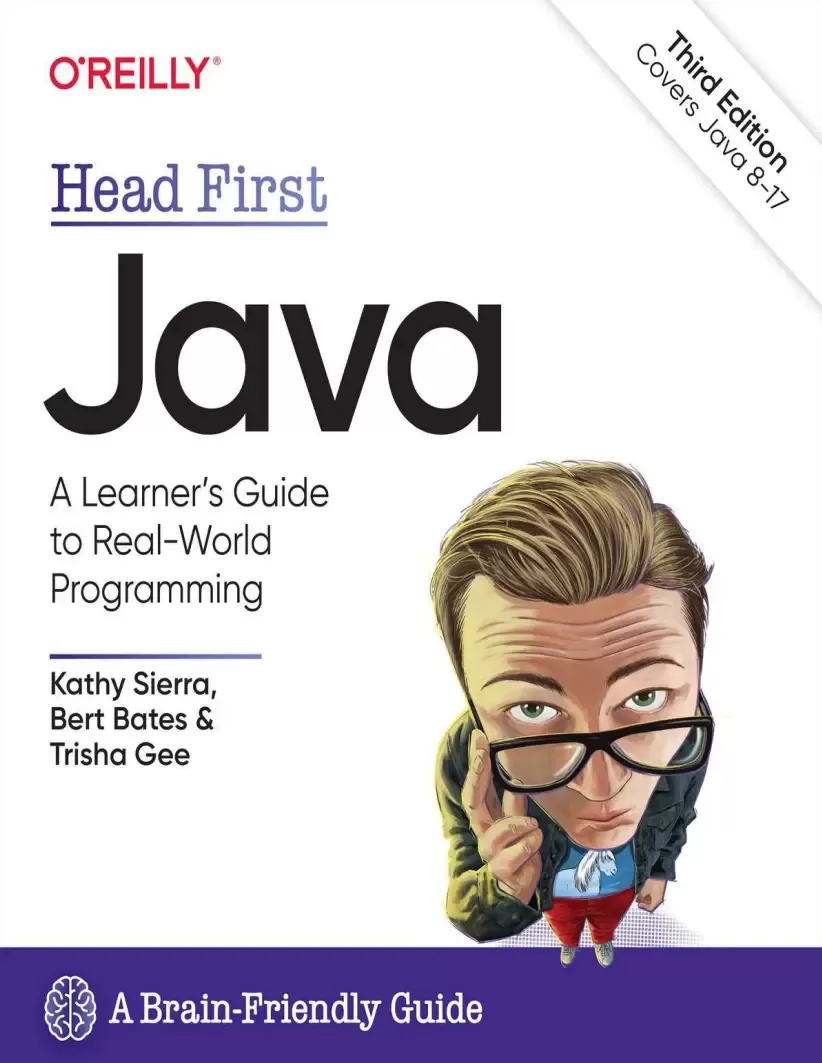
Head First Java: A Learner's Guide to Real-World Programming. Covers Java 8-17. 3 Ed
Оглавление⌄
Other books in O’Reilly’s Head First series....12 Table of Contents (the real thing)....17 How to Use This Book: Intro....33 Who is this book for?....35 Who should probably back away from this book?....36 We know what you’re thinking....37 And we know what your brain is thinking....37 Metacognition: thinking about thinking....44 Here’s what WE did:....46 Here’s what YOU can do to bend your brain into submission....49 What you need for this book:....52 Last-minute things you need to know:....55 Technical Reviewers for the 3rd Edition....58 Other people to acknowledge for the 3rd Edition....59 Technical Editors for the 2nd Edition....62 Other people to credit, for the 2nd Edition....64 Just when you thought there wouldn’t be any more acknowledgments*....67 1. Breaking the Surface: Dive In: A Quick Dip....69 The way Java works....70 What you’ll do in Java....71 A very brief history of Java....72 Speed and memory usage....74 Code structure in Java....80 What goes in a source file?....81 What goes in a class?....82 What goes in a method?....82 Anatomy of a class....83 Writing a class with a main()....84 What can you say in the main method?....90 Looping and looping and.......94 Simple boolean tests....95 Example of a while loop....96 Conditional branching....98 Coding a serious business application....101 Monday morning at Bob’s Java-enabled house....103 Phrase-O-Matic....108 How it works....109 Exercise....110 Code Magnets....110 BE the Compiler....113 JavaCross....114 Mixed Messages....116 Pool Puzzle....119 Exercise Solutions....121 Sharpen your pencil....121 Code Magnets....122 BE the Compiler....122 Pool Puzzle....124 JavaCross....125 Mixed Messages....126 2. A Trip to Objectville: Classes and Objects....128 Chair Wars....129 (or How Objects Can Change Your Life)....129 At Laura’s desk....130 At Brad’s laptop at the cafe....131 Back at Laura’s desk....132 At Brad’s laptop at the beach....133 Back at Laura’s desk....135 At Brad’s laptop on his lawn chair at the Telluride Bluegrass Festival....135 So, Brad the OO guy got the chair and desk, right?....136 What about the Amoeba rotate()?....139 The suspense is killing me. Who got the chair and desk?....141 When you design a class, think about the objects that will be created from that class type. Think about:....144 What’s the difference between a class and an object?....147 A class is not an object (but it’s used to construct them)....147 Making your first object....148 Making and testing Movie objects....151 Quick! Get out of main!....155 The two uses of main:....155 The Guessing Game....156 Running the Guessing Game....159 Exercise....164 BE the Compiler....165 Code Magnets....166 Pool Puzzle....169 Who Am I?....172 Exercise Solutions....173 Code Magnets....174 BE the Compiler....174 Puzzle Solutions....176 Who Am I?....177 3. Know Your Variables: Primitives and References....179 Declaring a variable....180 “I’d like a double mocha, no, make it an int.”....183 Primitive Types....185 You really don’t want to spill that.......186 Back away from that keyword!....190 This table reserved....192 Controlling your Dog object....193 An object reference is just another variable value....196 Java Exposed....200 Life on the garbage-collectible heap....202 Life and death on the heap....205 An array is like a tray of cups....207 Arrays are objects too....210 Make an array of Dogs....210 Control your Dog (with a reference variable)....213 What happens if the Dog is in a Dog array?....215 A Dog example....216 Exercise....219 BE the Compiler....219 Code Magnets....221 Pool Puzzle....223 A Heap o’ Trouble....226 The case of the pilfered references....228 Five-Minute Mystery....229 Exercise Solutions....230 Sharpen your pencil....230 Code Magnets....231 BE the Compiler....232 Puzzle Solutions....234 Five-Minute Mystery....235 A Heap o’ Trouble....236 4. How Objects Behave: Methods Use Instance Variables....238 Remember: a class describes what an object knows and what an object does....239 Can every object of that type have different method behavior?....239 The size affects the bark....241 You can send things to a method....244 You can get things back from a method....245 You can send more than one thing to a method....247 Calling a two-parameter method and sending it two arguments....247 You can pass variables into a method, as long as the variable type matches the parameter type....248 Java is pass-by-value. That means pass-by-copy.....249 Reminder: Java cares about type!....252 Cool things you can do with parameters and return types....253 Encapsulation....256 Do it or risk humiliation and ridicule.....256 Hide the data....258 Java Exposed....259 Encapsulating the GoodDog class....261 How do objects in an array behave?....263 Declaring and initializing instance variables....265 The difference between instance and local variables....267 Comparing variables (primitives or references)....269 Exercise....276 BE the Compiler....276 Who Am I?....278 Mixed Messages....279 Pool Puzzle....281 Five-Minute Mystery....284 Exercise Solutions....286 Sharpen your pencil....286 BE the Compiler....286 Who Am I?....287 Puzzle Solutions....288 Five-Minute Mystery....289 Mixed Messages....289 5. Extra-Strength Methods: Writing A Program....291 Let’s build a Battleship-style game: “Sink a Startup”....292 First, a high-level design....295 The “Simple Startup Game” a gentler introduction....297 Developing a Class....300 The three things we’ll write for each class:....302 Writing the method implementations....306 Writing test code for the SimpleStartup class....308 Based on this prep code:....308 Here’s what we should test:....308 Test code for the SimpleStartup class....309 The checkYourself() method....311 Just the new stuff....312 Final code for SimpleStartup and SimpleStartupTestDrive....315 Prep code for the SimpleStartupGame class Everything happens in main()....319 The game’s main() method....323 random() and getUserInput()....325 One last class: GameHelper....326 Let’s play....328 What’s this? A bug ?....329 Gasp!....329 More about for loops....331 Regular (non-enhanced) for loops....332 Trips through a loop....334 Difference between for and while....335 The enhanced for loop....338 Casting primitives....339 Exercise....341 BE the JVM....341 Code Magnets....343 JavaCross....346 Mixed Messages....349 Exercise Solutions....351 Be the JVM....351 Code Magnets....352 Puzzle Solutions....353 JavaCross....353 Mixed Messages....354 6. Using the Java Library: Get to Know the Java API....356 In our last chapter, we left you with the cliff-hanger: a bug....357 How it’s supposed to look....357 How the bug looks....358 So what happened?....359 How do we fix it?....361 Option one is too clunky....362 Option two is a little better, but still pretty clunky....363 Wake up and smell the library....367 Some things you can do with ArrayList....369 Java Exposed....374 Solution....376 Sharpen your pencil....376 Comparing ArrayList to a regular array....379 Let’s fix the Startup code....381 New and improved Startup class....383 Let’s build the REAL game: “Sink a Startup”....385 What needs to change?....388 Who does what in the StartupBust game (and when)....389 Prep code for the real StartupBust class....393 The final version of the Startup class....405 Super powerful Boolean expressions....407 Ready-Bake Code....409 Using the Library (the Java API)....413 You have to know the full name* of the class you want to use in your code.....414 How to discover the API....422 Browse a book....424 Use the HTML API docs....426 Using the class documentation....430 Exercise....432 Code Magnets....433 JavaCross....435 Exercise Solutions....437 Code Magnets....438 JavaCross....439 7. Better Living in Objectville: Inheritance and Polymorphism....442 Chair Wars Revisited.......444 What about the Amoeba rotate()?....446 Understanding Inheritance....448 An inheritance example:....450 Let’s design the inheritance tree for an Animal simulation program....454 Using inheritance to avoid duplicating code in subclasses....455 Do all animals eat the same way?....457 Which methods should we override?....458 Looking for more inheritance opportunities....459 Which method is called?....464 Designing an Inheritance Tree....466 Using IS-A and HAS-A....468 But wait! There’s more!....471 How do you know if you’ve got your inheritance right?....473 When designing with inheritance, are you using or abusing?....478 So what does all this inheritance really buy you?....479 Inheritance lets you guarantee that all classes grouped under a certain supertype have all the methods that the supertype has*....481 Keeping the contract: rules for overriding....493 Overloading a method....496 Exercise....498 Mixed Messages....498 BE the Compiler....500 Exercise Solutions....506 BE the Compiler....507 Mixed Messages....508 Pool Puzzle....508 8. Serious Polymorphism: Interfaces and Abstract Classes....510 Did we forget about something when we designed this?....511 The compiler won’t let you instantiate an abstract class....517 Abstract vs. Concrete....519 Abstract methods....524 You MUST implement all abstract methods....526 Polymorphism in action....531 Uh-oh, now we need to keep Cats, too....532 What about non-Animals? Why not make a class generic enough to take anything?....535 So what’s in this ultra-super-megaclass Object?....538 Using polymorphic references of type Object has a price.......542 When a Dog won’t act like a Dog....545 Objects don’t bark....547 Get in touch with your inner Object....552 Polymorphism means “many forms.”....554 Casting an object reference back to its real type.....558 What if you need to change the contract?....564 Let’s explore some design options for reusing some of our existing classes in a PetShop program....565 Interface to the rescue!....578 Making and implementing the Pet interface....579 Invoking the superclass version of a method....586 Exercise....592 Pool Puzzle....597 Exercise Solutions....599 What’s the Picture ?....599 What’s the Declaration?....601 Pool Puzzle....602 9. Life and Death of an Object: Constructors and Garbage Collection....604 The Stack and the Heap: where things live....606 Methods are stacked....609 A stack scenario....611 What about local variables that are objects?....612 If local variables live on the stack, where do instance variables live?....615 The miracle of object creation....617 Construct a Duck....620 Initializing the state of a new Duck....623 Using the constructor to initialize important Duck state*....627 Make it easy to make a Duck....630 Be sure you have a no-arg constructor....630 Doesn’t the compiler always make a no-arg constructor for you? No!....632 Nanoreview: four things to remember about constructors....642 Wait a minute...we never DID talk about superclasses and inheritance and how that all fits in with constructors....644 The role of superclass constructors in an object’s life....648 Making a Hippo means making the Animal and Object parts too.......650 How do you invoke a superclass constructor?....654 Can the child exist before the parents?....657 Superclass constructors with arguments....660 Invoking one overloaded constructor from another....665 Now we know how an object is born, but how long does an object live?....673 What about reference variables?....679 Exercise....695 BE the Garbage Collector....695 Popular Objects....697 Five-Minute Mystery....699 Exercise Solutions....701 Be the Garbage Collector....701 Popular Objects....702 Five-Minute Mystery....704 10. Numbers Matter: Numbers and Statics....706 MATH methods: as close as you’ll ever get to a global method....708 The difference between regular (non-static) and static methods....710 What it means to have a class with static methods....712 Static methods can’t use non-static (instance) variables!....713 Static methods can’t use non-static methods, either!....716 Static variable: value is the same for ALL instances of the class....720 Initializing a static variable....724 static final variables are constants....727 final isn’t just for static variables.......730 Math methods....739 Wrapping a primitive....742 Java will Autobox primitives for you....747 Autoboxing works almost everywhere....748 But wait! There’s more! Wrappers have static utility methods too!....752 And now in reverse...turning a primitive number into a String....754 Number formatting....759 Formatting deconstructed.......760 The percent (%) says, “insert argument here” (and format it using these instructions)....762 The format String uses its own little language syntax....766 The format specifier....766 The only required specifier is for TYPE....768 What happens if I have more than one argument?....770 Just one more thing...static imports....772 Fireside Chats....775 Exercise....778 BE the compiler....779 True or False....781 Exercise Solution....782 Sharpen your pencil....782 BE the compiler....783 True or False....783 11. Data Structures: Collections and Generics....785 Tracking song popularity on your jukebox....787 Your first job, sort the songs in alphabetical order....789 Great question! You spotted the diamond operator....794 Exploring the java.util API, List and Collections....796 In the “Real-World”™ there are lots of ways to sort....797 “Natural Ordering,” what Java means by alphabetical....797 But now you need Song objects, not just simple Strings....800 Changing the Jukebox code to use Songs instead of Strings....802 It won’t compile!....803 The sort() method declaration....806 Generics means more type-safety....806 Learning generics....808 Using generic CLASSES....810 Using type parameters with ArrayList....812 Using generic METHODS....813 Here’s where it gets weird.......815 Revisiting the sort() method....819 In generics, “extends” means “extends or implements”....822 Finally we know what’s wrong.......823 The Song class needs to implement Comparable....823 The new, improved, comparable Song class....825 We can sort the list, but.......828 Using a custom Comparator....832 Updating the Jukebox to use a Comparator....834 Fill-in-the-blanks....836 But wait! We’re sorting in two different ways!....837 Sorting using only Comparators....839 Just the code that matters....842 What do we REALLY need in order to sort?....843 Enter lambdas! Leveraging what the compiler can infer....847 Where did all that code go?....849 Some interfaces have only ONE method to implement....850 Updating the Jukebox code with lambdas....851 Reverse Engineer....853 Uh-oh. The sorting all works, but now we have duplicates.......855 We need a Set instead of a List....857 The Collection API (part of it)....859 Using a HashSet instead of ArrayList....863 What makes two objects equal?....864 How a HashSet checks for duplicates: hashCode() and equals()....867 The Song class with overridden hashCode() and equals()....870 If we want the set to stay sorted, we’ve got TreeSet....874 What you MUST know about TreeSet.......876 TreeSet elements MUST be comparable....878 We’ve seen Lists and Sets, now we’ll use a Map....879 Creating and filling collections....881 Convenience Factory Methods for Collections....882 Finally, back to generics....884 Using polymorphic arguments and generics....885 But will it work with List?....886 What could happen if it were allowed...?....888 We can do this with wildcards....889 Using the method’s generic type parameter....891 Exercise....892 BE the Compiler, advanced....893 Exercise Solution....894 Fill-in-the-blanks....894 “Reverse Engineer” lambdas exercise....895 Sorting with lambdas....897 TreeSet exercise....897 BE the Compiler solution....898 12. Lambdas and Streams: What, Not How: Lambdas and Streams....901 Tell the computer WHAT you want....902 Fireside Chats....903 When for loops go wrong....905 Mixed Messages....905 Small errors in common code can be hard to spot....907 Building blocks of common operations....909 Introducing the Streams API....910 Getting started with Streams....912 Streams are like recipes: nothing’s going to happen until someone actually cooks them....914 Getting a result from a Stream....916 Stream operations are building blocks....918 Building blocks can be stacked and combined....920 Customizing the building blocks....921 Create complex pipelines block by block....922 Yes, because Streams are lazy....923 Terminal operations do all the work....924 Collecting to a List....925 Guidelines for working with streams....925 Correct! Stream operations don’t change the original collection.....928 Exercise....929 Code Magnets....929 Hello Lambda, my (not so) old friend....935 Passing behavior around....936 The shape of lambda expressions....939 Anatomy of a lambda expression....940 Variety is the spice of life....942 A lambda might have more than one line....942 Single-line lambdas don’t need ceremony....943 A lambda might not return anything....943 A lambda might have zero, one, or many parameters....944 How can I tell if a method takes a lambda?....945 Exercise....947 BE the Compiler, advanced....947 Spotting Functional Interfaces....949 Functional interfaces in the wild....950 Lou’s back!....953 Exercise....954 Ready-Bake Code....954 Lou’s Challenge #1: Find all the “rock” songs....956 Filter a stream to keep certain elements....958 Let’s Rock!....959 Getting clever with filters....961 Lou’s Challenge #2: List all the genres....963 Mapping from one type to another....964 Removing duplicates....966 Only one of every genre....967 Just keep building!....968 Sometimes you don’t even need a lambda expression....969 Collecting results in different ways....971 But wait, there’s more!....973 Checking if something exists....973 Find a specific thing....973 Count the items....974 Well, some operations may return something, or may not return anything at all....975 Optional is a wrapper....977 Yes, but now we have a way to ask if we have a result....978 Don’t forget to talk to the Optional wrapper....979 The Unexpected Coffee....981 Five-Minute Mystery....981 Pool Puzzle....982 Mixed Messages....985 Who Does What?....985 Exercise Solutions....986 Code Magnets....986 BE the Compiler....987 Sharpen your pencil....989 Five-Minute Mystery....990 Pool Puzzle....990 13. Risky Behavior: Exception Handling....992 Let’s make a Music Machine....993 The finished BeatBox looks something like this:....993 We’ll start with the basics....995 The JavaSound API....995 First we need a Sequencer....998 Something’s wrong!....998 What happens when a method you want to call (probably in a class you didn’t write) is risky?....999 Methods in Java use exceptions to tell the calling code, “Something Bad Happened. I failed.”....1002 The compiler needs to know that YOU know you’re calling a risky method....1004 An exception is an object... of type Exception....1007 If it’s your code that catches the exception, then whose code throws it?....1008 Flow control in try/catch blocks....1015 Finally: for the things you want to do no matter what....1016 Flow Control....1019 Did we mention that a method can throw more than one exception?....1020 Catching multiple exceptions....1020 Exceptions are polymorphic....1021 Multiple catch blocks must be ordered from smallest to biggest....1026 You can’t put bigger baskets above smaller baskets....1028 When you don’t want to handle an exception.......1033 Ducking (by declaring) only delays the inevitable....1036 Getting back to our music code.......1039 Exception Rules....1040 Code Kitchen....1041 Making actual sound....1043 Version 1: Your very first sound player app....1046 Making a MidiEvent (song data)....1049 MIDI message: the heart of a MidiEvent....1050 Anatomy of a message....1051 Change a message....1053 Version 2: Using command-line args to experiment with sounds....1055 Where we’re headed with the rest of the CodeKitchens....1057 Exercise....1059 True or False....1060 Code Magnets....1061 JavaCross....1063 Sharpen your pencil....1066 Exercise Solution....1066 True or False....1067 Code Magnets....1068 JavaCross....1069 14. A Very Graphic Story: Getting Gui....1071 It all starts with a window....1072 Put widgets in the window....1074 Your first GUI: a button on a frame....1075 But nothing happens when I click it.......1077 Getting a user event....1079 Listeners, Sources, and Events....1087 Getting back to graphics.......1091 Make your own drawing widget....1093 Fun things to do in paintComponent()....1095 Behind every good Graphics reference is a Graphics2D object....1097 Because life’s too short to paint the circle a solid color when there’s a gradient blend waiting for you....1100 We can get an event. We can paint graphics. But can we paint graphics when we get an event?....1106 GUI layouts: putting more than one widget on a frame....1108 Let’s try it with TWO buttons....1112 So now we need FOUR widgets....1112 And we need to get TWO events....1113 How do you get action events for two different buttons when each button needs to do something different?....1113 Inner class to the rescue!....1119 An inner class instance must be tied to an outer class instance*....1120 How to make an instance of an inner class....1122 Java Exposed....1126 Lambdas to the rescue! (again)....1132 ActionListener is a Functional Interface....1134 Lambdas, clearer and more concise....1135 Using an inner class for animation....1136 Code Kitchen....1141 Listening for a non-GUI event....1142 An easier way to make messages/events....1144 Version One: using the new static makeEvent() method....1146 Version Two: registering and getting ControllerEvents....1148 Version Three: drawing graphics in time with the music....1150 Exercise....1154 Who Am I?....1154 BE the Compiler....1155 Pool Puzzle....1157 Exercise Solutions....1159 Who am I?....1160 BE the Compiler....1160 Pool Puzzle....1162 15. Work on Your Swing: Using Swing....1164 Swing components....1165 Components can be nested....1165 Layout Managers....1167 How does the layout manager decide?....1169 Different layout managers have different policies....1171 The Big Three layout managers: border, flow, and box....1171 Playing with Swing components....1192 Code Kitchen....1201 Making the BeatBox....1203 Exercise....1210 Which code goes with which layout?....1211 Code Fragments....1213 GUI-Cross....1214 Exercise Solutions....1217 Which code goes with which layout?....1217 GUI-Cross....1219 16. Saving Objects (and Text): Serialization and File I/O....1221 Capture the beat....1222 Saving state....1224 Writing a serialized object to a file....1227 Data moves in streams from one place to another....1229 What really happens to an object when it’s serialized?....1230 But what exactly IS an object’s state? What needs to be saved?....1232 If you want your class to be serializable, implement Serializable....1236 Deserialization: restoring an object....1244 What happens during deserialization?....1246 Saving and restoring the game characters....1249 The GameCharacter class....1251 Version ID: A big serialization gotcha....1252 Using the serialVersionUID....1255 Object Serialization....1257 Writing a String to a Text File....1259 Text file example: e-Flashcards....1261 Quiz Card Builder (code outline)....1264 The java.io.File class....1270 Reading from a text file....1274 Quiz Card Player (code outline)....1277 Parsing with String split()....1282 NIO.2 and the java.nio.file package....1286 Path, Paths, and Files (messing with directories)....1287 Finally, a closer look at finally....1289 Remember, finally ALWAYS runs!!....1290 Finally, a closer look at finally, cont.....1291 There IS a better way!....1293 The try-with-resources (TWR), statement....1293 Autocloseable, the very small catch....1295 Autocloseable, it’s everywhere you do I/O....1296 Code Kitchen....1297 Saving a BeatBox pattern....1297 Restoring a BeatBox pattern....1299 Can they be saved?....1301 Exercise....1303 True or False....1303 Code Magnets....1304 Exercise Solutions....1307 True or False....1307 Code Magnets....1308 17. Make a Connection: Networking and Threads....1311 Real-time BeatBox chat....1312 Connecting, sending, and receiving....1317 1. Connect....1318 2. Receive....1325 Reading from the network with BufferedReader....1326 3. Send....1328 Writing to the network with PrintWriter....1328 There’s more than one way to make a connection....1330 Using a Socket....1330 The DailyAdviceClient....1333 DailyAdviceClient code....1335 Writing a simple server application....1338 DailyAdviceServer code....1340 Writing a Chat Client....1346 The really, really simple Chat Server....1349 Java has multiple threads but only one Thread class....1355 What does it mean to have more than one call stack?....1357 To create a new call stack you need a job to run....1359 To make a job for your thread, implement the Runnable interface....1360 How NOT to run the Runnable....1361 How we used to launch a new thread....1362 A better alternative: don’t manage the Threads at all....1364 Running one job....1364 The three states of a new thread....1365 The thread scheduler....1368 How did we end up with different results?....1372 Putting a thread to sleep....1376 Using sleep to make our program more predictable....1378 There are downsides to forcing the thread to sleep....1381 Counting down until ready....1382 Making and starting two threads (or more!)....1385 Pooling Threads....1386 Running multiple threads....1388 What will happen?....1389 Closing time at the thread pool....1390 Um, yes. There IS a dark side. Multithreading can lead to concurrency “issues.”....1393 Exercise....1396 Who Am I?....1396 New and improved SimpleChatClient....1398 Exercise....1403 Code Magnets....1403 Exercise Solutions....1406 Who Am I?....1406 Code Magnets....1406 Code Kitchen....1407 18. Dealing with Concurrency Issues: Race Conditions and Immutable Data....1410 What could possibly go wrong?....1411 The Ryan and Monica problem, in code....1414 The Ryan and Monica example....1417 We need to check the balance and spend the money as one atomic thing....1421 Using an object’s lock....1424 Using synchronized methods....1426 It’s important to lock the correct object....1427 The dreaded “Lost Update” problem....1429 Let’s run this code.......1431 Make the increment() method atomic. Synchronize it!....1433 Deadlock, a deadly side of synchronization....1437 You don’t always have to use synchronized....1439 Atomic variables....1439 Compare-and-swap with atomic variables....1441 Ryan and Monica, going atomic....1442 Writing a class for immutable data....1446 Using immutable objects....1447 Changing immutable data....1448 More problems with shared data....1452 Reading from a changing data structure causes an Exception....1454 Use a thread-safe data structure....1455 CopyOnWriteArrayList....1456 Exercise....1462 BE the JVM....1462 Five-Minute Mystery....1464 Exercise Solution....1466 BE the JVM....1466 Five-Minute Mystery....1467 A. Final Code Kitchen....1469 Final BeatBox client program....1471 Final BeatBox server program....1482 B. The top ten-ish topics that didn’t make it into the rest of the book.......1485 #11 JShell (Java REPL)....1487 Why do you care?....1487 #10 Packages....1490 Packages prevent class name conflicts....1490 Preventing package name conflicts....1492 Compiling and running with packages....1495 #9 Immutability in Strings and Wrappers....1498 Why do you care that Strings are immutable?....1498 Why do you care that Wrappers are immutable?....1500 #8 Access levels and access modifiers (who sees what)....1500 #7 Varargs....1503 Why do you care?....1504 #6 Annotations....1505 Why do you care?....1505 #5 Lambdas and Maps....1507 Why do you care?....1508 #4 Parallel Streams....1510 Going parallel....1511 OK now what?....1511 Multithreading is taken care of....1512 Do not use parallel everywhere!....1512 #3 Enumerations (also called enumerated types or enums)....1513 Who’s in the band?....1513 The old way to fake an “enum”:....1513 #2 Local Variable Type Inference (var)....1516 Type inference, NOT dynamic types....1517 Someone has to read your code....1517 Tip: Better with useful variable names....1518 Tip: Variable will be the concrete type....1518 Tip: Don’t use var with the diamond operator....1518 #1 Records....1519 Why do you care?....1519 Index....1525 Authors of Head First Java and Creators of the Head First series....1593 Co-author of Head First Java, 3rd Edition....1596
Описание
В этом материале разберём тему: java.
With this book, you'll learn the Java language with a unique method that goes beyond how-to manuals and helps you become a great programmer. What will you learn from this book?Head First Java is a complete learning experience in Java and object-oriented programming. Through puzzles, mysteries, and soul-searching interviews with famous Java objects, you'll quickly get up to speed on Java's fundamentals and advanced topics including lambdas, streams, generics, threading, networking, and the dreaded desktop GUI. If you have experience with another programming language, Head First Java will engage your brain with more modern approaches to coding--the sleeker, faster, and easier to read, write, and maintain Java of today.
If you haven't, you're in for a treat. What's so special about this book?If you've read a Head First book, you know what to expect--a visually rich format designed for the way your brain works. With Head First Java, you'll learn Java through a multisensory experience that engages your mind, rather than by means of a text-heavy approach that puts you to sleep.
На этом основные моменты по теме закрыты.
Поделиться
Частые вопросы
Можно ли скачать «Head First Java: A Learner's Guide to Real-World Programming. Covers Java 8-17. 3 Ed» бесплатно?
Да, «Head First Java: A Learner's Guide to Real-World Programming. Covers Java 8-17. 3 Ed» доступна для бесплатного скачивания на нашем сайте в формате PDF. Ссылка на файл находится на этой странице.
В каком формате и какого размера файл?
Книга предоставляется в формате PDF, размер файла 32,8 МБ.
Кто автор и когда вышла книга?
автор — Bates Bert , Gee Trisha , Sierra Kathy, издательство O’Reilly Media, Inc., год выпуска 2022, 1597 страниц.
О чём книга «Head First Java: A Learner's Guide to Real-World Programming. Covers Java 8-17. 3 Ed»?
What will you learn from this book?Head First Java is a complete learning experience in Java and object-oriented programming.
Похожие материалы
 Гид Java-разработчика
 Quick Java
 Java Programming Made Easy: Unlock Your Coding Potential from Scratch
 Core Java: Made Simple
 Learning Java: An Introduction to Real-World Programming with Java. 6 Ed
 Functional Programming in Java: Harness the Power of Streams and Lambda Expressions. 2 Ed
 Основы программирования с Java
 Pro Spring 6: An In-Depth Guide to the Spring Framework. 6 Ed