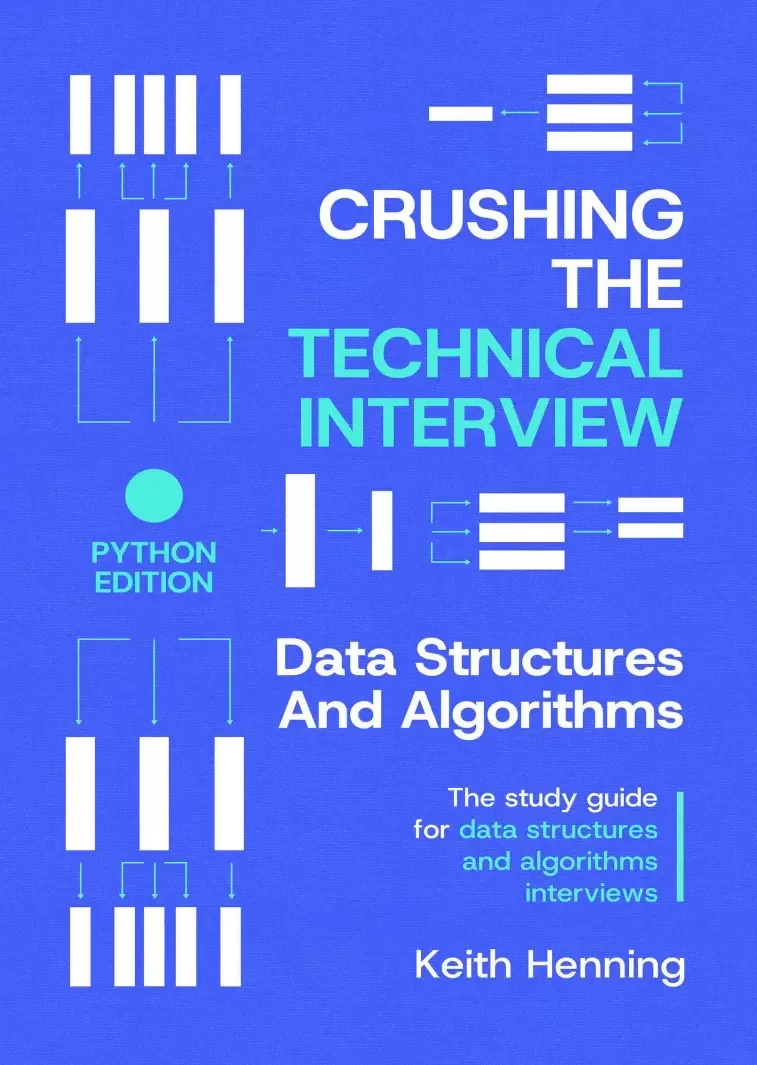
Crushing The Technical Interview: Data Structures and Algorithms. The study guide for data structures and algorithms interviews (Python Edition)
Оглавление⌄
1. IntroductionWhat to ExpectWhy I Wrote This BookWho This Book Is ForConventions in this Book2. The Interview ProcessOverviewRecruiter Phone InterviewCoding ChallengeCoding ProjectOn-Site InterviewsData Structures & Algorithms InterviewsSystem Design InterviewsThe Process and Communication InterviewManager/Team Matching InterviewsNow What Happens3. Big-O NotationSimplifying Big-O NotationConstant TimeLogarithmic TimeLinear TimeSuper-Linear TimePolynomial TimeExponential TimeFactorial Time: Final Boss Fight!4. Software TheoryIntroductionSingle Responsibility Principle (SRP)Open-Closed Principle (OCP)Liskov Substitution Principle (LSP)Interface Segregation Principle (ISP)Dependency Inversion Principle (DIP)Don’t Repeat Yourself (DRY)KISS PrincipleOOP Design Patterns5. Data StructuresWhat Is A Data Structure?ArraysListsStacksQueuesLinked ListsGraphsTreesHeapsHash Maps6. AlgorithmsBubble SortMerge SortQuick SortInsertion SortTree TraversalsBreadth First Search (BFS)Depth First Search (DFS)A* AlgorithmDijkstra’s AlgorithmTwo PointersSliding WindowBacktracking (N-Queens Problem)Trie Data StructureTopological SortBucket SortQuickselectPrefix SumMonotonic StackUnion FindPrim’s Algorithm (Minimum Spanning Trees)Kruskal’s AlgorithmBinary ManipulationFloyd’s AlgorithmMedian-of-Medians AlgorithmRecursion with MemoizationHuffman Coding AlgorithmRed-Black Tree AlgorithmFord-Fulkerson Algorithm (Edmonds-Karp)Array Mutation7. Practice Coding Problems1. Arrays & Hashing: Character Pattern Matching2. Arrays & Hashing: Product Price Pairing3. Arrays & Hashing: Vocabulary Pattern Clusters4. Heap/Priority Queue: Trending Hashtag Analysis5. Arrays & Hashing: Supply Network Resilience Calculator6. Sliding Window: Optimal Document Segment7. Sliding Window: Extrema Product8. Arrays & Hashing: Longest Palindromic Substring9. Arrays & Hashing: Two Sum10. Trees: Level Order Traversal11. Dynamic Programming: Fibonacci with Memoization12. Graphs: Number of Islands13. Arrays & Hashing: First Non-Repeating Character14. Linked List: Reverse a Linked List15. Heap/Priority Queue: Balanced Network Traffic16. Graphs: Dependency Resolver17. Intelligent Cache System18. Trees: Text Editor Line Tracker19. Sliding Window: Message Rate Limiter21: Arrays & Hashing: Circular Array Rotation Sequence22. Greedy Algorithm: Optimized Task Scheduler23. Greedy Algorithm: Interval Coverage Optimization24. Graphs: Dynamic Maze Flood Fill25. Heap/Priority Queue: Adaptive Resource Scheduler26. Graphs: Distributed Cache Consistency27. Arrays & Hashing: Maximum Subarray With Target Sum28. Sliding Window: K-Nearest Neighbors29. Backtracking: Matrix Circuit30. Dynamic Programming: Artwork Gallery Heist31. Sliding Window: Range Duplicate Finder32. Stack: Temperature Forecast Analysis33. Two Pointers: Scenic Skyline Viewpoints34. Two Pointers: Mountain Valley Rainwater Collection35. Greedy Algorithms: Maximum Property Value Appreciation36. Arrays & Hashing: Frequency Threshold Detection37. Arrays & Hashing: X-Sudoku Validator38. Greedy Algorithms: Vehicle Convoy Formation39. Stack: Maximum Productivity Zone40. Matrix Operations: Layered Security Clearance Search41. Binary Search: Document Processing Throughput42. Binary Search: Encrypted Circular Buffer Search43. Matrix Operations: Parallel Matrix Diagonal Sum44. Binary Search: Version-Based Configuration Store45. Binary Search: Minimum Processing Power46. Trees: Clone Bi1nary Tree with Connection Pointers47. Linked List: Rotate Linked List Around Pivot48. Linked List: Interleave K Linked Lists49. Trees: Path Matching Binary Tree50. Trees: Symmetric Tree Transformation51. Stack: Expression Tree Execution52. Stack: Balanced Bracket Sequence Generator53. Trees: Balanced Tree Reconstruction54. Trees: Optimal Node Removal for Minimum Height55. Tries: Context-Sensitive Search Suggestion System56. Tries: Fuzzy Word Finder57. Binary Search: Minimum Allocation Threshold for Equal Array Groups58. Binary Search: Kth Ancestral Element in Sorted Arrays59. Graphs: Key Collection Sequence60. Arrays & Hashing: Group Anagrams By Frequency61. Dynamic Programming: Maximum Product Path62. Graphs: Island Count with Restrictions63. Binary Search: Find Kth Element in Two Sorted Arrays64. Stack: Evaluate Reverse Polish Notation with Custom Operations65. Matrix Operations: Optimal Kennel Assignment66. Matrix Operations: Wedding Seating Arrangement67. Linked List: Boat Fleet Chain Inspection68. Linked List: Baseball Lineup Rotation69. Two Pointers: Coffee Bean Blend Matcher70. Sliding Window: Holiday Card Joy Maximizer71. Stack: Fashion Display Stack Optimizer72. Heap/Priority Queue: Restaurant Priority Seating System73. Backtracking: Optimal Race Day Strategy74. Graphs: Detective Case Assignment Network75. Dynamic Programming: Seasonal Orange Grove Harvest8. Problem Solutions1. Character Pattern Matching2. Product Price Pairing3. Vocabulary Pattern Clusters4. Trending Hashtag Analysis5. Supply Network Resilience Calculator6. Optimal Document Segment7. Sliding Window Extrema Product8. Longest Palindromic Substring9. Two Sum10. Level Order Traversal11. Fibonacci with Memoization12. Number of Islands13. First Non-Repeating Character14. Reverse a Linked List15. Balanced Network Traffic16. Dependency Resolver17. Intelligent Cache System18. Text Editor Line Tracker19. Message Rate Limiter20. Evidence Processing Queue21: Circular Array Rotation Sequence22. Optimized Task Scheduler23. Interval Coverage Optimization24. Dynamic Maze Flood Fill25. Adaptive Resource Scheduler26. Distributed Cache Consistency27. Maximum Subarray With Target Sum28. K-Nearest Neighbors in Sliding Window29: Matrix Circuit30. Artwork Gallery Heist31. Range Duplicate Finder32. Temperature Forecast Analysis33. Scenic Skyline Viewpoints34. Mountain Valley Rainwater Collection35. Maximum Property Value Appreciation36. Frequency Threshold Detection37. X-Sudoku Validator38. Vehicle Convoy Formation39. Maximum Productivity Zone40. Layered Security Clearance Search41. Document Processing Throughput42. Encrypted Circular Buffer Search43. Parallel Matrix Diagonal Sum44. Version-Based Configuration Store45. Minimum Processing Power46. Clone Binary Tree with Connection Pointers47. Rotate Linked List Around Pivot48. Interleave K Linked Lists49. Path Matching Binary Tree50. Symmetric Tree Transformation51. Expression Tree Execution52. Balanced Bracket Sequence Generator53. Balanced Tree Reconstruction54. Optimal Node Removal for Minimum Height55. Context-Sensitive Search Suggestion System56. Fuzzy Word Finder57. Minimum Allocation Threshold for Equal Array Groups58. Kth Ancestral Element in Sorted Arrays59. Key Collection Sequence60. Group Anagrams By Frequency61. Maximum Product Path62. Island Count with Restrictions63. Find Kth Element in Two Sorted Arrays64. Evaluate Reverse Polish Notation with Custom Operations65. Optimal Kennel Assignment66. Wedding Seating Arrangement67. Boat Fleet Chain Inspection68. Baseball Lineup Rotation69. Coffee Bean Blend Matcher70. Holiday Card Joy Maximizer71. Fashion Display Stack Optimizer72. Restaurant Priority Seating System73. Optimal Race Day Strategy74. Detective Case Assignment Network75. Seasonal Orange Grove Harvest9. Tips for Hiring Managers & InterviewersTake-Home Coding Project ChallengesWhy Top Tech Companies Don’t Use Take-Home TestsA Better Hiring FunnelFor CandidatesFinal Thoughts10. ResourcesTop Leetcode ProblemsRecommended Books11. Appendix: Take Home Code ProjectIn-Memory Cache For Online Advertising AgencyAbout the Author
Описание
В этом материале разберём тему: learn.
This book covers what to expect in each stage of the interview process, how to describe the complexity of an algorithm using Big-O notation, the basic software theories you will need to succeed, and how to answer behavioral questions meaningfully. Learn the process of interviewing for a software development role, how to prepare, and all the information you will need to make it through the data structures and algorithms interview. Then you will learn the most important data structures and the minimum number of targeted algorithms need in order to crush your coding interview. Once you are done, you should be able to map the patterns you learn onto any problem and solve them with ease. There are 75 unique coding problems for you to practice on along with the solutions. This book is available in various editions based on the programming language of your choice. This is the Python Edition.
На этом основные моменты по теме закрыты.
Поделиться
Частые вопросы
Можно ли скачать «Crushing The Technical Interview: Data Structures and Algorithms. The study guide for data structures and algorithms interviews (Python Edition)» бесплатно?
Да, «Crushing The Technical Interview: Data Structures and Algorithms. The study guide for data structures and algorithms interviews (Python Edition)» доступна для бесплатного скачивания на нашем сайте в формате PDF. Ссылка на файл находится на этой странице.
В каком формате и какого размера файл?
Книга предоставляется в формате PDF, размер файла 2,5 МБ.
Кто автор и когда вышла книга?
автор — Henning Keith, издательство Spore Press LLC, год выпуска 2025, 333 страниц.
О чём книга «Crushing The Technical Interview: Data Structures and Algorithms. The study guide for data structures and algorithms interviews (Python Edition)»?
Learn the process of interviewing for a software development role, how to prepare, and all the information you will need to make it through the data structures and algorithms interview.This book covers what to expect in each stage of the in
Похожие материалы
 Основы программирования на Python
 Python для детей. Самоучитель по программированию
 Python. Сборник упражнений. Введение в язык Python с задачами и решениями
 Структуры данных в Python: начальный курс
 Python за 7 дней. Краткий курс для начинающих
 Python in a Nutshell: A Desktop Quick Reference. 4 Ed
 Python for Microcontrollers: Getting Started with MicroPython
 Programming with MicroPython