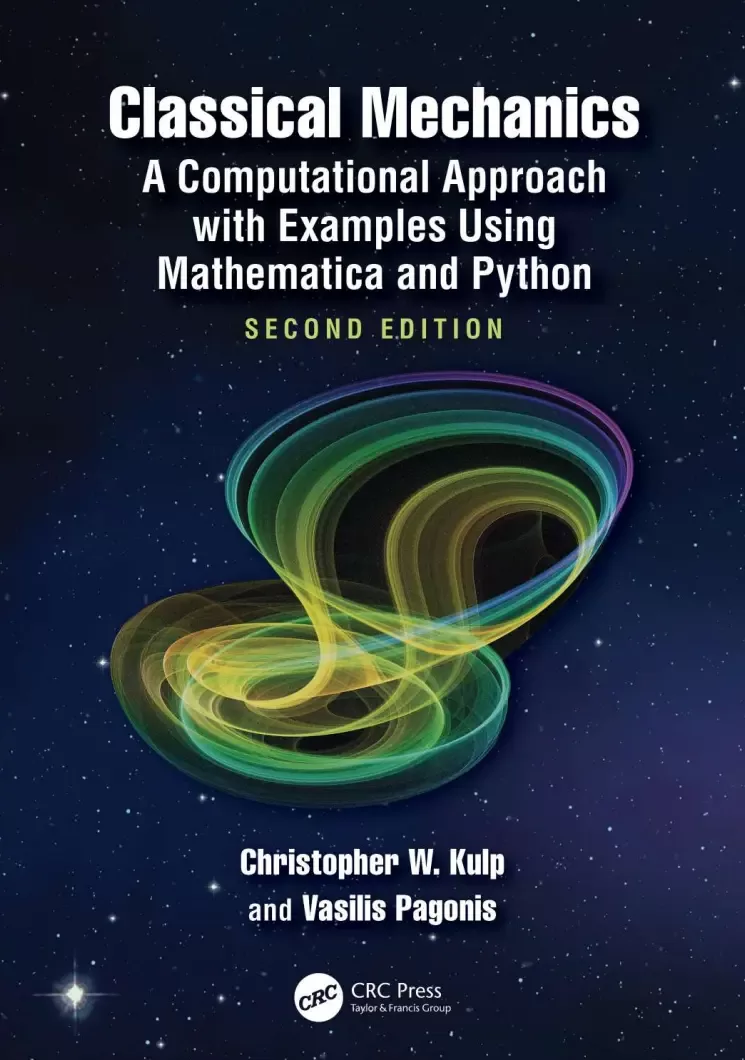
Classical Mechanics: A Computational Approach with Examples Using Mathematica and Python. 2 Ed
Оглавление⌄
Cover....1 Half Title....2 Title Page....4 Copyright Page....5 Dedication....6 Contents....8 PREFACE TO THE SECOND EDITION....14 Chapter 1: Foundations of Motion and Computation....16 1.1. Basics of classical mechanics....16 1.2. Basic descriptors of motion....17 1.2.1. Position and displacement....17 1.2.2. Velocity....21 1.2.3. Acceleration....21 1.2.4. Mass....24 1.2.5. Force....24 1.3. Newton’s laws of motion....25 1.3.1. Newton’s first law....25 1.3.2. Newton’s second law....26 1.3.3. Newton’s third law....28 1.4. Reference frames....29 1.5. Computation in physics....31 1.5.1. The use of computation in physics....31 1.5.2. Symbolic computations....32 1.5.3. Numerical computations with python and mathematica....34 1.5.4. Some warnings....38 1.6. Chapter summary....39 1.7. End-of-chapter problems....40 Chapter 2: Single-Particle Motion in One Dimension....44 2.1. Equations of motion....44 2.2. Ordinary differential equations....45 2.3. Constant forces....47 2.4. Time-dependent forces....53 2.5. Air resistance and velocity-dependent forces....57 2.6. Position-dependent forces....65 2.7. Euler’s method of numerically solving ODEs....68 2.8. Numerical ODE solvers in mathematica and python....72 2.9. Evaluation of integrals with numerical integration functions....74 2.10. Simpson’s rules for numerical evaluation of integrals....76 2.11. Chapter summary....78 2.12. End-of-chapter problems....79 Chapter 3: Motion in Two and Three Dimensions....88 3.1. Position, velocity, and acceleration in cartesian coordinate systems....88 3.2. Vector products....97 3.2.1. Dot product....97 3.2.2. Cross product....100 3.3. Position, velocity, and acceleration in non-cartesian coordinate systems....106 3.3.1. Polar coordinates....106 3.3.2. Position, velocity, and acceleration in cylindrical coordinates....113 3.3.3. Position, velocity, and acceleration in spherical coordinates....115 3.4. Gradient, divergence, and curl....117 3.4.1. Gradient....117 3.4.2. Divergence....129 3.4.3. Curl....131 3.4.4. Second derivatives with the del operator....133 3.5. Chapter summary....134 3.6. End-of-chapter problems....136 Chapter 4: Momentum, Angular Momentum, and Multiparticle Systems....144 4.1. Conservation of momentum and Newton’s third law....144 4.2. Rockets....149 4.3. Center of mass....151 4.4. Momentum of a system of multiple particles....159 4.5. Angular momentum of a single particle....161 4.6. Angular momentum of multiple particles....162 4.7. Chapter summary....167 4.8. End-of-chapter problems....168 Chapter 5: Energy....174 5.1. Work and energy in one-dimensional systems....174 5.2. Potential energy and equilibrium points....178 5.3. Work and line integrals....188 5.4. Work-kinetic energy theorem, revisited....195 5.5. Conservative forces and potential energy....195 5.6. Energy and multiparticle system....201 5.7. Chapter summary....203 5.8. End-of-chapter problems....204 Chapter 6: Harmonic Oscillations....210 6.1. Differential equations....210 6.2. Simple harmonic oscillator....211 6.2.1. Equation of motion of the simple harmonic oscillator....211 6.2.2. Potential and kinetic energy in simple harmonic motion....216 6.2.3. The simple plane pendulum as an example of a harmonic oscillator....217 6.3. Numerical solutions of the simple pendulum....219 6.4. Damped harmonic oscillator....221 6.4.1. Comparison of overdamped, underdamped and critically damped oscillations....224 6.5. Energy in damped harmonic motion....228 6.6. Forced harmonic oscillator....229 6.7. Energy resonance and the quality factor for driven oscillations....238 6.8. Electrical circuits....242 6.9. Principle of superposition and Fourier series....244 6.9.1. Principle of superposition....245 6.9.2. Fourier series....246 6.9.3. Example of superposition principle and Fourier series....250 6.10. Phase space....252 6.11. Chapter summary....256 6.12. End-of-chapter problems....257 Chapter 7: Calculus of Variations....266 7.1. Motivation for learning the calculus of variations....266 7.2. Shortest distance between two points—setting up the calculus of variations....267 7.3. First form of the euler equation....268 7.4. Second form of the euler equation....273 7.5. Some examples of problems solved using the calculus of variations....274 7.5.1. The brachistochrone problem....274 7.5.2. Geodesics....279 7.5.3. Minimum surface of revolution....281 7.6. Multiple dependent variables....285 7.7. Chapter summary....287 7.8. End-of-chapter problems....288 Chapter 8: Lagrangian and Hamiltonian Dynamics....292 8.1. Introduction to the lagrangian....292 8.2. Generalized coordinates and degrees of freedom....294 8.3. Hamilton’s principle....296 8.4. Examples of lagrangian dynamics....297 8.5. Constraint forces and lagrange’s equation with undetermined multipliers....312 8.6. Conservation theorems and the lagrangian....317 8.6.1. Conservation of momentum....317 8.6.2. Conservation of energy....319 8.7. Hamiltonian dynamics....321 8.8. Additional explorations into the hamiltonian....327 8.9. Chapter summary....331 8.10. End-of-chapter problems....332 Chapter 9: Central Forces and Planetary Motion....338 9.1. Central forces....338 9.1.1. Central forces and the conservation of energy....339 9.1.2. Central forces and the conservation of angular momentum....340 9.2. The two-body problem....340 9.3. Equations of motion for the two-body problem....344 9.4. Planetary motion and kepler’s first law....353 9.5. Orbits in a central force field....354 9.6. Kepler’s laws of planetary motion....357 9.6.1. Kepler’s first law....357 9.6.2. Kepler’s second law....365 9.6.3. Kepler’s third law....367 9.7. Planar circular restricted three-body problem....371 9.8. Chapter summary....377 9.9. End-of-chapter problems....378 Chapter 10: Motion in Noninertial Reference Frames....386 10.1. Motion in a nonrotating accelerating reference frame....386 10.2. Angular velocity as a vector....388 10.3. Time derivatives of vectors in rotating coordinate frames....391 10.4. Newton’s second law in a rotating frame....393 10.4.1. Centrifugal force....395 10.4.2. Coriolis force....398 10.5. Foucault pendulum....402 10.6. Projectile motion in a noninertial frame....407 10.7. Chapter summary....411 10.8. End-of-chapter problems....411 Chapter 11: Rigid Body Motion....416 11.1. Rotational motion of particles around a fixed axis....416 11.2. Review of rotational properties for a system of particles....422 11.2.1. Center of mass....422 11.2.2. Momentum of a system of particles....423 11.2.3. Angular momentum of a system of particles....423 11.2.4. Work and kinetic energy for a system of particles....423 11.3. Moment of inertia tensor....424 11.4. Kinetic energy and the inertia tensor....435 11.5. Inertia tensor in different coordinate systems − the parallel axis theorem....438 11.6. Principal axes of rotation....441 11.7. Precession of a symmetric spinning top with one point fixed and experiencing a weak torque....449 11.8. Rigid body motion in 3D and euler’s equations....451 11.9. Force-free symmetric top....453 11.10. Chapter summary....456 11.11. End-of-chapter problems....457 Chapter 12: Coupled Oscillations....468 12.1. Coupled oscillations of a two-mass, three-spring system....468 12.1.1. Equations of motion....468 12.1.2. Numerical solution of the equations of motion....469 12.1.3. Equal masses and identical springs: the normal modes....471 12.1.4. General case: linear combination of normal modes....476 12.2. Normal mode analysis of the two-mass, three-spring system....480 12.2.1. Equal masses and identical springs − analytical solution....480 12.2.2. Solving the two-mass and three-spring system as an eigenvalue problem....484 12.3. Double pendulum....489 12.3.1. Lagrangian and equations of motion − numerical solutions....490 12.3.2. Identical masses and lengths - analytical solutions....491 12.3.3. Double pendulum as an eigenvector/eigenvalue problem....495 12.4. General theory of small oscillations and normal coordinates....495 12.4.1. Lagrangian for small oscillations around an equilibrium position....495 12.4.2. Equations of motion for small oscillations around an equilibrium point....498 12.4.3. Normal coordinates....500 12.5. Chapter summary....501 12.6. End−of−chapter problems....502 Chapter 13: Nonlinear Systems....512 13.1. Linear vs. nonlinear systems....512 13.2. Damped harmonic oscillator, revisited....513 13.3. Fixed points and phase portraits....515 13.3.1. Simple plane pendulum, revisited....525 13.3.2. Double-well potential, revisited....527 13.3.3. Damped double-well....530 13.3.4. Bifurcations of fixed points....534 13.4. Limit cycles....535 13.4.1. Duffing equation....535 13.4.2. Limit cycles and period-doubling bifurcations....536 13.5. Chaos....539 13.5.1. Chaos and initial conditions....542 13.5.2. Lyapunov exponents....544 13.6. A final word on nonlinear systems....545 13.7. Chapter summary....545 13.8. End-of-chapter problems....546 Appendix A: Introduction to Python....554 A.1. Data types and variables in python....554 A.2. Sequences in python....556 A.2.1. Lists....556 A.2.2. Range sequences and list comprehensions....559 A.2.3. Tuple sequences....560 A.2.4. Functions on sequences....560 A.3. Functions, for loops and conditional statements....561 A.4. Importing python libraries and packages....564 A.5. The NumPy library....565 A.5.1. Creating NumPy arrays....565 A.5.2. Array functions, attributes, and methods....567 A.5.3. Arithmetic operations with NumPy arrays....568 A.5.4. Indexing and slicing of NumPy arrays....570 A.6. The matplotlib module....571 A.6.1. 2D plots using matplotlib....571 A.6.2. 3D plots using matplotlib....574 A.7. Symbolic computation with SymPy....576 A.8. Lambdify() and diff() functions in python....577 A.9. Overview of integration methods in python....578 A.10. Dsolve() command in SymPy....580 A.11. Numerical integration: the odeint() command in SciPy....581 A.12. Vector representation in SymPy....583 Appendix B: Introduction to Mathematica....584 B.1. Variables in Mathematica....584 B.2. Lists in Mathematica....586 B.3. Functions, loops, and conditional statements....587 B.4. Vectors and matrices in Mathematica....590 B.5. Creating plots in Mathematica....591 B.6. Basic symbolic calculations in Mathematica....594 B.7. Numerical solutions to integrals and differential equations in Mathematica....596 Bibliography....600 Index....602
Описание
В этом материале разберём тему: problems.
Classical Mechanics: A Computational Approach with Examples using Python and Mathematica provides a unique, contemporary introduction to classical mechanics, with a focus on computational methods. In addition to providing clear and thorough coverage of key topics, this textbook includes integrated instructions and treatments of computation.
All worked example problems in the second edition contain both Python and Mathematica code. This newly updated and revised second edition includes two new appendices instructing the reader in both the Python and Mathematica languages. New end-of-chapter problems explore the application of computational methods to classical mechanics problems.
The example problems teach readers both analytical methods and how to use computer algebra systems and computer programming to solve problems in classical mechanics. Full of pedagogy, it contains both analytical and computational example problems within the body of each chapter. End-of-chapter problems allow students to hone their skills in problem solving with and without the use of a computer. The methods presented in this book can then be used by students when solving problems in other fields both within and outside of physics.
It is an ideal textbook for undergraduate students in physics, mathematics, and engineering studying classical mechanics.
Key Features:Gives readers the "big picture" of classical mechanics and the importance of computation in the solution of problems in physicsNumerous example problems using both analytical and computational methods, as well as explanations as to how and why specific techniques were usedOnline resources containing specific example codes to help students learn computational methods and write their own algorithms
Файл доступен для загрузки ниже.
Поделиться
Частые вопросы
Можно ли скачать «Classical Mechanics: A Computational Approach with Examples Using Mathematica and Python. 2 Ed» бесплатно?
Да, «Classical Mechanics: A Computational Approach with Examples Using Mathematica and Python. 2 Ed» доступна для бесплатного скачивания на нашем сайте в формате PDF. Ссылка на файл находится на этой странице.
В каком формате и какого размера файл?
Книга предоставляется в формате PDF, размер файла 5,0 МБ.
Кто автор и когда вышла книга?
автор — Kulp Christopher , Pagonis Vasilis, издательство CRC Press is an imprint of Taylor & Francis Group, LLC, год выпуска 2026, 609 страниц.
О чём книга «Classical Mechanics: A Computational Approach with Examples Using Mathematica and Python. 2 Ed»?
Classical Mechanics: A Computational Approach with Examples using Python and Mathematica provides a unique, contemporary introduction to classical mechanics, with a focus on computational methods.
Похожие материалы
 Основы программирования на Python
 Python для детей. Самоучитель по программированию
 Python. Сборник упражнений. Введение в язык Python с задачами и решениями
 Структуры данных в Python: начальный курс
 Python за 7 дней. Краткий курс для начинающих
 Python in a Nutshell: A Desktop Quick Reference. 4 Ed
 Python for Microcontrollers: Getting Started with MicroPython
 Programming with MicroPython