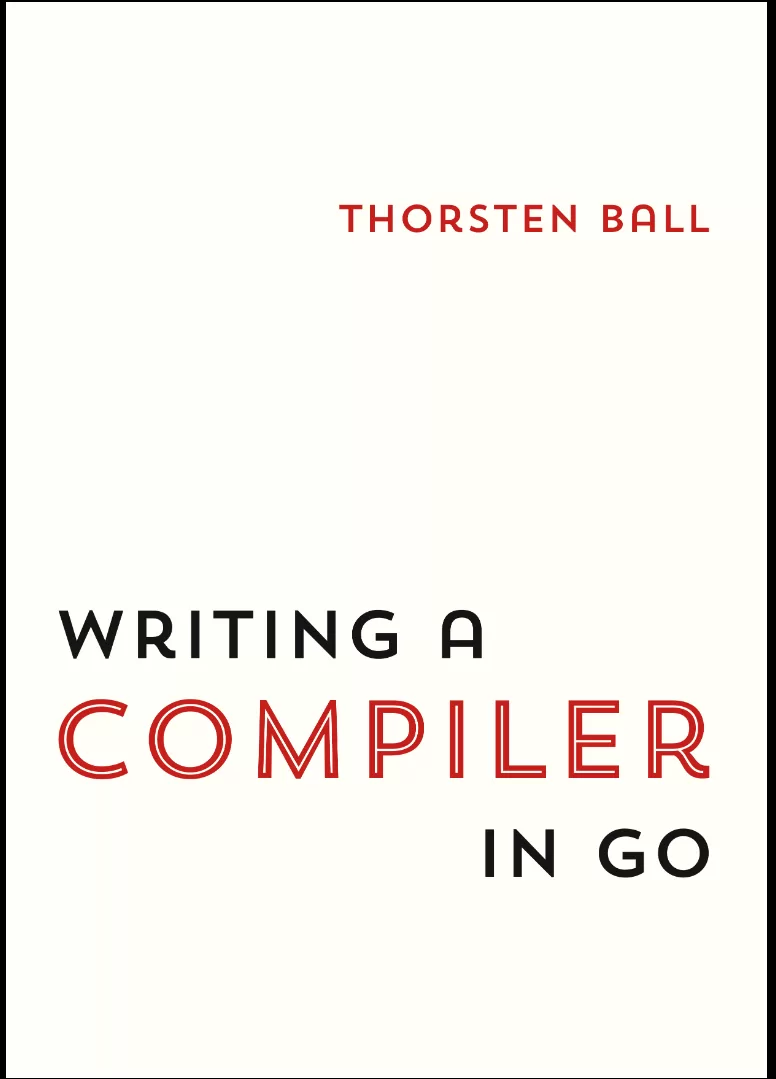
Writing A Compiler In Go
Оглавление⌄
Acknowledgments....6 Introduction....7 Evolving Monkey....8 The Past and Present....8 The Future....10 Use This Book....11 Compilers & Virtual Machines....13 Compilers....14 Virtual and Real Machines....17 Real Machines....17 What Is a Virtual Machine?....22 Why Build One?....24 Bytecode....26 What We're Going to Do, or: the Duality of VM and Compiler....27 Hello Bytecode!....29 First Instructions....30 Starting With Bytes....31 The Smallest Compiler....35 Bytecode, Disassemble!....40 Back to the Task at Hand....44 Powering On the Machine....46 Adding on the Stack....52 Hooking up the REPL....57 Compiling Expressions....60 Cleaning Up the Stack....60 Infix Expressions....64 Booleans....68 Comparison Operators....72 Prefix Expressions....79 Conditionals....85 Jumps....88 Compiling Conditionals....90 Executing Jumps....102 Welcome Back, Null!....105 Keeping Track of Names....113 The Plan....114 Compiling Bindings....115 Introducing: the Symbol Table....117 Using Symbols in the Compiler....120 Adding Globals to the VM....123 String, Array and Hash....128 String....128 Array....133 Hash....137 Adding the index operator....143 Functions....149 Dipping Our Toes: a Simple Function....149 Representing Functions....149 Opcodes to Execute Functions....151 Compiling Function Literals....153 Compiling Function Calls....166 Functions in the VM....169 A Little Bonus....178 Local Bindings....179 Opcodes for Local Bindings....180 Compiling Locals....183 Implementing Local Bindings in the VM....194 Arguments....202 Compiling Calls With Arguments....203 Resolving References to Arguments....208 Arguments in the VM....210 Built-in Functions....219 Making the Change Easy....220 Making the Change: the Plan....225 A New Scope for Built-in Functions....226 Executing built-in functions....230 Closures....236 The Problem....237 The Plan....238 Everything's a closure....239 Compiling and resolving free variables....249 Creating real closures at run time....260 Recursive Closures....264 Taking Time....276 Resources....280 Feedback....282 Changelog....283
Описание
Коротко и по делу о том, что важно знать про monkey.
We're picking up right where we left off and write a compiler and a virtual machine for Monkey.Runnable and tested code front and center, built from the ground up, step by step — just like before. This is the sequel to Writing An Interpreter In Go. But this time, we're going to define bytecode, compile Monkey and execute it in our very own virtual machine. It's the sequel to … a programming language. It's the next step in Monkey's evolution.
In this book, we use the codebase (included in the book!) from the first part and extend it. Writing A Compiler In Go is the sequel to Writing An Interpreter In Go.It starts right where the first one stopped, with a fully-working, fully-tested Monkey interpreter in hand, connecting both books seamlessly, ready to build a compiler and a virtual machine for Monkey. We take the lexer, the parser, the AST, the REPL and the object system and use them to build a new, faster implementation of Monkey, right next to the tree-walking evaluator we built in the first book.The approach is unchanged, too. Do you need to read the first part before this one? Working, tested code is the focus, we build everything from scratch, do baby steps, write tests firsts, use no 3rd-party-libraries and see and understand how all the pieces fit together.It's a continuation in prose and in code. If you're okay with treating the code from the first book as black box, then no. You'll have the best understanding of where we're going in this book, if you know where we started. But that's not what these books are about; they're about opening up black boxes, looking inside and shining a light.
We change its architecture and turn it into a bytecode compiler and virtual machine.We'll take the lexer, the parser, the AST and the object system we wrote in the first book and use them to build our own Monkey compiler and virtual machine … from scratch! Learn how to write a compiler and a virtual machineOur main goal in in this book is to evolve Monkey. We'll build them side-by-side so that we'll always have a running system we can steadily evolve.What we end up with is not only much closer to the programming languages we use every day, giving us a better understanding of how they work, but also 3x faster. And that's without explicitly aiming for performance.
Here's what we'll do:We define our own bytecode instructions, specifying their operands and their encoding. Along the way, we also build a mini-disassembler for them.We write a compiler that takes in a Monkey AST and turns it into bytecode by emitting instructionsAt the same time we build a stack-based virtual machine that executes the bytecode in its main loopWe'll learn a lot about computers, how they work, what machine code and opcodes are, what the stack is and how to work with stack pointers and frame pointers, what it means to define a calling convention, and much more.
We alsobuild a symbol table and a constant pooldo stack arithmeticgenerate jump instructionsbuild frames into our VM to execute functions with local bindings and arguments!add built-in functions to the VMget real closures working in the virtual machine and learn why closure-compilation is so tricky
Файл доступен для загрузки ниже.
Поделиться
Частые вопросы
Можно ли скачать «Writing A Compiler In Go» бесплатно?
Да, «Writing A Compiler In Go» доступна для бесплатного скачивания на нашем сайте в формате PDF. Ссылка на файл находится на этой странице.
В каком формате и какого размера файл?
Книга предоставляется в формате PDF, размер файла 1,4 МБ.
Кто автор и когда вышла книга?
автор — Ball Thorsten, издательство Independent publishing, год выпуска 2018, 284 страниц.
О чём книга «Writing A Compiler In Go»?
This is the sequel to Writing An Interpreter In Go.
Похожие материалы
 Облачный Go. Создание надежных служб в ненадежных окружениях
 Pro Go. Полное руководство по программированию надежного и эффективного программного обеспечения с использованием Golang
 Learning Go: An Idiomatic Approach to Real-World Go Programming
 Software Development with Go: Cloud-Native Programming using Golang with Linux and Docker
 Efficient Go: Data-Driven Performance Optimization
 Black Hat Go: Программирование для хакеров и пентестеров
 Microservices with Go: Building scalable and reliable microservices with Go
 Concurrency in Go: Tools and Techniques for Developers