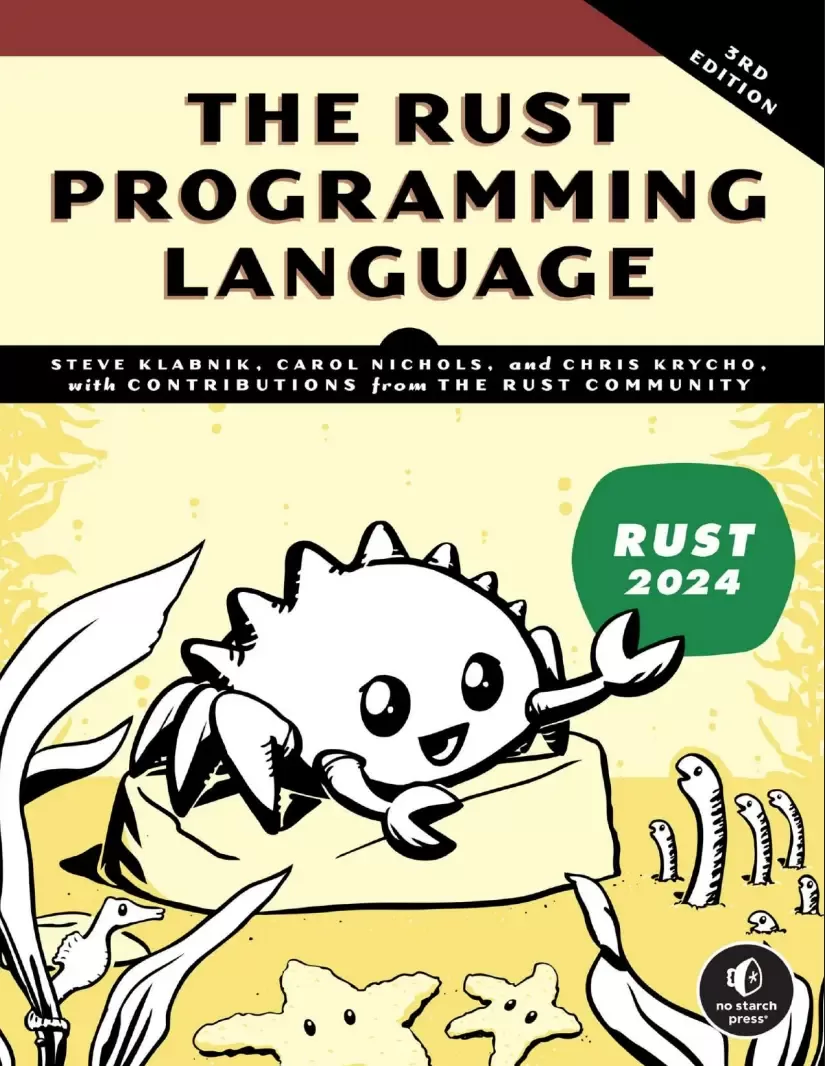
The Rust Programming Language. 3 Ed
Оглавление⌄
FOREWORD....20 PREFACE....22 ACKNOWLEDGMENTS....23 INTRODUCTION....24 Who Rust Is For....25 Teams of Developers....25 Students....25 Companies....26 Open Source Developers....26 People Who Value Speed and Stability....26 Who This Book Is For....27 How to Use This Book....27 Resources and How to Contribute to This Book....29 1....30 GETTING STARTED....30 Installation....31 Installing rustup on Linux or macOS....31 Installing rustup on Windows....32 Troubleshooting....32 Updating and Uninstalling....33 Reading the Local Documentation....34 Using Text Editors and IDEs....34 Hello, World!....34 Project Directory Setup....35 Rust Program Basics....35 Anatomy of a Rust Program....36 Compilation and Execution....37 Hello, Cargo!....39 Creating a Project with Cargo....39 Building and Running a Cargo Project....41 Building for Release....44 Leveraging Cargo’s Conventions....44 Summary....45 2....46 PROGRAMMING A GUESSING GAME....46 Setting Up a New Project....47 Processing a Guess....48 Storing Values with Variables....49 Receiving User Input....51 Handling Potential Failure with the Result Type....52 Printing Values with println! Placeholders....53 Testing the First Part....54 Generating a Secret Number....54 Increasing Functionality with a Crate....55 Generating a Random Number....58 Comparing the Guess to the Secret Number....60 Allowing Multiple Guesses with Looping....65 Quitting After a Correct Guess....66 Handling Invalid Input....66 Summary....69 3....70 COMMON PROGRAMMING CONCEPTS....70 Variables and Mutability....71 Declaring Constants....73 Shadowing....74 Data Types....76 Scalar Types....77 Compound Types....82 Functions....87 Parameters....88 Statements and Expressions....90 Functions with Return Values....92 Comments....94 Control Flow....95 if Expressions....96 Repetition with Loops....101 Summary....107 4....108 UNDERSTANDING OWNERSHIP....108 What Is Ownership?....109 Ownership Rules....110 Variable Scope....110 The String Type....111 Memory and Allocation....112 Ownership and Functions....123 Return Values and Scope....124 References and Borrowing....126 Mutable References....129 Dangling References....132 The Rules of References....134 The Slice Type....134 String Slices....137 Other Slices....142 Summary....143 5....144 USING STRUCTS TO STRUCTURE RELATED DATA....144 Defining and Instantiating Structs....145 Using the Field Init Shorthand....147 Creating Instances with Struct Update Syntax....148 Creating Different Types with Tuple Structs....149 Defining Unit-Like Structs....150 An Example Program Using Structs....152 Refactoring with Tuples....153 Refactoring with Structs....154 Adding Functionality with Derived Traits....155 Methods....159 Method Syntax....160 Methods with More Parameters....163 Associated Functions....164 Multiple impl Blocks....165 Summary....166 6....167 ENUMS AND PATTERN MATCHING....167 Defining an Enum....168 Enum Values....169 The Option Enum....173 The match Control Flow Construct....176 Patterns That Bind to Values....178 The Option Match Pattern....180 Matches Are Exhaustive....181 Catch-All Patterns and the _ Placeholder....182 Concise Control Flow with if let....184 Staying on the “Happy Path” with let...else....186 Summary....188 7....190 PACKAGES, CRATES, AND MODULES....190 Packages and Crates....192 Control Scope and Privacy with Modules....195 Paths for Referring to an Item in the Module Tree....197 Exposing Paths with the pub Keyword....200 Starting Relative Paths with super....203 Making Structs and Enums Public....204 Bringing Paths into Scope with the use Keyword....206 Creating Idiomatic use Paths....208 Providing New Names with the as Keyword....210 Re-exporting Names with pub use....210 Using External Packages....211 Using Nested Paths to Clean Up use Lists....212 Importing Items with the Glob Operator....214 Separating Modules into Different Files....214 Summary....217 8....218 COMMON COLLECTIONS....218 Storing Lists of Values with Vectors....219 Creating a New Vector....219 Updating a Vector....220 Reading Elements of Vectors....221 Iterating Over the Values in a Vector....223 Using an Enum to Store Multiple Types....224 Dropping a Vector Drops Its Elements....225 Storing UTF-8 Encoded Text with Strings....226 Defining Strings....226 Creating a New String....226 Updating a String....228 Indexing into Strings....231 Slicing Strings....233 Iterating Over Strings....234 Handling the Complexities of Strings....235 Storing Keys with Associated Values in Hash Maps....236 Creating a New Hash Map....236 Accessing Values in a Hash Map....237 Managing Ownership in Hash Maps....238 Updating a Hash Map....238 Hashing Functions....241 Summary....241 9....243 ERROR HANDLING....243 Unrecoverable Errors with the panic! Macro....244 Recoverable Errors with Result....248 Matching on Different Errors....250 Propagating Errors....254 To panic! or Not to panic!....262 Examples, Prototype Code, and Tests....262 When You Have More Information Than the Compiler....263 Guidelines for Error Handling....264 Custom Types for Validation....265 Summary....268 10....269 GENERIC TYPES, TRAITS, AND LIFETIMES....269 Removing Duplication by Extracting a Function....270 Generic Data Types....273 In Function Definitions....273 In Struct Definitions....276 In Enum Definitions....278 In Method Definitions....279 Performance of Code Using Generics....282 Defining Shared Behavior with Traits....283 Defining a Trait....283 Implementing a Trait on a Type....284 Using Default Implementations....287 Using Traits as Parameters....289 Returning Types That Implement Traits....291 Using Trait Bounds to Conditionally Implement Methods....293 Validating References with Lifetimes....295 Dangling References....295 The Borrow Checker....297 Generic Lifetimes in Functions....298 Lifetime Annotation Syntax....299 In Function Signatures....300 Relationships....304 In Struct Definitions....305 Lifetime Elision....306 In Method Definitions....309 The Static Lifetime....310 Generic Type Parameters, Trait Bounds, and Lifetimes....311 Summary....311 11....313 WRITING AUTOMATED TESTS....313 How to Write Tests....314 Structuring Test Functions....315 Checking Results with the assert! Macro....319 Testing Equality with the assert_eq! and assert_ne! Macros....323 Adding Custom Failure Messages....326 Checking for Panics with the should_panic Attribute....328 Using Result in Tests....332 Controlling How Tests Are Run....333 Running Tests in Parallel or Consecutively....334 Showing Function Output....334 Running a Subset of Tests by Name....337 Ignoring Tests Unless Specifically Requested....339 Test Organization....340 Unit Tests....341 Integration Tests....343 Summary....348 12....349 AN I/O PROJECT: BUILDING A COMMAND LINE PROGRAM....349 Accepting Command Line Arguments....350 Reading the Argument Values....351 Saving the Argument Values in Variables....353 Reading a File....354 Refactoring to Improve Modularity and Error Handling....356 Separating Concerns in Binary Projects....357 Fixing the Error Handling....361 Extracting Logic from main....365 Splitting Code into a Library Crate....368 Adding Functionality with Test-Driven Development....370 Writing a Failing Test....370 Writing Code to Pass the Test....373 Working with Environment Variables....376 Writing a Failing Test for Case-Insensitive Search....376 Implementing the search_case_insensitive Function....378 Redirecting Errors to Standard Error....383 Checking Where Errors Are Written....383 Printing Errors to Standard Error....384 Summary....385 13....386 FUNCTIONAL LANGUAGE FEATURES: ITERATORS AND CLOSURES....386 Closures....387 Capturing the Environment....387 Inferring and Annotating Closure Types....390 Capturing References or Moving Ownership....392 Moving Captured Values Out of Closures....395 Processing a Series of Items with Iterators....400 The Iterator Trait and the next Method....401 Methods That Consume the Iterator....403 Methods That Produce Other Iterators....403 Closures That Capture Their Environment....405 Improving Our I/O Project....407 Removing a clone Using an Iterator....407 Clarifying Code with Iterator Adapters....410 Choosing Between Loops and Iterators....412 Performance in Loops vs. Iterators....412 Summary....413 14....414 MORE ABOUT CARGO AND CRATES.IO....414 Customizing Builds with Release Profiles....415 Publishing a Crate to Crates.io....416 Making Useful Documentation Comments....417 Exporting a Convenient Public API....421 Setting Up a Crates.io Account....426 Adding Metadata to a New Crate....427 Publishing to Crates.io....429 Publishing a New Version of an Existing Crate....430 Deprecating Versions from Crates.io....430 Cargo Workspaces....431 Creating a Workspace....431 Creating the Second Package in the Workspace....433 Installing Binaries with cargo install....438 Extending Cargo with Custom Commands....439 Summary....439 15....441 SMART POINTERS....441 Using Box to Point to Data on the Heap....443 Storing Data on the Heap....443 Enabling Recursive Types with Boxes....444 Treating Smart Pointers Like Regular References....450 Following the Reference to the Value....450 Using Box Like a Reference....451 Defining Our Own Smart Pointer....452 Implementing the Deref Trait....453 Using Deref Coercion in Functions and Methods....455 Handling Deref Coercion with Mutable References....457 Running Code on Cleanup with the Drop Trait....458 A Reference-Counted Smart Pointer....462 Sharing Data....463 Cloning to Increase the Reference Count....465 The Interior Mutability Pattern....467 Enforcing Borrowing Rules at Runtime....467 Using Interior Mutability....469 Allowing Multiple Owners of Mutable Data....477 Reference Cycles Can Leak Memory....479 Creating a Reference Cycle....479 Preventing Reference Cycles Using Weak....482 Summary....488 16....490 FEARLESS CONCURRENCY....490 Using Threads to Run Code Simultaneously....492 Creating a New Thread with spawn....493 Waiting for All Threads to Finish....494 Using move Closures with Threads....496 Transfer Data Between Threads with Message Passing....500 Transferring Ownership Through Channels....504 Sending Multiple Values....505 Creating Multiple Producers....506 Shared-State Concurrency....508 Controlling Access with Mutexes....508 Comparing RefCell/Rc and Mutex/Arc....515 Extensible Concurrency with Send and Sync....515 Transferring Ownership Between Threads....516 Accessing from Multiple Threads....516 Implementing Send and Sync Manually Is Unsafe....517 Summary....517 17....518 FUNDAMENTALS OF ASYNCHRONOUS PROGRAMMING....518 Parallelism and Concurrency....521 Futures and the Async Syntax....524 Our First Async Program....525 Defining the page_title Function....526 Executing an Async Function with a Runtime....529 Concurrently Racing Two URLs Against Each Other....532 Applying Concurrency with Async....534 Creating a New Task with spawn_task....534 Sending Data Between Two Tasks....539 Yielding Control to the Runtime....545 Building Our Own Async Abstractions....550 Streams: Futures in Sequence....552 A Closer Look at the Traits for Async....555 The Future Trait....555 The Pin Type and the Unpin Trait....557 The Stream Trait....567 Futures, Tasks, and Threads....569 Summary....572 18....573 OBJECT-ORIENTED PROGRAMMING FEATURES....573 Characteristics of Object-Oriented Languages....574 Objects Contain Data and Behavior....574 Encapsulation That Hides Implementation Details....575 Inheritance as a Type System and as Code Sharing....577 Using Trait Objects to Abstract Over Shared Behavior....578 Defining a Trait for Common Behavior....579 Implementing the Trait....581 Performing Dynamic Dispatch....585 Implementing an Object-Oriented Design Pattern....585 Attempting Traditional Object-Oriented Style....586 Encoding States and Behavior as Types....596 Summary....600 19....602 PATTERNS AND MATCHING....602 All the Places Patterns Can Be Used....603 match Arms....603 let Statements....604 Conditional if let Expressions....606 while let Conditional Loops....607 for Loops....608 Function Parameters....609 Refutability: Whether a Pattern Might Fail to Match....610 Pattern Syntax....612 Matching Literals....613 Matching Named Variables....613 Matching Multiple Patterns....614 Matching Ranges of Values....615 Destructuring to Break Apart Values....616 Ignoring Values in a Pattern....621 Adding Conditionals with Match Guards....626 Using @ Bindings....629 Summary....630 20....631 ADVANCED FEATURES....631 Unsafe Rust....632 Performing Unsafe Superpowers....633 Dereferencing a Raw Pointer....634 Calling an Unsafe Function or Method....636 Accessing or Modifying a Mutable Static Variable....643 Implementing an Unsafe Trait....645 Accessing Fields of a Union....645 Using Miri to Check Unsafe Code....646 Using Unsafe Code Correctly....648 Advanced Traits....648 Defining Traits with Associated Types....648 Using Default Generic Parameters and Operator Overloading....650 Disambiguating Between Identically Named Methods....653 Using Supertraits....658 Implementing External Traits with the Newtype Pattern....660 Advanced Types....662 Type Safety and Abstraction with the Newtype Pattern....662 Type Synonyms and Type Aliases....663 The Never Type That Never Returns....665 Dynamically Sized Types and the Sized Trait....668 Advanced Functions and Closures....670 Function Pointers....670 Returning Closures....672 Macros....675 The Difference Between Macros and Functions....675 Declarative Macros for General Metaprogramming....676 Procedural Macros for Generating Code from Attributes....678 Custom derive Macros....679 Attribute-Like Macros....686 Function-Like Macros....687 Summary....688 21....689 FINAL PROJECT: BUILDING A MULTITHREADED WEB SERVER....689 Building a Single-Threaded Web Server....691 Listening to the TCP Connection....691 Reading the Request....694 Looking More Closely at an HTTP Request....696 Writing a Response....697 Returning Real HTML....699 Validating the Request and Selectively Responding....701 Refactoring....703 From a Single-Threaded to a Multithreaded Server....704 Simulating a Slow Request....705 Improving Throughput with a Thread Pool....706 Graceful Shutdown and Cleanup....726 Implementing the Drop Trait on ThreadPool....727 Signaling to the Threads to Stop Listening for Jobs....729 Summary....733 A....734 KEYWORDS....734 Keywords Currently in Use....735 Keywords Reserved for Future Use....736 Raw Identifiers....737 B....739 OPERATORS AND SYMBOLS....739 Operators....739 Non-operator Symbols....743 C....750 DERIVABLE TRAITS....750 Debug for Programmer Output....751 PartialEq and Eq for Equality Comparisons....752 PartialOrd and Ord for Ordering Comparisons....752 Clone and Copy for Duplicating Values....753 Hash for Mapping a Value to a Value of Fixed Size....754 Default for Default Values....754 D....755 USEFUL DEVELOPMENT TOOLS....755 Automatic Formatting with rustfmt....755 Fix Your Code with rustfix....756 More Lints with Clippy....757 IDE Integration Using rust-analyzer....759 E....760 EDITIONS....760 INDEX....763
Описание
В этом материале разберём тему: rust.
Build stable, production-grade systems with Rust.
The Rust Programming Language, 3rd Edition, teaches you to write code that the compiler can verify, teams can maintain, and systems can evolve safely over time. Written by longtime Rust community members, this book shows you how to work effectively with Rust’s type system, concurrency model, and tooling, using patterns and idioms chosen for long-term stability.
Learn how to:Design programs that communicate their invariants to the compilerUse ownership, lifetimes, and traits to model real-world constraintsWrite concurrent and multithreaded code with confidence and clarityBuild, test, document, and refactor projects using Cargo effectivelyHandle errors explicitly and idiomaticallyApply expressive pattern matching to simplify complex logicThree substantial project chapters—focusing on a number-guessing game, a command-line tool, and a multithreaded server—demonstrate how these concepts work together in complete, real programs.
Whether you’re new to Rust or already using it in production, this book helps you write code that scales safely and makes its guarantees explicit.
New to this edition:Complete async programming chapterMiri for analyzing unsafe codeBuilt on the Rust 2024 EditionModern Rust idioms, tooling, and practices
Если материал оказался полезен — сохраните страницу.
Поделиться
Частые вопросы
Можно ли скачать «The Rust Programming Language. 3 Ed» бесплатно?
Да, «The Rust Programming Language. 3 Ed» доступна для бесплатного скачивания на нашем сайте в формате PDF. Ссылка на файл находится на этой странице.
В каком формате и какого размера файл?
Книга предоставляется в формате PDF, размер файла 3,3 МБ.
Кто автор и когда вышла книга?
автор — Klabnik Steve , Krycho Chris , Nichols Carol, издательство No Starch Press, Inc., год выпуска 2026, 789 страниц.
О чём книга «The Rust Programming Language. 3 Ed»?
Build stable, production-grade systems with Rust.The Rust Programming Language, 3rd Edition, teaches you to write code that the compiler can verify, teams can maintain, and systems can evolve safely over time.
Похожие материалы
 Practical System programming for Rust developers: Build fast and secure software for Linux/Unix systems with the help of practical examples
 Beginning Rust Programming
 Hands-On Systems Programming with Rust: A Project-Based Approach
 Network Programming with Rust: Build fast and resilient network servers and clients by leveraging Rust's memory-safety and concurrency features
 Rust for Rustaceans: Idiomatic Programming for Experienced Developers
 Rust In Practice: A Programmers Guide to Build Rust Programs, Test Applications and Create Cargo Packages
 Rust Web Development with Rocket: A practical guide to starting your journey in Rust web development using the Rocket framework
 Rust for Network Programming and Automation: Learn to Design and Automate Networks, Performance Optimization, and Packet Analysis with low-level Rust