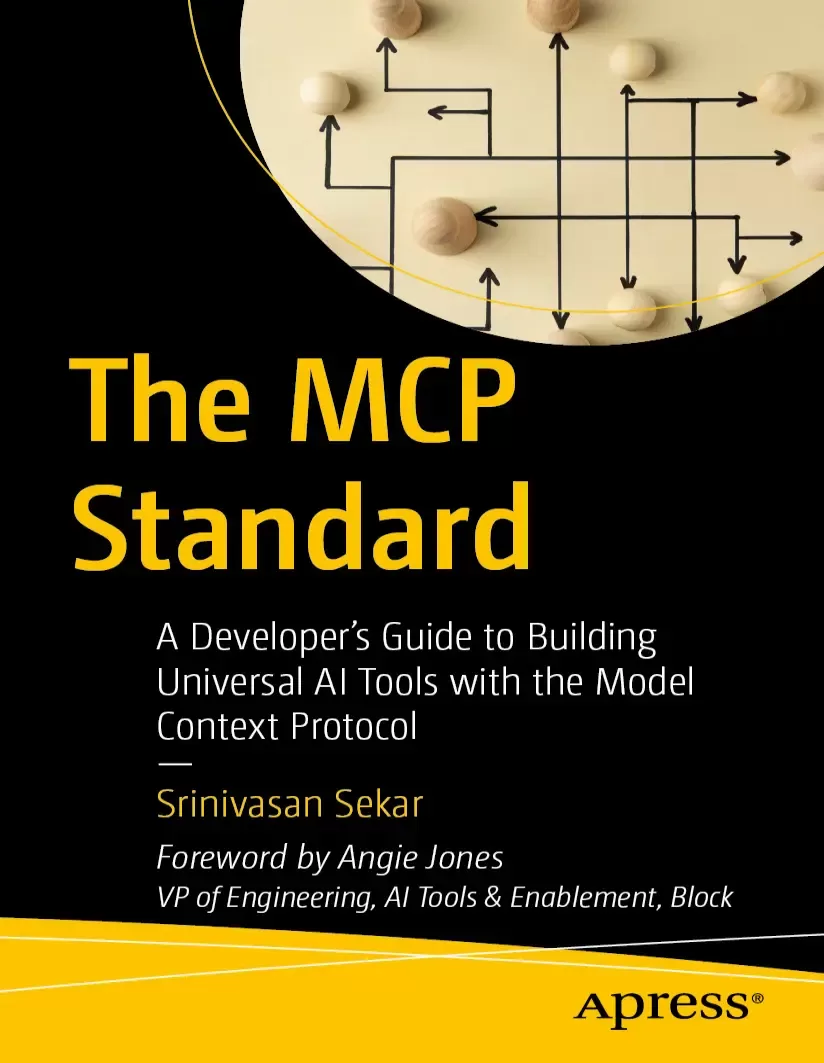
The MCP Standard: A Developer's Guide to Building Universal Al Tools with the Model Context Protocol
Оглавление⌄
The MCP Standard....2 Foreword....5 Introduction....7 What This Book Is About....8 Who This Book Is For....9 The Journey Ahead....9 A Word on Philosophy....10 How to Use This Book....10 The Bigger Picture....10 Acknowledgments....13 Table of Contents....14 About the Author....23 About the Technical Reviewers....24 Part I: The Foundation: Why MCP Matters....26 1. The Age of Tooling Chaos....27 The M×N Integration Nightmare....27 A Closer Look at the Pain: Anatomy of the Chaos....29 1. Interfaces....29 2. The Developer’s Cognitive Tax....30 3. The API Treadmill and Technical Debt by Fragmentation....31 4. The Siloed Garden of Innovation....31 Echoes of the Past: Lessons from the Cloud Native Revolution....32 Chapter Summary....33 Key Takeaways....33 2. The Solution: A Universal Language for AI....35 Introducing the Model Context Protocol (MCP)....35 The Monolithic Agent: An Architecture Before MCP....36 The MCP Architecture: The Decoupled Agent....37 The Core Promise: A Standardized Interface for Capabilities....39 1. Tools: Designed for Model Control....39 2. Resources: Designed for Application Control....40 3. Prompts: Designed for User Control....40 Key Benefits of a Unified Approach....41 Analogy: The Universal Translator for AI Agents....42 MCP in the Emerging Agentic Ecosystem: A Look Ahead....43 Chapter Summary....44 Key Takeaways....44 3. MCP and the AI-Native Transformation....45 Learning from History: From Cloud Native to AI Native....45 The Role of Standardization in Technological Waves....47 How MCP Paves the Way for AI-Native Architectures....47 Positioning Your Organization for the Future....48 Chapter Summary....51 Key Takeaways....51 Part II: The Architecture: A Technical Deep Dive....52 4. The MCP Architectural Roles....53 The Host: The Conductor of the AI Orchestra....55 Core Responsibilities of the Host....55 1. Managing the User Experience (the Stage)....55 2. Maintaining Session State (the Director’s Notes)....55 3. Initiating and Configuring Connections (Assembling the Orchestra)....56 4. Governing Capability (The Ultimate Gatekeeper)....56 The Client....56 Core Responsibilities of the Client....57 1. Managing the Connection Lifecycle (Opening Diplomatic Channels)....57 2. Serializing and Deserializing Messages (Translation and Interpretation)....57 3. Dynamic Capability Discovery (Requesting the Menu)....57 The Server: The Specialist in the Workshop....58 Core Responsibilities of the Server....58 1. Advertising Skills (Putting Up a Sign)....58 2. Listening for and Executing Requests (Fulfilling the Order)....58 3. The Range of Servers (from Local Scripts to Enterprise Services)....59 A Complete Interaction Trace....59 Chapter Summary....62 Key Takeaways....62 5. The Language of MCP: Tools, Resources, and Prompts....63 Breaking Down MCP’s Core Capabilities....63 Tools: The Verbs of Action....64 Anatomy of a Tool....64 Advanced Capabilities: ResourceLinks and Server-Side Sampling....66 Resources: The Nouns of Context....68 Prompts: The Grammar of Conversation....70 Summary Table: Tools vs. Resources vs. Prompts....71 Overview of Tools, Resources, and Prompts....71 Chapter Summary....73 Key Takeaways....73 6. Under the Hood: The Protocol Specification....75 The Transport Layer: How Messages Travel....75 1. Standard I/O (stdio)....76 2. Streamable HTTP....76 The Message Format: The Anatomy of a Request....77 The Interaction Flow: A Step-by-Step Sequence....79 Error Handling and Timeouts....80 Chapter Summary....82 Key Takeaways....82 Part III: The Practitioners: Building with MCP....83 7. For the Tool Provider: Creating an MCP Server....84 A Complete, End-to-End Guide to Building the Advanced MCP Server....84 Step 1: Environment Setup....84 Step 2: Create and Populate the Database....86 Step 3: The Server Foundation and Core Logic....87 Step 4: Building Rich, Discoverable Resources....89 Step 5: Implementing Prompts....92 Step 6: Advanced Tool Implementation....95 Tool 1: Listing Tables with Pagination....95 Tool 2: Creating a Table and Notifying the Client....98 Tool 3 and 4: The Admin/Modification Flow (Dynamic Capabilities and Advanced Notifications)....99 Tool 5: Interactive User Creation with Complex Elicitation....103 Step 7: Running the Server....106 Option 1: Running with stdio....106 Option 2: Running with StreamableHTTP....107 Step 8: Testing and Verification....109 Chapter Summary....116 Key Takeaways....116 8. For the AI Application Developer: Building an MCP Client....118 Step 1: Project Scaffolding and Environment Setup....118 Step 2: Defining Schemas and Initializing the Core Components....120 Step 3: The Bidirectional Contract-Handling Server-Initiated Communication....124 Handling Notifications....124 Responding to Server Requests....125 Step 4: Orchestrating the Agent—The Manual Tool-Calling Loop....128 Step 5: Running the End-to-End System and a Guided Interaction....132 Interaction 1: Dynamic Capabilities....133 Interaction 2: Elicitation....133 Interaction 3: Resource Updates....134 Chapter Summary....135 Key Takeaways....135 Part IV: Security and Production Readiness....137 9. The Agentic Threat Landscape....138 A New Paradigm, a New Attack Surface....138 The Lethal Trifecta: A Recipe for Disaster....139 Case Studies in Agentic Failure: Two Real-World Breaches....139 Case Study 1: The GitHub MCP Exploit (the Hijacked Agent)....140 Case Study 2: The Asana Data Leak (the Broken Wall)....141 A New Framework: Securing Flows, Not Just Prompts....142 A Catalog of Agentic Threats....143 Chapter Summary....145 Key Takeaways....145 10. Foundational Security: Authentication with OpenID Connect (OIDC)....147 The Architectural Pattern: The Three Roles of OAuth....147 Understanding OAuth 2.1 vs OpenID Connect (OIDC)....148 Step 1: Configuring the Google Cloud OAuth 2.1 Client for OIDC....149 Step 2: Building the Server-Side OAuth 2.1/OIDC Authentication Flow....150 2.1. Server and Session Setup....150 2.2. The /authorize and /callback Endpoints....150 2.3. The /token Endpoint and PKCE Validation....152 2.4. Protecting and Proxying the MCP Endpoint....152 Step 3: Building the Advanced OAuth/OIDC Client....153 3.1. The HTTPCallbackOAuthMCPClient Class....153 Running the End-to-End System: A Look at the Logs....153 Production Readiness: Analysis and Recommendations....154 Chapter Summary....155 Key Takeaways....155 11. Server-Side Hardening: Mitigating Common Vulnerabilities....156 Vulnerability 1: Excessive Permission Scope....156 The Fundamental Problem....156 The Threat: The Valet with the Master Key....157 Exploit 1: The Unconstrained Log Viewer....157 Attack Vector 1—Implementation Bug (Path Traversal)....157 The Attack....158 Why This Happens....158 Mitigation 1: Fix the Implementation Bug (Application-Level Defense)....159 Why This Works....161 The Hidden Problem: Architectural Flaw....162 Mitigation 2: Fix the Architectural Flaw (Operating System-Level Defense)....163 Dockerfile (Minimal Hardening)....163 Docker Compose (Where the Security Happens)....163 What This Does....164 Proof It Works....164 Why Both Mitigations Are Required....164 Vulnerability 2: Malicious Code Execution....165 The Threat: The Unsandboxed Playground....165 The Exploit: The “Helpful” Report Generator....165 The Mitigation: Never eval( ), Use Safe Interpreters....166 Vulnerability 3: Command Injection....167 The Threat: The Unescaped String....167 The Exploit: The Insecure Diagnostic Tool....168 The Mitigation: Parameterized Execution....169 Chapter Summary....171 Key Takeaways....171 12. LLM-Centric Threats: Injection and Poisoning....172 Vulnerability 1: Prompt Injection (Direct and Indirect)....172 The Threat: The Deceitful Conversation....172 The Exploit: The Poisoned Document....173 The Mitigation: Data/Instruction Separation and Sanitization....174 Vulnerability 2: Tool Poisoning....176 The Threat: The Deceptive Toolmaker....176 The Exploit: The Deceitful Calculator....177 The Mitigation: Host-Side Validation and Sandboxing....179 Chapter Summary....181 Key Takeaways....181 13. Ecosystem and Dynamic Threats....182 Vulnerability 1: Tool Shadowing (Tool Hijacking)....182 The Threat: The Fake Person in the Workshop....182 The Exploit: The Hijacked Email....184 The Mitigation: Namespacing, Prioritization, and Host-Level Defenses....185 1. For Server Developers: Use Namespacing....185 2. For Host Developers: The Critical Defense Layer....186 Vulnerability 2: Rug Pull Attacks....187 The Threat: The Bait-and-Switch....187 The Exploit: The Weather Tool That Spies....187 The Mitigation: Immutable Definitions and Host-Level Auditing....189 Chapter Summary....191 Key Takeaways....191 Part V: The Playbook: A Real-World Case Study....192 14. Deep Dive Case Study: Building an Agentic RAG System....193 Understanding RAG: Grounding LLMs in Reality....193 Agent vs. LLM vs. RAG....193 The Limitation of Basic RAG....194 The Next Evolution: Agentic RAG....194 The Architecture: A Secure, Multi-tool, Agentic System....195 Agentic Design Patterns in Our System....196 Building Blocks of Our AI Agent....196 Tech Stack Analysis....197 Implementation Phase 1: Infrastructure and Data Ingestion....197 Scrape the Documentation....198 Embedding and Upserting the Data....198 Implementation Phase 2: Building the Multi-tool MCP Server....199 Registering the Tools....199 Handling Tool Calls....200 Implementation Phase 3: Building the Agentic Client....202 The System Prompt....202 Processing User Input....202 Bringing It All Together: A Live Execution....203 Step 1: Setup and Data Ingestion....203 Step 2: Server and Client Initialization....204 Step 3: Interactive Session—The Agent in Action....205 Scenario A: Internal Knowledge Success....205 Scenario B: Web Search Fallback....205 Chapter Summary....207 Key Takeaways....207 Part VI: The Horizon: The Future of MCP....208 15. Navigating the Ecosystem: Servers, Clients, and Registries....209 The Server Landscape and the Rise of Registries....209 The Official MCP Registry: An App Store for AI Tools....210 A Tour of the Server Ecosystem....211 The Host and Client Landscape: Where the Magic Happens....213 1. The AI-Powered IDEs: The Developer’s Cockpit....213 2. The Conversational Powerhouses: Desktop Agents....214 3. The Headless and Terminal Clients: For the Power User....215 Chapter Summary....216 Key Takeaways....216 16. The Evolving Ecosystem and What’s Next....217 Introduction: From a Standard to an Ecosystem....217 The Path to a Formal Standard....217 The Growing Adoption: The Network Effect in Action....218 Emerging Patterns and Best Practices....218 Final Thoughts: Your Role in Building a Unified AI Future....219 Appendix A: MCP Resource Compendium....221 Official Protocol Resources....221 Official SDKs and Tools....221 Server Registries and Discovery Platforms....222 Popular MCP Host Applications....222 Security Tools and Resources....223 Appendix B: Glossary of Terms....224 Index....227
Описание
Ниже — практический обзор по теме «will».
In the world of AI development mired in a chaotic mess of proprietary, incompatible APIs, the Model Context Protocol is the open standard that will become the universal language for AI tools. Master the art of building feature-rich Model Context Protocol (MCP) servers in TypeScript, by designing decoupled, scalable, and future-proof AI systems that are not locked into a single model vendor. This book will be your invaluable companion for understanding this solution.
It first finds the "why”, the tool's issue — and shows how MCP is the only logical solution. The book takes you on a full, hands-on journey through MCP, looking at it not just as a technical specification but also as a way to help AI-native transformation. After that, the book goes into deep detail about the protocol's architecture, breaking down the roles of the Host, Client, and Server, and giving you a guide to its main language of Tools, Resources, and Prompts.
You will learn best practices for everything from schema design with Zod to adding advanced features like elicitation and server-side sampling. Using the official TypeScript SDK, you will learn how to build a full-featured MCP server from scratch. The book is unique in its holistic approach. It doesn't just tell you how to do something; it also has a whole section on production readiness and security that talks about the MCP security model, threat landscapes, and client-side hardening.
This book will give developers, architects, and technical leaders not only the tactical skills they need to succeed in the next wave of software development but also the strategic vision they need to do so. By the end of this book, you will not only have learnt how to use the MCP, but you will have gained a deep understanding of MCP in the context of the larger shift from cloud-native to AI-native.
You Will Learn To:Master the art of building feature-rich MCP servers in TypeScript, from basic tools to advanced capabilities like elicitation, resource linking, and server-side sampling.Understand the complete MCP architecture and protocol specification, enabling you to debug complex interactions and build custom clients or servers.Implement a robust, multi-layered security strategy for your MCP deployments, including authentication, authorization, and client-side hardening against common threats.Solve the "M x N" integration problem by designing decoupled, scalable, and future-proof AI systems that are not locked into a single model vendor.Gain a strategic understanding of MCP's role in the broader AI-native transformation, which empowers you to make informed architectural decisions for your organization.This Book is For:Software developers, AI engineers, and solutions architects who are creating apps that interface with large language models should read this book.
Файл доступен для загрузки ниже.
Поделиться
Частые вопросы
Можно ли скачать «The MCP Standard: A Developer's Guide to Building Universal Al Tools with the Model Context Protocol» бесплатно?
Да, «The MCP Standard: A Developer's Guide to Building Universal Al Tools with the Model Context Protocol» доступна для бесплатного скачивания на нашем сайте в формате PDF. Ссылка на файл находится на этой странице.
В каком формате и какого размера файл?
Книга предоставляется в формате PDF, размер файла 1,5 МБ.
Кто автор и когда вышла книга?
автор — Sekar Srinivasan, издательство Apress Media, LLC., год выпуска 2026, 246 страниц.
О чём книга «The MCP Standard: A Developer's Guide to Building Universal Al Tools with the Model Context Protocol»?
Master the art of building feature-rich Model Context Protocol (MCP) servers in TypeScript, by designing decoupled, scalable, and future-proof AI systems that are not locked into a single model vendor.
Похожие материалы
 GPT студентам
 ChatGPT для саморазвития
 Всё об ИИ чат-боте ChatGPT
 Modern Generative AI with ChatGPT and OpenAI Models
 ChatGPT и Революция Искусственного Интеллекта
 ChatGPT для чайников
 ChatGPT and Bard for Business Automation
 Building AI Applications with ChatGPT APIs: Master ChatGPT, Whisper, and DALL-E APIs by building ten innovative AI projects