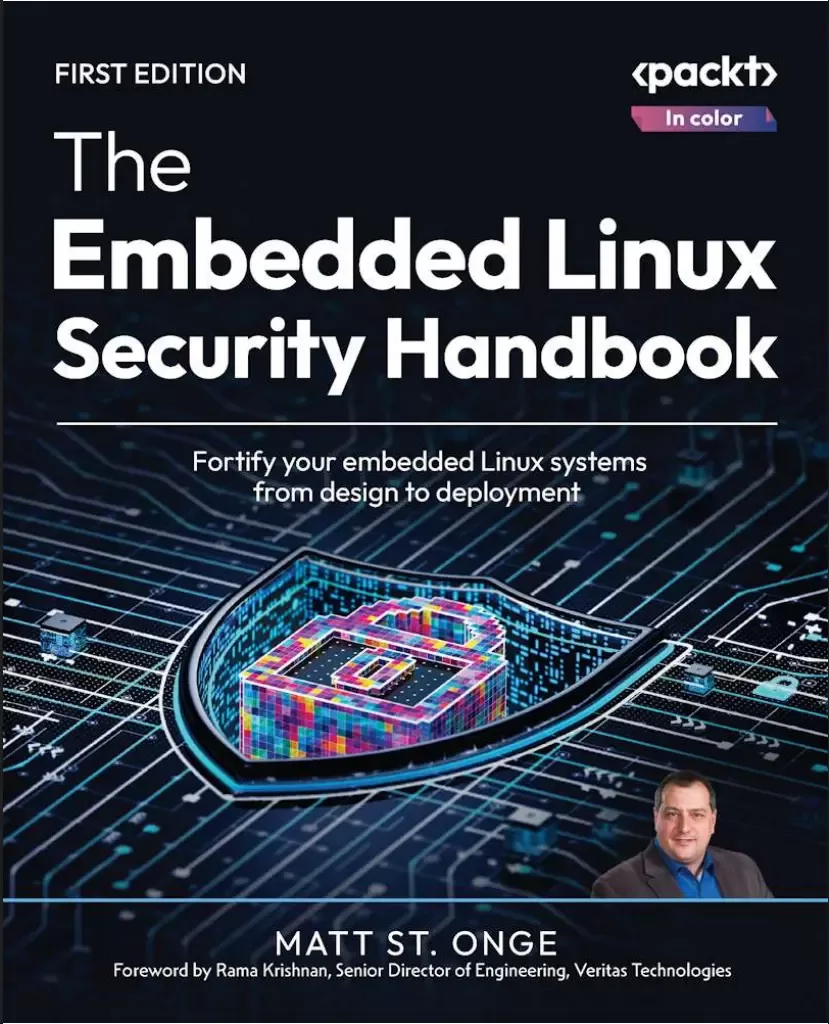
The Embedded Linux Security Handbook: Fortify your embedded Linux systems from design to deployment
Оглавление⌄
The Embedded Linux Security Handbook....2 Foreword....6 Author’s Note....8 Contributors....10 About the author....10 About the reviewers....11 Preface....27 Who this book is for....28 What this book covers....29 To get the most out of this book....30 Download the example code files....30 Conventions used....30 Get in touch....31 Join our community on Discord....32 Share Your Thoughts....32 Download a free PDF copy of this book....32 Part 1:Introduction to Embedded Systems and Secure Design....34 Chapter 1: Welcome to the Cyber Security Landscape....35 What is a Linux-embedded system?....35 How are Linux-embedded systems used?....37 Why is securing Linux-embedded systems so important?....40 Examples where embedded Linux systems had a security breach....41 Summary....42 Chapter 2: Security Starts at the Design Table....43 What are the business needs that the solution caters to?....44 Who is my target buyer and my target user?....45 The target buyer....46 The target user....47 Will any specific government compliance standards drive the decision tree?....48 Healthcare systems (and data privacy)....49 Financial services systems....50 Retail and online marketplace systems....52 Government and military systems....52 How will we support this appliance solution?....55 Managed service....55 Online support....56 Offline support....56 No support/self-support....56 Replacements....57 Other product-impacting needs and concerns....57 Hardware life cycle....57 Linux distribution life cycle....59 Supply chain issues....62 Summary....63 Chapter 3: Applying Design Requirements Criteria – Hardware Selection....64 What are the targeted performance requirements?....65 Virtual appliances....65 T-shirt sizing....66 CPU/VCPU....67 Memory....69 Disk input/output (I/O)....69 Networking....71 GPU....72 Custom hardware and peripherals....73 Are there any environmental limitations?....73 Power....74 Offline/air-gapped....74 Climate control....75 COTS versus custom-built hardware....76 Dell....77 OnLogic™....77 What mainstream CPU/hardware platforms are available?....79 Xeon™....79 Core™....79 Atom™....79 Ryzen™....79 Advanced RISC Machine (ARM™)....80 RISC-V®....80 Power® and IBM Z®....81 Summary....81 Chapter 4: Applying Design Requirements Criteria – the Operating System....83 Matching an operating system to your base hardware platform....83 IBM Power....84 IBM System z....85 RISC-V....85 ARM....87 Driver support, vendor support, and stability....88 Enterprise versus community distributions of Linux....88 Lifecycle of operating systems versus your solution....90 Hard costs versus soft costs....91 Hardware costs....91 Software costs....92 Soft costs....92 Summary....93 Part 2: Design Components....94 Chapter 5: Basic Needs in My Build Chain....95 Technical requirements....96 Software supply chain control....97 Source code control....97 Automation and tool integration – a brief overview....97 Security scanning, testing, and remediation....98 Exercise – executing a network port scan....99 Manifest and configuration tracking....108 Exercise – tracking changes in your product....109 Update control mechanisms....115 Exercise – building custom software packages....116 Exercise – signing your custom RPM package....119 Exercise – creating a custom DNF repository....123 Exercise – configuring your solution to use your custom repository....125 Summary....127 Chapter 6: Disk Encryption....128 Technical requirements....128 Introduction to LUKS....128 Basic implementation review....129 Implementing LUKS on an appliance with automated keys....132 Exercise – implementing LUKS with stored keys and leveraging the crypttab file....132 Is recovery possible?....135 Summary....136 Chapter 7: The Trusted Platform Module....138 What is TPM?....138 The history of TPM....139 Configuring TPM by example....140 Exercise – enabling TPM 2 in conjunction with LUKS encryption....142 Summary....145 Join our community on Discord....145 Chapter 8: Boot, BIOS, and Firmware Security....147 Deep dive into various booting system components....147 Understanding boot-level security using examples....149 Accessing the UEFI configuration....149 What is Secure Boot?....150 Possible threats in firmware....152 Summary....154 Chapter 9: Image-Based Deployments....155 Technical requirements....155 Introducing image-based Linux deployments....156 rpm-ostree and atomic images....156 bootc and bootable container images....158 Special tooling and support infrastructure differences....160 Limitations of image-based deployments....161 rpm-ostree image limitations....162 bootc bootable container image limitations....163 Updating and rolling back changes....163 Upgrade of operating system version in place....164 Practical exercises....164 Exercise 1 – preparing the environment....165 Exercise 2 – creating a container file....171 Exercise 3 – creating an installer....174 Exercise 4 – initial installation....180 Exercise 5 – creating an updated container....183 Exercise 6 – updating your system....185 Summary....186 Chapter 10: Childproofing the Solution: Protection from the End-User and Their Environment....187 Introduction to child-proofing (i.e., protecting the appliance from the end-user)....187 Ensuring hardware-level protections....188 Tamper-proofing with BIOS security....188 USB disablement....189 Case tamper-proofing....190 Operating-system-level and application protections....191 Minimizing access to root....191 SUDO and restricting console access....192 Non-interactive LUKS encryption....193 Keeping users in the application space....193 Application auto-launch at boot....193 Building a UI to simplify configuration while providing a great User Experience (UX)....194 Initial config – text UI....195 Initial config – web UI....200 Update controls – text UI....202 Factory reset controls....203 Summary....205 Part 3: The Build Chain, Appliance Lifecycle, and Continuous Improvement....206 Chapter 11: Knowing the Threat Landscape – Staying Informed....207 Navigating the information and disinformation online....208 Government resources....208 Commercial resources....211 Community resources....212 Knowing what vulnerabilities can impact your builds....214 Running smart searches based on your components....215 Being part of the solution....217 Contribute to the development process....217 Join a user group....218 Summary....219 Chapter 12: Are My Devices’ Communications and Interactions Secure?....220 Technical requirements....220 Bus types and issues....220 USB....222 Serial port....224 The CAN bus....225 Enhancing security with certificates....226 Exercise 1: Creating a self-signed certificate....226 Exercise 2: Adding a certificate to your custom repository server....229 Confirming that your networking is secure....234 Firewalls....234 The command line....235 Web console....236 Graphical UI-based tools....237 Limitations of legacy hardware and software....239 Validating your solution before shipping....240 Summary....241 Chapter 13: Applying Government Security Standards – System Hardening....242 Technical requirements....243 Adherence to key US government standards....243 How do I implement this?....244 Implementation of security standards....245 Validation as part of the QA process....253 Exercise: Installing the OpenSCAP tools and running a scan....253 Example: Using the OpenSCAP Workbench....257 Implementation as part of your continuous integration/continuous deployment (CI/CD) process....261 How do I certify my solution?....262 FIPS certification re-branding by vendors....263 Summary....263 Chapter 14: Customer and Community Feedback Loops....265 Use case development....266 User groups....266 Executive roundtables....269 Community feedback loops....270 Summary....271 Closing the loop....271 Putting all the pieces together....271 Staying engaged....272 Join our community on Discord....273 Index....274 Why subscribe?....290 Other Books You May Enjoy....290 Packt is searching for authors like you....294 Share Your Thoughts....294 Download a free PDF copy of this book....294
Описание
В этом материале разберём тему: embedded.
As embedded Linux systems power countless devices in our daily lives, they’ve become prime targets for cyberattacks. In this in-depth guide to safeguarding your Linux devices, the author leverages his 30+ years of technology experience to help you mitigate the risks associated with hardware and software vulnerabilities.
It takes you through the different types of embedded systems, their uses, and the platforms they run on while addressing their unique security challenges and support considerations. This book introduces you to the world of embedded systems, the brains behind your everyday appliances. You’ll learn to build a successful, secure, and user-friendly solution by exploring the critical hardware and software components that form the foundation of a secure appliance. The book lets you put your newfound knowledge into action, guiding you through designing a robust build chain that supports the entire life cycle of your appliance solution, enabling seamless updates without your direct involvement. We won't forget the human element either; you'll find out how to configure your system to prevent user errors and maintain its integrity.
By the end of this book, you’ll be able to adapt your appliance to the ever-evolving threat landscape, ensuring its continued security and functionality in real-world conditions.
What you will learnUnderstand how to determine the optimal hardware platform based on design criteriaRecognize the importance of security by design in embedded systemsImplement advanced security measures such as TPM, LUKS encryption, and secure boot processesDiscover best practices for secure life cycle management, including appliance update and upgrade mechanismsCreate a secure software supply chain efficientlyImplement childproofing by controlling access and resources on the applianceWho this book is forThis book helps embedded systems professionals, embedded software engineers, and Linux security professionals gain the skills needed to address critical security requirements during the design, development, and testing of software for embedded systems. If you’re a product manager or architect, this book will teach you how to identify and integrate essential security features based on the specific platforms and their intended users.
Если материал оказался полезен — сохраните страницу.
Поделиться
Частые вопросы
Можно ли скачать «The Embedded Linux Security Handbook: Fortify your embedded Linux systems from design to deployment» бесплатно?
Да, «The Embedded Linux Security Handbook: Fortify your embedded Linux systems from design to deployment» доступна для бесплатного скачивания на нашем сайте в формате PDF. Ссылка на файл находится на этой странице.
В каком формате и какого размера файл?
Книга предоставляется в формате PDF, размер файла 7,5 МБ.
Кто автор и когда вышла книга?
автор — Onge Matthew David St. , Ярошенко Алексей Андреевич, издательство Packt Publishing Limited, год выпуска 2025, 302 страниц.
О чём книга «The Embedded Linux Security Handbook: Fortify your embedded Linux systems from design to deployment»?
As embedded Linux systems power countless devices in our daily lives, they’ve become prime targets for cyberattacks.
Похожие материалы
 Security and Privacy Vision in 6G: A Comprehensive Guide
 Ethical Hacking: A Comprehensive Beginner’s Guide to Learn and Understand the Concept of Ethical Hacking
 Kali Linux. Тестирование на проникновение и безопасность
 Защита личной информации в интернете, смартфоне и компьютере
 Хакинг. Искусство эксплойта. 2 изд
 Кибербезопасность стратегии атак и обороны. Безопасность инфраструктуры с использованием тактик Красной и Синей команд
 Секреты безопасности и анонимности в интернете
 Реагирование на компьютерные инциденты. Прикладной курс