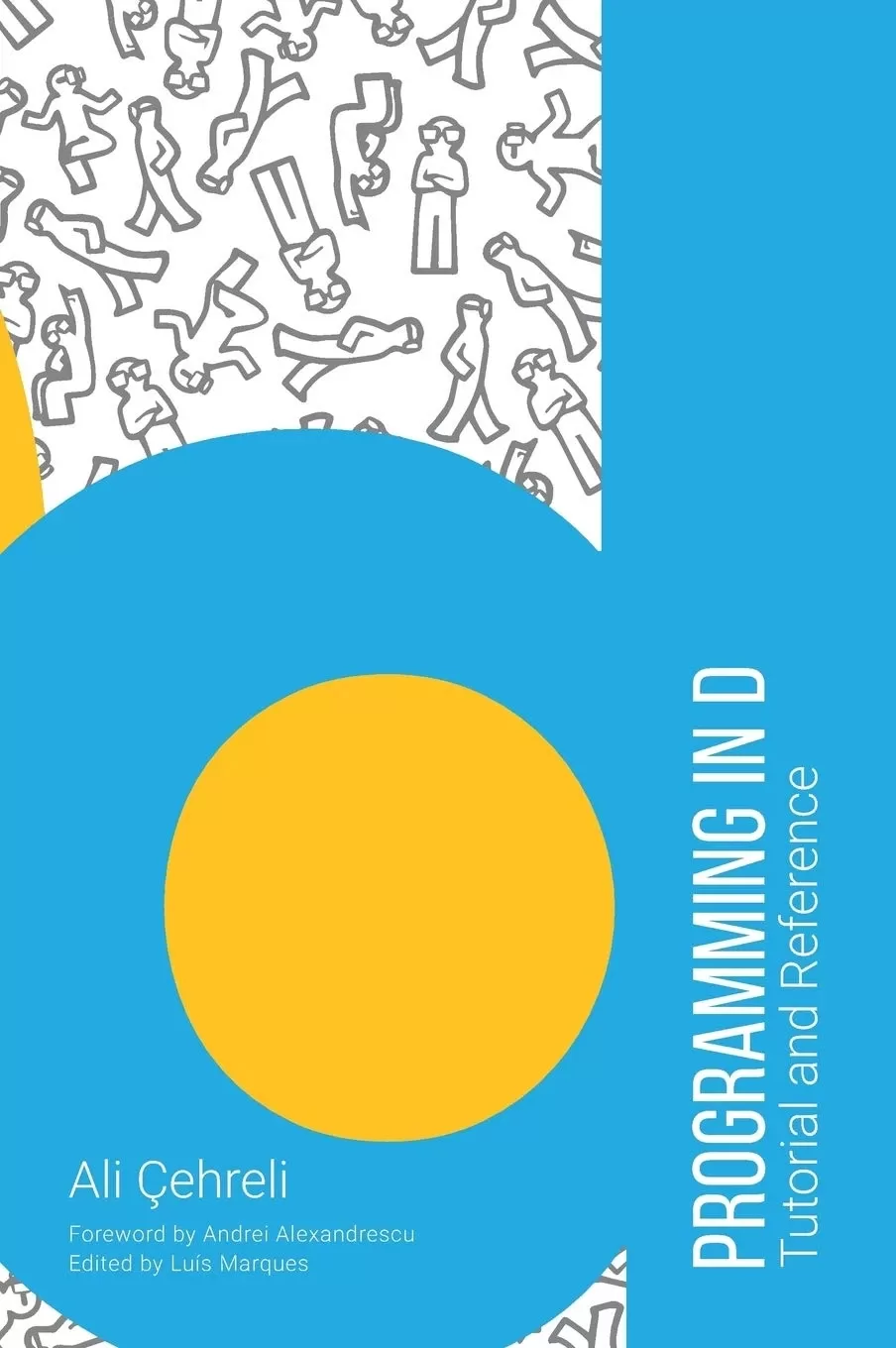
Programming in D
Оглавление⌄
Contents....5 Foreword by Andrei Alexandrescu....17 Preface....19 Acknowledgments....19 The Hello World Program....21 Compiler installation....21 Source file....21 Compiling the hello world program....21 Compiler switches....22 IDE....23 Contents of the hello world program....23 Exercises....24 writeln and write....25 Exercises....25 Compilation....26 Machine code....26 Programming language....26 Interpreter....26 Compiler....27 Compilation error....27 Fundamental Types....28 Properties of types....29 size_t....30 Exercise....30 Assignment and Order of Evaluation....31 The assignment operation....31 Order of evaluation....31 Exercise....31 Variables....32 Exercise....33 Standard Input and Output Streams....34 Exercise....34 Reading from the Standard Input....35 Skipping the whitespace characters....36 Additional information....37 Exercise....37 Logical Expressions....38 Logical Expressions....38 Grouping expressions....41 Reading bool input....41 Exercises....41 if Statement....44 The if block and its scope....44 The else block and its scope....44 Always use the scope curly brackets....45 The "if, else if, else" chain....45 Exercises....47 while Loop....48 The continue statement....48 The break statement....49 Unconditional loop....49 Exercises....50 Integers and Arithmetic Operations....51 Integer types....52 Number of bits of a type....52 Choosing a type....53 Overflow....53 Truncation....53 .min and .max....54 Increment: ++....54 Decrement: --....54 Addition: +....55 Subtraction: -....55 Multiplication: *....56 Division: /....56 Remainder (modulus): %....56 Power: ^^....57 Arithmetic operations with assignment....57 Negation: -....57 Plus sign: +....58 Post-increment: ++....58 Post-decrement: --....58 Operator precedence....59 Detecting overflow....59 Preventing overflow....59 Preventing truncation....60 Exercises....61 Floating Point Types....62 Floating point type properties....62 .nan....63 Specifying floating point values....63 Observations....64 Overflow is not ignored....64 Precision....65 There is no truncation in division....65 Which type to use....66 Cannot represent all values....66 Unorderedness....67 isNaN() for .nan equality comparison....67 Exercises....68 Arrays....69 Definition....69 Containers and elements....70 Accessing the elements....70 Index....71 Fixed-length arrays vs. dynamic arrays....71 Using .length to get or set the number of elements....71 An array example....72 Initializing the elements....72 Basic array operations....73 Copying fixed-length arrays....73 Adding elements to dynamic arrays....73 Removing elements from dynamic arrays....74 Combining arrays....74 Sorting the elements....75 Reversing the elements....75 Exercises....75 Characters....77 History....77 ASCII Table....77 IBM Code Pages....77 ISO/IEC 8859 Code Pages....78 Unicode....78 Unicode encodings....78 The character types of D....79 Character literals....79 Control characters....80 Single quote and backslash....80 The std.uni module....81 Limited support for ı and i....82 Problems with reading characters....82 D's Unicode support....83 Summary....84 Slices and Other Array Features....85 Slices....85 Using $, instead of array.length....86 Using .dup to copy....86 Assignment....87 Making a slice longer may terminate sharing....87 Using capacity to determine whether sharing will be terminated....89 Reserving room for elements....90 Operations on all elements....90 Multi-dimensional arrays....92 Summary....94 Exercise....94 Strings....95 readln and strip, instead of readf....95 formattedRead for parsing strings....96 Double quotes, not single quotes....97 string, wstring, and dstring are immutable....97 Potentially confusing length of strings....98 String literals....99 String concatenation....99 Comparing strings....100 Lowercase and uppercase are different....100 Exercises....101 Redirecting the Standard Input and Output Streams....102 Redirecting the standard output to a file with operator >....102 Redirecting the standard input from a file with operator <....102 Redirecting both standard streams....103 Piping programs with operator |....103 Exercise....103 Files....104 Fundamental concepts....104 The producer and the consumer....104 Access rights....104 Opening a file....104 Closing a file....105 Writing to and reading from files....105 eof() to determine the end of a file....105 The std.file module....105 std.stdio.File struct....106 Writing to a file....106 Reading from a file....106 Exercise....107 auto and typeof....108 auto....108 typeof....108 Exercise....109 Name Scope....110 Defining names closest to their first use....110 for Loop....112 The sections of the while loop....112 The sections of the for loop....112 The sections may be empty....113 The name scope of the loop variable....114 Exercises....114 Ternary Operator ?:....115 The type of the ternary expression....116 Exercise....117 Literals....118 Integer literals....118 The types of integer literals....118 The L suffix....119 The U suffix....119 Floating point literals....120 The types of floating point literals....120 Character literals....120 String literals....121 Double-quoted string literals....121 Wysiwyg string literals....121 Delimited string literals....121 Token string literals....122 Types of string literals....122 Literals are calculated at compile time....122 Exercises....122 Formatted Output....123 format_character....124 width....126 separator....126 precision....127 flags....127 Positional parameters....128 Formatted element output....129 format....130 Checked format string....131 Exercises....131 Formatted Input....132 Format specifier characters....133 Exercise....133 do-while Loop....134 Exercise....135 Associative Arrays....136 Definition....136 Adding key-value pairs....137 Initialization....137 Removing key-value pairs....137 Determining the presence of a key....138 Properties....138 Example....139 Exercises....139 foreach Loop....140 The foreach syntax....140 continue and break....141 foreach with arrays....141 foreach with strings and std.range.stride....141 foreach with associative arrays....142 foreach with number ranges....142 foreach with structs, classes, and ranges....142 The counter is automatic only for arrays....143 The copy of the element, not the element itself....143 The integrity of the container must be preserved....144 foreach_reverse to iterate in the reverse direction....144 Exercise....145 switch and case....146 The goto statement....146 The expression must be an integer, string, or bool type....148 Value ranges....149 Distinct values....149 The final switch statement....149 When to use....150 Exercises....150 enum....151 Effects of magic constants on code quality....151 The enum syntax....151 Actual values and base types....152 enum values that are not of an enum type....152 Properties....153 Converting from the base type....154 Exercise....154 Functions....155 Parameters....156 Calling a function....158 Doing work....158 The return value....158 The return statement....159 void functions....159 The name of the function....160 Code quality through functions....160 Code duplication is harmful....160 Commented lines of code as functions....164 Exercises....164 Immutability....166 Immutable variables....166 enum constants....166 immutable variables....168 const variables....169 Immutable parameters....169 const parameters....170 immutable parameters....171 Should a parameter be const or immutable?....171 Immutability of the slice versus the elements....173 const and immutable are transitive....174 .dup and .idup....174 How to use....174 Summary....175 Value Types and Reference Types....176 Value types....176 The use of assert checks below....176 Value identity....177 Address-of operator, &....177 Reference variables....177 Reference types....178 The difference in the assignment operation....180 Variables of reference types may not be referencing any object....181 Fixed-length arrays are value types, slices are reference types....182 Experiment....182 Summary....184 Function Parameters....185 Parameters are always copied....185 Referenced variables are not copied....186 Surprising reference semantics of slices....186 Surprising reference semantics of associative arrays....187 Parameter qualifiers....188 in....188 out....188 const....189 immutable....190 ref....190 auto ref....191 inout....191 lazy....193 scope....194 shared....194 return....195 Summary....196 Exercise....197 Lvalues and Rvalues....198 Limitations of rvalues....198 Rvalues don't have memory addresses....198 Rvalues cannot be assigned new values....198 Rvalues cannot be passed to functions by reference....199 Using auto ref parameters to accept both lvalues and rvalues....199 Terminology....200 Lazy Operators....201 Program Environment....202 The return value of main()....202 main() always returns a value....202 Specifying the return value....203 Standard error stream stderr....204 Parameters of main()....204 Command line options and the std.getopt module....205 Environment variables....207 Starting other programs....207 Summary....208 Exercises....208 Exceptions....209 The throw statement to throw exceptions....209 The exception types Exception and Error....210 Thrown exception terminates all scopes....210 When to use throw....214 The try-catch statement to catch exceptions....214 catch blocks are considered sequentially....216 The finally block....218 When to use the try-catch statement....218 Exception properties....219 Kinds of errors....220 User errors....220 Programmer errors....221 Unexpected situations....222 Summary....222 scope....223 assert and enforce....225 Syntax....225 static assert....226 assert even if absolutely true....227 No value nor side effect....227 Disabling assert checks....228 enforce for throwing exceptions....228 How to use....228 Exercises....229 Unit Testing....231 Causes of bugs....231 Discovering the bugs....231 Unit testing for catching bugs....232 Activating the unit tests....233 unittest blocks....233 Testing for exceptions....234 Test driven development....235 Unit tests before bug fixes....236 Exercise....237 Contract Programming....238 in blocks for preconditions....238 out blocks for postconditions....239 Disabling contract programming....241 in blocks versus enforce checks....241 Exercise....242 Lifetimes and Fundamental Operations....244 Lifetime of a variable....244 Lifetime of a parameter....244 Fundamental operations....245 Initialization....246 Finalization....247 Assignment....248 The null Value and the is Operator....249 The null value....249 The is operator....250 The !is operator....250 Assigning the null value....250 Summary....251 Type Conversions....253 Automatic type conversions....253 Integer promotions....254 Arithmetic conversions....254 Slice conversions....255 const conversions....256 immutable conversions....256 enum conversions....257 bool conversions....257 Explicit type conversions....258 Construction syntax....258 to() for most conversions....259 assumeUnique() for fast immutable conversions....259 The cast operator....260 Summary....261 Structs....262 Definition....262 struct defines a type, not a variable....263 Coding convenience....263 Accessing the members....264 Construction....265 Constructing objects as immutable....266 Trailing members need not be specified....266 Specifying default values for members....267 Constructing by the {} syntax....267 Copying and assignment....267 Careful with members that are of reference types!....268 Struct literals....269 static members....269 static this() for initialization and static ~this() for finalization....271 Exercises....272 Variable Number of Parameters....274 Default arguments....274 Special keywords as default arguments....275 Variadic functions....276 Variadic function arguments have a short lifetime....278 Exercise....279 Function Overloading....281 Overload resolution....282 Function overloading for user-defined types....282 Limitations....283 Exercise....284 Member Functions....285 Defining member functions....285 toString() for string representations....286 Example: increment() member function....287 Exercises....289 const ref Parameters and const Member Functions....291 immutable objects....291 ref parameters that are not const....291 const ref parameters....291 Non-const member functions....292 const member functions....292 inout member functions....293 How to use....294 Constructor and Other Special Functions....295 Constructor....295 Constructor syntax....295 Compiler-generated automatic constructor....296 Accessing the members by this.....296 User-defined constructors....297 First assignment to a member is construction....298 User-defined constructor disables compiler-generated constructor....298 static opCall instead of the default constructor....299 Calling other constructors....300 Constructor qualifiers....300 Immutability of constructor parameters....302 Type conversions through single-parameter constructors....303 Disabling the default constructor....303 Destructor....304 Destructor is executed automatically....304 Destructor example....305 Postblit....307 Disabling postblit....308 Assignment operator....308 Assigning from other types....309 Summary....310 Operator Overloading....311 Overloadable operators....313 Unary operators....313 Binary operators....314 Element indexing and slicing operators....315 Other operators....316 Defining more than one operator at the same time....316 Return types of operators....317 opEquals() for equality comparisons....319 opCmp() for sorting....320 opCall() to call objects as functions....322 Indexing operators....323 Indexing operators example....324 Slicing operators....326 opCast for type conversions....328 Catch-all operator opDispatch....330 Inclusion query by opBinaryRight!"in"....330 Example of the in operator....331 Exercise....332 Classes....335 Comparing with structs....335 Classes are reference types....335 Class variables may be null....335 Class variables versus class objects....336 Copying....336 Assignment....337 Definition....337 Construction....338 Destruction....338 Member access....339 Operator overloading....339 Member functions....339 The is and !is operators....340 Summary....340 Inheritance....341 Warning: Inherit only if "is a"....343 Inheritance from at most one class....343 Hierarchy charts....344 Accessing superclass members....344 Constructing superclass members....345 Overriding the definitions of member functions....346 Using the subclass in place of the superclass....347 Inheritance is transitive....348 Abstract member functions and abstract classes....349 Example....350 Summary....353 Exercises....353 Object....355 typeid and TypeInfo....355 toString....357 opEquals....357 opCmp....360 opCmp for string members....361 toHash....362 Hash table indexes....362 Selecting members for toHash....363 Calculating hash values....363 Hash values for structs....364 Exercises....364 Interfaces....367 Definition....367 Inheriting from an interface....367 Inheriting from more than one interface....368 Inheriting from interface and class....369 Inheriting interface from interface....369 static member functions....369 final member functions....371 How to use....372 Abstraction....372 Example....373 Summary....374 destroy and scoped....376 An example of calling destructors late....376 destroy() to execute the destructor....377 When to use....377 Example....377 scoped() to call the destructor automatically....380 Summary....381 Modules and Libraries....383 static this() and static ~this()....383 File and module names....383 Packages....384 Importing modules....384 Selective imports....385 Local imports....385 Locations of modules....386 Long and short module names....386 Renamed imports....386 Importing a package as a module....387 Deprecating features....387 Adding module definitions to the program....388 Libraries....389 Using libraries of other languages....389 Encapsulation and Protection Attributes....392 Encapsulation....393 Protection attributes....393 Definition....394 Module imports are private by default....394 When to use encapsulation....395 Example....396 Universal Function Call Syntax (UFCS)....398 Properties....401 Calling functions without parentheses....401 Property functions that return values....401 Property functions that are used in assignment....402 Properties are not absolutely necessary....403 When to use....404 Contract Programming for Structs and Classes....406 Preconditions and postconditions for member functions....406 Preconditions and postconditions for object consistency....407 invariant() blocks for object consistency....408 Contract inheritance....409 Unintentionally disabling preconditions....411 Summary....411 Templates....413 Function templates....414 More than one template parameter....415 Type deduction....416 Explicit type specification....416 Template instantiation....417 Template specializations....417 Struct and class templates....418 Default template parameters....420 Every template instantiation yields a distinct type....421 A compile-time feature....421 Class template example: stack data structure....421 Function template example: binary search algorithm....424 Summary....426 Pragmas....428 pragma(msg)....428 pragma(lib)....428 pragma(inline)....428 pragma(startaddress)....430 pragma(mangle)....430 alias and with....432 alias....432 Shortening a long name....432 Design flexibility....433 Revealing hidden names of superclasses....434 with....436 Summary....437 alias this....438 Multiple inheritance....438 Pointers....441 The concept of a reference....441 The ref variables in foreach loops....441 ref function parameters....442 Reference types....442 Syntax....443 Pointer value and the address-of operator &....444 The access operator *....445 The . (dot) operator to access a member of the pointee....445 Modifying the value of a pointer....446 Pointers are risky....448 The element one past the end of an array....448 Using pointers with the array indexing operator []....449 Producing a slice from a pointer....450 void* can point at any type....450 Using pointers in logical expressions....451 new returns a pointer for some types....452 The .ptr property of arrays....453 The in operator of associative arrays....453 When to use pointers....454 When required by libraries....454 When referencing variables of value types....454 As member variables of data structures....455 When accessing memory directly....455 Examples....455 A simple linked list....455 Observing the contents of memory by ubyte*....457 Exercises....460 Bit Operations....462 Representation of data at the lowest level....462 Transistor....462 Bit....462 Byte....462 Register....462 Binary number system....463 The sign bit of signed integer types....464 Hexadecimal number system....464 Bit operations....466 Complement operator: ~....466 And operator: &....467 Or operator: |....467 Xor operator: ^....468 Right-shift operator: >>....468 Unsigned right-shift operator: >>>....469 Left-shift operator: <<....469 Operators with assignment....470 Semantics....470 | is a union set....470 & is an intersection set....470 |= sets selected bits to 1....471 &= clears selected bits....471 & determines whether a bit is 1 or not....471 Right-shifting by one is the equivalent of dividing by two....472 Left-shifting by one is the equivalent of multiplying by two....472 Common uses....472 Flags....472 Masking....473 Exercises....474 Conditional Compilation....476 debug....476 debug(tag)....478 debug(level)....478 version(tag) and version(level)....479 Assigning identifiers to debug and version....480 static if....480 static assert....481 Type traits....482 Summary....483 is Expression....484 is (T)....484 is (T Alias)....484 is (T : OtherT)....485 is (T Alias : OtherT)....485 is (T == Specifier)....485 Whether the same type....485 Whether matches the same specifier....486 is (T identifier == Specifier)....487 is (/* ... */ Specifier, TemplateParamList)....488 Function Pointers, Delegates, and Lambdas....491 Function pointers....491 Member function pointers....491 Definition....492 Calling a function pointer....492 When to use....492 Function pointer as a parameter....493 Function pointer as a member....495 Anonymous functions....496 Shorter syntax....496 Lambda syntax instead of a single return statement....497 Delegates....499 Shorter syntax....500 An object and a member function as a delegate....500 Delegate properties....502 Lazy parameters are delegates....502 Lazy variadic functions....503 toString() with a delegate parameter....503 Summary....505 foreach with Structs and Classes....507 foreach support by range member functions....507 Example....508 std.range.retro to iterate in reverse....508 foreach support by opApply and opApplyReverse member functions....509 Overloading opApply to iterate in different ways....511 Loop counter....512 Loop counter with range functions....512 Loop counter with opApply....513 Warning: The collection must not mutate during the iteration....514 Exercises....515 Nested Functions, Structs, and Classes....516 static when a closure is not needed....517 Classes nested inside classes....518 Summary....519 Unions....520 Anonymous unions....521 Dissecting other members....521 Examples....522 Communication protocol....522 Discriminated union....523 Labels and goto....526 goto....526 Finalization area....526 continue and break for outer loops....527 The problem of skipping constructors....527 Loop labels....528 goto in case sections....528 Summary....528 Tuples....529 Tuple and tuple()....529 Member properties....529 Expanding the members as a list of values....530 Compile-time foreach....530 Returning multiple values from functions....531 AliasSeq....532 AliasSeq consisting of values....532 Indexing and slicing....533 AliasSeq consisting of types....533 foreach with AliasSeq....534 .tupleof property....534 Summary....535 More Templates....536 The shortcut syntax....536 Template name space....537 Eponymous templates....537 Kinds of templates....538 Function, class, and struct templates....538 Member function templates....538 Union templates....539 Interface templates....541 Kinds of template parameters....541 Type template parameters....541 Value template parameters....541 this template parameters for member functions....544 alias template parameters....545 Tuple template parameters....547 typeof(this), typeof(super), and typeof(return)....549 Template specializations....550 Meta programming....550 Compile-time polymorphism....552 Code bloat....553 Template constraints....554 Tuple parameter of single element....555 Named constraints....555 Using templates in multi-dimensional operator overloading....557 Multi-dimensional operator overloading example....559 Summary....562 More Functions....563 Return type attributes....563 auto functions....563 ref functions....563 auto ref functions....565 inout functions....565 Behavioral attributes....566 pure functions....566 nothrow functions....570 @nogc functions....571 Code safety attributes....571 @safe functions....572 @trusted functions....572 @system functions....572 Compile time function execution (CTFE)....572 The __ctfe variable....574 Summary....574 Mixins....576 Template mixins....576 Template mixins must use local imports....577 Identifying the type that is mixing in....578 String mixins....578 Mixin name spaces....579 String mixins in operator overloading....580 Mixed in destructors....581 Importing text files....581 Example....582 Ranges....584 History....584 Ranges are an integral part of D....585 Traditional implementations of algorithms....585 Phobos ranges....586 Iterating by shortening the range....587 InputRange....588 InputRange example....588 The std.array module to use slices as ranges....590 Automatic decoding of strings as ranges of dchar....591 Ranges without actual elements....592 Infinite ranges....593 Functions that return ranges....594 std.range and std.algorithm modules....595 Laziness....597 ForwardRange....597 BidirectionalRange....599 RandomAccessRange....600 Infinite RandomAccessRange....600 Finite RandomAccessRange....602 OutputRange....606 Using slices as OutputRange....607 Range templates....609 Summary....609 More Ranges....610 Range kind templates....610 ElementType and ElementEncodingType....613 More range templates....613 Run-time polymorphism with inputRangeObject() and outputRangeObject()....614 Summary....615 static foreach....616 Parallelism....619 taskPool.parallel()....621 Work unit size....622 Task....622 Exceptions....624 Member functions of Task....625 taskPool.asyncBuf()....626 taskPool.map()....628 taskPool.amap()....630 taskPool.reduce()....631 Multiple functions and tuple results....634 TaskPool....634 Summary....635 Message Passing Concurrency....636 Concepts....636 Starting threads....637 Thread identifiers....638 Message Passing....639 Example....640 Expecting different types of messages....643 Receiving any type of message....644 Waiting for messages up to a certain time....645 Exceptions during the execution of the worker....645 Detecting thread termination....648 OwnerTerminated exception....648 LinkTerminated exception....649 Receiving exceptions as messages....649 Mailbox management....650 Priority messages....651 Thread names....651 Summary....653 Data Sharing Concurrency....654 Sharing is not automatic....654 shared to share mutable data between threads....655 A race condition example....656 synchronized to avoid race conditions....657 shared static this() for single initialization and shared static ~this() for single finalization....661 Atomic operations....662 atomicOp....662 cas....663 Summary....664 Fibers....665 Call stack....665 Recursion....666 Usage....667 Fibers in range implementations....668 std.concurrency.Generator for presenting fibers as ranges....672 Fibers in asynchronous input and output....674 Exceptions and fibers....678 Cooperative multitasking....679 Summary....680 Memory Management....681 Memory....681 The garbage collector....681 Starting and delaying garbage collection cycles....682 Allocating memory....683 Memory block attributes....685 Example of extending a memory area....687 Alignment....688 The .alignof property....688 The .offsetof property....690 The align attribute....692 Constructing variables at specific memory locations....693 Constructing a struct object at a specific location....693 Constructing a class object at a specific location....694 Destroying objects explicitly....697 Constructing objects at run time by name....698 Summary....699 User Defined Attributes (UDA)....700 Example....702 The benefit of user defined attributes....704 Summary....705 Operator Precedence....706 Chaining....706 Associativity....707 Unordered operator groups....707 The precedence of =>....707 Comma operator....708 Exercise Solutions....709 The Hello World Program....709 writeln and write....709 Fundamental Types....709 Assignment and Order of Evaluation....709 Variables....710 Standard Input and Output Streams....710 Reading from the Standard Input....710 Logical Expressions....710 The if Statement....711 The while Loop....712 Integers and Arithmetic Operations....713 Floating Point Types....714 Arrays....715 Slices and Other Array Features....717 Strings....718 Redirecting the Standard Input and Output Streams....718 Files....718 auto and typeof....719 The for Loop....719 The Ternary Operator ?:....720 Literals....720 Formatted Output....721 Formatted Input....721 The do-while Loop....722 Associative Arrays....722 The foreach Loop....723 switch and case....723 enum....725 Functions....726 Function Parameters....726 Program Environment....727 assert and enforce....727 Unit Testing....729 Contract Programming....731 Structs....732 Variable Number of Parameters....734 Function Overloading....736 Member Functions....737 Operator Overloading....739 Inheritance....743 Object....746 Pointers....747 Bit Operations....750 foreach with Structs and Classes....750 Index....754 A....755 B....755 C....756 D....757 E....757 F....758 G....758 H....759 I....759 J....760 K....760 L....760 M....760 N....761 O....761 P....762 Q....763 R....763 S....763 T....764 U....765 V....766 W....766 X....766 Y....766Описание
В этом материале разберём тему: book.
The main aim of this book is to teach D to readers who are new to computer programming. Although having experience in other programming languages is certainly helpful, this book starts from the basics.
It has C-like syntax and static typing. D is a multi-paradigm system programming language that combines a wide range of powerful programming concepts from the lowest to the highest levels. It pragmatically combines efficiency, control, and modeling power, with safety and programmer productivity in mind.
Each chapter is based on the contents of the previous ones, introducing as few new concepts as possible. It is recommended that the book is read in linear fashion, without skipping chapters if possible.
Although this book was written with beginners in mind, it covers almost all features of D. More experienced programmers can use the book as a D language reference by starting from the index section.
Ali's book is a gem. Blurbs from the back cover:"D is pristine, clean, immensely powerful, and arguably the actual state-of-the-art programming language. Clear, concise, and complete." - Olivier Henley"I have been using Ali's online D book to teach D at the university level. Having a print version is even better! It is up-to-date, complete, and most importantly, extremely readable. This is now the 'go-to' book for learning D programming." - Chuck Allison, Professor and Chair, Computer Science Department, Utah Valley University"Ali's explanations are succinct and on target. This is the best computer language book I've read." - Robbin Carlson, Luthier and Enterprise Architect"I taught a CS2 Data Structures class in D with more success and student appreciation than when using either C++ or Java as it's an ideal language to express the relevant concepts at all scales, from detailed to big picture, without needless complexity. I like that he provides rationale for why D was designed in a particular way and how I can use it most effectively. Ali Çehreli's tutorial played a central role supporting students especially during the first half of the course -- without it the course simply would not have worked, so "many thanks Ali" -- and an important part of that is its linearity -- it can be read with only backward dependencies. It is hard to overstate this factor. This meant that with hard work even students of little experience and only moderate current abilities could get up to speed, and we saw just that. I unreservedly recommend this book to all." - Dr. Not exactly 'D for Dummies' but it's easy to follow even if you don't have much experience with compiled languages." - bachmeier, Reddit user"Having worked through the book, I have to say this is one of the easiest to follow and distraction free read there is and the fact that it made learning a new language a total breeze really impressed me." - Imran Khan, Student Carl Sturtivant, University of Minnesota Department of Computer Science & Engineering"This book is one of the best guides through the language that I've seen." - Andrew Wray, D Enthusiast"I encourage anyone considering D to read this book.
Если материал оказался полезен — сохраните страницу.
Поделиться
Частые вопросы
Можно ли скачать «Programming in D» бесплатно?
Да, «Programming in D» доступна для бесплатного скачивания на нашем сайте в формате PDF. Ссылка на файл находится на этой странице.
В каком формате и какого размера файл?
Книга предоставляется в формате PDF, размер файла 4,0 МБ.
Кто автор и когда вышла книга?
автор — Çehreli Ali, издательство Independent publishing, год выпуска 2018, 766 страниц.
О чём книга «Programming in D»?
The main aim of this book is to teach D to readers who are new to computer programming.
Похожие материалы
 Язык программирования D
 Learning D: Leverage the modern convenience and modelling power of the D programming language to develop software with native efficiency
 Шаблоны D: учебное пособие
 D Web Development: Leverage the Power of D and the Vibe.d Framework to Develop Web Applications That Are Incredibly Fast