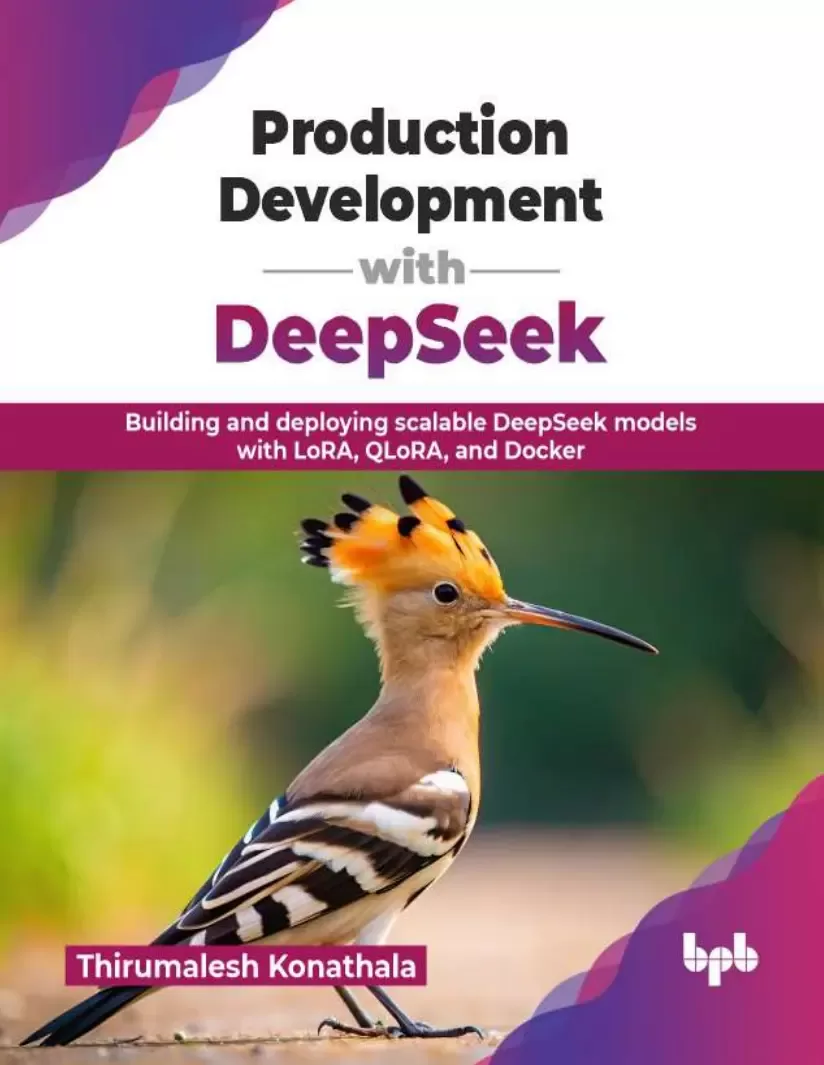
Production Development with DeepSeek: Building and deploying scalable DeepSeek models with LoRA, QLoRA, and Docker
Оглавление⌄
Cover....2 Title Page....3 Copyright Page....4 Dedication Page....5 About the Author....6 About the Reviewer....7 Acknowledgement....8 Preface....9 Table of Contents....14 1. Introduction to DeepSeek....28 Introduction....28 Structure....29 Objectives....29 Introduction to DeepSeek....29 Main features and abilities....29 Comparison with traditional LLMs....31 The significance of reasoning abilities....33 Origins and development....34 The research team behind DeepSeek....34 Evolution from concept to implementation....34 Key milestones in DeepSeek's development....35 Key research and contributions....36 Reinforcement learning innovations....36 Mixture of expert architecture....37 Distillation of reasoning capabilities....38 Impact on the AI landscape....38 Applications and use cases....39 Conclusion....41 Points to remember....42 Key terms....43 2. Understanding the Essentials of DeepSeek....45 Introduction....45 Structure....46 Objectives....46 Reasoning capabilities....46 The emergence of reasoning in DeepSeek....47 Core reasoning abilities....48 Performance metrics....49 Chain-of-thought reasoning....50 Emergent behaviors in reasoning....52 Comparative advantage in reasoning....53 Introduction to reinforcement learning....54 Fundamental concepts of reinforcement learning....55 The reinforcement learning process....55 Reinforcement learning vs. traditional training methods....56 Pretraining....56 Supervised fine-tuning....57 Reinforcement learning....57 Key reinforcement learning concepts applied to DeepSeek....58 Reward functions....58 Exploration vs. exploitation....58 Policy optimization....58 DeepSeek's reinforcement learning implementation....59 DeepSeek-R1-Zero trained through reinforcement learning....59 DeepSeek-R1 using a hybrid approach....60 Self-learning and emergent behaviors....60 The aha moment....61 Thinking time allocation....61 Self-verification....61 Challenges and solutions in reinforcement learning training....62 Role of reinforcement learning in DeepSeek's reasoning capabilities....63 Introduction to Group Relative Policy Optimization....64 Policy optimization fundamentals....64 Traditional policy optimization....64 Challenges in LLM policy optimization....65 A more efficient approach using GRPO....66 Eliminating the critic model....66 The GRPO algorithm....66 Implementation in DeepSeek....68 DeepSeek-R1-Zero training....68 DeepSeek-R1 implementation....70 Advantages of GRPO....70 Limitations and considerations....71 Conclusion....72 Points to remember....72 Key terms....73 3. Overview of DeepSeek Models and Types....75 Introduction....75 Structure....75 Objectives....76 Language models....76 Evolution of DeepSeek language models....77 Architecture and technical specifications....79 Capabilities and performance....80 Mathematical and logical reasoning....80 Scientific reasoning....80 Programming and code generation....81 Natural language understanding and generation....81 Applications of DeepSeek language models....81 Research and academia....81 Education....81 Software development....81 Business intelligence....82 Content creation....82 Vision models....82 Bridging vision and language using DeepSeek-VL....82 Architecture and design....83 Capabilities and performance....84 Specialized vision processing using DeepSeek-VL....84 Applications of DeepSeek vision models....85 Healthcare and medical imaging....85 Retail and e-commerce....85 Manufacturing and quality control....85 Document processing....86 Autonomous systems....86 Distilled models....86 The distillation process....86 The process of distillation....87 Innovations in DeepSeek's distillation approach....88 The DeepSeek-R1-Distill series....89 Available models and specifications....89 Quick download and setup summary....90 Performance benchmarks....91 Practical applications of distilled models....91 Edge computing....91 Cost-effective deployment....92 Latency-sensitive applications....92 Educational and research accessibility....92 Trade-offs and considerations....93 Performance gaps....93 Domain specificity....93 Continuous improvement....93 Comparative analysis of DeepSeek models....94 Performance vs. resource requirements....94 Selecting the right model for your use case....94 Conclusion....96 Points to remember....97 Key terms....98 4. Production Approaches....100 Introduction....100 Structure....101 Objectives....101 API....101 Understanding how API based deployment works....102 DeepSeek API services....103 API pricing and quotas....105 API integration best practices....106 Error handling and retries....106 Caching....107 Prompt engineering....108 Token optimization....108 API security considerations....109 Local LLMs....110 Understanding how local LLM deployment works....110 DeepSeek local deployment options....111 Hardware requirements....112 Deployment frameworks and tools....112 Hugging Face Transformers....112 VLLM....113 Ollama....114 LlamaIndex....115 Optimization techniques....115 Quantization....115 Model sharding....116 Key-Value cache management....117 Flash Attention....118 Local deployment architectures....118 Single-server deployment....118 Distributed deployment....118 Hybrid deployment....119 Local deployment best practices....119 Security considerations....120 Pros and cons of API versus local LLMs....121 Performance and latency....121 Cost and resource requirements....122 Data privacy and security....123 Customization and control....124 Scalability and reliability....125 Choosing the right approach....126 Conclusion....127 Points to remember....128 Key terms....129 5. Setup and Environment....131 Introduction....131 Structure....132 Objectives....132 Local LLM tools....133 Core frameworks and libraries....133 Installation....133 Hugging Face Transformers....134 Accelerate....134 VLLM....134 Specialized tools for local deployment....135 Ollama....135 LM Studio....135 Text Generation WebUI....136 Optimization libraries....136 bitsandbytes....136 Flash Attention....137 AutoGPTQ....137 Setting up your environment....137 System requirements....138 Setting up a Python environment....138 GPU setup for NVIDIA cards....139 Environment configuration for optimal performance....139 Troubleshooting common setup issues....140 CUDA out of memory errors....141 Slow inference performance....142 Dependency conflicts....143 Hello DeepSeek: Your first model....143 Choosing the right DeepSeek model....143 Downloading and loading the model....144 Using Hugging Face Transformers....144 Using Ollama....145 Using LM Studio....145 Running inference with DeepSeek....146 Using Hugging Face Transformers....146 Using Ollama....147 Using LM Studio....147 Exploring DeepSeek's capabilities....147 Optimizing inference for use case....149 Prompt engineering....149 Parameter tuning....149 Batch processing....150 Streaming generation....151 Building a simple chat application....152 Conclusion....154 Points to remember....155 Key terms....156 6. Supervised Fine-tuning....158 Introduction....158 Structure....159 Objectives....159 Understanding supervised fine-tuning....159 The fine-tuning paradigm....160 Knowing when to use fine-tuning....160 The fine-tuning process....161 Dataset preparation....161 Model selection....163 Hyperparameter selection....164 Training execution....164 Evaluation....164 Fine-tuning DeepSeek models....165 Challenges in traditional fine-tuning....167 Parameter-efficient techniques....168 Low-Rank Adaptation....168 Learning how LoRA works....168 Advantages of LoRA....169 Implementing LoRA for DeepSeek models....169 Target modules for DeepSeek models....172 Quantized Low-Rank Adaptation....173 Learning how QLoRA works....173 Advantages of QLoRA....173 Implementing QLoRA for DeepSeek models....174 Comparing fine-tuning approaches....177 Best practices for parameter-efficient fine-tuning....178 Merging LoRA adapters with base models....179 Advanced techniques and future directions....181 Conclusion....181 Points to remember....182 Key terms....183 7. Reinforcement Learning from Human Feedback....185 Introduction....185 Structure....186 Objectives....186 Understanding reinforcement learning from human feedback....187 The RLHF paradigm....188 Reasons why RLHF matters....189 The RLHF process in detail....189 Supervised fine-tuning....190 Reward modeling....190 Preference data collection....190 Reward model training....191 Policy optimization....191 Proximal policy optimization....192 KL penalty and reference model....193 Challenges and considerations in RLHF....193 Advanced RLHF techniques....195 Direct preference optimization....195 Iterative RLHF....197 Constitutional AI....197 Group Relative Policy Optimization....197 Role of RLHF in DeepSeek development....198 Implementing RLHF with DeepSeek....200 Prerequisites....200 Preference data collection....200 Generating responses for comparison....200 Building a preference collection interface....201 Preference data guidelines....203 Reward model training....204 Preparing the dataset....204 Implementing the reward model....205 Training the reward model....207 Policy optimization with proximal policy optimization....208 Setting up the proximal policy optimization environment....208 Implementing the proximal policy optimization training loop....210 Implementing direct preference optimization....212 Implementing Group Relative Policy Optimization....213 Evaluating RLHF models....218 Preference evaluation....218 Task-specific evaluation....221 Safety and alignment evaluation....222 Conclusion....224 Points to remember....224 Key terms....225 8. Deploying DeepSeek with Inference and RAG....228 Introduction....228 Structure....229 Objectives....229 Inference endpoint with Hugging Face....229 Retrieval-augmented generation....230 Understanding how RAG works....230 Building a RAG system with DeepSeek....231 Document processing and indexing....232 Retrieval component....233 Prompt construction....234 Generation with DeepSeek....234 A complete RAG system....235 Improving response quality with retrieval pipelines....236 Hybrid search....236 Re-ranking....237 Query decomposition....238 Hypothetical Document Embeddings....239 Evaluating RAG systems....240 Relevance evaluation....240 Answer quality evaluation....241 Hallucination assessment....242 Retrieval-augmented generation applications with DeepSeek....243 Medical question answering....243 Legal research....243 Technical support....244 Educational content....245 Conclusion....245 Points to remember....246 Key terms....247 9. Deploying DeepSeek with Cloud, Multimodal and Agents....249 Introduction....249 Structure....249 Objectives....250 Cloud deployment with AWS....250 Install dependencies....251 Inference endpoint....251 FastAPI app....252 Run the server....252 Multimodal applications....253 Understanding multimodal integration....253 Building multimodal applications with DeepSeek-VL....254 Setting up DeepSeek-VL....254 Image captioning....255 Visual Question Answering....256 Image-based reasoning....257 Image-to-Text Generation....258 Putting the multimodal application all together....259 Advanced multimodal techniques....259 Retrieval-augmented generation....260 Multimodal retrieval-augmented generation....260 Improving response qauality with retrieval pipelines....261 Multimodal chain-of-thought reasoning....261 Multimodal few-shot learning....263 Multimodal applications with DeepSeek-VL....265 Intelligent agents....266 Agent architecture....266 Building agents with DeepSeek....267 Setting up the language model....267 Implementing memory....268 Defining tools....269 Implementing planning and execution....271 Implementing the agent....272 Advanced agent techniques....273 Reasoning and Acting....274 Tool learning....275 Chain of thought planning....276 Self-reflection and correction....278 Agent applications with DeepSeek....279 Conclusion....281 Points to remember....281 Key terms....283 10. Dockerization and Real-world Applications....285 Introduction....285 Structure....286 Objectives....286 Introduction to Docker....287 Docker architecture and components....287 Docker Engine....287 Docker objects....287 Dockerfile....288 Docker workflow....289 Benefits of Docker for AI applications....290 Docker best practices....291 Latest update DeepSeek-V3.2-Exp....294 Containerizing DeepSeek....295 Preparing for containerization....295 Project structure....295 Dependencies management....296 Model handling strategy....296 Creating a Dockerfile for DeepSeek....297 Approach 1: Including model weights in the image....298 Approach 2: Downloading model weights at runtime....300 Approach 3: Mounting model weights as a volume....301 Optimizing Docker images for DeepSeek....303 Multi-stage builds....303 Distilled models....304 Efficient dependency management....304 Layer optimization....305 Building and testing the Docker image....305 Containerizing different DeepSeek models....306 Deployment and API calling....307 Creating a FastAPI application for DeepSeek....308 Deploying with Docker Compose....310 Deploying to Kubernetes....311 Scaling and load balancing....313 Horizontal Pod Autoscaler....314 Load balancing....314 Monitoring and logging....315 Prometheus and Grafana....315 Elasticsearch, Logstash, Kibana stack....316 API calling from client applications....317 Real-world applications....319 Customer support....319 Educational assistants....320 Healthcare assistants....320 Conclusion....321 Points to remember....322 Key terms....323 Index....325
Описание
Ниже — практический обзор по теме «deepseek».
Multimodal models like DeepSeek are redefining what modern systems can achieve. With its reinforcement learning driven architecture, DeepSeek represents a new shift in adaptability, efficiency, and real-world intelligence making it highly useful for today’s developers, engineers, and AI enthusiasts.
It takes you through architecture of DeepSeek in a clear, practical manner. The book is structured to follow the production flow, beginning with core principles of DeepSeek, model types (language, vision, distilled), and the critical choice between cloud APIs and local LLMs. Each chapter explores a specific aspect, understanding its core design, comparing it with traditional deep learning, optimizing and fine-tuning workflows, building multimodal applications, and deploying models seamlessly using Docker. Along the way, you will learn through hands-on coding exercises, practical use cases, and best practices suited for production-grade AI. You will then get hands-on with environment setup before diving into supervised fine-tuning (SFT) with LoRA/QLoRA and performance-boosting reinforcement learning (RL) using GRPO techniques.
By the end, along with understanding how DeepSeek works, you will also know how to make it work for you. You will gain the skills to build AI solutions, customize models for user needs, deploy scalable inference endpoints, and confidently integrate DeepSeek into real-world systems.
WHAT YOU WILL LEARNUnderstand architecture of DeepSeek and RL foundations.Compare DeepSeek with conventional deep learning model approaches.Fine-tune DeepSeek effectively for specialized real-world production-grade tasks.Build multimodal applications using advanced capabilities of DeepSeek.Deploy DeepSeek models efficiently using Docker and containers.Integrate DeepSeek into automation, chatbots, and industry workflows.Apply best practices for scalable, production-ready AI solutions.WHO THIS BOOK IS FORThis book is ideal for AI enthusiasts, ML engineers, data scientists, researchers, and developers who want to understand and apply RL-driven capabilities of DeepSeek. It is especially useful for professionals with basic deep learning and Python experience looking to build practical, production-ready AI systems.
На этом основные моменты по теме закрыты.
Поделиться
Частые вопросы
Можно ли скачать «Production Development with DeepSeek: Building and deploying scalable DeepSeek models with LoRA, QLoRA, and Docker» бесплатно?
Да, «Production Development with DeepSeek: Building and deploying scalable DeepSeek models with LoRA, QLoRA, and Docker» доступна для бесплатного скачивания на нашем сайте в формате PDF. Ссылка на файл находится на этой странице.
В каком формате и какого размера файл?
Книга предоставляется в формате PDF, размер файла 1,9 МБ.
Кто автор и когда вышла книга?
автор — Konthala Thirumalesh, издательство BPB Publications, год выпуска 2026, 334 страниц.
О чём книга «Production Development with DeepSeek: Building and deploying scalable DeepSeek models with LoRA, QLoRA, and Docker»?
Multimodal models like DeepSeek are redefining what modern systems can achieve.
Похожие материалы
 GPT студентам
 ChatGPT для саморазвития
 Всё об ИИ чат-боте ChatGPT
 Modern Generative AI with ChatGPT and OpenAI Models
 ChatGPT и Революция Искусственного Интеллекта
 ChatGPT для чайников
 ChatGPT and Bard for Business Automation
 Building AI Applications with ChatGPT APIs: Master ChatGPT, Whisper, and DALL-E APIs by building ten innovative AI projects