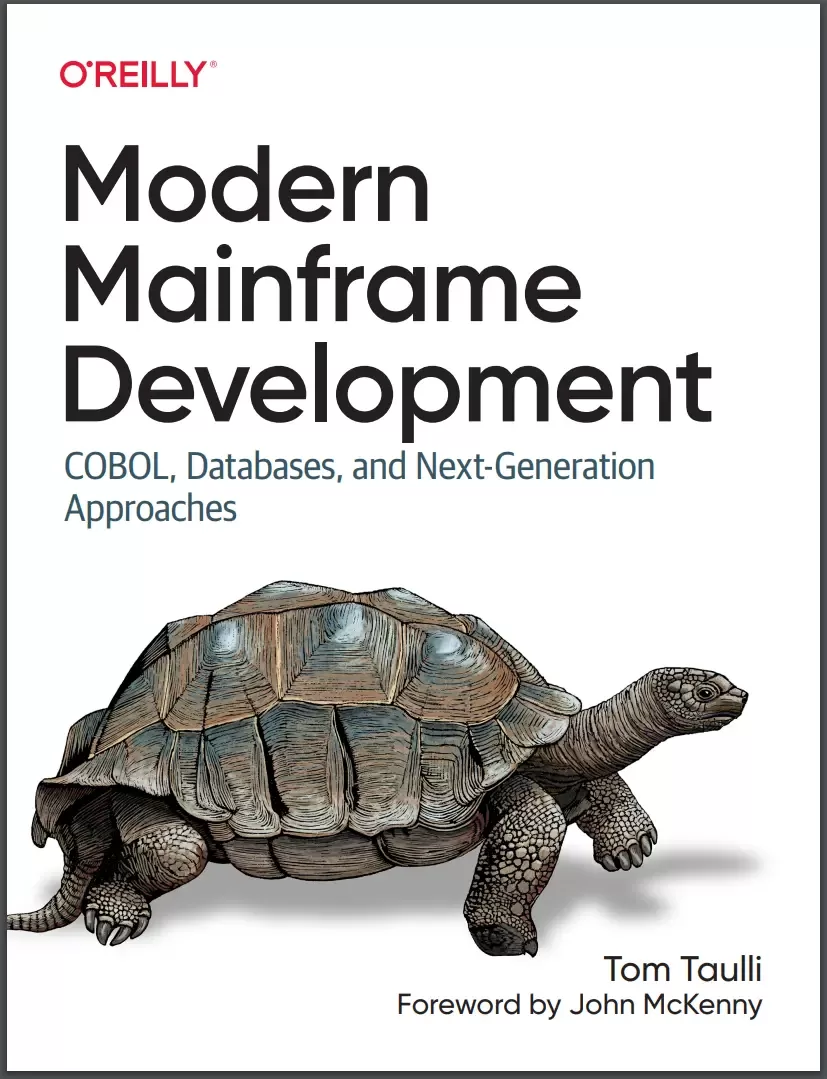
Modern Mainframe Development: COBOL, Databases, and Next-Generation Approaches
Оглавление⌄
Cover....1 Copyright....6 Table of Contents....7 Foreword....15 Preface....17 What’s Covered....17 Who Is This Book For?....18 The Approach to This Book....18 Conventions Used in This Book....19 Using Code Examples....19 O’Reilly Online Learning....20 How to Contact Us....20 Acknowledgments....21 Part I. Fundamentals of the Mainframe....23 Chapter 1. Why Be a Mainframe Developer?....25 Fear of Disruption....26 Software Is Eating the World....27 COVID-19....29 Government Modernization....30 Future of Mainframe Development....31 Career Opportunities....32 Conclusion....33 Chapter 2. World of the Mainframe....35 What Does “Mainframe” Mean Anyway?....36 A Brief History....36 What Are Punch Cards?....37 Growth of the Mainframe....37 Mainframe Innovation....40 The Terminal....40 Mainframe Challenges....41 Why Have a Mainframe?....42 The OS....43 z/VSE....44 z/TPF....45 z/VM....45 Linux....45 KVM....46 Processor Architecture....46 LPAR....46 Disks....47 Batch and Online Transaction Processing....48 Mainframe Trends....49 The Mainframe “Shop”....49 Conclusion....50 Chapter 3. The Development Environment....51 Accessing a Mainframe....51 TSO....54 ISPF....54 Datasets....56 Main Types of Datasets....57 Sequential File....57 Partitioned Dataset....57 Virtual Storage Access Method....58 Catalogs....59 ISPF and Datasets....60 Creating a File with ISPF....62 System Display and Search Facility....66 Job Control Language....68 Unix System Services....70 Mainframe Tools....70 Modern IDEs....71 IBM Developer for z/OS....71 BMC Compuware Topaz Workbench....72 Che4z....72 Visual Studio Code....73 Standardizing on Visual Studio....78 Simple IDEs....79 Web-Based Editors....79 Development Process....80 Conclusion....81 Chapter 4. The COBOL Language....83 COBOL’s Background, in Brief....83 COBOL Versions....84 Why Use COBOL?....85 COBOL Program Structure: Columns....86 COBOL Program Structure: Divisions....87 IDENTIFICATION DIVISION....88 ENVIRONMENT DIVISION....88 DATA DIVISION....89 PROCEDURE DIVISION....95 Conclusion....110 Chapter 5. File Handling....111 Records and Files....111 Sequential File....112 File Errors....116 WRITE to a File....117 JCL for File-Handling Programs....118 Inventory Update Program....120 File with Multiple Records....124 Variable-Length Records....126 Indexed Files....128 Updating an Indexed File....130 VSAM Files....132 Conclusion....135 Chapter 6. COBOL Tables and Reports....137 Introduction to Tables....137 Tables and Reading Files....140 Multilevel Tables....142 Indexes....146 Searching a Table....146 Binary Search....150 Reports....151 The PROCEDURE DIVISION for Reports....154 Testing a Report....154 Reporting Tools....155 Working with Characters and Strings....156 STRING....158 UNSTRING....159 INSPECT....161 Conclusion....162 Chapter 7. Other Languages and Programming Techniques....163 What Language to Use?....163 Assembler Language....164 Memory....165 Registers....167 Base Displacement Addressing....168 Sample Assembler Language Code....169 Java....169 C and C++....170 PL/I....171 CLIST and REXX....172 REXX Variables....173 REXX Comparisons....174 Control Structures....175 Calling Functions....177 Arrays....179 Object-Oriented COBOL....180 Programming Techniques....180 Copy Member....181 Subprograms....182 Conclusion....183 Chapter 8. Databases and Transaction Managers....185 Information Management System....185 IMS Database Manager....187 IMS Transaction Manager....189 IMS Services and Tools....190 IMS Programming Language....192 Db2 and the Relational Database....195 Benefits of Relational Databases....197 Using Db2....198 Structured Query Language....200 Joins....202 Database Administrator....203 Application Development with Db2....204 Db2 Ecosystem....206 Customer Information Control System....207 Working with the CICS Platform....208 Programming in CICS....209 Conclusion....211 Part II. Modern Topics....213 Chapter 9. DevOps....215 Advantages of DevOps....215 Waterfall Method Model....217 Agile Method....218 Scrum....220 Kanban....221 Lean....223 Agile: It’s Not All About Speed....224 Mainframes and the Challenges for DevOps....225 DevOps Best Practices....226 Configuration Management....227 Issues with DevOps....229 Metrics....230 Mainframe DevOps Tooling....230 Automation....231 CI/CD....232 Zowe....235 BMC Jenkins Plug-ins....237 Zigi....241 Conclusion....244 Chapter 10. Artificial Intelligence....245 What Is AI?....246 Why Use AI?....247 Downsides of AI....248 Machine Learning....250 Binary Classification....251 Multiclass Classification....252 Multilabel Classification....252 Imbalanced Classification....252 Types of Machine Learning....252 Supervised Learning....253 Unsupervised Learning....253 Reinforcement Learning....254 Deep Learning....255 Data....256 Big Data....257 Data Management....258 Log Data....260 Data Wrangling....261 The AI Process....263 Accuracy....265 An AI Demo....266 AI on Z....269 AIOps....270 Conclusion....271 Chapter 11. Robotic Process Automation, and Low-Code and No-Code Systems....273 What Is RPA?....274 The Disadvantages of RPA....276 Macros, Scripts, and APIs....276 Types of RPA....277 Process Methodologies....278 RPA Roles....279 Evaluating RPA Software....280 Process Mining....281 How to Create a Bot....283 Creating a UiPath Bot....283 Creating a Bot for the Mainframe....288 RPA Issues with Mainframes....290 Low-Code and No-Code Systems....291 Conclusion....293 Chapter 12. Mainframe Modernization Strategies....295 Why Modernize?....295 Using a Hybrid Cloud....297 Setting Goals....298 Encapsulating....300 Rehosting or Replatforming....300 Refactoring or Rearchitecting....301 Replacing or Rebuilding....303 Working with the Hyperscalers....304 Amazon Web Services....305 Microsoft....306 Google Cloud....308 Automation Tools....309 Heirloom Computing....310 EvolveWare....311 Advanced’s Automated COBOL Refactoring....312 Astadia....312 Data Migration....312 Conclusion....313 Chapter 13. The Future....315 Innovation of the Mainframe....315 Enterprise Integration....317 The Hybrid Model....319 Mainframe as a Service....320 Conclusion....321 Additional Resources....323 Glossary....325 Index....331 About the Author....348 Colophon....348
Описание
Ниже — практический обзор по теме «mainframe».
These systems still process huge amounts of information and allow for highly secure transactions. Even as spending on digital transformation continues to skyrocket, mainframes nevertheless have major advantages for global enterprises. In this practical book, author Tom Taulli shows software developers how to pursue a hybrid approach by integrating traditional mainframes and applications with modern digital systems.
You'll also learn how to blend in newer technologies such as the cloud, AI and machine learning, and microservices. By the end of this book, you'll have a solid understanding of the mainframe architecture and ecosystem, including core concepts and technologies such as COBOL, REXX, JCL, Db2, VSAM, and CICS. This handbook is indispensable for enterprises looking to thrive in the new digital world.
Learn strategies and approaches for mainframe DevOpsCreate, update, and maintain existing mainframe code, and analyze and resolve common errorsApply modern approaches to the mainframe, including microservices, APIs, cloud, and AI and machine learningWork with datasets and databases and put together effective reportsUnderstand how to work with modern cloud systems, like AWS, for pursuing data migration
Если материал оказался полезен — сохраните страницу.
Поделиться
Частые вопросы
Можно ли скачать «Modern Mainframe Development: COBOL, Databases, and Next-Generation Approaches» бесплатно?
Да, «Modern Mainframe Development: COBOL, Databases, and Next-Generation Approaches» доступна для бесплатного скачивания на нашем сайте в формате PDF. Ссылка на файл находится на этой странице.
В каком формате и какого размера файл?
Книга предоставляется в формате PDF, размер файла 2,2 МБ.
Кто автор и когда вышла книга?
автор — Taulli Tom, издательство O’Reilly Media, Inc., год выпуска 2022, 349 страниц.
О чём книга «Modern Mainframe Development: COBOL, Databases, and Next-Generation Approaches»?
Even as spending on digital transformation continues to skyrocket, mainframes nevertheless have major advantages for global enterprises.