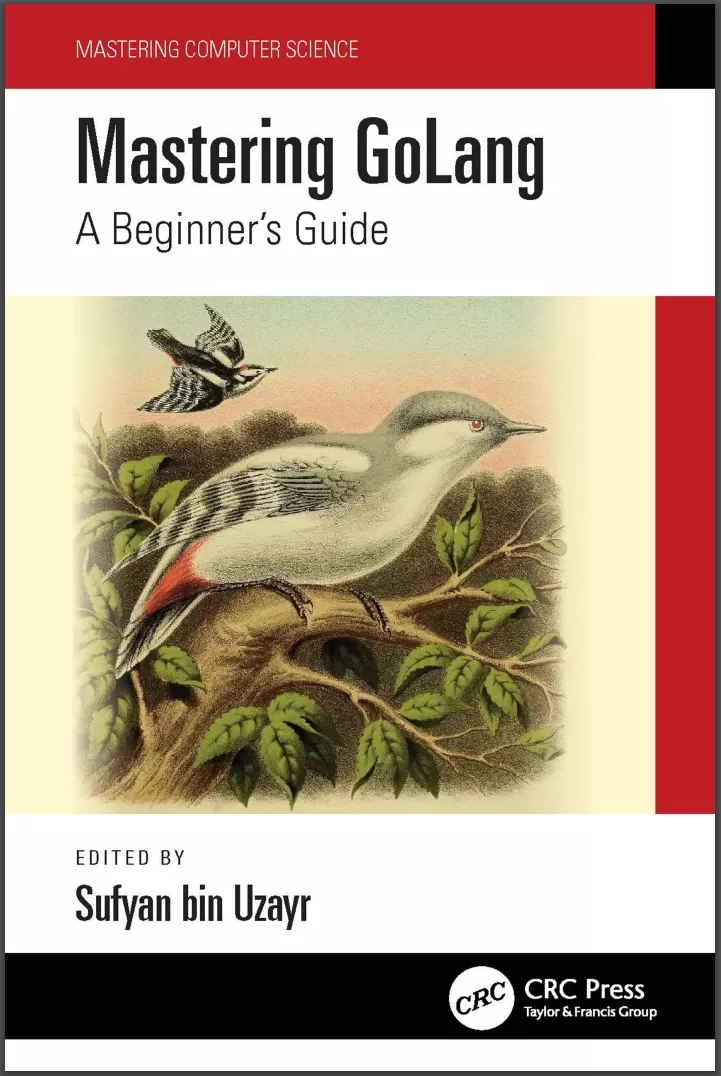
Mastering Golang. A Beginner's Guide
Оглавление⌄
Cover....1 Half Title....2 Series Page....3 Title Page....4 Copyright Page....5 Contents....6 Preface....16 About the Author....18 CHAPTER 1: Getting Started with Go....20 GO PROGRAMMING FEATURES....20 WHY IS GoLang BETTER THAN THE OTHER PROGRAMMING LANGUAGES?....21 GoLang’s Core Capability....21 Multithreading and Concurrency....22 Go Empowers Hardware from Within....23 The Unmatched Simplicity of Go....23 Inbuilt Testing and Profiling Framework....23 Easy Learning Curve....24 BEGINNING WITH Go....24 Text Editor....24 Finding a Go Compiler....24 INSTALL Go ON WINDOWS....25 How Do We Determine the Go Language Version That Is Preinstalled?....25 Downloading and Installing Go....25 WRITING THE FIRST Go PROGRAM....26 Single-Line Comment....27 Multiline Comment....27 Explanation of the Preceding Program....27 Why Is There a “Go Language”?....28 What Is Absent in Go That Is Present in Other Languages?....28 Hardware Restrictions....28 Benefits and Drawbacks of the Go Language....28 TERMINAL....29 The Open Terminal Tool Window....30 Start New Session....30 INSTALL Go ON MAC....30 Making Our First Program....32 Execute a Go Program....33 Do Programs in Go Link with the C/C++ Programming Language?....33 IN GoLang, HOW DO WE CREATE AN EMPTY FILE?....34 In GoLang, We May Check Whether a Given File Exists or Not....35 CREATE A DIRECTORY IN Go....37 Make a Single Directory....37 Make a Directory Hierarchy (Nested Directories)....37 CHAPTER 2: GoLang Tools....40 HOW TO READ AND WRITE PROGRAMS IN Go....40 IN GoLang, HOW TO RENAME AND MOVE A FILE....45 HOW TO READ FILES LINE BY LINE TO STRING....46 CHAPTER 3: Data Types....48 BASIC SYNTAX....48 Tokens....48 Line Separator....49 Comments....49 Identifiers....49 Keywords....51 Whitespace....51 DATA TYPES IN Go....52 Numbers....52 Floating Point Numbers....53 Complex Numbers....53 Booleans....54 Strings....55 CHAPTER 4: Variables and Constants....56 VARIABLES IN Go....56 Declaring a Variable....57 Using the var Keyword....57 Using the Short Variable Declaration....60 CONSTANTS....64 How Should We Declare?....64 Untyped and Typed Numeric Constants....64 Numeric Constant....65 String Literals....66 Boolean Constant....67 VARIABLE SCOPE IN Go....68 Local Variables....68 Global Variables....69 DECLARATION OF MULTIPLE VARIABLES....71 Shorthand Declaration....73 CHAPTER 5: Operators and Control Structures....76 OPERATORS IN Go....76 Arithmetic Operators....77 Relational Operators....78 Logical Operators....79 Bitwise Operators....80 Assignment Operators....81 Misc Operators....83 CONTROL STATEMENTS....84 if Statement....85 if…else Statement....86 Nested if Statement....88 if..else..if Ladder....89 Go LANGUAGE LOOPS....91 Go SWITCH STATEMENT....96 Expression Switch....97 Type Switch....99 CHAPTER 6: Arrays, Slices, and Maps....102 ARRAYS....102 Creating and Accessing an Array....102 Using the var Keyword....103 Using a Shorthand Declaration....104 Multidimensional Array....105 Important Observations about the Array....106 In GoLang, How Do We Copy an Array into Another Array?....109 In GoLang, How Can We Pass an Array to a Function?....111 SLICES....112 Slice Declaration....112 Slice Components....113 How Can We Create and Initialize a Slice?....114 Using the Slice Literal....114 Using an Array....115 Using an Existing Slice....115 Using the make() Function....116 How to Iterate over a Slice....117 Using the for loop....118 Using Range in the for loop....118 Using a Blank Identifier in a for loop....119 Important Points about Slice....119 Zero Value Slice....119 Modifying Slices....119 Slice Comparison....120 Multidimensional Slice....121 Sorting of Slice....121 Slice Composite Literal....122 In GoLang, How Do We Sort a Slice of Ints?....123 Ints....123 IntsAreSorted....124 In GoLang, How Can You Trim a Slice of Bytes?....125 How Can You Split a Slice of Bytes in GoLang?....127 STRINGS....129 String Literals....130 Using Double Quotes("")....130 Using backticks(")....130 Important Points about Strings....131 Strings Are Immutable....131 How to Iterate over a String....132 How to Access an Individual Byte of the String....133 How to Make a String from a Slice of Bytes....133 How Can We Determine the Length of a String in GoLang?....134 In GoLang, How Do We Trim a String?....134 Trim....134 TrimLeft....135 TrimRight....136 TrimSpace....137 TrimSuffix....138 TrimPrefix....139 In GoLang, How Do We Split a String?....140 Split....140 SplitAfter....141 SplitAfterN....143 In GoLang, There Are Several Ways to Compare Strings....144 Making Use of Comparison Operators....144 Using Compare() Method....145 MAPS....146 How Do We Create and Initialize Maps?....147 Simple....147 Using the make() Function....148 Important Considerations....149 How Do We Iterate over a Map?....149 How to Add Key-Value Pairs to the Map....150 How to Retrieve the Value Associated with a Key in a Map....151 How to Check If the Key Is Present on the Map....151 How to Remove a Key from a Map....152 Map Modification....153 CHAPTER 7: Functions and Recursion....156 Go LANGUAGE FUNCTIONS....156 Function Declaration....156 Function Calling....157 Function Arguments....158 Call by Value....158 Call by Reference....159 FUNCTION RETURNING MULTIPLE VALUES....160 Giving Names to the Return Values....160 VARIADIC FUNCTIONS....161 Anonymous Functions....163 GoLang main() and init() Functions....166 main() Function....166 init() Function....167 In GoLang, What Is a Blank Identifier (Underscore)?....168 DEFER KEYWORD....169 PANIC IN GoLang....172 Panic’s Usage....175 RECOVER....175 Quick Points....176 CLOSURE....177 RECURSION....179 Recursion Types....180 Direct Recursion....181 Indirect Recursion....182 Tail Recursion....183 Head Recursion....184 Infinite Recursion....185 Anonymous Function Recursion....185 CHAPTER 8: Pointers....190 GoLang POINTERS....190 What Is the Purpose of a Pointer?....190 Declaration and Initialization of Pointers....192 Declaring a Pointer....192 Pointer Initialization....192 Important Considerations....193 Dereferencing Pointer....195 In GoLang, How Can We Instantiate a Struct Using the New Keyword?....196 POINTERS TO A FUNCTION....197 Create a Pointer and Pass It to the Function....197 Passing an Address of the Variable to Function Call....198 POINTER TO A STRUCT....199 POINTER TO POINTER (DOUBLE POINTER) IN Go....201 How to Declare a Pointer to a Pointer....201 COMPARING POINTERS....203 CHAPTER 9: Structs and Interfaces....206 GoLang STRUCTURES....206 How Can We Get to Struct Fields?....208 Pointers to a Struct....209 GoLang’s NESTED STRUCTURE....210 GoLang’s ANONYMOUS STRUCTURE AND FIELD....212 Anonymous Structure....212 Anonymous Fields....213 GoLang METHODS....215 Method with the Struct Type Receiver....215 Method with the Non-Struct Type Receiver....216 Methods with the Pointer Receiver....217 Method Can Accept Both the Pointer and the Value....218 Difference between the Method and the Function....219 INTERFACES....219 How Do We Make an Interface?....220 How to Implement Interfaces....220 Why Go Interfaces Are Great....225 Redundant Functions....225 Enter Interface....227 EMBEDDING INTERFACES....228 INHERITANCE....234 POLYMORPHISM USING INTERFACES....237 CHAPTER 10: Concurrency and Goroutines....240 GOROUTINES – CONCURRENCY IN GoLang....240 Go Concurrent Programming....241 Issues with Multithreading....241 Concurrent Programming in Go....242 How to Handle Concurrency Issues in Go....242 Goroutine with WaitGroup Example....242 How to Create a Goroutine....243 Anonymous Goroutines....245 SELECT STATEMENT....246 MULTIPLE GOROUTINES....250 GoLang CHANNEL....252 Creating a Channel....252 Send and Receive Data from a Channel....253 Send Operation....253 Receive Operation....253 Channel Closing....254 UNIDIRECTIONAL CHANNEL....258 Converting a Bidirectional Channel to a Unidirectional Channel....259 CHAPTER 11: Packages in GoLang....260 PACKAGES IN GoLang....260 Workspace....260 Packages....261 Main Package....261 Importing Packages....262 Installing Third-Party Packages....262 Init Function....262 Important Considerations....264 Giving the Packages Names....265 Code Exported....267 DOCUMENTATION....269 CHAPTER 12: The Core Packages....270 STRING....271 INPUT/OUTPUT (I/O)....272 FILES AND FOLDERS....272 ERRORS....275 CONTAINERS AND SORTING....275 List....275 SORT....276 HASHES AND CRYPTOGRAPHY....277 SERVERS....279 HTTP....281 RPC....282 PARSING THE COMMAND LINE ARGUMENTS....283 SYNCHRONIZATION PRIMITIVES....284 Mutexes....284 APPRAISAL....286 BIBLIOGRAPHY....290 INDEX....294Описание
Коротко и по делу о том, что важно знать про golang.
Mastering GoLang helps readers quickly understand the core concepts and then move on to practical projects using the Go programming language.
Instead of starting from scratch, Go was created using the C programming language. GoLang is often dubbed a game-changer in the world of programming languages. GoLang inherits C’s disciplined grammar but with specific tweaks and enhancements to properly manage memory. This lessens the memory leakage problems that developers tend to face with C.
Go’s concurrency features are well-suited to build the infrastructure for gigantic projects such as networking systems and distributed hardware. Go borrows and adapts notions from various programming languages while skipping characteristics that result in complicated, insecure, and unpredictable code. Go is also often employed in domains such as visuals, mobile applications, and Machine Learning.
Even though GoLang is a relatively new language, it has been adopted by several major organizations owing to its benefits, which include code clarity, custom libraries, adaptability, multithreading, and a simple build process. Because Go is gaining traction in the development community, learning GoLang can open up new avenues across various fields and career trajectories.
Since it is still a relatively newer language, quality literature pertaining to Go is often hard to find. This particular book covers all the bases that you might need, and is an ideal companion for beginner-level developers looking to master Go programming.
With Mastering GoLang, learning GoLang becomes an easy task, and learners can use their skills to create innovative projects.
The Mastering Computer Science series is edited by Sufyan bin Uzayr, a writer and educator with over a decade of experience in the computing field.
Если материал оказался полезен — сохраните страницу.
Поделиться
Частые вопросы
Можно ли скачать «Mastering Golang. A Beginner's Guide» бесплатно?
Да, «Mastering Golang. A Beginner's Guide» доступна для бесплатного скачивания на нашем сайте в формате PDF. Ссылка на файл находится на этой странице.
В каком формате и какого размера файл?
Книга предоставляется в формате PDF, размер файла 1,4 МБ.
Кто автор и когда вышла книга?
автор — Bin Uzayr Sufyan, издательство CRC Press is an imprint of Taylor & Francis Group, LLC, год выпуска 2023, 299 страниц.
О чём книга «Mastering Golang. A Beginner's Guide»?
Mastering GoLang helps readers quickly understand the core concepts and then move on to practical projects using the Go programming language.GoLang is often dubbed a game-changer in the world of programming languages.
Похожие материалы
 Облачный Go. Создание надежных служб в ненадежных окружениях
 Pro Go. Полное руководство по программированию надежного и эффективного программного обеспечения с использованием Golang
 Learning Go: An Idiomatic Approach to Real-World Go Programming
 Software Development with Go: Cloud-Native Programming using Golang with Linux and Docker
 Efficient Go: Data-Driven Performance Optimization
 Black Hat Go: Программирование для хакеров и пентестеров
 Microservices with Go: Building scalable and reliable microservices with Go
 Concurrency in Go: Tools and Techniques for Developers