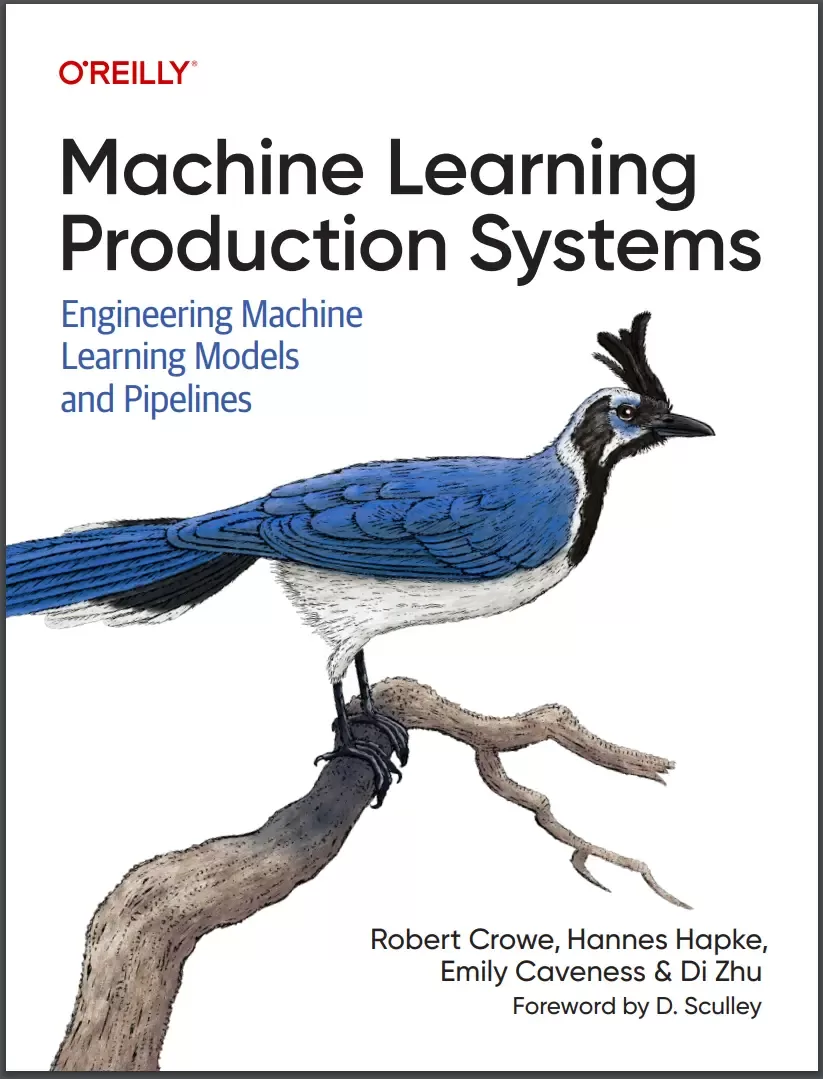
Machine Learning Production Systems: Engineering Machine Learning Models and Pipelines
Оглавление⌄
Copyright....3 Table of Contents....4 Foreword....16 Preface....20 Who Should Read This Book....20 Why We Wrote This Book....21 Navigating This Book....21 Conventions Used in This Book....22 Using Code Examples....22 O’Reilly Online Learning....23 How to Contact Us....23 Acknowledgments....24 Robert....25 Hannes....25 Emily....25 Di....26 Chapter 1. Introduction to Machine Learning Production Systems....28 What Is Production Machine Learning?....28 Benefits of Machine Learning Pipelines....30 Focus on Developing New Models, Not on Maintaining Existing Models....30 Prevention of Bugs....30 Creation of Records for Debugging and Reproducing Results....31 Standardization....31 The Business Case for ML Pipelines....31 When to Use Machine Learning Pipelines....32 Steps in a Machine Learning Pipeline....32 Data Ingestion and Data Versioning....33 Data Validation....33 Feature Engineering....33 Model Training and Model Tuning....34 Model Analysis....34 Model Deployment....35 Looking Ahead....35 Chapter 2. Collecting, Labeling, and Validating Data....36 Important Considerations in Data Collection....36 Responsible Data Collection....37 Labeling Data: Data Changes and Drift in Production ML....38 Labeling Data: Direct Labeling and Human Labeling....40 Validating Data: Detecting Data Issues....41 Validating Data: TensorFlow Data Validation....41 Skew Detection with TFDV....42 Types of Skew....43 Example: Spotting Imbalanced Datasets with TensorFlow Data Validation....44 Conclusion....46 Chapter 3. Feature Engineering and Feature Selection....48 Introduction to Feature Engineering....48 Preprocessing Operations....50 Feature Engineering Techniques....51 Normalizing and Standardizing....51 Bucketizing....52 Feature Crosses....53 Dimensionality and Embeddings....53 Visualization....53 Feature Transformation at Scale....54 Choose a Framework That Scales Well....54 Avoid Training–Serving Skew....55 Consider Instance-Level Versus Full-Pass Transformations....55 Using TensorFlow Transform....56 Analyzers....58 Code Example....59 Feature Selection....59 Feature Spaces....60 Feature Selection Overview....60 Filter Methods....61 Wrapper Methods....62 Embedded Methods....64 Feature and Example Selection for LLMs and GenAI....65 Example: Using TF Transform to Tokenize Text....65 Benefits of Using TF Transform....68 Alternatives to TF Transform....69 Conclusion....69 Chapter 4. Data Journey and Data Storage....70 Data Journey....70 ML Metadata....71 Using a Schema....72 Schema Development....73 Schema Environments....73 Changes Across Datasets....74 Enterprise Data Storage....75 Feature Stores....75 Data Warehouses....77 Data Lakes....78 Conclusion....78 Chapter 5. Advanced Labeling, Augmentation, and Data Preprocessing....80 Advanced Labeling....81 Semi-Supervised Labeling....81 Active Learning....83 Weak Supervision....86 Advanced Labeling Review....87 Data Augmentation....88 Example: CIFAR-10....89 Other Augmentation Techniques....89 Data Augmentation Review....89 Preprocessing Time Series Data: An Example....90 Windowing....91 Sampling....92 Conclusion....93 Chapter 6. Model Resource Management Techniques....94 Dimensionality Reduction: Dimensionality Effect on Performance....94 Example: Word Embedding Using Keras....95 Curse of Dimensionality....99 Adding Dimensions Increases Feature Space Volume....100 Dimensionality Reduction....101 Quantization and Pruning....105 Mobile, IoT, Edge, and Similar Use Cases....105 Quantization....105 Optimizing Your TensorFlow Model with TF Lite....111 Optimization Options....112 Pruning....113 Knowledge Distillation....116 Teacher and Student Networks....116 Knowledge Distillation Techniques....117 TMKD: Distilling Knowledge for a Q&A Task....120 Increasing Robustness by Distilling EfficientNets....122 Conclusion....123 Chapter 7. High-Performance Modeling....124 Distributed Training....124 Data Parallelism....125 Efficient Input Pipelines....128 Input Pipeline Basics....128 Input Pipeline Patterns: Improving Efficiency....129 Optimizing Your Input Pipeline with TensorFlow Data....130 Training Large Models: The Rise of Giant Neural Nets and Parallelism....132 Potential Solutions and Their Shortcomings....133 Pipeline Parallelism to the Rescue?....134 Conclusion....136 Chapter 8. Model Analysis....138 Analyzing Model Performance....138 Black-Box Evaluation....139 Performance Metrics and Optimization Objectives....139 Advanced Model Analysis....140 TensorFlow Model Analysis....140 The Learning Interpretability Tool....146 Advanced Model Debugging....147 Benchmark Models....148 Sensitivity Analysis....148 Residual Analysis....152 Model Remediation....153 Discrimination Remediation....154 Fairness....154 Fairness Evaluation....155 Fairness Considerations....157 Continuous Evaluation and Monitoring....157 Conclusion....158 Chapter 9. Interpretability....160 Explainable AI....160 Model Interpretation Methods....163 Method Categories....163 Intrinsically Interpretable Models....166 Model-Agnostic Methods....171 Local Interpretable Model-Agnostic Explanations....175 Shapley Values....176 The SHAP Library....178 Testing Concept Activation Vectors....180 AI Explanations....181 Example: Exploring Model Sensitivity with SHAP....183 Regression Models....183 Natural Language Processing Models....185 Conclusion....186 Chapter 10. Neural Architecture Search....188 Hyperparameter Tuning....188 Introduction to AutoML....190 Key Components of NAS....190 Search Spaces....191 Search Strategies....193 Performance Estimation Strategies....195 AutoML in the Cloud....196 Amazon SageMaker Autopilot....196 Microsoft Azure Automated Machine Learning....197 Google Cloud AutoML....198 Using AutoML....199 Generative AI and AutoML....199 Conclusion....199 Chapter 11. Introduction to Model Serving....200 Model Training....200 Model Prediction....201 Latency....201 Throughput....201 Cost....202 Resources and Requirements for Serving Models....202 Cost and Complexity....202 Accelerators....203 Feeding the Beast....204 Model Deployments....204 Data Center Deployments....205 Mobile and Distributed Deployments....205 Model Servers....206 Managed Services....207 Conclusion....208 Chapter 12. Model Serving Patterns....210 Batch Inference....210 Batch Throughput....211 Batch Inference Use Cases....212 ETL for Distributed Batch and Stream Processing Systems....213 Introduction to Real-Time Inference....213 Synchronous Delivery of Real-Time Predictions....215 Asynchronous Delivery of Real-Time Predictions....215 Optimizing Real-Time Inference....215 Real-Time Inference Use Cases....216 Serving Model Ensembles....217 Ensemble Topologies....217 Example Ensemble....217 Ensemble Serving Considerations....217 Model Routers: Ensembles in GenAI....218 Data Preprocessing and Postprocessing in Real Time....218 Training Transformations Versus Serving Transformations....220 Windowing....220 Options for Preprocessing....221 Enter TensorFlow Transform....223 Postprocessing....224 Inference at the Edge and at the Browser....225 Challenges....226 Model Deployments via Containers....227 Training on the Device....227 Federated Learning....228 Runtime Interoperability....228 Inference in Web Browsers....229 Conclusion....229 Chapter 13. Model Serving Infrastructure....230 Model Servers....231 TensorFlow Serving....231 NVIDIA Triton Inference Server....233 TorchServe....234 Building Scalable Infrastructure....235 Containerization....237 Traditional Deployment Era....237 Virtualized Deployment Era....238 Container Deployment Era....238 The Docker Containerization Framework....238 Container Orchestration....240 Reliability and Availability Through Redundancy....243 Observability....244 High Availability....245 Automated Deployments....246 Hardware Accelerators....246 GPUs....247 TPUs....247 Conclusion....248 Chapter 14. Model Serving Examples....250 Example: Deploying TensorFlow Models with TensorFlow Serving....250 Exporting Keras Models for TF Serving....250 Setting Up TF Serving with Docker....251 Basic Configuration of TF Serving....251 Making Model Prediction Requests with REST....252 Making Model Prediction Requests with gRPC....254 Getting Predictions from Classification and Regression Models....255 Using Payloads....256 Getting Model Metadata from TF Serving....256 Making Batch Inference Requests....257 Example: Profiling TF Serving Inferences with TF Profiler....259 Prerequisites....259 TensorBoard Setup....260 Model Profile....261 Example: Basic TorchServe Setup....265 Installing the TorchServe Dependencies....265 Exporting Your Model for TorchServe....265 Setting Up TorchServe....266 Making Model Prediction Requests....269 Making Batch Inference Requests....269 Conclusion....270 Chapter 15. Model Management and Delivery....272 Experiment Tracking....272 Experimenting in Notebooks....273 Experimenting Overall....274 Tools for Experiment Tracking and Versioning....275 Introduction to MLOps....279 Data Scientists Versus Software Engineers....279 ML Engineers....279 ML in Products and Services....280 MLOps....280 MLOps Methodology....282 MLOps Level 0....282 MLOps Level 1....284 MLOps Level 2....287 Components of an Orchestrated Workflow....290 Three Types of Custom Components....292 Python Function–Based Components....292 Container-Based Components....293 Fully Custom Components....294 TFX Deep Dive....297 TFX SDK....297 Intermediate Representation....298 Runtime....298 Implementing an ML Pipeline Using TFX Components....298 Advanced Features of TFX....300 Managing Model Versions....302 Approaches to Versioning Models....302 Model Lineage....304 Model Registries....304 Continuous Integration and Continuous Deployment....305 Continuous Integration....305 Continuous Delivery....307 Progressive Delivery....307 Blue/Green Deployment....308 Canary Deployment....308 Live Experimentation....309 Conclusion....311 Chapter 16. Model Monitoring and Logging....312 The Importance of Monitoring....313 Observability in Machine Learning....314 What Should You Monitor?....315 Custom Alerting in TFX....316 Logging....317 Distributed Tracing....319 Monitoring for Model Decay....320 Data Drift and Concept Drift....321 Model Decay Detection....322 Supervised Monitoring Techniques....323 Unsupervised Monitoring Techniques....324 Mitigating Model Decay....325 Retraining Your Model....326 When to Retrain....326 Automated Retraining....327 Conclusion....327 Chapter 17. Privacy and Legal Requirements....328 Why Is Data Privacy Important?....329 What Data Needs to Be Kept Private?....329 Harms....330 Only Collect What You Need....330 GenAI Data Scraped from the Web and Other Sources....331 Legal Requirements....331 The GDPR and the CCPA....331 The GDPR’s Right to Be Forgotten....332 Pseudonymization and Anonymization....333 Differential Privacy....334 Local and Global DP....335 Epsilon-Delta DP....335 Applying Differential Privacy to ML....336 TensorFlow Privacy Example....337 Federated Learning....339 Encrypted ML....340 Conclusion....341 Chapter 18. Orchestrating Machine Learning Pipelines....342 An Introduction to Pipeline Orchestration....342 Why Pipeline Orchestration?....342 Directed Acyclic Graphs....343 Pipeline Orchestration with TFX....344 Interactive TFX Pipelines....344 Converting Your Interactive Pipeline for Production....346 Orchestrating TFX Pipelines with Apache Beam....346 Orchestrating TFX Pipelines with Kubeflow Pipelines....348 Introduction to Kubeflow Pipelines....348 Installation and Initial Setup....350 Accessing Kubeflow Pipelines....351 The Workflow from TFX to Kubeflow....352 OpFunc Functions....355 Orchestrating Kubeflow Pipelines....357 Google Cloud Vertex Pipelines....360 Setting Up Google Cloud and Vertex Pipelines....360 Setting Up a Google Cloud Service Account....364 Orchestrating Pipelines with Vertex Pipelines....367 Executing Vertex Pipelines....369 Choosing Your Orchestrator....371 Interactive TFX....371 Apache Beam....371 Kubeflow Pipelines....371 Google Cloud Vertex Pipelines....372 Alternatives to TFX....372 Conclusion....372 Chapter 19. Advanced TFX....374 Advanced Pipeline Practices....374 Configure Your Components....374 Import Artifacts....375 Use Resolver Node....376 Execute a Conditional Pipeline....377 Export TF Lite Models....378 Warm-Starting Model Training....379 Use Exit Handlers....380 Trigger Messages from TFX....381 Custom TFX Components: Architecture and Use Cases....383 Architecture of TFX Components....383 Use Cases of Custom Components....384 Using Function-Based Custom Components....384 Writing a Custom Component from Scratch....385 Defining Component Specifications....387 Defining Component Channels....388 Writing the Custom Executor....388 Writing the Custom Driver....391 Assembling the Custom Component....392 Using Our Basic Custom Component....393 Implementation Review....394 Reusing Existing Components....394 Creating Container-Based Custom Components....397 Which Custom Component Is Right for You?....399 TFX-Addons....400 Conclusion....401 Chapter 20. ML Pipelines for Computer Vision Problems....402 Our Data....403 Our Model....403 Custom Ingestion Component....404 Data Preprocessing....405 Exporting the Model....406 Our Pipeline....407 Data Ingestion....407 Data Preprocessing....408 Model Training....409 Model Evaluation....409 Model Export....411 Putting It All Together....411 Executing on Apache Beam....412 Executing on Vertex Pipelines....413 Model Deployment with TensorFlow Serving....414 Conclusion....416 Chapter 21. ML Pipelines for Natural Language Processing....418 Our Data....419 Our Model....419 Ingestion Component....420 Data Preprocessing....421 Putting the Pipeline Together....424 Executing the Pipeline....424 Model Deployment with Google Cloud Vertex....425 Registering Your ML Model....425 Creating a New Model Endpoint....427 Deploying Your ML Model....427 Requesting Predictions from the Deployed Model....429 Cleaning Up Your Deployed Model....430 Conclusion....431 Chapter 22. Generative AI....432 Generative Models....433 GenAI Model Types....433 Agents and Copilots....434 Pretraining....434 Pretraining Datasets....435 Embeddings....435 Self-Supervised Training with Masks....436 Fine-Tuning....437 Fine-Tuning Versus Transfer Learning....437 Fine-Tuning Datasets....438 Fine-Tuning Considerations for Production....438 Fine-Tuning Versus Model APIs....439 Parameter-Efficient Fine-Tuning....439 LoRA....439 S-LoRA....440 Human Alignment....440 Reinforcement Learning from Human Feedback....440 Reinforcement Learning from AI Feedback....441 Direct Preference Optimization....441 Prompting....442 Chaining....443 Retrieval Augmented Generation....443 ReAct....444 Evaluation....444 Evaluation Techniques....444 Benchmarking Across Models....445 LMOps....445 GenAI Attacks....446 Jailbreaks....446 Prompt Injection....447 Responsible GenAI....447 Design for Responsibility....447 Conduct Adversarial Testing....448 Constitutional AI....448 Conclusion....449 Chapter 23. The Future of Machine Learning Production Systems and Next Steps....450 Let’s Think in Terms of ML Systems, Not ML Models....450 Bringing ML Systems Closer to Domain Experts....451 Privacy Has Never Been More Important....451 Conclusion....451 Index....454 About the Authors....473 Colophon....473
Описание
Ниже — практический обзор по теме «that».
Using machine learning for products, services, and critical business processes is quite different from using ML in an academic or research setting—especially for recent ML graduates and those moving from research to a commercial environment. Whether you currently work to create products and services that use ML, or would like to in the future, this practical book gives you a broad view of the entire field.
You'll learn the state of the art of machine learning engineering, including a wide range of topics such as modeling, deployment, and MLOps. Authors Robert Crowe, Hannes Hapke, Emily Caveness, and Di Zhu help you identify topics that you can dive into deeper, along with reference materials and tutorials that teach you the details. You'll learn the basics and advanced aspects to understand the production ML lifecycle.
This book provides four in-depth sections that cover all aspects of machine learning engineering:Data: collecting, labeling, validating, automation, and data preprocessing; data feature engineering and selection; data journey and storageModeling: high performance modeling; model resource management techniques; model analysis and interoperability; neural architecture searchDeployment: model serving patterns and infrastructure for ML models and LLMs; management and delivery; monitoring and loggingProductionalizing: ML pipelines; classifying unstructured texts and images; genAI model pipelines
Файл доступен для загрузки ниже.
Поделиться
Частые вопросы
Можно ли скачать «Machine Learning Production Systems: Engineering Machine Learning Models and Pipelines» бесплатно?
Да, «Machine Learning Production Systems: Engineering Machine Learning Models and Pipelines» доступна для бесплатного скачивания на нашем сайте в формате PDF. Ссылка на файл находится на этой странице.
В каком формате и какого размера файл?
Книга предоставляется в формате PDF, размер файла 3,6 МБ.
Кто автор и когда вышла книга?
автор — Caveness Emily , Crowe Robert , Hapke Hannes , Zhu Di, издательство O’Reilly Media, Inc., год выпуска 2025, 475 страниц.
О чём книга «Machine Learning Production Systems: Engineering Machine Learning Models and Pipelines»?
Using machine learning for products, services, and critical business processes is quite different from using ML in an academic or research setting—especially for recent ML graduates and those moving from research to a commercial environment
Похожие материалы
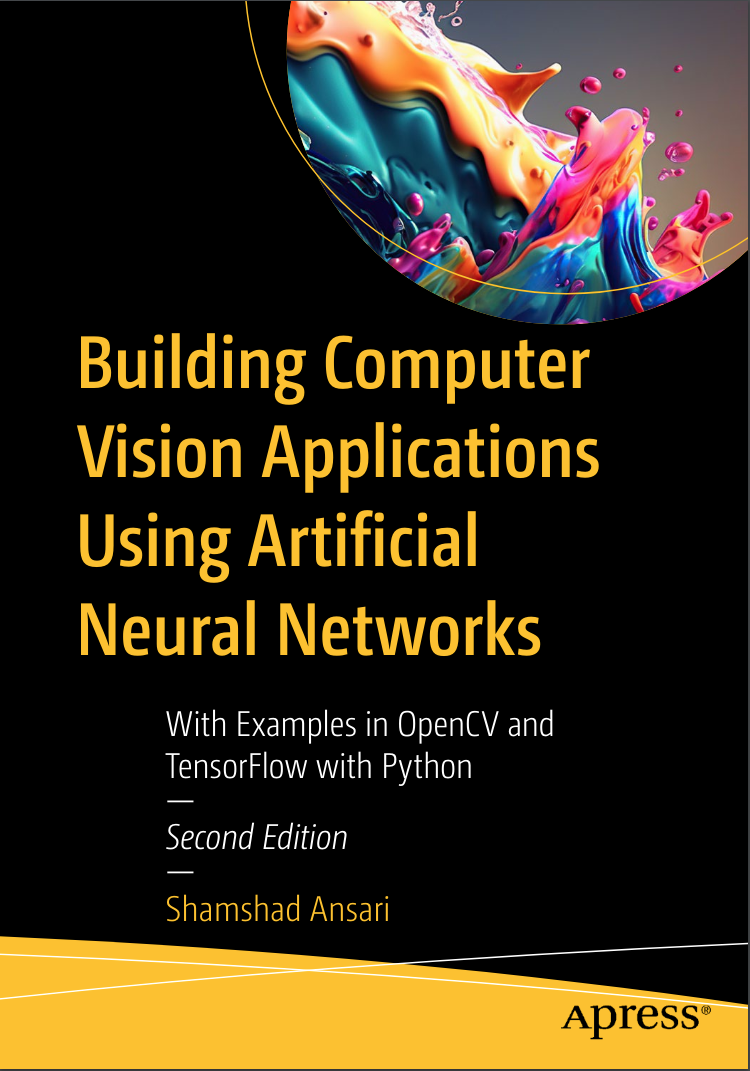 Building Computer Vision Applications Using Artificial Neural Networks: With Examples in OpenCV and TensorFlow with Python. 2 Ed
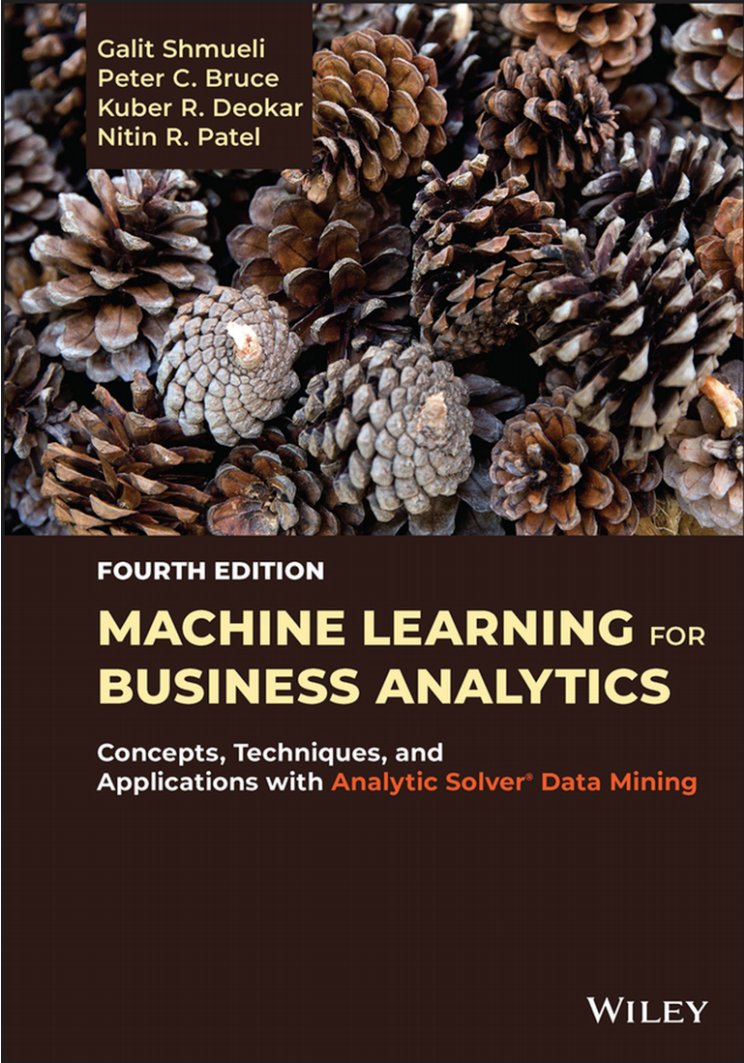 Machine Learning for Business Analytics: Concepts, Techniques, and Applications with Analytic Solver Data Mining. 4 Ed
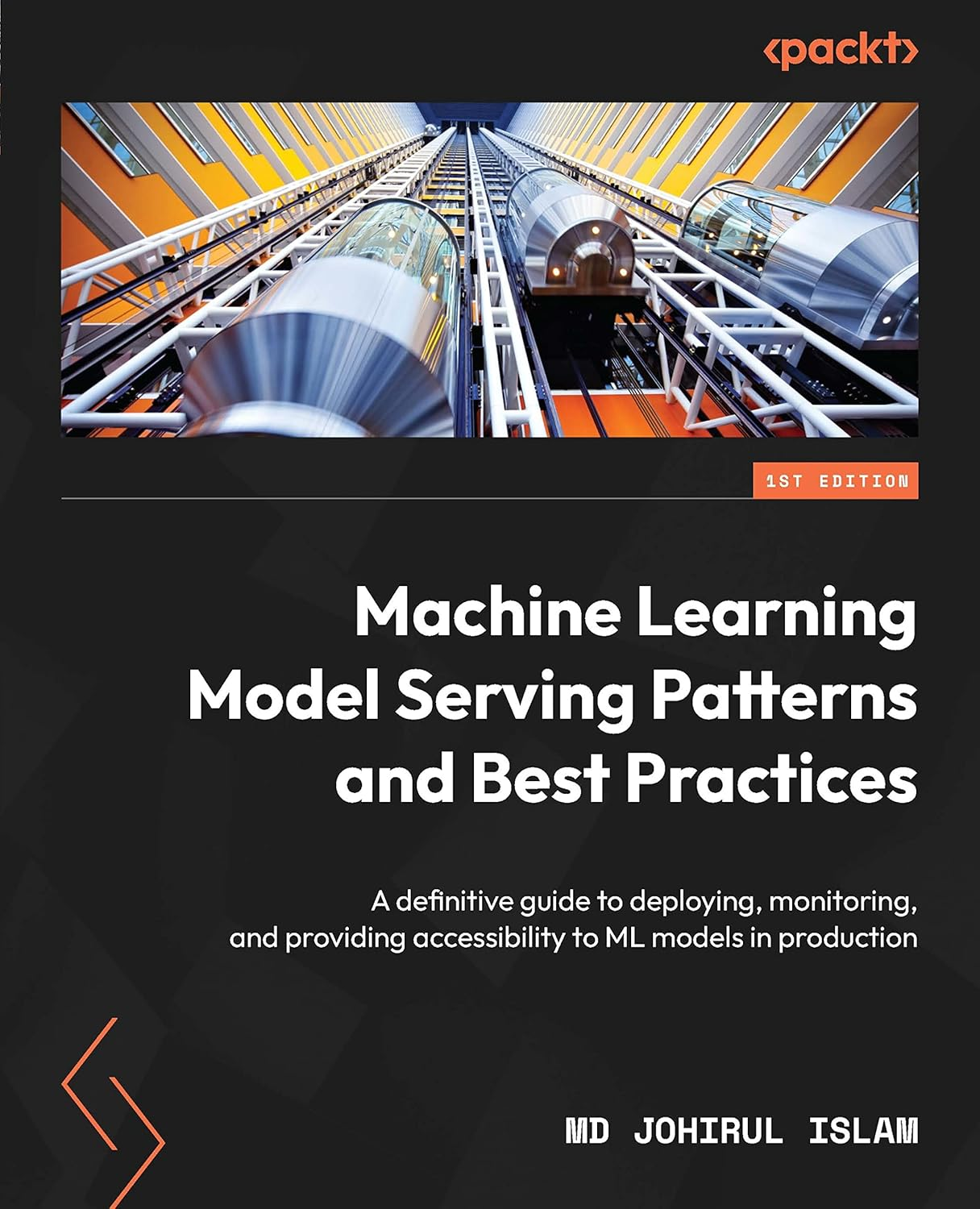 Machine Learning Model Serving Patterns and Best Practices: A definitive guide to deploying, monitoring, and providing accessibility to ML models in production
 Applied Machine Learning and High-Performance Computing on AWS: Accelerate the development of machine learning applications following architectural best practices
 Random Matrix Methods for Machine Learning
 Машинное обучение с использованием Python. Сборник рецептов. Практические решения от предобработки до глубокого обучения. 2 изд
 System Design: Машинное обучение. Подготовка к сложному интервью
 Machine Learning Interviews: Kickstart Your Machine Learning and Data Career