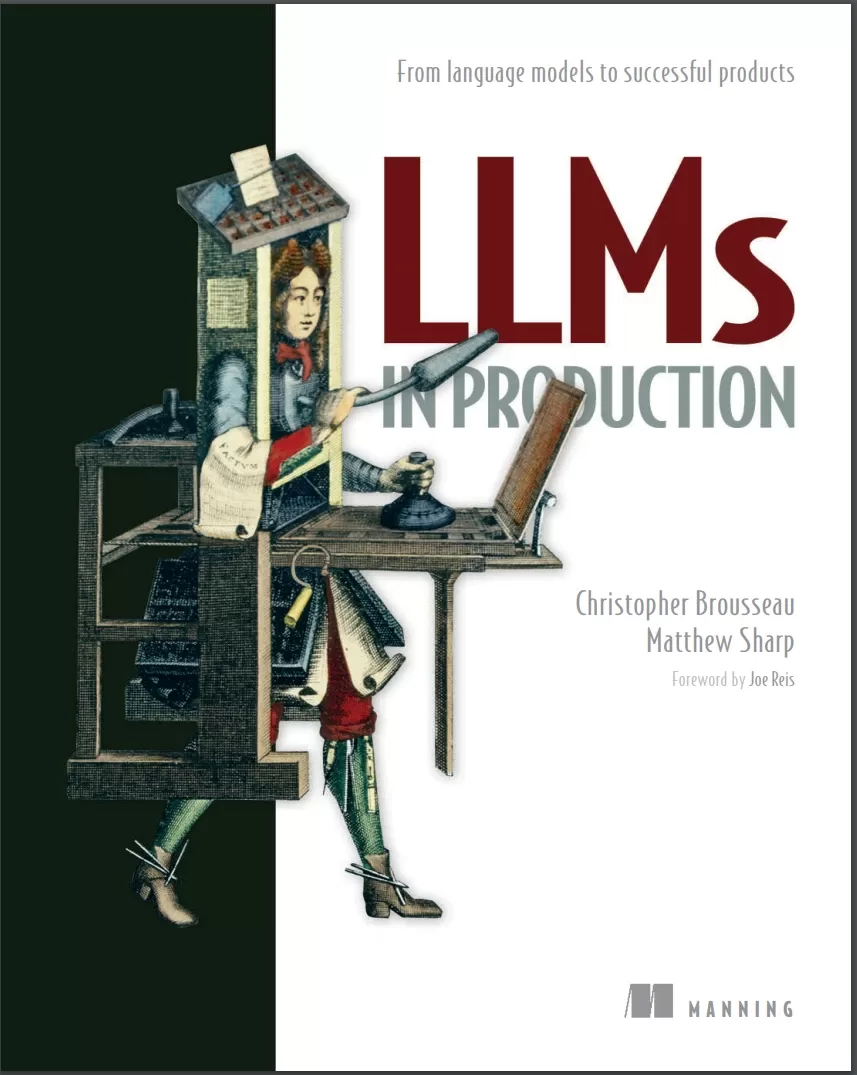
LLMs in Production: From language models to successful products
Оглавление⌄
LLMs in Production....1 brief contents....8 contents....9 foreword....14 preface....15 acknowledgments....17 about the book....19 Who should read this book....19 How this book is organized....20 About the code....21 liveBook Discussion Forum....21 about the authors....22 about the cover illustration....23 1 Words’ awakening: Why large language models have captured attention....24 1.1 Large language models accelerating communication....26 1.2 Navigating the build-and-buy decision with LLMs....30 1.2.1 Buying: The beaten path....31 1.2.2 Building: The path less traveled....32 1.2.3 A word of warning: Embrace the future now....38 1.3 Debunking myths....39 Summary....42 2 Large language models: A deep dive into language modeling....43 2.1 Language modeling....44 2.1.1 Linguistic features....46 2.1.2 Semiotics....52 2.1.3 Multilingual NLP....55 2.2 Language modeling techniques....56 2.2.1 N-gram and corpus-based techniques....57 2.2.2 Bayesian techniques....59 2.2.3 Markov chains....63 2.2.4 Continuous language modeling....66 2.2.5 Embeddings....70 2.2.6 Multilayer perceptrons....72 2.2.7 Recurrent neural networks and long short-term memory networks....74 2.2.8 Attention....81 2.3 Attention is all you need....83 2.3.1 Encoders....84 2.3.2 Decoders....85 2.3.3 Transformers....87 2.4 Really big transformers....89 Summary....94 3 Large language model operations: Building a platform for LLMs....96 3.1 Introduction to large language model operations....96 3.2 Operations challenges with large language models....97 3.2.1 Long download times....97 3.2.2 Longer deploy times....98 3.2.3 Latency....99 3.2.4 Managing GPUs....100 3.2.5 Peculiarities of text data....100 3.2.6 Token limits create bottlenecks....101 3.2.7 Hallucinations cause confusion....103 3.2.8 Bias and ethical considerations....104 3.2.9 Security concerns....104 3.2.10 Controlling costs....107 3.3 LLMOps essentials....107 3.3.1 Compression....107 3.3.2 Distributed computing....116 3.4 LLM operations infrastructure....122 3.4.1 Data infrastructure....124 3.4.2 Experiment trackers....125 3.4.3 Model registry....126 3.4.4 Feature stores....127 3.4.5 Vector databases....128 3.4.6 Monitoring system....129 3.4.7 GPU-enabled workstations....130 3.4.8 Deployment service....131 Summary....132 4 Data engineering for large language models: Setting up for success....134 4.1 Models are the foundation....135 4.1.1 GPT....136 4.1.2 BLOOM....137 4.1.3 LLaMA....138 4.1.4 Wizard....138 4.1.5 Falcon....139 4.1.6 Vicuna....139 4.1.7 Dolly....139 4.1.8 OpenChat....140 4.2 Evaluating LLMs....141 4.2.1 Metrics for evaluating text....141 4.2.2 Industry benchmarks....144 4.2.3 Responsible AI benchmarks....149 4.2.4 Developing your own benchmark....151 4.2.5 Evaluating code generators....153 4.2.6 Evaluating model parameters....154 4.3 Data for LLMs....156 4.3.1 Datasets you should know....157 4.3.2 Data cleaning and preparation....161 4.4 Text processors....167 4.4.1 Tokenization....167 4.4.2 Embeddings....172 4.5 Preparing a Slack dataset....175 Summary....176 5 Training large language models: How to generate the generator....177 5.1 Multi-GPU environments....178 5.1.1 Setting up....178 5.1.2 Libraries....182 5.2 Basic training techniques....184 5.2.1 From scratch....185 5.2.2 Transfer learning (finetuning)....192 5.2.3 Prompting....197 5.3 Advanced training techniques....198 5.3.1 Prompt tuning....198 5.3.2 Finetuning with knowledge distillation....204 5.3.3 Reinforcement learning with human feedback....208 5.3.4 Mixture of experts....211 5.3.5 LoRA and PEFT....214 5.4 Training tips and tricks....219 5.4.1 Training data size notes....219 5.4.2 Efficient training....220 5.4.3 Local minima traps....221 5.4.4 Hyperparameter tuning tips....221 5.4.5 A note on operating systems....222 5.4.6 Activation function advice....222 Summary....223 6 Large language model services: A practical guide....224 6.1 Creating an LLM service....225 6.1.1 Model compilation....226 6.1.2 LLM storage strategies....232 6.1.3 Adaptive request batching....235 6.1.4 Flow control....235 6.1.5 Streaming responses....238 6.1.6 Feature store....239 6.1.7 Retrieval-augmented generation....242 6.1.8 LLM service libraries....246 6.2 Setting up infrastructure....247 6.2.1 Provisioning clusters....248 6.2.2 Autoscaling....250 6.2.3 Rolling updates....255 6.2.4 Inference graphs....257 6.2.5 Monitoring....260 6.3 Production challenges....263 6.3.1 Model updates and retraining....264 6.3.2 Load testing....264 6.3.3 Troubleshooting poor latency....268 6.3.4 Resource management....270 6.3.5 Cost engineering....271 6.3.6 Security....272 6.4 Deploying to the edge....274 Summary....276 7 Prompt engineering: Becoming an LLM whisperer....277 7.1 Prompting your model....278 7.1.1 Few-shot prompting....278 7.1.2 One-shot prompting....280 7.1.3 Zero-shot prompting....281 7.2 Prompt engineering basics....283 7.2.1 Anatomy of a prompt....284 7.2.2 Prompting hyperparameters....286 7.2.3 Scrounging the training data....288 7.3 Prompt engineering tooling....289 7.3.1 LangChain....289 7.3.2 Guidance....290 7.3.3 DSPy....293 7.3.4 Other tooling is available but . . .....294 7.4 Advanced prompt engineering techniques....294 7.4.1 Giving LLMs tools....294 7.4.2 ReAct....297 Summary....300 8 Large language model applications: Building an interactive experience....302 8.1 Building an application....303 8.1.1 Streaming on the frontend....304 8.1.2 Keeping a history....307 8.1.3 Chatbot interaction features....310 8.1.4 Token counting....313 8.1.5 RAG applied....314 8.2 Edge applications....316 8.3 LLM agents....319 Summary....327 9 Creating an LLM project: Reimplementing Llama 3....328 9.1 Implementing Meta’s Llama....329 9.1.1 Tokenization and configuration....329 9.1.2 Dataset, data loading, evaluation, and generation....332 9.1.3 Network architecture....337 9.2 Simple Llama....340 9.3 Making it better....344 9.3.1 Quantization....345 9.3.2 LoRA....346 9.3.3 Fully sharded data parallel–quantized LoRA....349 9.4 Deploy to a Hugging Face Hub Space....351 Summary....354 10 Creating a coding copilot project: This would have helped you earlier....355 10.1 Our model....356 10.2 Data is king....359 10.2.1 Our VectorDB....359 10.2.2 Our dataset....360 10.2.3 Using RAG....364 10.3 Build the VS Code extension....367 10.4 Lessons learned and next steps....374 Summary....377 11 Deploying an LLM on a Raspberry Pi: How low can you go?....378 11.1 Setting up your Raspberry Pi....379 11.1.1 Pi Imager....380 11.1.2 Connecting to Pi....382 11.1.3 Software installations and updates....386 11.2 Preparing the model....387 11.3 Serving the model....389 11.4 Improvements....391 11.4.1 Using a better interface....391 11.4.2 Changing quantization....392 11.4.3 Adding multimodality....393 11.4.4 Serving the model on Google Colab....397 Summary....400 12 Production, an ever-changing landscape: Things are just getting started....402 12.1 A thousand-foot view....403 12.2 The future of LLMs....404 12.2.1 Government and regulation....404 12.2.2 LLMs are getting bigger....409 12.2.3 Multimodal spaces....415 12.2.4 Datasets....416 12.2.5 Solving hallucination....417 12.2.6 New hardware....424 12.2.7 Agents will become useful....425 12.3 Final thoughts....429 Summary....430 appendix A History of linguistics....431 A.1 Ancient linguistics....431 A.2 Medieval linguistics....432 A.3 Renaissance and early modern linguistics....433 A.4 Early 20th-century linguistics....435 A.5 Mid-20th century and modern linguistics....437 appendix B Reinforcement learning with human feedback....439 appendix C Multimodal latent spaces....443 index....450 Symbols....450 Numerics....450 A....450 B....450 C....450 D....451 E....451 F....451 G....451 H....452 I....452 J....452 K....452 L....452 M....453 N....453 O....454 P....454 Q....454 R....454 S....454 T....455 U....455 V....455 W....455 X....455 Z....455
Описание
В этом материале разберём тему: llms.
This practical book offers clear, example-rich explanations of how LLMs work, how you can interact with them, and how to integrate LLMs into your own applications. Find out what makes LLMs so different from traditional software and ML, discover best practices for working with them out of the lab, and dodge common pitfalls with experienced advice.
By contrast, because LLMs are expensive to create and difficult to modify, they require meticulous upfront planning, exacting data standards, and carefully-executed technical implementation. In LLMs in Production you will:Grasp the fundamentals of LLMs and the technology behind themEvaluate when to use a premade LLM and when to build your ownEfficiently scale up an ML platform to handle the needs of LLMsTrain LLM foundation models and finetune an existing LLMDeploy LLMs to the cloud and edge devices using complex architectures like PEFT and LoRABuild applications leveraging the strengths of LLMs while mitigating their weaknessesAbout the technologyMost business software is developed and improved iteratively, and can change significantly even after deployment. Integrating LLMs into production products impacts every aspect of your operations plan, including the application lifecycle, data pipeline, compute cost, security, and more. Get it wrong, and you may have a costly failure on your hands.
You’ll learn techniques for preparing an LLM dataset, cost-efficient training hacks like LORA and RLHF, and industry benchmarks for model evaluation. About the bookLLMs in Production teaches you how to develop an LLMOps plan that can take an AI app smoothly from design to delivery. Along the way, you’ll put your new skills to use in three exciting example projects: creating and training a custom LLM, building a VSCode AI coding extension, and deploying a small model to a Raspberry Pi.
What's insideBalancing cost and performanceRetraining and load testingOptimizing models for commodity hardwareDeploying on a Kubernetes clusterAbout the readerFor data scientists and ML engineers who know Python and the basics of cloud deployment.
На этом основные моменты по теме закрыты.
Поделиться
Частые вопросы
Можно ли скачать «LLMs in Production: From language models to successful products» бесплатно?
Да, «LLMs in Production: From language models to successful products» доступна для бесплатного скачивания на нашем сайте в формате PDF. Ссылка на файл находится на этой странице.
В каком формате и какого размера файл?
Книга предоставляется в формате PDF, размер файла 4,8 МБ.
Кто автор и когда вышла книга?
автор — Brousseau Christopher , Sharp Matt, издательство Manning Publications Co., год выпуска 2025, 456 страниц.
О чём книга «LLMs in Production: From language models to successful products»?
This practical book offers clear, example-rich explanations of how LLMs work, how you can interact with them, and how to integrate LLMs into your own applications.
Похожие материалы
 GPT студентам
 ChatGPT для саморазвития
 Всё об ИИ чат-боте ChatGPT
 Modern Generative AI with ChatGPT and OpenAI Models
 ChatGPT и Революция Искусственного Интеллекта
 ChatGPT для чайников
 ChatGPT and Bard for Business Automation
 Building AI Applications with ChatGPT APIs: Master ChatGPT, Whisper, and DALL-E APIs by building ten innovative AI projects