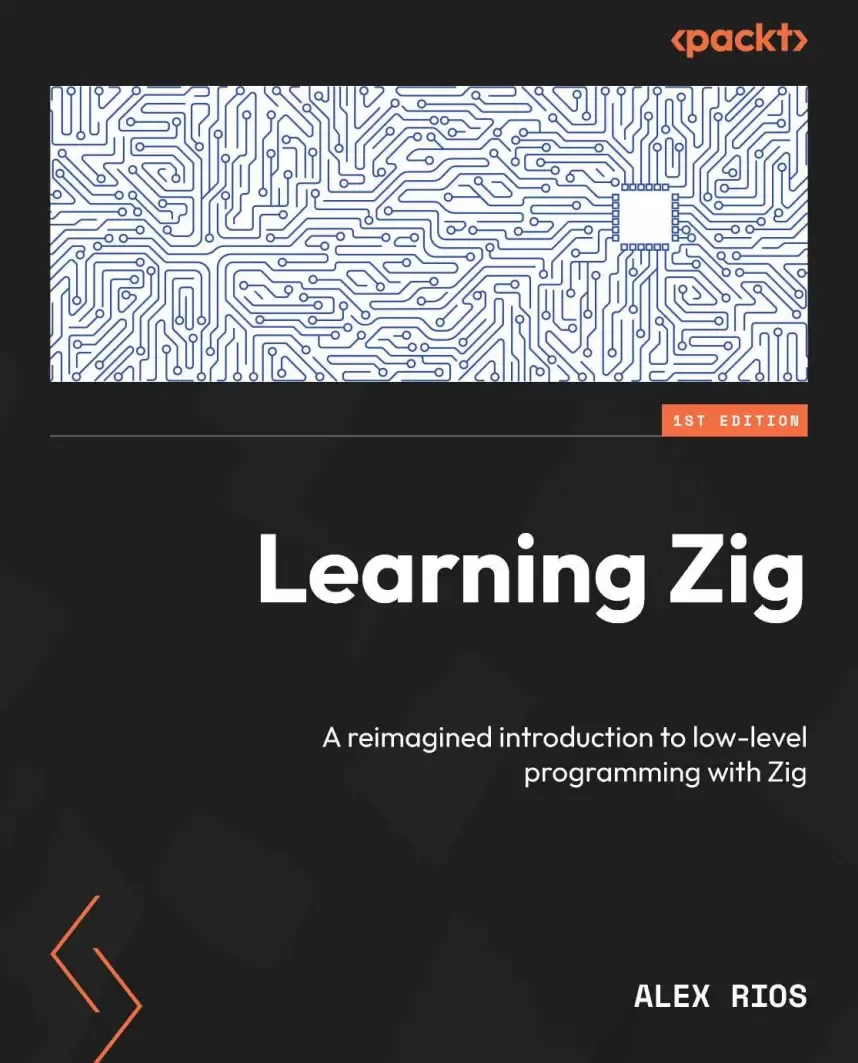
Learning Zig: A reimagined introduction to low-level programming with Zig
Оглавление⌄
Cover....1 Title Page....2 Copyright and Credits....3 Dedication....4 Contributors....5 Table of Contents....8 Preface....26 Part 1: Zig Fundamentals....34 Chapter 1: Safety First....36 Getting the most out of this book – get to know your free benefits....37 Next-gen reader....37 Interactive AI assistant (beta)....38 DRM-free PDF or ePub version ....38 Training your brain to think in Zig....39 Systems programming reimagined....40 The genesis of Zig – fixing what’s broken....41 The flaws of mainstream languages....42 The solution? Obviously, Zig....43 A modern alternative to C....44 Simplicity – focus on what matters....44 No hidden control flow....45 Compile-time execution....45 Tooling – ready to go, right out of the box....46 More than just a language....47 Why does Zig have its own build system?....47 A unified approach....47 Cross-compilation made easy....48 Maintain with Zig....48 Interoperability....49 Too good to be ignored....53 A new era begins....55 Safety....55 Where to use Zig....57 Summary....58 Chapter 2: Setting Up Your Playground....60 Installing Zig....61 Playing it safe or living on the edge: your first Zig dilemma....62 Stable or Bold....62 Linux: the land of choices....64 Windows: the land of path variables and PowerShell....65 Mac: the cult of brew....66 Verifying your installation....66 BTW, I use Arch Nix....66 The ZLS for smarter Zig coding....67 Building the ZLS from source....67 Integrating the ZLS....68 Using the ZLS in VS Code....68 Using the ZLS in Neovim....70 Installing the vim-plug plugin manager....71 Fine-tuning the ZLS....72 Finding the right spot for your zls.json file....73 Taking the ZLS to the next level....74 Defining a custom check step in your build.zig file....74 Activating your configuration....76 Zig setup: surprise test!....77 Summary....79 Chapter 3: Your First Zig Program....82 “Hello, World!”: Your first taste of Zig....82 Bringing in the Standard Library....83 Importing packages....84 zig run....85 Step 1: Building the executable manually....85 Step 2: Running the executable....86 Why go through this?....86 Variables....87 Shadowing....90 Identifiers....91 A quick word on primitive types....92 Basic debugging....92 Step 1: Building the program in debug mode....93 Step 2: Running the program....93 Step 3: What’s going on?....93 Understanding the byte pattern....93 std.debug....94 Maintaining consistency....95 Line endings: Keep it simple, keep it LF....95 Tabs versus spaces: Pick a side (spoiler: use spaces)....95 Byte order marks: Only at the start....95 The power of zig fmt....96 Building Zig projects....96 Step 1: Creating your project....96 Step 2: Your first build....97 Step 3: Running your program....97 Step 4: What’s inside the source code?....98 Step 5: Too many moving parts....98 Summary....99 Make it stick....99 Answers....105 Chapter 4: Control Flow, Loops, and Other Forms of Digital Domination....106 Technical requirements....107 Making choices with if, else, and switch (your code’s moral compass)....107 if as an expression....109 if with Boolean conditions: The classic that never gets old....110 if with union types....111 The elegant switch: Leveling up decision-making....112 Repeating actions....113 Iterating over a portion of a collection....115 Accessing indices....116 Iterating over multiple collections: Because one isn’t challenging enough....117 Using loops as expressions with else: Handling disappointment gracefully....118 Best practices, or how to sleep at night....121 Optional types: Because life (and code) isn’t always certain....123 What is the ?T type?....123 Embracing uncertainty in iteration....125 Labeled switches: When a regular switch just isn’t enough....127 Summary....133 Testing your knowledge....133 Chapter 5: Functions for the Efficient Programmer....138 Technical requirements....139 Blocks – keeping your variables on a tight leash....139 Shadowing – Zig doesn’t play that game....141 Functions....142 Parameters – accepting inputs....143 Return values – sending outputs back to the caller....144 The unreachable statement – asserting the impossible....147 Deferring decisions....150 Summary....152 Lock it in....153 Answers....155 Chapter 6: Error Handling....158 Technical requirements....158 Zig’s error handling philosophy....159 What’s an error value?....159 Enums: When you’re tired of magic numbers ruining your day....160 switch statements revisited: For when you need even more control flow....162 Enum literals: Saving you a few microseconds of typing....163 Non-exhaustive enums: Keep your options open....163 Introspection: When you want to play detective in your own code....165 Enum type information: Dive deeper if you dare....166 Unions....167 Tagged unions: Adding a tag for safety....168 Errors: Turning failures into manageable events....171 Error sets: Enumerating the possible mishaps....172 Handling errors with try and catch....172 Error unions: Combining errors with values....173 Handling error unions....174 Coercing error sets....174 The errdefer statement: Cleaning up after errors....176 Why Zig embraces error values....176 Why do error sets matter?....176 Error return traces: Breadcrumbs for when it all goes wrong....177 The anatomy of an error return trace....177 Error return traces are better than stack traces....178 Enabling and using error return traces....179 Why you’ll actually love error return traces....179 Summary....180 Reinforcing your understanding of enums, unions, and errors in Zig....181 Answers....187 Chapter 7: Testing Your Zig Code....190 Technical requirements....191 Unit testing: because debugging is a form of self-torture....191 Why bother with unit tests?....191 Understanding the test structure....192 Embracing failure (in your tests, not in life)....193 std.testing: Zig’s not-so-secret weapon for code confidence....194 Leveraging the testing allocator....197 Filtering tests....198 Making the most of std.testing....198 Test structure: Organizing your tests (so you can find them later)....199 The art of keeping tests close....199 Naming conventions: because vague names help no one....200 Leveraging doctests: Kill two birds with one stone....202 Running tests: the moment of truth (will It blend?)....203 Test Coverage....204 Using kcov: Step by step....205 Generating coverage for tests....206 Limitations and Considerations....209 Summary....209 Test time!....210 Answers....213 Part 2: Data, Memory, and Tools....216 Chapter 8: Organizing Data....218 Technical requirements....218 Arrays: fixed-size collections of things....219 A few good arrays....219 Because size matters....220 Iterating over arrays....220 Modifying arrays....221 Compile-time array magic....221 Initialize arrays to zero....222 Multidimensional arrays: like arrays, but more....222 Sentinel-terminated arrays: because sometimes you need a flag....223 Slices: dynamic views into arrays....224 Step 1: Arrays and their royal stubbornness....225 Step 2: Introducing slices (runtime flexibility)....226 Step 3: A more complex scenario – filtering and sub-slicing....229 Step 4: Treating strings as slices....231 Step 5: Sentinel-terminated slices (because some APIs are stuck in the past)....232 Structs: your own custom data (because you’re special)....233 Step 1: A simple struct (the basics)....234 Step 2: Adding functions to structs (methods, but not really)....235 Step 3: Namespaced declarations and empty structs....236 Step 4: Field parent pointers (fancy reflection)....237 Step 5: Default field values done right....238 Step 6: Packed structs (memory layout shenanigans)....239 Step 7: Anonymous structs and tuples....240 Summary....242 Let’s make this knowledge stick!....243 Chapter 9: Memory Management....248 Technical requirements....249 Stack and heap: The two-headed beast of memory....249 Memory and processes (at a glance)....249 Stack....249 Heap....250 Other sections (we swear they exist)....251 Pointers: The good, the bad, and the ugly (but mostly good)....251 Why bother with pointers?....251 Getting a pointer: & (address of)....252 Explicit mutability....253 Pointer semantics....253 Compile-time safety....254 Pointer array access....254 Converting between pointers and integers....255 volatile....257 volatile versus concurrency....258 Casting pointers: Loot boxes and mystery bytes....258 Why use @alignCast with @ptrCast?....259 Reinterpreting bits....259 Single-item versus many-item pointers....260 Slicing with pointers....261 Pointer arithmetic: A loaded gun....261 Allocation: The art of asking for more memory (and getting it)....262 Zig versus mainstream languages: The babysitters and the grown-ups....263 Allocators interface....263 Allocators in Zig....264 alloc: Grabbing memory manually....264 free: Return it or suffer....264 resize: Asking politely for more....265 create: Single-item allocation....265 destroy: Free that single item....265 Lifetime considerations....265 Testing allocators: std.testing.allocator....268 Testing your equipment....269 Handling allocation failures: std.testing.failing_allocator....270 FixedBufferAllocator: Your first real allocator....274 The GeneralPurposeAllocator(s): Plural? Yes, plural.....277 The page allocator: The unsung hero....279 The arena allocator: A playground for memory management....281 The elephant in the room: Safety, part 2....285 Zig’s design philosophy: Honest, explicit, and controlled....286 Zero-sized types: The phantom menace of memory management (but they have their uses)....287 A type that stores nothing....288 void versus anyopaque....289 Ignoring expressions....289 Shrinking your code with zero-sized types....289 Type conversion (casting): When your data needs a disguise....290 Type coercion: Safe and automatic....290 When coercion fails....291 C pointers special case....292 Peer type resolution....292 Summary....295 Chapter 10: The Standard Library....298 Technical requirements....298 Common data structures: ArrayLists, HashMaps, and other fun things ....299 Party Members: ArrayLists in Zig — the art of controlled chaos....299 init: raising the banner....299 append: the delusion of safety....300 Capacity: the chess game....300 The unmanaged horde....300 Insertions and removals: the dance of death....301 The sentinel gambit....301 The philosophy of pain....301 Epilogue: why bother?....302 HashMaps: the tavern brawlers of data structures....302 Key operations (pun intended)....302 The dark arts of hashing....303 Tombstones: the ghosts of hashes past....304 Adapt or perish: contexts and customization....304 Zig versus the world....304 Boss fight: test your gear....305 File I/O: reading, writing, and wrangling files like a boss ....305 Opening act: the filesystem dungeon....305 Opening files: negotiating with the file system’s bouncer....305 Reading files: from bytes to bragging rights....307 Writing files: carving your legacy into the disk....307 Binary files: telepathy for machines....308 Buffered I/O: the blazing-fast option....308 File sync: the ritual of flushing....309 File seeking: time travel for bytes....309 Error handling: Zig’s “No BS” policy....309 File permissions: the guardian spells....310 Hard links: the doppelgänger files....310 Final boss challenge: the atomic logger....311 The Zig filesystem creed....311 Untapped territories in Zig file operations: the lost scrolls ....311 File modes and flags: the fine print of file creation....311 Memory-mapped files: the necromancy of I/O....312 Disk space intel: the scout’s report....312 Symbolic link creation: traps for the unwary....313 Advanced error recovery: the phoenix protocol....313 Formatting and printing: making your output look pretty (or at least legible)....314 Why std.fmt? Precision meets flexibility....314 Core tools: crafting strings with purpose....314 Advanced techniques: precision, padding, and personality....315 Custom formatting: make your types shine....316 Quiz time: spot the mistake....317 Other utilities: random numbers, time, and more fun stuff....318 Randomness: choose your weapon wisely....318 Time: raw, unfiltered, and unapologetic....319 Why no DateTime?....319 Iterators: scalpels versus chainsaws....320 1. std.mem.SplitIterator....320 2. std.mem.TokenIterator....320 Sorting: no training wheels, no regrets....320 The Zig difference: no magic, no compromises....321 Final challenge....321 std.mem utilities: a comprehensive guide....322 Core operations....322 set....322 Memory manipulation....323 Advanced utilities....323 Iteration and splitting....324 Challenge solution: 64-byte chunk processor....324 Summary....325 Chapter 11: Packing....328 Technical requirements....329 The Zig build system: automating your workflow....329 zig init: your project’s starter kit (with free existential dread)....329 The yin and yang of Zig’s init twins....330 build.zig dissected: what’s in the box?....330 Using zig build....332 Building....332 Testing....332 Running....333 Customizing build.zig: from Meh to MVP**....334 Cross-compilation: Zig’s party trick (1 code base, 57 platform-specific bugs)....335 Tier 1: production-ready support....336 Tier 2: community-maintained support....336 Tier 3: experimental or minimal support....337 Tier 4: deprecated or legacy support....338 Using the target....338 Why do these matter?....342 Release modes....342 Optimizations: Debug versus Release (choose your poison)....342 Debug....344 ReleaseSafe....344 ReleaseFast....344 ReleaseSmall....345 Mix and match....346 Undefined behavior and granular control....347 Custom options....347 The build team....350 Steps: the atomic actions of a build pipeline....351 The taxonomy of steps....351 The DAG: Git’s angrier cousin....351 Declarative syntax: the illusion of simplicity....352 Custom steps: the build system’s escape hatch....352 The RPG side quest principle....353 The philosophy beneath....353 Modules....353 Code islands....354 Dependency hoarders....354 Configuration fetishists....354 The circle of (module) life: from declaration to domination....354 Declaration: the grand proclamation....355 Configuration: the fiddling and tweaking....355 Integration: joining the big leagues....355 Multi-module mania: when modules collide....356 The show must go on....358 The grand finale....358 Pop quiz: Are you smarter than a build script?....359 Generating docs: because code should be less cryptic than ancient runes....360 Doc comments: breadcrumbs for future-you....360 Generating docs: the compiler’s side hustle....361 Error set drama....361 Weaponize the build system....362 Package management: because reinventing the wheel is so last century....364 build.zig.zon: your new best friend (or worst enemy, the jury’s still out)....364 zig fetch: your command-line dependency fetcher....365 Putting dependencies to work: from build.zig.zon to @import....367 Important naming relationship....368 From fingerprint to fortress....368 Beyond the usual suspects....369 Cache: the memory of the compiler....370 Core concepts (how to avoid recompiling the universe)....371 Content-addressable storage (everything has a unique fingerprint)....371 Manifest files (the librarian’s secret notebook)....371 Cache workflow (the dance of hashes)....372 The Zig build cache directories....372 Real-world scenarios (proof that it works)....374 Performance and reliability (fast and correct)....376 Why this matters (the “so what?” section)....376 zig build --watch: your new best friend (who doesn’t talk back)....377 Why this is better than the old way....379 Summary....379 Part 3: Advanced Zig and Real-World Application....382 Chapter 12: Sophisticated Topics....384 Technical requirements....385 comptime: The time machine you didn’t know you needed....385 comptime basics....385 Type inference: Schrödinger’s integer....386 Every block, every time: The backbone of comptime....387 Zig’s double identity: Compile time versus runtime....389 Compile-time Zig: The master planner....389 Runtime Zig: The speed demon....389 The golden rule for calling comptime functions....390 The type supertype: Compile time’s bouncer....390 Compile-time exclusivity....391 Type functions: The type-generating powerhouses....391 Building simple types....391 Leveling up: Creating structs....392 Tools of the trade: @typeOf, @typeInfo, and @Type....394 @typeOf: The detective....394 @typeInfo: The magnifying glass....394 @Type: Bringing types to life....395 Reflection and metaprogramming....396 anytype: The Swiss Army knife of types....398 Common pitfalls: When types fight back....399 Mistake 1: Using anytype where type is required....399 Mistake 2: Confusing compile time with runtime contexts....400 Mistake 3: The “everything should be anytype” trap....401 Mistake 4: Forgetting about type coercion rules....402 Mistake 5: Type parameter naming confusion....403 comptime budgets: The branch quota....404 The override: What is @setEvalBranchQuota()?....404 Threads in Zig: Herding cats with a laser pointer....406 Spawning threads: Welcome to the Thunderdome....406 Sharing data: Mutexes are your bouncers....407 Mutexes: The bouncers of your nightclub....407 Atomics: The cheetahs of concurrency....408 Pitfalls: How to summon a segfault demon....410 Performance considerations: Don’t be a resource hog....411 Interoperability with C: When you need to borrow someone else’s tools (but make them work your way)....413 C: The cockroach of code (and why you’ll learn to love/hate it)....413 ABI....413 @cImport: Your gateway to the C underworld....414 Calling Zig from C: Exporting your chaos....416 Playing nice with C: Structs, alignment, and the quest for interoperability (RPG edition)....419 Extern structs: Your diplomatic passport to C....419 Alignment: The CPU’s picky preferences....419 Packed structs: The Tetris champions of memory....419 Bit-aligned pointers: Navigating the bitstream....420 The perils of [*c]T: Zig’s C pointer (and why you should (almost) never use it)....421 Summary....422 Chapter 13: Real-World Zig....424 Technical requirements....425 Command-line tools: automating your life (and annoy your coworkers)....425 FileGuard architecture: building your first real-world application....427 The file monitoring challenge....427 Design decisions: working smarter, not harder....428 Project structure: breaking it down....429 The implementation roadmap....430 Implementing file metadata: the foundation of change detection....431 The FileMetadata struct: identity, state, and ownership....431 Initializing file metadata: the birth of a tracking record....432 Memory management: the circle of life....433 Cloning metadata: sometimes you need a perfect copy....433 Content hashing: when size and timestamp aren’t enough....434 Cross-platform considerations: the beauty of abstraction....435 Putting it all together: the complete file metadata implementation....436 Building a file index: organizing your digital filing cabinet....436 The FileIndex struct: a tale of two maps....436 Initializing the index: setting up shop....438 Cleanup: leaving no trace behind....438 Adding files: populating your index....439 Lookup operations: finding your files....440 Cloning the index: sometimes you need a perfect copy....440 Removing files: when it’s time to say goodbye....442 Counting files: how big is your collection?....442 The power of dual indexing: path and inode lookups....443 Memory management: the path tracking mystery explained....443 Directory traversal: exploring your digital wilderness....444 The TraversalConfig: your expedition parameters....444 Pattern matching: your file-finding filter....445 The file filter: should we include this file?....446 The main traversal: your digital safari....446 Handling symbolic links: the portals of the filesystem....448 The traversal dance: how it all works together....449 Performance considerations: traversal isn’t free....450 Change detection: spot the differences in your digital world....451 Defining change types: building your detective’s notebook....451 Representing changes: the FileChange struct....452 The change journal: collecting your evidence....452 Detection configuration: customizing your detective work....453 The main detection algorithm: finding your culprits....454 Detecting file modifications: the devil in the details....456 The magic of move detection: inodes to the rescue....459 Building the command-line interface: making FileGuard user-friendly....460 Command-line options: giving users control....460 Parsing arguments: turning text into configuration....461 Displaying help: guiding lost souls....463 Running the monitor: the main event loop....463 Reporting changes: making results human-readable....467 Error handling: when things go wrong....469 Beyond the basics: professional CLI features....470 Tying it all together: the main program and beyond....471 Building and wrangling dependencies....472 Building and running FileGuard: from code to executable....474 Extending FileGuard: the road to professional use....475 Other project ideas: the sky’s the limit (or at least the memory limit)....475 Community resources: forums, chat rooms, and other dens of iniquity (we mean knowledge)....477 Contributing to Zig: open-source development for the greater good (and your resume)....478 The roadmap: Zig’s future plans (world domination, probably)....478 Zig’s impact: case studies and success stories (from humble beginnings to tech giants)....479 Summary....479 Chapter 14: Unlock Your Book’s Exclusive Benefits....482 How to unlock these benefits in three easy steps....482 Step 1....482 Step 2....483 Step 3....483 Need help?....484 Other Books You May Enjoy....488 Index....492
Описание
Ниже — практический обзор по теме «control».
Master Zig's blend of safety and performance by building real-world systems applications, and learn memory management through to compile-time execution to create reliable software with full control and zero hidden behaviors
Key FeaturesWrite high-performance code with Zig's clear, no-surprises approach to control flowDiscover memory management techniques to get complete control without sacrificing safety or introducing complexityBuild portable apps with Zig's powerful build system and seamless C interoperability for real-world problem-solvingPurchase of the print or Kindle book includes a free PDF eBookBook DescriptionSystem programming has long forced developers to choose between safety and performance, but Zig changes the game with its no hidden control flow philosophy and explicit resource management. If you've struggled with memory leaks, undefined behavior, or cryptic compiler errors, Zig offers an alternative that puts you back in control.
Alex Rios, a seasoned software engineer with experience building high-throughput systems across fintech, telecom, and gaming industries, brings his unconventional system design approach and offers insight into Zig, as someone who's seen the limitations of existing languages firsthand.
You'll then explore Zig's distinctive features in depth, such as explicit error handling, manual memory management, and compile-time execution. You’ll get to grips with Zig's safety-centric design fundamentals, which will guide you through setting up your app development environment and writing your first programs. The book tackles each topic with a blend of technical depth and wit, ensuring you grasp not just the how but also the why behind Zig's design decisions.
By the end of this book, you'll be ready to build a complete application that interacts with the OS, third-party libraries, and C dependencies, as well as engage with Zig's growing community and contribute to its ecosystem.
What you will learnFind out how to maintain low-level control over system resourcesSet up a Zig development environment across different operating systemsOrganize maintainable projects with proper structure and build systemsImplement error handling using Zig's unique approach to managing failuresLeverage Zig's standard library effectively for everyday programming tasksBuild applications that use files, external libraries, and C codeCross-compile and package Zig applications for multiple platformsWho this book is forThis book is for developers looking to master efficient and safe programming with Zig. The target audience includes system programmers exploring manual memory management and safety features, embedded systems developers building high-performance software, WebAssembly enthusiasts creating web applications, programmers transitioning from Go or JavaScript for better control over memory and performance, and C/C++ developers seeking simplicity and low-level control without sacrificing safety or performance.
На этом основные моменты по теме закрыты.
Поделиться
Частые вопросы
Можно ли скачать «Learning Zig: A reimagined introduction to low-level programming with Zig» бесплатно?
Да, «Learning Zig: A reimagined introduction to low-level programming with Zig» доступна для бесплатного скачивания на нашем сайте в формате PDF. Ссылка на файл находится на этой странице.
В каком формате и какого размера файл?
Книга предоставляется в формате PDF, размер файла 2,7 МБ.
Кто автор и когда вышла книга?
автор — Rios Alex, издательство Packt Publishing Limited, год выпуска 2025, 502 страниц.
О чём книга «Learning Zig: A reimagined introduction to low-level programming with Zig»?
Master Zig's blend of safety and performance by building real-world systems applications, and learn memory management through to compile-time execution to create reliable software with full control and zero hidden behaviorsKey FeaturesWrite
Похожие материалы
 Building Computer Vision Applications Using Artificial Neural Networks: With Examples in OpenCV and TensorFlow with Python. 2 Ed
 Machine Learning for Business Analytics: Concepts, Techniques, and Applications with Analytic Solver Data Mining. 4 Ed
 Machine Learning Model Serving Patterns and Best Practices: A definitive guide to deploying, monitoring, and providing accessibility to ML models in production
 Applied Machine Learning and High-Performance Computing on AWS: Accelerate the development of machine learning applications following architectural best practices
 Random Matrix Methods for Machine Learning
 Машинное обучение с использованием Python. Сборник рецептов. Практические решения от предобработки до глубокого обучения. 2 изд
 System Design: Машинное обучение. Подготовка к сложному интервью
 Machine Learning Interviews: Kickstart Your Machine Learning and Data Career