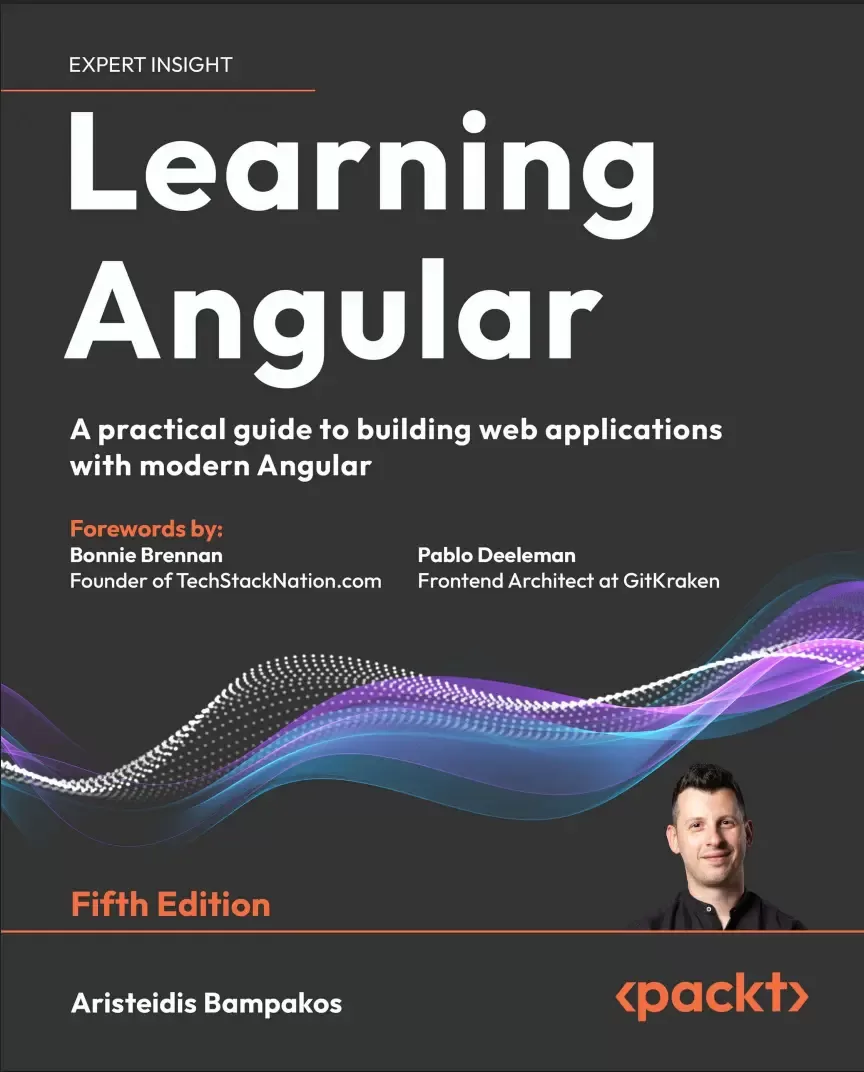
Learning Angular: A practical guide to building web applications with modern Angular. 5 Ed
Оглавление⌄
Preface xixChapter 1: Building Your First Angular Application 1Technical requirements ....2What is Angular? ....2Why choose Angular? ....4Cross-platform • 4Tooling • 4Onboarding • 5The usage of Angular worldwide • 5Setting up the Angular CLI workspace ....6Prerequisites • 6Node.js • 6npm • 7Git • 7Installing the Angular CLI • 7CLI commands • 8Creating a new project • 9The structure of an Angular application ....12Components • 13Bootstrapping • 13Template syntax • 14Angular tooling ....16Angular DevTools • 16VSCode Debugger • 20VSCode Profiles • 22Angular Language Service • 22Material Icon Theme • 24EditorConfig • 24Summary ....25Chapter 2: Introduction to TypeScript 27Technical requirements ....27JavaScript essentials ....28Variable declaration • 28Function parameters • 31Arrow functions • 32Optional chaining • 33Nullish coalescing • 34Classes • 35Modules • 36What is TypeScript? ....37Getting started with TypeScript ....39Types • 41String • 42Boolean • 42Number • 42Array • 42any • 43Custom types • 43Functions • 44Classes • 45Interfaces • 48Generics • 50Utility types • 52Summary • 52Chapter 3: Structuring User Interfaces with Components 55Technical requirements ....55Creating our first component ....56The structure of an Angular component • 56Creating components with the Angular CLI • 58Interacting with the template ....60Loading the component template • 60Displaying data from the component class • 62Controlling data representation • 63Class binding • 71Style binding • 72Getting data from the template • 73Component inter-communication ....75Passing data using an input binding • 75Listening for events using an output binding • 77Emitting data through custom events • 80Local reference variables in templates • 81Encapsulating CSS styling ....82Deciding on a change detection strategy ....85Introducing the component lifecycle ....89Performing component initialization • 90Cleaning up component resources • 91Detecting input binding changes • 93Accessing child components • 95Summary ....96Chapter 4: Enriching Applications Using Pipes and Directives 99Technical requirements ....99Manipulating data with pipes ....99Building pipes ....106Sorting data using pipes • 106Passing parameters to pipes • 110Change detection with pipes • 112Building directives ....113Displaying dynamic data • 114Property binding and responding to events • 118Summary ....120Chapter 5: Managing Complex Tasks with Services 121Technical requirements ....122Introducing Angular DI ....122Creating our first Angular service ....124Injecting services in the constructor • 126The inject keyword • 128Providing dependencies across the application ....129Injecting services in the component tree ....133Sharing dependencies through components • 133Root and component injectors • 138Sandboxing components with multiple instances • 139Restricting provider lookup • 145Overriding providers in the injector hierarchy ....147Overriding service implementation • 147Providing services conditionally • 149Transforming objects in Angular services • 151Summary ....153Chapter 6: Reactive Patterns in Angular 155Technical requirements ....155Strategies for handling asynchronous information ....156Shifting from callback hell to promises • 156Observables in a nutshell • 160Reactive programming in Angular ....162The RxJS library ....165Creating observables • 166Transforming observables • 167Subscribing to observables ....169Unsubscribing from observables ....172Destroying a component • 172Using the async pipe • 174Summary ....176Chapter 7: Tracking Application State with Signals 177Technical requirements ....177Understanding signals ....178Reading and writing signals ....178Computed signals ....180Cooperating with RxJS ....182Summary ....185Chapter 8: Communicating with Data Services over HTTP 187Technical requirements ....187Communicating data over HTTP ....188Introducing the Angular HTTP client ....189Setting up a backend API ....191Handling CRUD data in Angular ....192Fetching data through HTTP • 192Modifying data through HTTP • 202Adding new products • 203Updating product price • 207Removing a product • 210Authentication and authorization with HTTP ....214Authenticating with a backend API • 214Authorizing user access • 216Authorizing HTTP requests • 218Summary ....222Chapter 9: Navigating through Applications with Routing 223Technical requirements ....224Introducing the Angular router ....224Specifying a base path • 226Enabling routing in Angular applications • 226Configuring the router • 227Rendering components • 228Configuring the main routes ....228Organizing application routes ....232Navigating imperatively to a route • 233Using built-in route paths • 238Styling router links • 239Passing parameters to routes ....240Building a detail page using route parameters • 240Reusing components using child routes • 245Taking a snapshot of route parameters • 247Filtering data using query parameters • 248Binding input properties to routes • 250Enhancing navigation with advanced features ....252Controlling route access • 252Preventing navigation away from a route • 254Prefetching route data • 256Lazy-loading parts of the application • 259Protecting a lazy-loaded route • 262Summary ....263Chapter 10: Collecting User Data with Forms 265Technical requirements ....265Introducing web forms ....265Building template-driven forms ....267Building reactive forms ....271Interacting with reactive forms • 271Creating nesting form hierarchies • 276Modifying forms dynamically • 278Using a form builder • 285Validating input in forms ....288Global validation with CSS • 288Validation in template-driven forms • 290Validation in reactive forms • 294Building custom validators • 297Manipulating form state ....303Updating form state • 303Reacting to state changes • 304Summary ....306Join Us on Discord ....306Chapter 11: Handling Application Errors 307Technical requirements ....307Handling runtime errors ....308Catching HTTP request errors • 308Creating a global error handler • 312Responding to the 401 Unauthorized error • 315Demystifying framework errors ....316Summary ....318Chapter 12: Introduction to Angular Material 319Technical requirements ....319Introducing Material Design ....320Introducing Angular Material ....320Installing Angular Material • 321Adding UI components • 324Theming UI components • 325Integrating UI components ....329Form controls • 330Input • 330Select • 335Chips • 337Navigation • 338Layout • 340Card • 341Data table • 344Popups and overlays • 350Creating a confirmation dialog • 350Configuring dialogs • 353Getting data from dialogs • 354Displaying user notifications • 355Summary ....359Chapter 13: Unit Testing Angular Applications 361Technical requirements ....362Why do we need unit tests? ....362The anatomy of a unit test ....363Introducing unit tests in Angular ....365Testing components ....366Testing with dependencies • 370Replacing the dependency with a stub • 371Spying on the dependency method • 375Testing asynchronous services • 378Testing with inputs and outputs • 380Testing with a component harness • 383Testing services ....385Testing synchronous/asynchronous methods • 386Testing services with dependencies • 387Testing pipes ....389Testing directives ....390Testing forms ....392Testing the router ....395Routed and routing components • 395Guards • 398Resolvers • 401Summary ....403Chapter 14: Bringing Applications to Production 405Technical requirements ....406Building an Angular application ....406Building for different environments • 408Building for the window object • 410Limiting the application bundle size ....411Optimizing the application bundle ....412Deploying an Angular application ....415Summary ....416Chapter 15: Optimizing Application Performance 417Technical requirements ....418Introducing Core Web Vitals ....418Rendering SSR applications ....422Overriding SSR in Angular applications • 425Optimizing image loading ....428Deferring components ....430Introducing deferrable views • 430Using deferrable blocks • 431Loading patterns in @defer blocks • 437Prerendering SSG applications ....440Summary ....441Other Books You May Enjoy 445Index 449
Описание
В этом материале разберём тему: angular.
Learning Angular is a comprehensive introduction to the framework from an experienced Angular developer and Google Developer Expert. Angular is an extremely fast, cross-platform JavaScript framework loved by millions. You’ll learn the Angular way of development as you build a real-world app from the ground up.
It covers app creation with standalone components, Angular Signals, and the new control flow syntax, while acknowledging differences in approach in older Angular code. Updated for Angular 19, this fifth edition tackles landmark changes in Angular after the “Angular Renaissance”. You’ll also find a brand-new chapter on optimizing performance with SSR and hydration, as well as revamped content on TypeScript.
Angular developers of all experience levels will benefit from this book. It is especially useful if you are new to Angular, as it will help you get to grips with the bare bones of the framework.
By the end of this book, you'll be able to create Angular applications with TypeScript from scratch and apply best practices in any Angular codebase.
What you will learnUse the Angular CLI to scaffold, build, and deploy new Angular applications
Create Angular applications using standalone APIs
Build rich components with Angular template syntax
Apply reactivity patterns with the RxJS library and Signals
Craft beautiful user interfaces using Angular Material
Create HTTP data services to access APIs and provide data to components
Improve your debugging and error handling skills during runtime and development
Optimize application performance with SSR and hydration techniques
Who this book is forThis book is for JavaScript developers and web developers dipping their feet for the first time in the world of frontend development with Angular, as well as those migrating to the Angular framework to build professional web applications. Current Angular developers looking to catch up with modern Angular will also find this book useful.
You'll need prior exposure to JavaScript and a solid foundation in the basics of web programming before you get started with this book.
Файл доступен для загрузки ниже.
Поделиться
Частые вопросы
Можно ли скачать «Learning Angular: A practical guide to building web applications with modern Angular. 5 Ed» бесплатно?
Да, «Learning Angular: A practical guide to building web applications with modern Angular. 5 Ed» доступна для бесплатного скачивания на нашем сайте в формате PDF. Ссылка на файл находится на этой странице.
В каком формате и какого размера файл?
Книга предоставляется в формате PDF, размер файла 3,6 МБ.
Кто автор и когда вышла книга?
автор — Bampakos Aristeidis, издательство Packt Publishing Limited, год выпуска 2024, 487 страниц.
О чём книга «Learning Angular: A practical guide to building web applications with modern Angular. 5 Ed»?
Angular is an extremely fast, cross-platform JavaScript framework loved by millions.
Похожие материалы
 JavaScript. Рецепты для разработчиков. 3 изд
 Become A Ninja With Angular
 Mastering jQuery: A Beginner’s Guide
 Professional JavaScript for Web Developers. 5 Ed
 React.js Design Patterns: Learn how to build scalable React apps with ease
 Typescript and JavaScript Coding Made Simple 2 Books in 1: A Beginner’s Guide to Programming
 React. Сборник рецептов. Практические приемы работы с фреймворком React
 JavaScript. Полное руководство: Справочник по самому популярному языку программирования. 7 изд