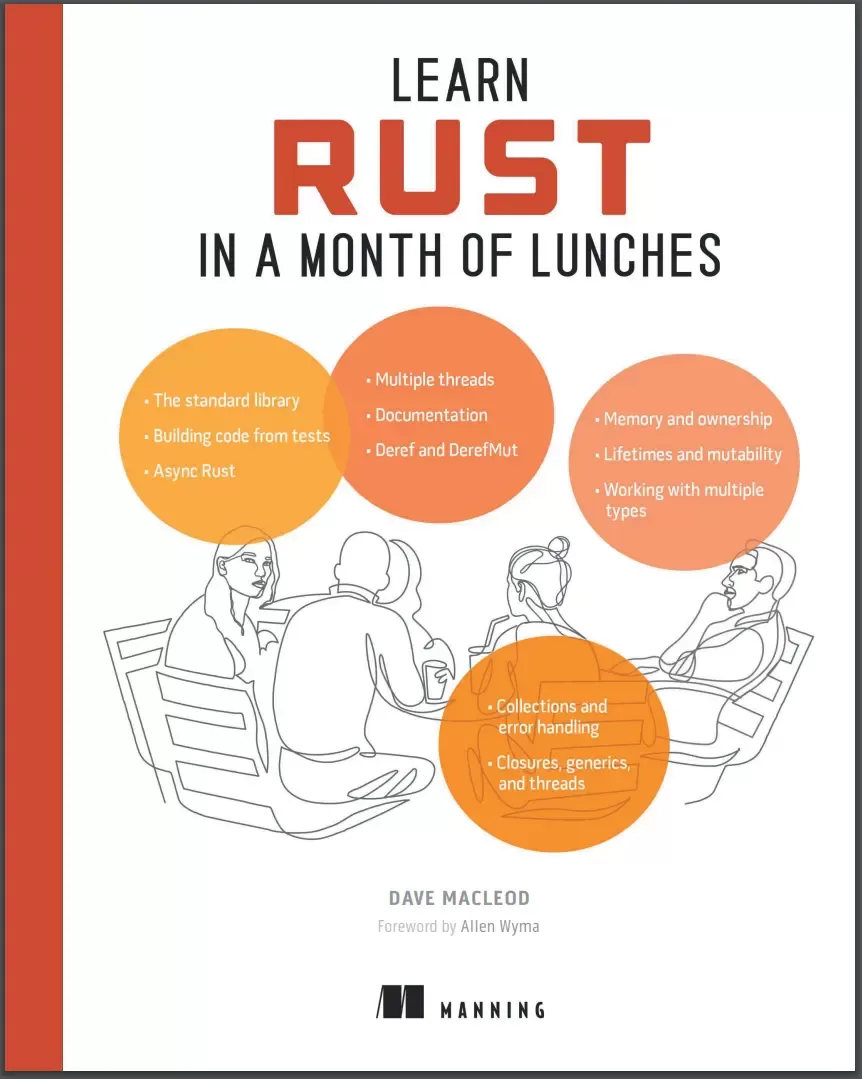
Learn Rust in a Month of Lunches
Оглавление⌄
Learn Rust in a Month of Lunches....1 brief contents....8 contents....9 foreword....17 preface....19 acknowledgments....21 about this book....23 Who should read this book....23 How this book is organized: A road map....24 About the code....25 liveBook discussion forum....25 about the author....26 1 Some basics....27 1.1 Introducing Rust....28 1.1.1 A pep talk....28 1.1.2 Rust is like a critical spouse....29 1.2 Comments....32 1.3 Primitive types: Integers, characters, and strings....33 1.4 Type inference....40 1.5 Floats....41 1.6 “Hello, World!” and printing....42 1.7 Declaring variables and code blocks....46 1.8 Display and Debug....48 1.9 Smallest and largest numbers....49 1.10 Mutability (changing)....50 1.11 Shadowing....51 Summary....53 2 Memory, variables, and ownership....54 2.1 The stack, the heap, pointers, and references....55 2.2 Strings....56 2.3 const and static....59 2.4 More on references....60 2.5 Mutable references....61 2.5.1 Rust’s reference rules....62 2.5.2 Situation 1: Only one mutable reference....62 2.5.3 Situation 2: Only immutable references....63 2.5.4 Situation 3: The problem situation....63 2.6 Shadowing again....64 2.7 Giving references to functions....64 2.8 Copy types....68 2.9 Variables without values....71 2.10 More about printing....71 Summary....77 3 More complex types....78 3.1 Collection types....78 3.1.1 Arrays....79 3.1.2 Vectors....81 3.1.3 Tuples....84 3.2 Control flow....86 3.2.1 Basic control flow....86 3.2.2 Match statements....87 3.2.3 Loops....92 Summary....96 4 Building your own types....97 4.1 A quick overview of structs and enums....97 4.1.1 Structs....98 4.1.2 Enums....101 4.1.3 Casting enums into integers....104 4.1.4 Enums to use multiple types....105 4.1.5 Implementing structs and enums....107 4.2 Destructuring....109 4.3 References and the dot operator....113 Summary....114 5 Generics, option, and result....116 5.1 Generics....116 5.2 Option and Result....121 5.2.1 Option....122 5.2.2 Result....125 5.2.3 Some other ways to do pattern matching....128 Summary....131 6 More collections, more error handling....132 6.1 Other collections....132 6.1.1 HashMap (and BTreeMap)....133 6.1.2 HashSet and BTreeSet....139 6.1.3 BinaryHeap....141 6.1.4 VecDeque....142 6.2 The ? operator....144 6.3 When panic and unwrap are good....148 Summary....152 7 Traits: Making different types do the same thing....154 7.1 Traits: The basics....154 7.1.1 All you need are the method signatures....157 7.1.2 More complex examples....161 7.1.3 Traits as bounds....166 7.1.4 Traits are like qualifications....168 7.2 The From trait....171 7.3 The orphan rule....173 7.4 Getting around the orphan rule with newtypes....173 7.5 Taking a String and a &str in a function....175 Summary....177 8 Iterators and closures....178 Iterators and closures....178 8.1 Chaining methods....179 8.2 Iterators....180 8.3 Closures and closures inside iterators....187 8.3.1 Closures inside of methods....188 8.3.2 Closures: Lazy and fast....190 8.3.3 |_| in a closure....193 Summary....194 9 Iterators and closures again!....195 9.1 Helpful methods for closures and iterators....196 9.1.1 Mapping and filtering....196 9.1.2 Some more iterator and related methods....200 9.1.3 Checking and finding items inside iterators....203 9.1.4 Cycling, zipping, folding, and more....206 9.2 The dbg! macro and .inspect....211 Summary....214 10 Lifetimes and interior mutability....215 10.1 Types of &str....215 10.2 Lifetime annotations....216 10.2.1 Lifetimes in functions....217 10.2.2 Lifetime annotations in types....218 10.2.3 The anonymous lifetime....221 10.3 Interior mutability....225 10.3.1 Cell....226 10.3.2 RefCell....227 10.3.3 Mutex....230 10.3.4 RwLock....232 Summary....234 11 Multiple threads and a lot more....235 11.1 Importing and renaming inside a function....236 11.2 The todo! macro....238 11.3 Type aliases....240 11.4 Cow....241 11.5 Rc....245 11.5.1 Why Rc exists....245 11.5.2 Using Rc in practice....246 11.5.3 Avoiding lifetime annotations with Rc....249 11.6 Multiple threads....251 11.6.1 Spawning threads....251 11.6.2 Using JoinHandles to wait for threads to finish....253 11.6.3 Types of closures....255 11.6.4 Using the move keyword....256 Summary....258 12 More on closures, generics, and threads....259 12.1 Closures as arguments....260 12.1.1 Some simple closures....263 12.1.2 The relationship between FnOnce, FnMut, and Fn....265 12.1.3 Closures are all unique....266 12.1.4 A closure example....268 12.2 impl Trait....270 12.2.1 Regular generics compared to impl Trait....270 12.2.2 Returning closures with impl Trait....272 12.3 Arc....275 12.4 Scoped threads....279 12.5 Channels....282 12.5.1 Channel basics....282 12.5.2 Implementing a channel....283 Summary....286 13 Box and Rust documentation....287 13.1 Reading Rust documentation....288 13.1.1 assert_eq!....288 13.1.2 Searching....289 13.1.3 The [src] button....290 13.1.4 Information on traits....291 13.1.5 Attributes....291 13.2 Box....297 13.2.1 Some Box basics....297 13.2.2 Putting a Box around traits....299 13.2.3 Using a Box to handle multiple error types....302 13.2.4 Downcasting to a concrete type....305 Summary....307 14 Testing and building your code from tests....308 14.1 Crates and modules....309 14.1.1 Module basics....309 14.1.2 More on how the pub keyword works....311 14.1.3 Modules inside modules....312 14.2 Testing....315 14.2.1 Just add #[test], and now it’s a test....315 14.2.2 What happens when tests fail....316 14.2.3 Writing multiple tests....318 14.3 Test-driven development....319 14.3.1 Building a calculator: Starting with the tests....320 14.3.2 Putting the calculator together....322 Summary....328 15 Default, the builder pattern, and Deref....329 15.1 Implementing Default....329 15.2 The builder pattern....332 15.2.1 Writing builder methods....333 15.2.2 Adding a final check to the builder pattern....335 15.2.3 Making the builder pattern more rigorous....338 15.3 Deref and DerefMut....340 15.3.1 Deref basics....340 15.3.2 Implementing Deref....342 15.3.3 Implementing DerefMut....344 15.3.4 Using Deref the wrong way....345 Summary....348 16 Const, “unsafe” Rust, and external crates....349 16.1 Const generics....350 16.2 Const functions....352 16.3 Mutable statics....354 16.4 Unsafe Rust....355 16.4.1 Overview of unsafe Rust....355 16.4.2 Using static mut in unsafe Rust....357 16.4.3 Rust’s most famous unsafe method....358 16.4.4 Methods ending in _unchecked....360 16.5 Introducing external crates....361 16.5.1 Crates and Cargo.toml....361 16.5.2 Using the rand crate....362 16.5.3 Rolling some dice with rand....363 Summary....365 17 Rust’s most popular crates....367 17.1 serde....368 17.2 Time in the standard library....370 17.3 chrono....375 17.3.1 Checking the code inside external crates....376 17.3.2 Back to chrono....377 17.4 Rayon....380 17.5 Anyhow and thiserror....383 17.5.1 Anyhow....383 17.5.2 thiserror....386 17.6 Blanket trait implementations....388 17.7 lazy_static and once_cell....392 17.7.1 Lazy static: Lazily evaluated statics....392 17.7.2 OnceCell: A cell to only write to once....395 Summary....397 18 Rust on your computer....399 18.1 Cargo....400 18.1.1 Why everyone uses Cargo....400 18.1.2 Using Cargo and what Rust does while it compiles....402 18.2 Working with user input....406 18.2.1 User input through stdin....406 18.2.2 Accessing command-line arguments....408 18.2.3 Accessing environment variables....411 18.3 Using files....414 18.3.1 Creating files....414 18.3.2 Opening existing files....415 18.3.3 Using OpenOptions to work with files....415 18.4 cargo doc....418 Summary....420 19 More crates and async Rust....422 19.1 The reqwest crate....422 19.2 Feature flags....425 19.3 Async Rust....428 19.3.1 Async basics....428 19.3.2 Checking whether a Future is ready....429 19.3.3 Using an async run time....431 19.3.4 Some other details about async Rust....433 Summary....436 20 A tour of the standard library....438 20.1 Arrays....439 20.1.1 Arrays now implement Iterator....439 20.1.2 Destructuring and mapping arrays....440 20.1.3 Using from_fn to make arrays....441 20.2 char....443 20.3 Integers....445 20.3.1 Checked operations....445 20.3.2 The Add trait and other similar traits....446 20.4 Floats....449 20.5 Associated items and associated constants....450 20.5.1 Associated functions....450 20.5.2 Associated types....451 20.5.3 Associated consts....453 20.6 bool....454 20.7 Vec....456 20.8 String....458 20.9 OsString and CString....460 Summary....461 21 Continuing the tour....463 21.1 std::mem....463 21.2 Setting panic hooks....468 21.3 Viewing backtraces....473 21.4 The standard library prelude....476 21.5 Other macros....477 21.5.1 unreachable!....478 21.5.2 column!, line!, file!, and module_path!....480 21.5.3 thread_local!....482 21.5.4 cfg!....484 Summary....486 22 Writing your own macros....487 22.1 Why macros exist....488 22.2 Writing basic macros....489 22.3 Reading macros from the standard library....496 22.4 Using macros to keep your code clean....501 Summary....505 23 Unfinished projects: Projects for you to finish....506 23.1 Setup for the last two chapters....507 23.2 Typing tutor....507 23.2.1 Setup and first code....507 23.2.2 Developing the code....508 23.2.3 Further development and cleanup....510 23.2.4 Over to you....512 23.3 Wikipedia article summary searcher....513 23.3.1 Setup and first code....513 23.3.2 Developing the code....514 23.3.3 Further development and cleanup....516 23.3.4 Over to you....518 23.4 Terminal stopwatch and clock....518 23.4.1 Setup and first code....518 23.4.2 Developing the code....521 23.4.3 Further development and cleanup....525 23.4.4 Over to you....527 Summary....528 24 Unfinished projects, continued....529 24.1 Web server word-guessing game....529 24.1.1 Setup and first code....530 24.1.2 Developing the code....532 24.1.3 Further development and cleanup....535 24.1.4 Over to you....538 24.2 Laser pointer....538 24.2.1 Setup and first code....538 24.2.2 Developing the code....540 24.2.3 Further development and cleanup....543 24.2.4 Over to you....546 24.3 Directory and file navigator....546 24.3.1 Setup and first code....547 24.3.2 Developing the code....548 24.3.3 Further development and cleanup....550 24.3.4 Over to you....552 Summary....553 index....555 Symbols....555 A....555 B....556 C....556 D....557 E....558 F....558 G....559 H....559 I....559 J....560 K....560 L....560 M....560 N....561 O....561 P....561 Q....562 R....562 S....563 T....564 U....565 V....566 W....566 Y....566 Z....566 Learn Rust in a Month of Lunches -back....569
Описание
Коротко и по делу о том, что важно знать про rust.
Learn Rust in a Month of Lunches teaches you to write super fast and super safe Rust code through lessons you can fit in your lunch break. Crystal-clear explanations and focused, relevant examples make it accessible to anyone—even if you’re learning Rust as your first programming language.
You’ll learn essential Rust skills you can use for everything from system programming, to web applications, and games. By the time you’re done reading Learn Rust in a Month of Lunches you’ll be able to:Build real software in RustUnderstand messages from the compiler and Clippy, Rust’s coding coachMake informed decisions on the right types to use in any contextMake sense of the Rust standard library and its commonly used itemsUse external Rust “crates” (libraries) for common tasksComment and build documentation for your Rust codeWork with crates that use async RustWrite simple declarative macrosExplore test driven development in RustLearn Rust in a Month of Lunches is full of 24 easy-to-digest lessons that ease you into real Rust programming. By the time you’re done learning, you’ll know exactly what makes Rust unique—and be one of the thousands of developers who say it’s their best loved language!
Rust gives you modern features like a top-notch compiler, a rich ecosystem of pre-built libraries, and the same low-level performance you get with a language like C, but without the awkward syntax, complex memory management, and code safety concerns. About the technologyLearn how to create fast powerful programs in Rust in just 24 short lessons! This book guides you step by step from your first line of code.
The examples are fun and easy to follow, so you’ll quickly progress from zero Rust knowledge to handling async and writing your own macros. About the bookLearn Rust in a Month of Lunches breaks down the Rust language into concise hands-on lessons designed to be completed in an hour or less. You won’t even need to install Rust—the book’s code samples run in the browser-based Rust Playground. There’s no easier way to get started!
What's insideBuild working Rust softwareUnderstand messages from the compiler and ClippyUse external Rust “crates” (libraries) for common tasksExplore test driven development in RustAbout the readerNo previous experience with Rust required.
Файл доступен для загрузки ниже.
Поделиться
Частые вопросы
Можно ли скачать «Learn Rust in a Month of Lunches» бесплатно?
Да, «Learn Rust in a Month of Lunches» доступна для бесплатного скачивания на нашем сайте в формате PDF. Ссылка на файл находится на этой странице.
В каком формате и какого размера файл?
Книга предоставляется в формате PDF, размер файла 5,7 МБ.
Кто автор и когда вышла книга?
автор — MacLeod Dave, издательство Manning Publications Co., год выпуска 2024, 569 страниц.
О чём книга «Learn Rust in a Month of Lunches»?
Learn Rust in a Month of Lunches teaches you to write super fast and super safe Rust code through lessons you can fit in your lunch break.
Похожие материалы
 Practical System programming for Rust developers: Build fast and secure software for Linux/Unix systems with the help of practical examples
 Beginning Rust Programming
 Hands-On Systems Programming with Rust: A Project-Based Approach
 Network Programming with Rust: Build fast and resilient network servers and clients by leveraging Rust's memory-safety and concurrency features
 Rust for Rustaceans: Idiomatic Programming for Experienced Developers
 Rust In Practice: A Programmers Guide to Build Rust Programs, Test Applications and Create Cargo Packages
 Rust Web Development with Rocket: A practical guide to starting your journey in Rust web development using the Rocket framework
 Rust for Network Programming and Automation: Learn to Design and Automate Networks, Performance Optimization, and Packet Analysis with low-level Rust