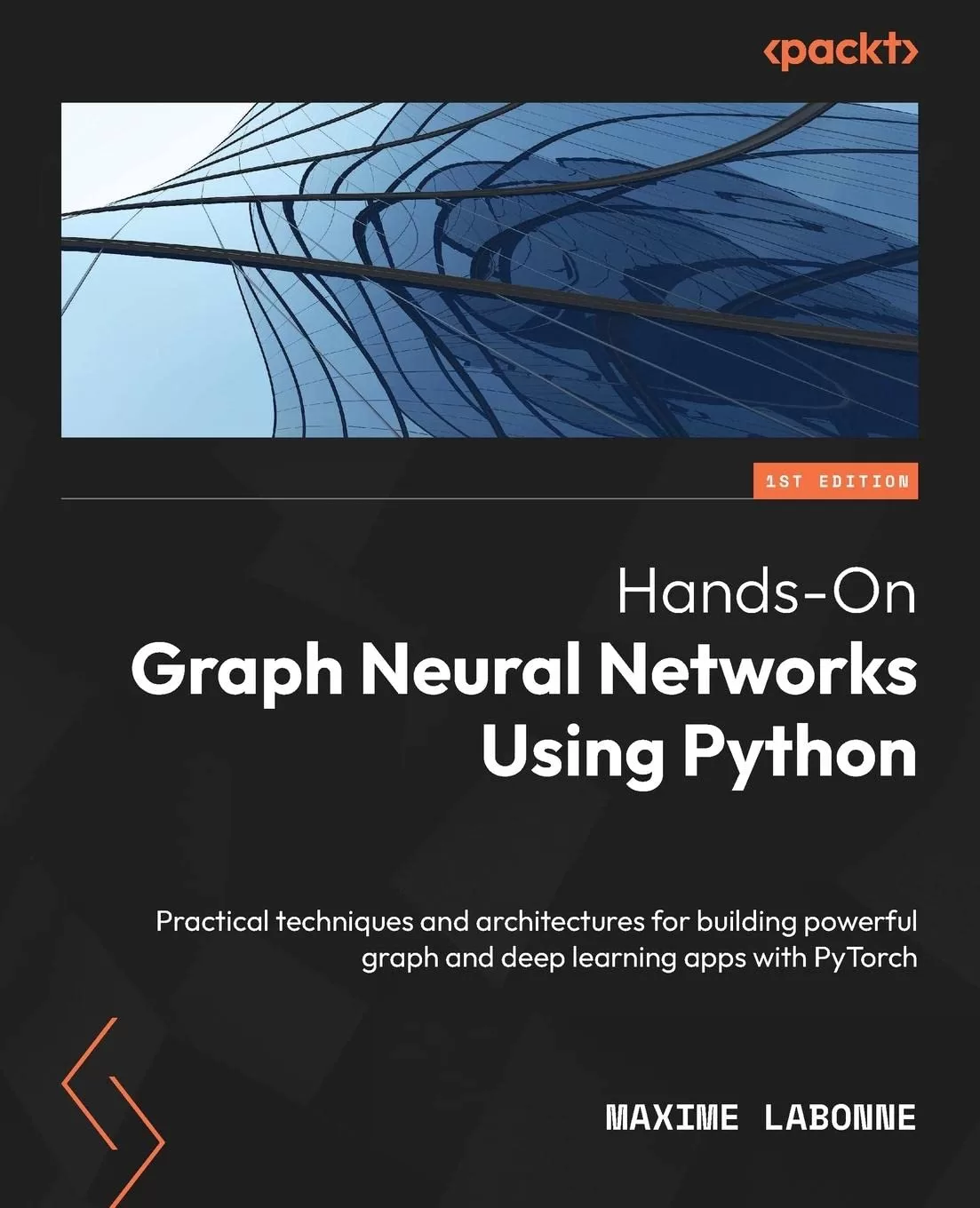
Hands-On Graph Neural Networks Using Python: Practical techniques and architectures for building powerful graph and deep learning apps with PyTorch
Оглавление⌄
Hands-On Graph Neural Networks Using Python....2 Contributors....3 About the author....3 About the reviewers....4 Preface....20 Who this book is for....22 What this book covers....23 To get the most out of this book....29 Download the example code files....32 Download the color images....32 Conventions used....33 Get in touch....33 Share your thoughts....34 Download a free PDF copy of this book....34 Part 1: Introduction to Graph Learning....36 Chapter 1: Getting Started with Graph Learning....38 Why graphs?....39 Why graph learning?....43 Why graph neural networks?....48 Summary....53 Further reading....53 Chapter 2: Graph Theory for Graph Neural Networks....55 Technical requirements....56 Introducing graph properties....56 Directed graphs....57 Weighted graphs....59 Connected graphs....61 Types of graphs....64 Discovering graph concepts....67 Fundamental objects....67 Graph measures....69 Adjacency matrix representation....72 Exploring graph algorithms....76 Breadth-first search....77 Depth-first search....80 Summary....83 Chapter 3: Creating Node Representations with DeepWalk....85 Technical requirements....86 Introducing Word2Vec....86 CBOW versus skip-gram....88 Creating skip-grams....90 The skip-gram model....93 DeepWalk and random walks....100 Implementing DeepWalk....104 Summary....112 Further reading....113 Part 2: Fundamentals....114 Chapter 4: Improving Embeddings with Biased Random Walks in Node2Vec....116 Technical requirements....117 Introducing Node2Vec....117 Defining a neighborhood....118 Introducing biases in random walks....121 Implementing Node2Vec....129 Building a movie RecSys....134 Summary....140 Further reading....141 Chapter 5: Including Node Features with Vanilla Neural Networks....142 Technical requirements....143 Introducing graph datasets....143 The Cora dataset....144 The Facebook Page-Page dataset....148 Classifying nodes with vanilla neural networks....151 Classifying nodes with vanilla graph neural networks....157 Summary....163 Further reading....164 Chapter 6: Introducing Graph Convolutional Networks....165 Technical requirements....166 Designing the graph convolutional layer....166 Comparing graph convolutional and graph linear layers....174 Predicting web traffic with node regression....183 Summary....195 Further reading....195 Chapter 7: Graph Attention Networks....197 Technical requirements....198 Introducing the graph attention layer....198 Linear transformation....199 Activation function....200 Softmax normalization....201 Multi-head attention....202 Improved graph attention layer....205 Implementing the graph attention layer in NumPy....206 Implementing a GAT in PyTorch Geometric....212 Summary....223 Part 3: Advanced Techniques....224 Chapter 8: Scaling Up Graph Neural Networks with GraphSAGE....226 Technical requirements....227 Introducing GraphSAGE....227 Neighbor sampling....228 Aggregation....234 Classifying nodes on PubMed....236 Inductive learning on protein-protein interactions....245 Summary....253 Further reading....253 Chapter 9: Defining Expressiveness for Graph Classification....255 Technical requirements....256 Defining expressiveness....256 Introducing the GIN....260 Classifying graphs using GIN....264 Graph classification....264 Implementing the GIN....266 Summary....280 Further reading....281 Chapter 10: Predicting Links with Graph Neural Networks....283 Technical requirements....284 Predicting links with traditional methods....284 Heuristic techniques....285 Matrix factorization....289 Predicting links with node embeddings....293 Introducing Graph Autoencoders....293 Introducing VGAEs....295 Implementing a VGAE....296 Predicting links with SEAL....300 Introducing the SEAL framework....301 Implementing the SEAL framework....305 Summary....312 Further reading....313 Chapter 11: Generating Graphs Using Graph Neural Networks....315 Technical requirements....316 Generating graphs with traditional techniques....316 The Erdős–Rényi model....317 The small-world model....321 Generating graphs with graph neural networks....324 Graph variational autoencoders....325 Autoregressive models....328 Generative adversarial networks....331 Generating molecules with MolGAN....335 Summary....340 Further reading....341 Chapter 12: Learning from Heterogeneous Graphs....343 Technical requirements....344 The message passing neural network framework....344 Introducing heterogeneous graphs....349 Transforming homogeneous GNNs to heterogeneous GNNs....354 Implementing a hierarchical self-attention network....365 Summary....372 Further reading....373 Chapter 13: Temporal Graph Neural Networks....375 Technical requirements....376 Introducing dynamic graphs....376 Forecasting web traffic....377 Introducing EvolveGCN....378 Implementing EvolveGCN....384 Predicting cases of COVID-19....397 Introducing MPNN-LSTM....399 Implementing MPNN-LSTM....402 Summary....410 Further reading....411 Chapter 14: Explaining Graph Neural Networks....413 Technical requirements....414 Introducing explanation techniques....414 Explaining GNNs with GNNExplainer....417 Introducing GNNExplainer....417 Implementing GNNExplainer....420 Explaining GNNs with Captum....425 Introducing Captum and integrated gradients....426 Implementing integrated gradients....427 Summary....435 Further reading....436 Part 4: Applications....438 Chapter 15: Forecasting Traffic Using A3T-GCN....440 Technical requirements....441 Exploring the PeMS-M dataset....441 Processing the dataset....449 Implementing the A3T-GCN architecture....457 Summary....464 Further reading....464 Chapter 16: Detecting Anomalies Using Heterogeneous GNNs....465 Technical requirements....466 Exploring the CIDDS-001 dataset....466 Preprocessing the CIDDS-001 dataset....475 Implementing a heterogeneous GNN....483 Summary....494 Further reading....494 Chapter 17: Building a Recommender System Using LightGCN....496 Technical requirements....497 Exploring the Book-Crossing dataset....497 Preprocessing the Book-Crossing dataset....509 Implementing the LightGCN architecture....515 Summary....529 Further reading....529 Chapter 18: Unlocking the Potential of Graph Neural Networks for Real-World Applications....531 Index....535 Why subscribe?....556 Other Books You May Enjoy....557 Packt is searching for authors like you....561 Share your thoughts....561 Download a free PDF copy of this book....562
Описание
Ниже — практический обзор по теме «graph».
Graph neural networks are a highly effective tool for analyzing data that can be represented as a graph, such as social networks, chemical compounds, or transportation networks. The past few years have seen an explosion in the use of graph neural networks, with their application ranging from natural language processing and computer vision to recommendation systems and drug discovery.
As you advance, you'll explore major graph neural network architectures and learn essential concepts such as graph convolution, self-attention, link prediction, and heterogeneous graphs. Hands-On Graph Neural Networks Using Python begins with the fundamentals of graph theory and shows you how to create graph datasets from tabular data. Finally, the book proposes applications to solve real-life problems, enabling you to build a professional portfolio. The code is readily available online and can be easily adapted to other datasets and apps.
By the end of this book, you'll have learned to create graph datasets, implement graph neural networks using Python and PyTorch Geometric, and apply them to solve real-world problems, along with building and training graph neural network models for node and graph classification, link prediction, and much more.
Whether you're new to graph neural networks or looking to take your knowledge to the next level, this book has something for you. What you will learnUnderstand the fundamental concepts of graph neural networksImplement graph neural networks using Python and PyTorch GeometricClassify nodes, graphs, and edges using millions of samplesPredict and generate realistic graph topologiesCombine heterogeneous sources to improve performanceForecast future events using topological informationApply graph neural networks to solve real-world problemsWho this book is forThis book is for machine learning practitioners and data scientists interested in learning about graph neural networks and their applications, as well as students looking for a comprehensive reference on this rapidly growing field. Basic knowledge of machine learning and Python programming will help you get the most out of this book.
Если материал оказался полезен — сохраните страницу.
Поделиться
Частые вопросы
Можно ли скачать «Hands-On Graph Neural Networks Using Python: Practical techniques and architectures for building powerful graph and deep learning apps with PyTorch» бесплатно?
Да, «Hands-On Graph Neural Networks Using Python: Practical techniques and architectures for building powerful graph and deep learning apps with PyTorch» доступна для бесплатного скачивания на нашем сайте в формате PDF. Ссылка на файл находится на этой странице.
В каком формате и какого размера файл?
Книга предоставляется в формате PDF, размер файла 18,7 МБ.
Кто автор и когда вышла книга?
автор — Labonne Maxime, издательство Packt Publishing Limited, год выпуска 2023, 563 страниц.
О чём книга «Hands-On Graph Neural Networks Using Python: Practical techniques and architectures for building powerful graph and deep learning apps with PyTorch»?
Graph neural networks are a highly effective tool for analyzing data that can be represented as a graph, such as social networks, chemical compounds, or transportation networks.
Похожие материалы
 GPT студентам
 ChatGPT для саморазвития
 Всё об ИИ чат-боте ChatGPT
 Modern Generative AI with ChatGPT and OpenAI Models
 ChatGPT и Революция Искусственного Интеллекта
 ChatGPT для чайников
 ChatGPT and Bard for Business Automation
 Building AI Applications with ChatGPT APIs: Master ChatGPT, Whisper, and DALL-E APIs by building ten innovative AI projects