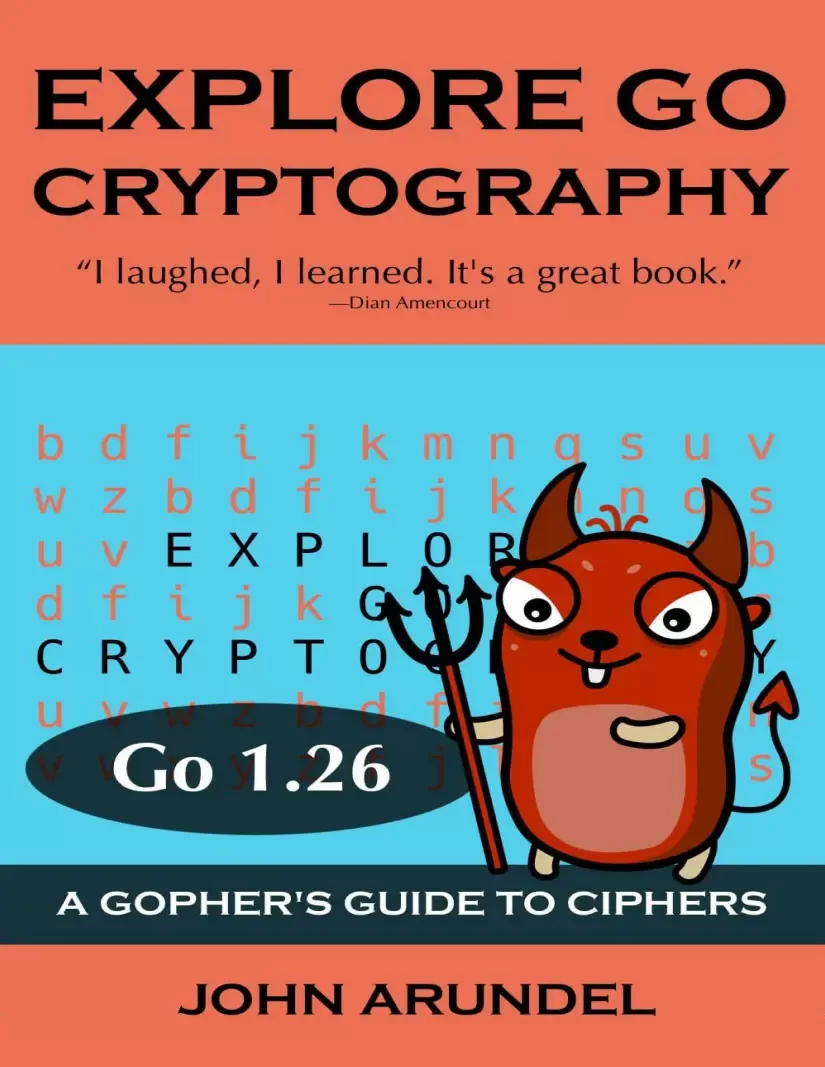
Explore Go: Cryptography
Оглавление⌄
Praise for Explore Go: Cryptography....14 Introduction....15 Cryptography....15 Why learn about cryptography?....16 What do you need to know?....17 About the book....18 What you’ll learn....18 How to use this book....19 1. Ciphers....20 Codes and ciphers....20 A shift cipher....22 Key points....22 Wheels within wheels....23 Enciphering....23 One byte at a time....23 Assume a spherical cow....24 From behaviour to test....25 Choose your own adventure....26 A first test....27 Anatomy of a test....28 When should the test fail?....28 The world’s greatest bug detector....29 A function about nothing....30 Cutting code....31 The smarty-pants answer....33 We’re gonna need a bigger test....33 A table of cases....34 Combining cases....34 A suspiciously similar test....35 A test case struct....36 Looping over the cases....36 Lighting a fire under the test....37 Introducing subtests....38 Subtests and t.Run....38 A litany of failure....40 Adding more cases....40 A working table test for Encipher....42 2. Enciphering....45 A simple enciphering filter....45 A command package....46 Garbage in, garbage out....46 All about Eve....48 Reverse engineering....48 Variable keys....49 Adding a keyhole....49 New keys, new cases....50 Compiler complaints....54 Stochastic debugging....54 Getting back to green....56 Getting the key....57 Defining a key flag....58 Getting the flag value....59 Enciphering with arbitrary keys....59 3. Deciphering....61 Brute force and ignorance....61 A statistical vulnerability....62 How many possible keys are there?....62 How safe is your safe?....63 Doing it for the crack....64 Cribs....64 Designing a cracking function....65 First, we need Decipher....66 Do we even need a test, then?....68 New test, same old table....68 Look before you loop....70 A deciphering tool....71 Let’s not complicate encipher....72 4. Cracking....74 Testing a Crack function....74 Failure is an option....75 A key-guessing function....76 A command-line cracker....77 What do users want?....78 Crib constraints....79 Cracking a real ciphertext....80 Waiting for the tiger....80 The devil in the details....81 0x89 is the magic number....82 Printing the unprintable....83 5. Keys....85 Lost in keyspace....85 The space of all possible keys....86 How long should the key be?....86 A keyspace the size of the universe....87 Multi-byte keys....88 Embiggening the key....89 Updating the test cases....89 Bytes in, bytes out....90 Fixing Encipher....91 A magical solution....91 Constraining the key index....92 Modulate your enthusiasm....92 The modulus operator....93 Refactoring will continue until morale improves....94 Testing longer keys....95 Designing the test cases....95 Sharpening the tools....97 When the right answer is wrong....98 What kind of flag do we need?....99 The joy of hex(adecimal)....100 Binary notation....100 A string flag....101 Where’s the BEEF?....102 Changing frequencies....103 6. Cribs....104 Cracking long keys....104 What needs to change?....105 A byte at the problem....105 Length limitations....106 Checking our guesses....107 Knowing when to stop....108 A proper little cracker....108 Updating the crack tool....111 Applying brute force....111 Crib considerations....112 A false deciphering....112 On being the right size....113 7. Passwords....114 Security....114 Password spaces....115 Dictionary words....115 Extremely guessable passwords....116 Passphrases....117 Rules....118 Character sets....118 Password policies....119 You’re really not helping....119 Maximising the keyspace....120 Unicode....121 Generation....122 What does “random” mean?....122 Predictability....123 Binary choices....124 Information....124 Knowledge....125 8. Blocks....127 Block ciphers....127 Why blocks?....128 The cipher.Block interface....129 Plugs and sockets....130 Adapting the shift cipher....130 The Encrypt method....131 Where’s the key?....131 Fixing the key size....132 A cipher constructor....133 The NewCipher function....133 If the key fits....134 A polite refusal....135 A special error value....135 Wrapping errors....136 Writing NewCipher....137 Implementing the cipher.Block interface....138 Testing Encrypt....138 Circumstances alter cases....139 Creating the cipher object....140 A test for Encrypt....141 Writing Encrypt and Decrypt....142 Forgotten something?....144 9. Modes....146 Handling data in blocks....146 Updating the encipher tool....147 Block by block....148 The cipher.BlockMode interface....148 A simple block mode....149 Testing CryptBlocks....150 Creating the encrypter object....152 Implementing CryptBlocks....152 Using a BlockMode in encipher....155 Block alignment....156 When misaligned data attacks....157 Checking our assumptions....157 The long and short of it....158 A test about nothing....159 A panic-proof CryptBlocks....160 10. Padding....162 A padding scheme....162 Making ends meet....163 The “illegal pixel” problem....163 An unambigous padding scheme....163 Testing Pad....164 Implementing Pad....167 Writing Unpad....168 Padding input to encipher....170 Adding the padding....170 Checking the results....171 Deciphering....172 Adding the unpadding....173 A decrypter that implements BlockMode....174 Waiting for the tiger....176 11. Enumeration....178 Adventures in keyspace....178 A new test for cracking long keys....178 A block is a black box....180 Enumerating long keys....181 Designing a Next function....182 Testing Next....184 Big endians and little endians....184 A simple implementation....185 Checking our key guesses....186 The soul of a new cracker....187 We apologise for the delay....188 Benchmarking key cracking....188 Pick an easier problem....189 Understanding benchmark output....189 Cranking up the difficulty....190 Ballparking a realistic crack time....191 A test we might live to see pass....192 Updating the crack tool....193 Putting it all together....193 Will it crack?....195 Parallelisation....195 Big computers are too slow....196 Dense computers become black holes....196 Parallel cracking is still useful....197 But we won’t implement it here....197 Strong keys can’t be cracked....198 12. Entropy....199 Information....199 Entropy: a measure of our ignorance....200 Entropy of digital messages....201 Compression....202 Enciphered data....203 Identifying ciphertexts....203 Complexity....204 Describing sequences....204 A generating algorithm....204 The shortest program that describes a sequence....206 Kolmogorov complexity....206 Complexity from simplicity....207 Security....208 Randomness is high entropy....209 Key generation....209 Pragmatic non-determinism....210 A little entropy goes a long way....211 Being unpredictable....211 13. Randomness....213 Pseudo-random generation....213 Randomness in games....214 The Fibonacci sequence....214 A simple random generator....215 A Fibonacci generator in Go....215 Repeatability....216 Seeding the RNG....217 Security problems....217 Periodicity....218 Distribution....218 Uniformity....219 “Secure enough” random generators....219 Environmental noise....220 The system entropy pool....220 Security is relative....221 You don’t need to outrun the bear....221 Keeping secrets from the gods....222 Hardware entropy sources....222 Defeating “God Emperor Eve”....223 Quantum measurements....223 A quantum randomness source....224 Generating quantum keys....225 14. Chains....226 Visualising the problem....226 A completely random image....227 Separating metadata and pixel data....229 Hidden figures....230 Muddying the waters....231 What’s wrong with this picture?....233 Mallory in the middle....234 ECB: a block-headed operating mode....234 Introducing Mallory....235 Block replay....235 Dropping and modifying blocks....236 More sophisticated modes....236 Counter mode (CTR)....237 Nonces....237 Cipher Block Chain (CBC)....237 Initialization Vector (IV)....238 Generating a secure IV....239 Implementing CBC mode....239 Enciphering in CBC mode....240 The updated encipher program....242 Updating the decipher program....244 The devil in disguise....246 15. Hashing....248 Message integrity....248 The night is dark, and full of errors....248 Bit-flipping and block-dropping....249 Integrity checking....250 Digests and hashing....250 Hash tables....251 Buckets and distribution....252 Collisions....252 Cryptographic hashing....253 Simple hash functions....254 A naïve algorithm....254 Implementing LenHash....255 Problems with LenHash....256 Preimage attacks....257 A slight improvement....258 Implementing SumHash....258 Testing SumHash....259 A preimage attack on SumHash....260 The avalanche effect....260 Real hash algorithms....261 MD5....261 SHA-1....262 SHA-256....262 Password hashing....263 Zero-knowledge secret storage....263 Password hashing requirements....264 Rainbow tables....264 Salting....265 Slow down, you move too fast....266 16. Coins....268 Cryptocurrency....268 Let there be “Bobcoin”....269 The problem of trust....269 A distributed digital ledger....270 Security....271 The double-spending problem....271 Ordering transactions....271 The blockchain....272 Doomed stubs....273 Integrity....274 Consensus....274 Proof of work....275 Up in smoke....276 Proof of stake....276 17. Authentication....278 Message integrity....278 Hash preimage attacks....279 Chosen ciphertext attacks....279 MAC....280 Length extension attacks....281 HMAC....281 Key exchange....282 The problem....283 Key splitting....283 Asymmetric encryption....284 Public and private keys....285 The Diffie-Hellman-Merkle protocol....285 A one-way function for key exchange....286 A DHM worked example....287 The reveal....288 Public-key cryptography....289 RSA....290 Signing....291 Authentication....292 Verification....292 The chain of trust....293 18. Cryptography....295 A little history....296 The origins of DES....296 Tripling down on DES....297 AES....297 Rijndael....297 The starting grid....298 Round and round....299 Confusion and diffusion....300 Putting it all together....301 Implementing AES....302 Getting ready to rumble....302 Ding ding, round one....303 The diffusion loop....304 The last round....305 AES encryption in practice....306 Enciphering with AES-CBC....306 Updating encipher and decipher....307 Encryption plus authentication....311 Enciphering with AES-GCM....312 The final final version....313 Weaknesses....317 Implementation fails....317 Mashing the keys....318 Tomorrow....319 The future is quantum....319 Quantum parallelism....320 The catch....321 Why your computer isn’t quantum… yet....322 Post-quantum cryptography....322 Afterword....323 About this book....325 Who wrote this?....325 Feedback....325 Get my free newsletter....325 Free updates to future editions....326 The Deeper Love of Go....326 The Power of Go: Tools....327 Further reading....327 Credits....328 Acknowledgements....329
Описание
В этом материале разберём тему: what.
I hope so, because much of the modern world is built on cryptography: the art of secret messages. Can you keep a secret? This book will show you what it’s all about and how it really works, with dozens of example programs in Go. What makes a good password? Have you ever wondered how passwords are stored securely? How codes and ciphers are designed–and broken? What are the connections between lava lamps, space games, digital signatures, black holes, and Bitcoin? Where random numbers come from, and what makes them random? Let’s find out. We’ll build a cipher system in Go from scratch, with step-by-step instructions and code examples at each stage (also available on GitHub). Join Alice, Bob, Eve, and Mallory as we learn about the fundamental principles of cryptography and digital security, from brute force and blockchains to keyspaces and hashing. Starting with the simplest cipher imaginable, we’ll gradually improve the system by attacking it, adding sophisticated features like block chaining, padding, digests, and authentication. We’ll see how state-of-the-art modern algorithms like AES, SHA-256, Diffie-Hellman, and RSA work under the hood, and how to integrate them into real-world Go tools. Along the way, you’ll develop a powerful intuitive understanding of ciphers and keys, what makes them strong (or weak), and how to use them securely. This book is essential reading for all Go programmers who have to deal with encryption, authentication, and security… in other words, all of us!
Файл доступен для загрузки ниже.
Поделиться
Частые вопросы
Можно ли скачать «Explore Go: Cryptography» бесплатно?
Да, «Explore Go: Cryptography» доступна для бесплатного скачивания на нашем сайте в формате PDF. Ссылка на файл находится на этой странице.
В каком формате и какого размера файл?
Книга предоставляется в формате PDF, размер файла 2,0 МБ.
Кто автор и когда вышла книга?
автор — Arundel John, издательство Independent publishing, год выпуска 2025, 329 страниц.
О чём книга «Explore Go: Cryptography»?
Can you keep a secret?
Похожие материалы
 Облачный Go. Создание надежных служб в ненадежных окружениях
 Pro Go. Полное руководство по программированию надежного и эффективного программного обеспечения с использованием Golang
 Learning Go: An Idiomatic Approach to Real-World Go Programming
 Software Development with Go: Cloud-Native Programming using Golang with Linux and Docker
 Efficient Go: Data-Driven Performance Optimization
 Black Hat Go: Программирование для хакеров и пентестеров
 Microservices with Go: Building scalable and reliable microservices with Go
 Concurrency in Go: Tools and Techniques for Developers