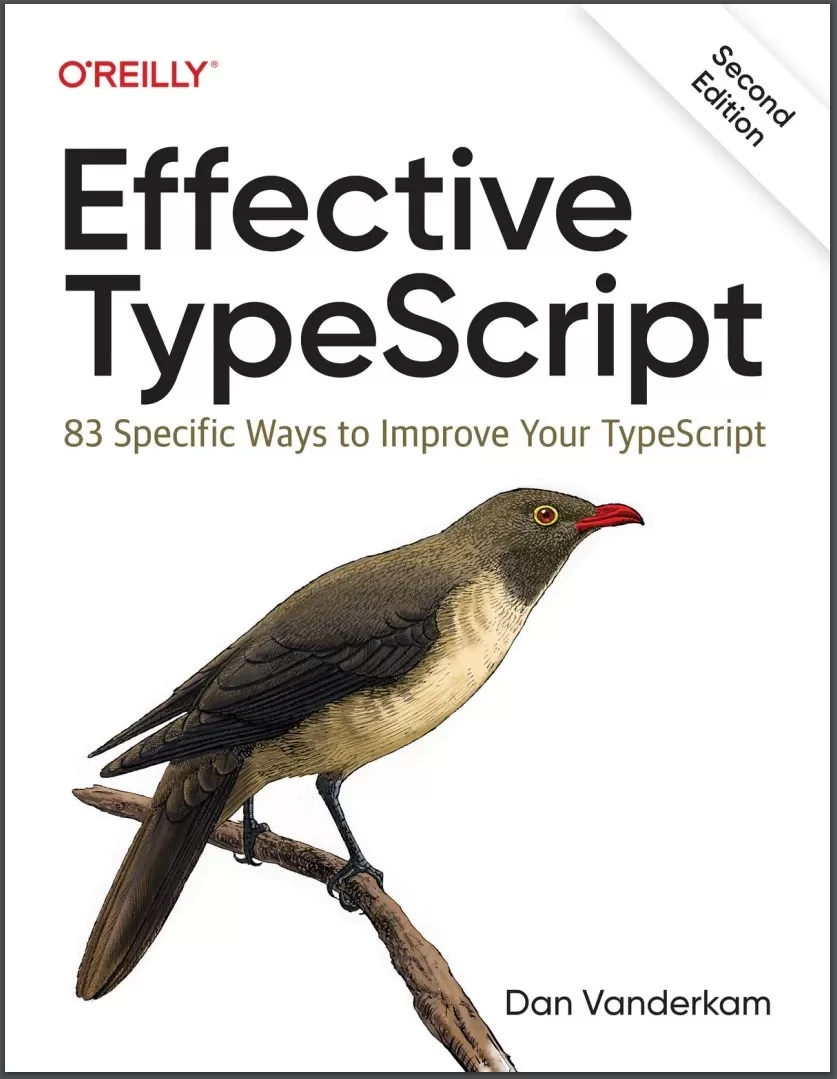
Effective TypeScript: 83 Specific Ways to Improve Your TypeScript. 2 Ed
Оглавление⌄
Preface to the Second Edition....8 Who This Book Is For....9 Why I Wrote This Book....10 How This Book Is Organized....11 Conventions in TypeScript Code Samples....13 Typographical Conventions Used in This Book....15 Using Code Examples....16 OReilly Online Learning....16 How to Contact Us....17 Acknowledgments....17 Preface to the First Edition (2019)....21 Acknowledgments to the First Edition....22 1. Getting to Know TypeScript....25 Item 1: Understand the Relationship Between TypeScript and JavaScript....25 Item 2: Know Which TypeScript Options Youre Using....33 Item 3: Understand That Code Generation Is Independent of Types....39 Item 4: Get Comfortable with Structural Typing....48 Item 5: Limit Use of the any Type....53 2. TypeScripts Type System....60 Item 6: Use Your Editor to Interrogate and Explore the Type System....60 Item 7: Think of Types as Sets of Values....67 Item 8: Know How to Tell Whether a Symbol Is in the Type Space or Value Space....79 Item 9: Prefer Type Annotations to Type Assertions....86 Item 10: Avoid Object Wrapper Types (String, Number, Boolean, Symbol, BigInt)....92 Item 11: Distinguish Excess Property Checking from Type Checking....96 Item 12: Apply Types to Entire Function Expressions When Possible....101 Item 13: Know the Differences Between type and interface....106 Item 14: Use readonly to Avoid Errors Associated with Mutation....114 Item 15: Use Type Operations and Generic Types to Avoid Repeating Yourself....122 Item 16: Prefer More Precise Alternatives to Index Signatures....134 Item 17: Avoid Numeric Index Signatures....140 3. Type Inference and Control Flow Analysis....145 Item 18: Avoid Cluttering Your Code with Inferable Types....146 Item 19: Use Different Variables for Different Types....155 Item 20: Understand How a Variable Gets Its Type....158 Item 21: Create Objects All at Once....165 Item 22: Understand Type Narrowing....168 Item 23: Be Consistent in Your Use of Aliases....174 Item 24: Understand How Context Is Used in Type Inference....179 Item 25: Understand Evolving Types....185 Item 26: Use Functional Constructs and Libraries to Help Types Flow....189 Item 27: Use async Functions Instead of Callbacks to Improve Type Flow....195 Item 28: Use Classes and Currying to Create New Inference Sites....201 4. Type Design....207 Item 29: Prefer Types That Always Represent Valid States....207 Item 30: Be Liberal in What You Accept and Strict in What You Produce....214 Item 31: Dont Repeat Type Information in Documentation....219 Item 32: Avoid Including null or undefined in Type Aliases....222 Item 33: Push Null Values to the Perimeter of Your Types....224 Item 34: Prefer Unions of Interfaces to Interfaces with Unions....229 Item 35: Prefer More Precise Alternatives to String Types....234 Item 36: Use a Distinct Type for Special Values....240 Item 37: Limit the Use of Optional Properties....244 Item 38: Avoid Repeated Parameters of the Same Type....248 Item 39: Prefer Unifying Types to Modeling Differences....251 Item 40: Prefer Imprecise Types to Inaccurate Types....254 Item 41: Name Types Using the Language of Your Problem Domain....260 Item 42: Avoid Types Based on Anecdotal Data....263 5. Unsoundness and the any Type....270 Item 43: Use the Narrowest Possible Scope for any Types....270 Item 44: Prefer More Precise Variants of any to Plain any....275 Item 45: Hide Unsafe Type Assertions in Well-Typed Functions....277 Item 46: Use unknown Instead of any for Values with an Unknown Type....283 Item 47: Prefer Type-Safe Approaches to Monkey Patching....288 Item 48: Avoid Soundness Traps....293 Item 49: Track Your Type Coverage to Prevent Regressions in Type Safety....305 6. Generics and Type-Level Programming....310 Item 50: Think of Generics as Functions Between Types....311 Item 51: Avoid Unnecessary Type Parameters....318 Item 52: Prefer Conditional Types to Overload Signatures....326 Item 53: Know How to Control the Distribution of Unions over Conditional Types....330 Item 54: Use Template Literal Types to Model DSLs and Relationships Between Strings....336 Item 55: Write Tests for Your Types....344 Item 56: Pay Attention to How Types Display....355 Item 57: Prefer Tail-Recursive Generic Types....360 Item 58: Consider Codegen as an Alternative to Complex Types....365 7. TypeScript Recipes....371 Item 59: Use Never Types to Perform Exhaustiveness Checking....371 Item 60: Know How to Iterate Over Objects....379 Item 61: Use Record Types to Keep Values in Sync....383 Item 62: Use Rest Parameters and Tuple Types to Model Variadic Functions....387 Item 63: Use Optional Never Properties to Model Exclusive Or....391 Item 64: Consider Brands for Nominal Typing....394 8. Type Declarations and types....400 Item 65: Put TypeScript and types in devDependencies....400 Item 66: Understand the Three Versions Involved in Type Declarations....403 Item 67: Export All Types That Appear in Public APIs....409 Item 68: Use TSDoc for API Comments....410 Item 69: Provide a Type for this in Callbacks if Its Part of Their API....414 Item 70: Mirror Types to Sever Dependencies....420 Item 71: Use Module Augmentation to Improve Types....423 9. Writing and Running Your Code....429 Item 72: Prefer ECMAScript Features to TypeScript Features....429 Item 73: Use Source Maps to Debug TypeScript....439 Item 74: Know How to Reconstruct Types at Runtime....446 Item 75: Understand the DOM Hierarchy....453 Item 76: Create an Accurate Model of Your Environment....460 Item 77: Understand the Relationship Between Type Checking and Unit Testing....463 Item 78: Pay Attention to Compiler Performance....468 10. Modernization and Migration....478 Item 79: Write Modern JavaScript....479 Item 80: Use ts-check and JSDoc to Experiment with TypeScript....485 Item 81: Use allowJs to Mix TypeScript and JavaScript....491 Item 82: Convert Module by Module Up Your Dependency Graph....493 Item 83: Dont Consider Migration Complete Until You Enable noImplicitAny....501 Appendix. Item Mapping Between First and Second Editions....505 Index....512 About the Author....567
Описание
В этом материале разберём тему: typescript.
But TypeScript has a learning curve of its own, and understanding how to use it effectively takes time and practice. TypeScript is a typed superset of JavaScript with the potential to solve many of the headaches for which JavaScript is famous. Using the format popularized by Effective C++ and Effective Java (both Addison-Wesley), this practical book features 83 items that give specific advice on what to do and what not to do, and how to think about the language.
Author Dan Vanderkam shows you how to apply each item's advice through concrete examples. This book will help you advance from a beginning or intermediate user familiar with TypeScript basics to an expert who knows how to use the language well.
Updated for TypeScript 5, this second edition includes two new chapters on type-level programming and TypeScript recipes.
Файл доступен для загрузки ниже.
Поделиться
Частые вопросы
Можно ли скачать «Effective TypeScript: 83 Specific Ways to Improve Your TypeScript. 2 Ed» бесплатно?
Да, «Effective TypeScript: 83 Specific Ways to Improve Your TypeScript. 2 Ed» доступна для бесплатного скачивания на нашем сайте в формате PDF. Ссылка на файл находится на этой странице.
В каком формате и какого размера файл?
Книга предоставляется в формате PDF, размер файла 10,7 МБ.
Кто автор и когда вышла книга?
автор — Vanderkam Dan, издательство O’Reilly Media, Inc., год выпуска 2024, 569 страниц.
О чём книга «Effective TypeScript: 83 Specific Ways to Improve Your TypeScript. 2 Ed»?
TypeScript is a typed superset of JavaScript with the potential to solve many of the headaches for which JavaScript is famous.
Похожие материалы
 JavaScript. Рецепты для разработчиков. 3 изд
 Become A Ninja With Angular
 Mastering jQuery: A Beginner’s Guide
 Professional JavaScript for Web Developers. 5 Ed
 React.js Design Patterns: Learn how to build scalable React apps with ease
 Typescript and JavaScript Coding Made Simple 2 Books in 1: A Beginner’s Guide to Programming
 React. Сборник рецептов. Практические приемы работы с фреймворком React
 JavaScript. Полное руководство: Справочник по самому популярному языку программирования. 7 изд