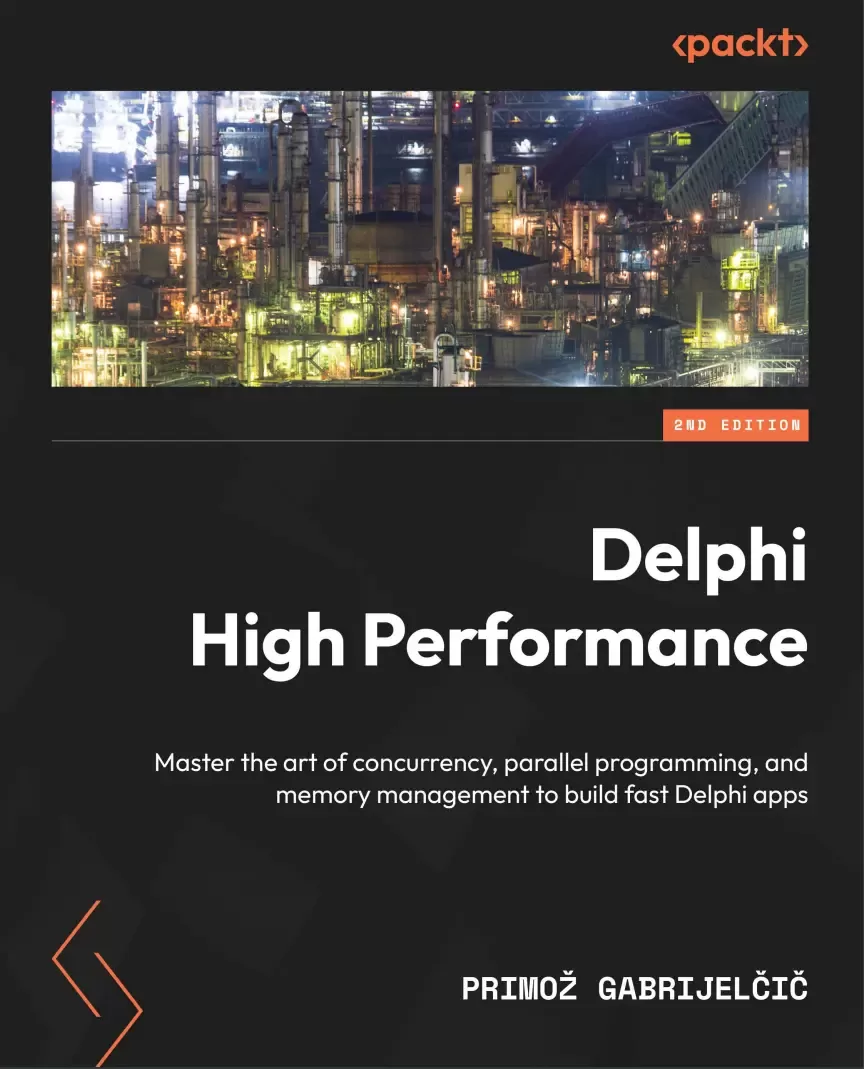
Delphi High Performance: Master the art of concurrency, parallel programming, and memory management to build fast Delphi apps. 2 Ed
Оглавление⌄
Cover....1 Title Page....2 Copyright and Credits....2 Contributors....4 Table of Contents....6 Preface....12 Chapter 1: About Performance....20 Technical requirements....20 What is performance?....21 Different types of speed....21 Algorithm complexity....22 Big O and Delphi data structures....26 Data structures in practice....30 Mr. Smith’s first program....35 Looking at code through Big O eyes....38 Summary....41 Chapter 2: Profiling the Code....42 Technical requirements....42 Don’t guess, measure!....43 Profiling with TStopwatch....43 Profilers....50 Summary....65 Chapter .3: Fixing the Algorithm....66 Technical requirements....67 Writing responsive user interfaces....67 Updating a progress bar....68 Bulk updates....71 Virtual display....74 Caching....80 Memoization....81 Dynamic cache....83 Speeding up SlowCode....88 Summary....91 Chapter 4: Don’t Reinvent, Reuse....92 Technical requirements....93 Spring for Delphi....93 Enumerations, collections, and lists....94 IEnumerable....96 ICollection....105 IList....106 Other interfaces....109 TEnumerable....109 Stacks and queues....111 Trees....120 Red-black trees....123 Sets and dictionaries....131 ISet....132 IMultiSet....134 IDictionary....136 IBiDiDictionary....139 Summary....143 Chapter 5: Fine-Tuning the Code....144 Technical requirements....145 Delphi compiler settings....145 Code inlining control....146 Optimization....147 Record field alignment....148 Assertions....151 Overflow checking....151 Range checking....152 Extracting common expressions....153 The helpful CPU window....155 Behind the scenes....157 A plethora of types....158 Simple types....159 Strings....159 Arrays....162 Records....165 Classes....176 Interfaces....177 Optimizing method calls....178 Parameter passing....178 Method inlining....186 The magic of pointers....189 Going the assembler way....193 Returning to SlowCode....196 Summary....197 Chapter 6: Memory Management....198 Technical requirements....199 Optimizing strings and array allocations....199 Memory management functions....203 Dynamic record allocation....205 FastMM4 internals....210 Memory allocation in a parallel world....213 Replacing the default memory manager....216 Logging memory manager....217 FastMM4 with release stack....222 FastMM5....225 TBBMalloc....225 Comparing memory managers....227 There is no silver bullet....228 Fine-tuning SlowCode....230 Summary....232 Chapter 7: Getting Started with the Parallel World....234 Technical requirements....235 Processes and threads....235 Multithreading....235 Multitasking....236 When to parallelize code....237 The most common problems....237 Never access the UI from a background thread....238 Simultaneous reading and writing....241 Sharing a variable....243 Hidden behavior....247 Synchronization....249 Critical sections....250 Other locking mechanisms....256 A short note on coding style....262 Shared data with built-in locking....263 Interlocked operations....264 Object life cycle....268 Communication....271 Windows messages....272 Synchronize and Queue....276 Polling....277 Performance....279 Third-party libraries....280 Summary....281 Chapter 8: Working with Parallel Tools....284 Technical requirements....284 TThread....285 Automatic life cycle management....288 Advanced TThread....290 Setting up a communication channel....292 Sending messages from a thread....296 Using TCommThread....298 Implementing a timer....300 Synchronizing with multiple workers....304 WaitForMultipleObjects....306 Condition variables....310 Comparing both approaches....315 Summary....315 Chapter 9: Exploring Parallel Practices....318 Technical requirements....319 Tasks and patterns....319 Variable capturing....320 Tasks....322 Exceptions in tasks....324 Parallelizing a loop....327 Thread pooling....330 Async/Await....332 Join....335 Join/Await....337 Future....342 Parallel for....344 Pipelines....349 Web spider....350 The filter stage....356 The downloader stage....358 The parser stage....359 Summary....362 Chapter 10: More Parallel Patterns....364 Technical requirements....364 Using OmniThreadLibrary....365 Blocking collections....366 Using blocking collections with TThread-based threads....368 Async/Await....371 Join....372 Future....376 Parallel Task....377 Background Worker....381 Initial query....384 Pipeline....389 Creating the pipeline....391 Stages....393 Displaying the result and shutting down....397 Map....398 Timed Task....400 Summary....404 Chapter 11: Using External Libraries....406 Technical requirements....406 Linking with object files....407 Object file formats....409 Object file linking in practice....410 Using C++ libraries....415 Writing exported functions....418 Using a proxy DLL in Delphi....420 Summary....424 Chapter 12: Best Practices....426 About performance....427 Profiling the code....427 Fixing the algorithm....428 Don’t reinvent, reuse....429 Fine-tuning the code....430 Memory management....431 Getting started with the parallel world....432 Working with parallel tools....435 Exploring parallel practices....436 More parallel patterns....437 Using external libraries....438 Final words....439 Index....440 Other Books You May Enjoy....448
Описание
Ниже — практический обзор по теме «delphi».
Users hate to use programs that are not responsive to interactions or run too slow to be useful. Performance matters! While becoming a programmer is simple enough, you require dedication and hard work to achieve an advanced level of programming proficiency where you know how to write fast code.
Subsequent chapters will provide you with practical ideas about optimizing code by doing less work or doing it in a smarter way. This book begins by helping you explore algorithms and algorithmic complexity and continues by describing tools that can help you find slow parts of your code. The book also teaches you how to use optimized data structures from the Spring4D library, along with exploring data structures that are not part of the standard Delphi runtime library.
You'll learn about the problems that only occur in multithreaded code and explore various approaches to fixing them effectively. The second part of the book talks about parallel programming. The concluding chapters provide instructions on writing parallel code in different ways - by using basic threading support or focusing on advanced concepts such as tasks and parallel patterns.
By the end of this book, you'll have learned to look at your programs from a totally different perspective and will be equipped to effortlessly make your code faster than it is now.
Whether you're a beginner or an accomplished programmer, you will find something interesting. What You Will Learn:Get to grips with algorithmic complexity and learn how to recognize itUse tools to determine program runtime behaviorSpeed up programs by doing less instead of moreDiscover the internal workings of Delphi data structuresGain an understanding of Delphi's memory managerFind out how to write low-level parallel programs with TThreadUse parallel patterns from the PPL and OTL libraries to write fast codeInclude external code, written in C or C++, in Delphi programsWho this book is for:This book is for all Delphi programmers. Even though the focus is on the latest Delphi release, the code uses only standard Delphi syntax without syntactic additions from the latest releases, and most of it should compile and run in any Delphi from XE7 onward. Most of the concepts in this book do not depend on a specific Delphi version and will be useful for everyone. If you're using an older version of Delphi, don't despair!
Если материал оказался полезен — сохраните страницу.
Поделиться
Частые вопросы
Можно ли скачать «Delphi High Performance: Master the art of concurrency, parallel programming, and memory management to build fast Delphi apps. 2 Ed» бесплатно?
Да, «Delphi High Performance: Master the art of concurrency, parallel programming, and memory management to build fast Delphi apps. 2 Ed» доступна для бесплатного скачивания на нашем сайте в формате PDF. Ссылка на файл находится на этой странице.
В каком формате и какого размера файл?
Книга предоставляется в формате PDF, размер файла 3,5 МБ.
Кто автор и когда вышла книга?
автор — Gabrijelčič Primož, издательство Packt Publishing Limited, год выпуска 2023, 452 страниц.