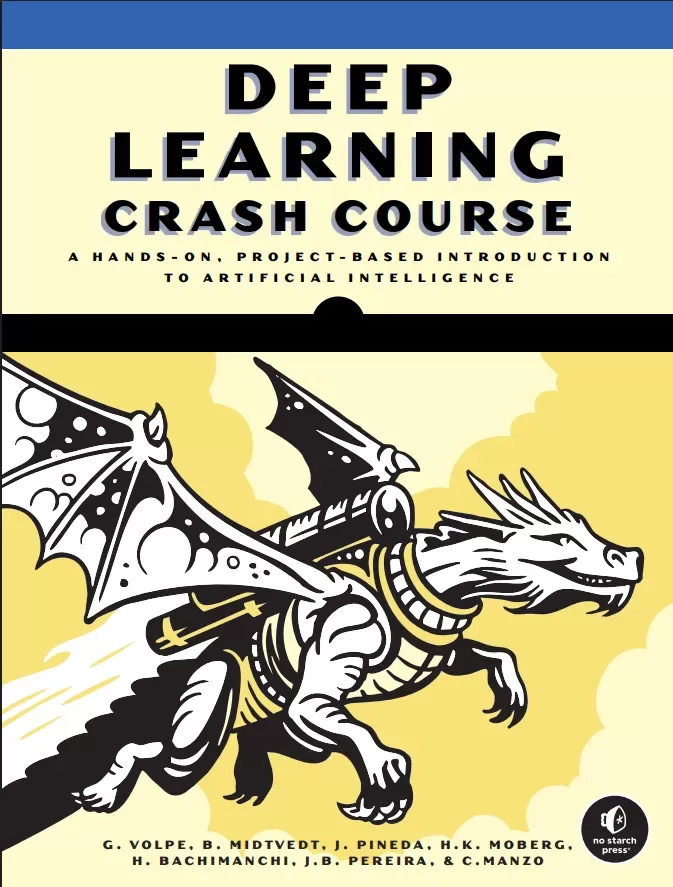
Deep Learning Crash Course: A Hands-On, Project-Based Introduction to Artificial Intelligence
Оглавление⌄
ABOUT THE AUTHORS....7 BRIEF CONTENTS....9 CONTENTS IN DETAIL....11 ACKNOWLEDGMENTS....21 INTRODUCTION....23 Who Should Read This Book?....25 This Book’s Approach....25 Setting Up Your Learning Environment....26 Obtaining the Data and Code Used in This Book....27 What’s in This Book?....27 Online Resources....30 Time to Start Your Journey....30 CHAPTER 1: BUILDING AND TRAINING YOUR FIRST NEURAL NETWORK....31 Classifying Data with a Single Neuron....32 Classifying 1D Data....33 Classifying 2D Data....41 Adding a Bias as Another Dimension....47 Using Weight Regularization to Stabilize the Training....48 Using Different Activation Functions....49 Classifying Data with a Two-Layer Neural Network....50 Implementing a Dense Neural Network....52 Training with Error Backpropagation....55 Attempting an Impossible Classification....60 Classifying Data with a Three-Layer Neural Network....61 Project 1A: Classifying Handwritten Digits....64 Using the MNIST Digit Dataset....64 Implementing the Neural Network....66 Training and Testing....68 Making Improvements....71 Performing Failure Analysis....76 Summary....78 Seminal Works and Further Reading....78 CHAPTER 2: CAPTURING TRENDS AND RECOGNIZING PATTERNS WITH DENSENEURAL NETWORKS....81 Regressing Data with a Single Neuron....82 Regressing 1D Data....82 Regressing 2D Data....87 Regressing Data with a Two-Layer Neural Network....91 Implementing a Dense Neural Network....92 Training with Error Backpropagation....93 Training Using Batches....95 Plotting Predictions vs. Ground Truth....95 Training with Mini-Batches....97 Tracking Training Metrics....99 Randomizing the Batches....101 Dividing Data into Multiple Datasets....103 Splitting the Data....104 Training and Validating the Neural Network....105 Project 2A: Emulating a Physical System....109 Loading the Theoretical and Geometrical–Optics Optical Forces....110 Loading and Preparing the Training Data....114 Implementing the Neural Network....117 Implementing Data Loaders....118 Training the Neural Network....118 Evaluating Performance....121 Summary....122 Seminal Works and Further Reading....123 CHAPTER 3: PROCESSING IMAGES WITH CONVOLUTIONAL NEURALNETWORKS....125 Understanding Convolutions....126 Convolving 1D Data....126 Convolving 2D Data....128 Using Convolutions in a Neural Network....130 Implementing Neural Networks in PyTorch....130 Defining Convolutional Layers....132 Adding ReLU Activation....134 Adding Pooling Layers....135 Using Upsampling Layers....136 Transforming Images....138 Using Dense Layers to Classify Images....139 Project 3A: Classifying Malaria-Infected Blood Smears....140 Loading the Malaria Dataset....141 Classifying with Dense Neural Networks....145 Classifying with Convolutional Neural Networks....148 Checking the Values of the Filters....150 Visualizing Activations of Convolutional Layers....151 Visualizing Heatmaps....154 Project 3B: Localizing Microscopic Particles....158 Loading the Videos....158 Manually Annotating the Videos....160 Implementing a Convolutional Neural Network....164 Training with Annotated Data....165 Simulating the Training Data....167 Training with Simulated Data....173 Project 3C: Creating DeepDreams....175 Loading an Image....176 Loading a Pretrained Neural Network....177 Implementing the DeepDreams Algorithm....179 Using Multiple Layers at Once....186 Project 3D: Transferring the Style of Images....188 Loading the Content and Style Images....188 Loading a Pretrained Neural Network....189 Implementing Style Transfer....190 Creating an Image in Gaudí's Style....193 Summary....194 Seminal Works and Further Reading....195 CHAPTER 4: ENHANCING, GENERATING, AND ANALYZING DATA WITHAUTOENCODERS....197 Project 4A: Generating Images with Variational Autoencoders....209 Understanding Variational Autoencoders....209 Loading the MNIST Dataset....211 Training the Variational Autoencoder....212 Generating Images with the Decoder....213 Clustering Images with the Encoder....216 Understanding Encoder-Decoders....198 Implementing a Denoising Encoder-Decoder....199 Generating the Data....199 Creating a Simulated Dataset....202 Defining and Training the Encoder-Decoder....203 Denoising the Image....203 Checking for Absence of Mode Collapse....205 Checking Generalization Capabilities....206 Retraining....207 Project 4B: Morphing Images with Wasserstein Autoencoders....218 Understanding Wasserstein Autoencoders....218 Loading the Fashion-MNIST Dataset....219 Training the Wasserstein Autoencoder....221 Reconstructing the Fashion-MNIST Images....222 Creating New Images....222 Morphing Images....223 Project 4C: Detecting Anomalies in ECG Data....225 Understanding Anomaly Detection....226 Loading the ECG Dataset....226 Defining and Training the Autoencoder....229 Testing with Normal and Anomalous ECGs....230 Detecting Anomalies....231 Summary....236 Seminal Works and Further Reading....237 CHAPTER 5: SEGMENTING AND ANALYZING IMAGES WITH U-NETS....239 Introducing U-Nets....240 Understanding Semantic Segmentation with U-Nets....241 Segmenting Images of Biological Tissues....242 Loading the Segmented Tissue Images....243 Creating the Data Pipelines....244 Defining and Training the U-Net....246 Plotting the Training Metrics....249 Preventing Overfitting....250 Evaluating the Trained U-Net....252 Project 5A: Detecting Quantum Dots in Fluorescence Images....254 Loading the Image....254 Simulating Quantum Dots....255 Defining and Training the U-Net....261 Evaluating the Trained U-Net....262 Project 5B: Counting Cells....264 Loading the Dataset....264 Creating a Pipeline....265 Simulating the Cell Images....267 Implementing and Training the U-Net....274 Testing the Trained U-Net....275 Summary....278 Seminal Works and Further Reading....278 CHAPTER 6: TRAINING NEURAL NETWORKS WITH SELF-SUPERVISEDLEARNING....281 Understanding Self-Supervised Learning....282 Self-Supervised Contrastive Learning....282 Self-Supervised Non-Contrastive Learning....283 Self-Supervised Geometric Learning....284 Determining the Position of a Particle in an Image....285 Creating the Dataset....285 Learning from Translations....287 Learning from Flipping the Image....292 Improving Performance with LodeSTAR....295 Project 6A: Localizing Mouse Stem Cells with LodeSTAR....298 Using the Cell Tracking Challenge Dataset....298 Preparing the Training Crop....301 Creating the Training Pipeline and Data Loader....302 Training the Neural Network....303 Evaluating Performance....304 Summary....307 Seminal Works and Further Reading....308 CHAPTER 7: PROCESSING TIME SERIES AND LANGUAGE WITH RECURRENTNEURAL NETWORKS....309 Understanding Recurrent Neural Networks....309 Using a Comb Filter....310 Understanding a Simple Recurrent Neural Network....311 Predicting Temperature with Recurrent Neural Networks....312 Loading the Jena Climate Dataset....312 Preprocessing the Data....314 Implementing a Commonsense Benchmark....317 Determining the Computational Device....317 Predicting with a Simple Recurrent Neural Network....318 Stacking Multiple Recurrent Layers....323 Using Gated Recurrent Units....324 Using Long Short-Term Memory Networks....326 Project 7A: Translating with Recurrent Neural Networks....329 Preparing the Bilingual Dataset....329 Defining the Sequence-to-Sequence Application....338 Loading Pretrained Embeddings....346 Training the Sequence-to-Sequence Application....348 Testing the Model Performance....349 Evaluating the Model with the BLEU Score....351 Summary....352 Seminal Works and Further Reading....353 CHAPTER 8: PROCESSING LANGUAGE AND CLASSIFYING IMAGES WITHATTENTION AND TRANSFORMERS....355 Understanding Attention....356 Implementing Dot-Product Attention....356 Visualizing Attention....361 Making the Attention Mechanism Trainable....363 Implementing Other Attention Mechanisms....365 Project 8A: Using Attention to Improve Language Translation....366 Incorporating Attention....367 Training and Testing the Seq2Seq Model with Attention....369 Interpreting the Attention Matrix....370 Project 8B: Performing Sentiment Analysis with a Transformer....372 Breaking Down Multi-Head Attention....372 Understanding the Transformer Structure....374 Loading the IMDb Dataset....375 Preprocessing the Reviews....377 Defining the Data Loaders....379 Building an Encoder-Only Transformer ....380 Training the Model....386 Evaluating the Trained Model....386 Project 8C: Classifying Images with a Vision Transformer....388 Using the CIFAR-10 Dataset....388 Data Preprocessing....390 Building the ViT Model....391 Training and Evaluating the ViT Model....393 Improving the ViT Model with CutMix....394 Using a Pretrained ViT Model....400 Summary....402 Seminal Works and Further Reading....403 CHAPTER 9: CREATING AND TRANSFORMING IMAGES WITH GENERATIVEADVERSARIAL NETWORKS....405 Understanding GANs....406 Discriminating Between Real and Fake Data....407 Generating Realistic Fake Data....408 Training a GAN....409 Generating Digits with a GAN....409 Loading the MNIST Dataset with PyTorch....410 Defining the Generator and Discriminator....411 Training the GAN....412 Plotting the Intermediate Results....416 Plotting the Training Losses....418 Project 9A: Generating Digits with a Conditional GAN....419 Defining the Conditional Generator and Discriminator....420 Training the Conditional GAN....422 Plotting the Generated Digits....423 Project 9B: Virtually Staining a Biological Tissue....424 Downloading the Human Motor Neurons Dataset....424 Creating a Dataset....425 Instantiating the Generator and Discriminator....430 Compiling the Conditional GAN....432 Training the Conditional GAN....433 Evaluating the Trained Conditional GAN....438 Project 9C: Converting Between Holographic and Bright-Field Microscopy Images....439 Understanding CycleGANs....440 Using the Holo2Bright Dataset....441 Instantiating the CycleGAN Generators and Discriminators....444 Training the CycleGAN....446 Evaluating the Trained CycleGAN....451 Summary....453 Seminal Works and Further Reading....453 CHAPTER 10: IMPLEMENTING GENERATIVE AI WITH DIFFUSION MODELS....455 Understanding Diffusion....456 Breaking Down Denoising Diffusion Probabilistic Models....457 Modeling the Forward Diffusion Process....458 Deriving the Fast Forward Process....459 Modeling the Reverse Diffusion Process....460 Generating Digits with a Diffusion Model....462 Loading the MNIST Dataset....462 Implementing the Forward Diffusion Process....463 Applying the Reverse Diffusion Process....465 Defining the Positional Encoding Function....466 Instantiating the Attention U-Net....468 Training the Diffusion Model....469 Sampling Images from Fixed Noise....474 Project 10A: Generating Bespoke Digits....476 Guiding the Diffusion Model....476 Defining the Conditional Attention U-Net....477 Training the Conditional Diffusion Model....478 Plotting the Intermediate Training Results....478 Project 10B: Generating Images from Text Prompts....480 Providing a Conditional Text Input....480 Defining the Conditional Attention U-Net....487 Training the Conditional Diffusion Model....488 Plotting the Intermediate Training Results....489 Training with the CLIP Tokenizer and CLIP Text Encoder....490 Project 10C: Generating Super-Resolution Images....493 Downloading the BioSR Dataset....493 Managing the Dataset....494 Preprocessing the Images....495 Creating the Training and Test Datasets....495 Adapting the Diffusion Process for Super-Resolution....496 Defining the Conditional Attention U-Net....497 Training the Conditional Diffusion Model....498 Summary....501 Seminal Works and Further Reading....501 CHAPTER 11: MODELING MOLECULES AND COMPLEX SYSTEMS WITH GRAPHNEURAL NETWORKS....505 Understanding Graph Convolutions....506 Predicting Molecular Properties with Graph Convolutions....509 Implementing a Graph Convolution Layer....510 Representing a Molecule as a Graph....512 Using the ZINC Dataset....513 Applying a Graph Convolutional Network....516 Training the Graph Convolutional Network....519 Evaluating the Graph Convolutional Network....521 Predicting Molecular Properties with Message Passing....521 Implementing a Message-Passing Layer....522 Implementing a Message-Passing Network....525 Training and Evaluating the Message-Passing Network....526 Project 11A: Simulating Complex Physical Phenomena....527 Working with the SAND Dataset....527 Building a Graph Network–Based Simulator....530 Building the Dataset....532 Training the Model....537 Testing the Model....538 Simulating the System....539 Project 11B: Identifying Cell Trajectories....541 Exploring the Cell-Tracking Data....542 Creating a Graph from Segmented Images....544 Building a Training Dataset....549 Making MAGIK....551 Evaluating Performance....552 Summary....556 Seminal Works and Further Reading....557 CHAPTER 12: CONTINUOUSLY IMPROVING PERFORMANCE WITH ACTIVELEARNING....559 Understanding Active Learning....560 Performing Binary Classification....561 Creating a Dataset with Two Groups of Data Points....561 Classifying the Data Points with a Logistic Regression....562 Implementing the Active Learning Process....563 Comparing Random and Uncertainty Sampling Strategies....568 Performing Multiclass Classification....569 Creating a Dataset with Three Groups of Data Points....570 Implementing the Active Learning Process with Multiple Classes....571 Comparing Sampling Strategies....575 Project 12A: Classifying MNIST Digits with Active Learning....577 Training a Baseline Model....577 Implementing Multiple Active Learning Strategies....578 Comparing the Performance of the Active Learning Strategies....583 Summary....585 Seminal Works and Further Reading....586 CHAPTER 13: MASTERING DECISION-MAKING WITH DEEP REINFORCEMENTLEARNING....587 Understanding Reinforcement Learning and Q-Learning....588 Implementing Tetris....591 Constructing a Simplified Tetris....591 Playing Tetris with the Command Line....598 Playing Tetris with a Pygame Graphical Interface....599 Making an Agent Play Tetris with Q-Learning....603 Adapting the Actions of Tetris for Q-Learning....603 Implementing the Q-Learning Agent....604 Training the Q-Learning Agent....611 Training with a Random Tile Sequence....614 Making an Agent Play Tetris with Deep Q-Learning....615 Understanding Deep Q-Learning....616 Implementing the Deep Q-Learning Agent....617 Training the Deep Q-Learning Agent....625 Summary....628 Seminal Works and Further Reading....628 CHAPTER 14: PREDICTING CHAOS WITH RESERVOIR COMPUTING....631 Introducing Reservoir Computing....631 Defining the Lorenz System....632 Numerically Integrating the Lorenz System....633 Visualizing Time Evolution....634 Visualizing the Lorenz Attractor....636 Demonstrating the Butterfly Effect....637 Implementing a Reservoir Computer....640 Setting Up the Reservoir....640 Preparing the Training and Validation Data....642 Training the Reservoir Computer....643 Evaluating the Performance of the Reservoir Computer....646 Summary....649 Seminal Works and Further Reading....650 CONCLUSION....653 INDEX....655
Описание
В этом материале разберём тему: deep.
Deep Learning Crash Course is a fast-paced, thorough introduction that will have you building today’s most powerful AI models from scratch. No experience with deep learning required!
Designed for programmers who may be new to deep learning, this book offers practical, hands-on experience, not just an abstract understanding of theory.
You’ll start from the basics, and using PyTorch with real datasets, you’ll quickly progress from your first neural network to advanced architectures like convolutional neural networks (CNNs), transformers, diffusion models, and graph neural networks (GNNs). Each project can be run on your own hardware or in the cloud, with annotated code available on GitHub.
You’ll build and train models to: Classify and analyze images, sequences, and time seriesGenerate and transform data with autoencoders, GANs (generative adversarial networks), and diffusion modelsProcess natural language with recurrent neural networks and transformersModel molecules and physical systems with graph neural networksImprove continuously through reinforcement and active learningPredict chaotic systems with reservoir computingWhether you’re an engineer, scientist, or professional developer, you’ll gain fluency in deep learning and the confidence to apply it to ambitious, real-world problems. With Deep Learning Crash Course, you’ll move from using AI tools to creating them.
Если материал оказался полезен — сохраните страницу.
Поделиться
Частые вопросы
Можно ли скачать «Deep Learning Crash Course: A Hands-On, Project-Based Introduction to Artificial Intelligence» бесплатно?
Да, «Deep Learning Crash Course: A Hands-On, Project-Based Introduction to Artificial Intelligence» доступна для бесплатного скачивания на нашем сайте в формате PDF. Ссылка на файл находится на этой странице.
В каком формате и какого размера файл?
Книга предоставляется в формате PDF, размер файла 20,0 МБ.
Кто автор и когда вышла книга?
автор — Bachimanchi Harshith , Manzo Carlo , Midtvedt Benjamin , Moberg Henrik Klein , Pereira Joana B. , Pineda Jesús , Volpe Giovanni, издательство No Starch Press, Inc., год выпуска 2026, 683 страниц.
О чём книга «Deep Learning Crash Course: A Hands-On, Project-Based Introduction to Artificial Intelligence»?
Deep Learning Crash Course is a fast-paced, thorough introduction that will have you building today’s most powerful AI models from scratch.
Похожие материалы
 GPT студентам
 ChatGPT для саморазвития
 Всё об ИИ чат-боте ChatGPT
 Modern Generative AI with ChatGPT and OpenAI Models
 ChatGPT и Революция Искусственного Интеллекта
 ChatGPT для чайников
 ChatGPT and Bard for Business Automation
 Building AI Applications with ChatGPT APIs: Master ChatGPT, Whisper, and DALL-E APIs by building ten innovative AI projects