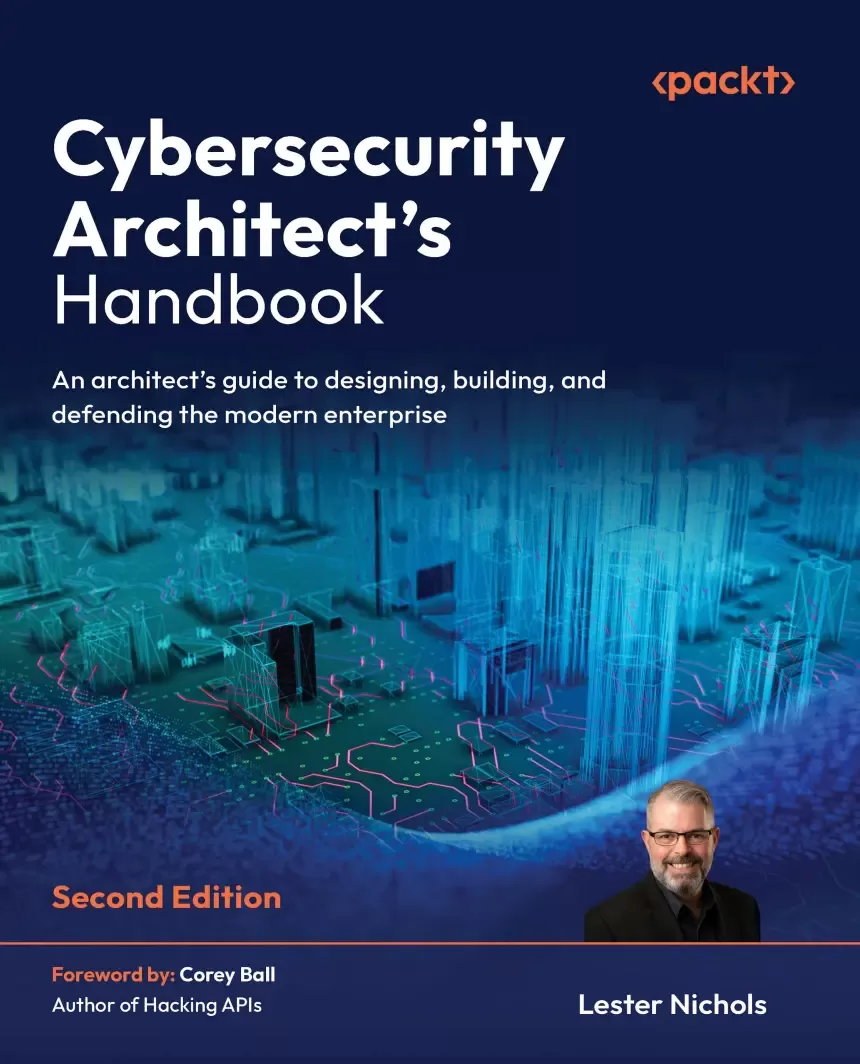
Cybersecurity Architect's Handbook: An architect's guide to designing, building, and defending the modern enterprise. 2 Ed
Оглавление⌄
Cover....1 Cybersecurity Architect's Handbook....2 Second Edition....2 An architect's guide to designing, building, and defending the modern enterprise....2 Cybersecurity Architect's Handbook....3 Foreword....5 Contributors....6 About the author....6 About the reviewers....7 Table of Contents....8 Preface....34 Who this book is for....35 What this book covers....35 To get the most out of this book....37 Download the example code files....37 Download the color images....38 Conventions used....38 Get in touch....39 Free benefits with your book....40 How to Unlock....41 Share your thoughts....41 Part 1....42 Foundations....42 1....44 Introduction to Modern Cybersecurity....44 Technical requirements....45 What is cybersecurity?....45 Core domains....46 ConfidentialityIntegrityAvailability....48 Networking and operating systems....49 Cybersecurity considerations for networking and OS....50 Network segmentation....50 Trust zones....50 Applications....52 Governance, regulations, and compliance (GRC)....53 Summary....54 2....56 Essential Cybersecurity Concepts....56 Understanding the environment and threat actors....56 Access control....57 Distributed systems and big data challenges....57 Authentication and emerging technologies....58 Weak and strong authentication....59 Regulatory, international considerations and threat landscape....60 Aligning access control with business....60 Aligning access control with business needs....60 Collaboration with operations teams....61 Implementing access control measures within an enterprise....61 Network and communication security....62 Network security technologies....63 Securing network communications....64 Network access control....64 Collaboration with operations teams....64 Network operations and network security....64 Incident response and network security....65 Security monitoring and logging....65 Key implementation drivers....65 Essential security measures....65 Continuous improvement....66 Cryptography....66 Cryptographic algorithms....67 Cryptography in practice....67 Secure key management....67 Cloud key management in practice (AWS KMS)....67 Secure communication channels....68 Digital signatures and certificates....68 Collaboration with business and operations teams....68 Regulatory and compliance requirements....68 Business drivers....69 Business continuitydisaster recovery planning (BCPDRP)....70 Business continuity planning (BCP)....70 Disaster recovery planning (DRP)....70 Physical security....71 Implementation drivers....72 Summary....73 Further reading....73 3....74 Cybersecurity Architects and their Responsibilities....74 Who is a cybersecurity architect?....75 Responsibilities of a cybersecurity architect....75 Areas of focus....76 Threat landscape analysis and modeling....77 Security framework development....78 Network security....79 Application security....81 Popular development tools and languages for application security....82 Cloud security....83 Common cloud platforms and services....84 Mobile security....84 Vendor and third-party risk management....85 Emerging technologies evaluation....86 Other areas of focus....87 Cybersecurity architect as part of a bigger team....88 Scope of vision....88 Summary....89 Part 2....90 Pathways....90 4....92 Cybersecurity Architecture PrinciplesDesignAnalysis....92 A note on terminology....93 Architectural principles....93 Key principles of cybersecurity architecture....93 Defense-in-depth....94 Least privilege....94 Separation of duties....95 Kinds of insider threats this principle addresses....96 How the mitigation works structurally....97 Fail-safe defaults....97 Secure by design....98 Regular updates and patching....98 Continuous monitoring....99 Incident response planning....99 Implementing the principles in cybersecurity architecture....99 Best practices for maintaining cybersecurity architecture....100 Key implementation challenges....101 Cybersecurity architecture frameworks....103 What these frameworks enable....103 Frameworks in practice....104 Why frameworks matter beyond compliance....104 Selecting the right framework....105 Framework implementation benefits....105 Examples of successful cybersecurity architecture implementations....107 Financial services....108 Healthcare....111 Retail....113 Business considerations for cybersecurity architecture....116 Architecture design....118 Identifying organizational goals....119 Establishing the context for design....120 Developing security goals....120 Designing security measures....120 Key aspects of cybersecurity architecture design....120 Aligning with organizational culture and skills....121 Establishing the organizational context....122 The three principles: firmitas, utilitas, venustas....123 Why cybersecurity architects invoke vitruvius....123 The Point of the analogy....124 Ensuring effectiveness....124 Considering maturity....125 Maintaining efficiency....125 Cybersecurity architecture design for cloud, enterprise applications, and network....126 Business goals....127 Methods for identifying business goals....127 Leveraging governance documents to understand organizational goals....128 Risk tolerance....129 Assessing risk tolerance....131 Setting risk tolerance thresholds....131 Optimizing architecture for risk objectives....132 Cybersecurity architecture analysis process....133 Monitoring and improving....134 Summary....134 5....136 ThreatRiskGovernance Considerations as an Architect....136 Threats – Understanding the threat landscape....137 Nation-state actors....137 Organized cybercrime....137 Hacktivists....138 Insider threats....138 The anatomy of modern cyberattacks....139 Stage 1: Initial access....139 Stage 2: Establishing persistence....139 Stage 4: Lateral movement....140 Stage 5: Exfiltration and impact....140 Emerging threat vectors....140 Artificial intelligence (AI) and machine learning (ML) threats....140 Convergence of the internet of things (IoT) and operational technology (OT)....141 Cloud and container threats....141 Supply chain ecosystem threats....141 Common types of cyber threats....141 Malware....141 Phishing....142 Man-in-the-middle attacks (MitM) or on-path attacks....142 Distributed denial-of-service (DDoS) attacks....143 Advanced persistent threats (APTs)....144 Risk management in cybersecurity architecture....144 Understanding risk components....145 Threats....146 Vulnerabilities....146 Impact....147 Efficacy and efficiency through preventive measures....147 Risk assessment frameworks and methodologies....148 Risk assessment frameworks....148 NIST Cybersecurity Framework (CSF)....148 ISOIEC 27005....149 Factor analysis of information risk (FAIR)....149 Operationally critical threat, asset, and vulnerability evaluation (OCTAVE)....149 Risk assessment methodologies....149 Quantitative risk analysis....149 Qualitative risk analysis....151 Hybrid approaches....151 Advanced risk scenarios....152 Supply chain and third-party risk....152 Cloud and digital transformation risks....152 Emerging technology risks....153 Risk treatment strategies....153 Risk acceptance....154 Risk avoidance....154 Risk transfer....154 Risk mitigation....155 Governance in cybersecurity architecture....155 Governance structure and decision making....156 Board and executive engagement....156 Policy architecture....156 Organizational structure and roles....157 Chief information security officer (CISO) role....157 Security governance committees....157 Compliance and regulatory considerations....158 Managing multiple regulations....158 Privacy regulations....158 Security culture and awareness....159 Metrics and measurement....159 Strategic vs. operational metrics....159 Avoiding metric pitfalls....160 Incident response governance....160 Decision authority....160 Stakeholder communication....161 Integration with business strategy....161 Business context of security....161 Value creation and security....161 Competitive advantage through security....162 Trust as currency....162 Security-enabled innovation....162 Regulatory compliance as market access....162 Risk appetite alignment....162 Security economics....163 Direct security costs....163 Indirect security costs....163 Security value calculation....163 Organizational change management....164 Security architect as a business partner....165 Practical implementation....165 Threat-informed architecture....165 Threat modeling in practice....165 Conducting threat modeling to identify vulnerabilities and attack vectors....166 Implementing threat intelligence....166 Risk-based implementation....167 Control selection and prioritization....167 Governance implementation....167 Policy deployment....167 Organizational structure implementation....168 Common implementation challenges....168 Summary....168 6....170 Documentation as a Cybersecurity Architect - Valuable Resources and Guidance....170 Importance of documentation in cybersecurity architecture....171 Types of documentation....172 Policies and procedures....173 Structural elements....173 Technical embedding and implementation....174 Auditing and revision....174 System architecture diagrams....175 Vulnerability identification....176 Integration with security tools and processes....176 Compliance and auditing....177 System architecture diagram types....178 Threat models....178 Core components of threat modeling....179 Strategic value of risk management....180 Governance integration and leadership support....181 Regulatory compliance and audit readiness....181 Operational risk management implementation....181 Continuous improvement and adaptation....181 Enterprise-wide impact....182 Risk assessments....182 Core components of effective risk assessment....182 Business impact and probability analysis....182 Risk calculation and strategic prioritization....183 Strategic value of governance and leadership....183 Regulatory compliance and audit support....183 Continuous risk management integration....184 Security requirements....184 Confidentiality requirements: Protecting information assets....184 Integrity requirements: Ensuring data and system trustworthiness....185 Availability requirements: Maintaining operational continuity....185 Advanced requirements engineering methodologies....185 Governance and strategic alignment....186 Regulatory compliance integration....186 Continuous requirements management....187 Logical architecture diagrams....187 Architectural components and design principles....187 Network segmentation and trust zones....187 Service and application layer mapping....188 Data flow and information architecture....188 Identity and access pathways....188 Communication protocols and integration points....188 Security analysis and risk identification capabilities....188 Advanced diagramming practices....189 Governance and strategic decision support....189 Regulatory compliance and audit enablement....190 Operational excellence and incident response....190 Physical architecture diagrams....191 Comprehensive infrastructure visualization....191 Hardware components documentation....191 Physical connectivity and pathways....191 Spatial and environmental context....191 Security analysis from a physical perspective....192 Vulnerability identification and risk assessment....192 Attack surface mapping....192 Incident response and operational support....192 Best practices....192 Integration with security operations....193 Compliance and governance enablement....193 Strategic planning and risk management....194 Configuration documents....194 Essential documentation components....194 Environmental prerequisites and dependencies....194 Detailed configuration specifications....194 Implementation procedures and workflows....195 Rollback and recovery procedures....195 Security context and rationale....195 Threat mitigation mapping....195 Compliance alignment documentation....196 Security tradeoff analysis....196 Operational excellence features....196 Change management integration....196 Multi-environment considerations....196 Automation and orchestration support....196 Knowledge management and training....197 Continuous improvement integration....197 Documentation tools....198 Architectural and visual documentation solutions....198 Microsoft Visio....198 Draw.iodiagrams.net....198 CherryTree....199 Confluence....199 Archer IRM....199 OneTrust....200 Microsoft 365 Suite....200 Open-source Office alternatives....200 Selection criteria and implementation considerations....200 Team approaches to documentation....201 Summary....202 7....204 Entry-Level to Architect Roadmap....204 The journey and where to start....205 From technology professional to cybersecurity architect....206 Foundation building in technology....206 Navigating career pathways....206 From help desk to architecture....207 From developer to security architect....207 From network administration to architecture....207 Hands-on practice: Continuous learning imperative....207 Your unique path....208 My real-world journey: From medicine to technology architecture....208 Mid-career evolution: Transition to cybersecurity leadership....209 Certification–experience balance....209 Strategic career navigation....210 From security analyst to architect....210 From ethical hacker to security architect....210 From incident responder to architect....210 The two-year planning cycle....211 Building an architectural mindset....211 Common success patterns and pitfalls....211 Real-world innovation: Building security solutions ahead of their time....212 The compliance challenge....212 Engineering a solution....212 Lessons in innovation and leadership....212 Advanced mastery: The evolution from specialist to architect....213 Advanced pathways to architecture....214 Application security specialist to enterprise architect (8–10 years)....214 Threat intelligence analyst to enterprise architect (10–12 years)....214 Incident response leader to enterprise architect (12 years)....214 Leadership development strategies....215 Building industry presence....215 The three- to five-year strategic plan....215 Real-world progression: From local government to enterprise security leadership....216 The architecture of experience....217 Mastering cybersecurity architecture leadership....218 Strategic development pathways....218 Application security architect to chief architect (4–5 years)....218 Infrastructure architect to chief security architect (6–8 years)....218 Identity and access architect to chief architect (8–10 years)....219 Essential leadership competencies....219 Transitioning to executive leadership....220 Lessons for aspiring architects....220 Getting started....221 Understanding the OODA loop....221 Applying OODA loop principles to cybersecurity career development....223 Entry-level analysts....223 Mid-level security engineers....223 Advanced-level principal consultants....224 Cybersecurity architects to chief information security officers....224 The cold open....224 Managing the technical learning curve....225 Entry-level position strategies....225 Foundation role execution....226 Continuing upskilling....226 Developing architectural vision....226 The transfer....227 How to expand....228 Pivoting to cybersecurity....228 Cultivating specialized expertise....228 Ascending to cybersecurity architect role....228 Summary....229 8....230 The Certification Dilemma....230 Industry and organizational considerations....231 Certifications landscape....232 Computing technology industry association (CompTIA)....232 EC-Council....232 Information systems audit and control association (ISACA)....233 The international information system security certification consortium (ISC)....233 Global information assurance certification (GIAC)....234 SABSA - The Open Group....234 Cloud vendor – AWSAzureGCP....235 Why get certified?....235 Certification considerations....237 Industry variations....237 Government requirements....237 Cost considerations....237 Summary....238 Part 3....240 Advancements....240 9....242 Decluttering the Toolset....242 Technical laboratory exercises....243 What is in the toolbox....243 Universal security domains....244 Strategic tool selection....244 Threat modeling and risk assessment tools....245 Network Defense and Monitoring: The Digital Perimeter....246 Core capabilities and architectural value....247 Strategic implementation impact....247 Endpoint protection: securing the Human–Machine interface....248 The architectural imperative....249 Organizational value and risk mitigation....249 Building resilient endpoint defense....250 Identity and Access Management: The Digital Gatekeeper....251 The architectural foundation of zero trust....251 Organizational impact and business value....252 Implementing least privilege at scale....252 The evolution of identity security....253 Data protection: securing the crown jewels....253 Lifecycle protection across infrastructure....255 The growing data protection challenge....255 Vulnerability management: closing the window of exposure....256 The architectural challenge of continuous security....256 Quantifiable risk reduction....256 Building proactive defense....257 Security configuration and patch management: building on solid foundations....258 The architectural challenge of configuration drift....258 Quantifiable organizational benefits....259 Strategic implementation advantages....259 The foundation of defense in depth....260 Incident response and forensics: when prevention fails....260 The architectural imperative of assume breach....261 Building organizational resilience....262 Application security: defending the code that runs the business....262 The architectural reality of software vulnerabilities....263 Comprehensive security throughout the development lifecycle....263 Quantifiable Organizational Value....263 Building security into development culture....264 The evolution of application security....264 Cloud security: protecting the borderless enterprise....265 Cloud access security brokers (CASBs)....265 Cloud workload protection platforms (CWPP)....265 Cloud security posture management (CSPM)....266 The architectural challenge of shared responsibility....267 Strategic cloud security capabilities....267 Quantifiable business value....268 Enabling secure cloud transformation....269 The evolution of Cloud-Native security....269 Governance and compliance: transforming security from art to science....269 The architectural need for structured governance....270 Strategic business value....270 Enabling systematic security management....270 Building defensible security programs....271 The evolution of integrated governance....272 Penetration testing and red teams: thinking like the enemy....272 The architectural imperative of adversarial validation....273 Compliance reality check: building offensive capabilities for defensive purposes....275 Ethical and operational considerations....276 Automation and orchestration: scaling security at machine speed....278 The architectural necessity of automated responses....279 The strategic value of security automation and orchestration....279 Building resilient security operations....280 The Human-Machine partnership....280 Summary....281 10....284 Best Practices....284 Least privilege....285 Practical implementation strategies....285 Best practices for implementing least privilege....285 Building comprehensive controls....286 Managing privileges dynamically....286 Conducting a user access review....287 From discovery to remediation....287 Establishing role-based access control....288 Implement strong authentication mechanisms....288 Employing JIT access....290 Regular audits and logs....291 Educating employees....291 Leveraging automation tools....292 Streamlining access lifecycle....292 Policy-driven automation....293 Intelligent access orchestration....293 Enabling scalable governance....293 Patching and development....293 Best practices for patch management....294 Establishing governance frameworks....294 Continuous inventory of assets....294 Comprehensive component catalog....294 Enabling rapid response....295 Automated vulnerability scanning....295 Adopting a patch management policy....296 Prioritization of patches....296 Testing patches before deployment....298 Mirroring production realities....298 Automated validation workflows....299 Clear decision criteria....299 Balancing speed and safety....300 Regular patch cycles and out-of-band updates....300 Documentation and audit trails....301 User and developer training....302 Multi-factor authentication (MFA)....303 Best practices for MFA implementation....303 Understanding the types of authentication factors....303 Adopting a layered security approach....304 User education and training....305 Enforcing policies....306 Regular review and updates....307 Implementing fallback mechanisms....307 Architecting recovery options....307 Automated recovery workflows....308 Real-world resilience planning....308 Confident security deployment....308 Adhering to compliance and standards....309 Security training....309 Best practices for effective security training....310 Tailored training programs....310 Engineering-focused education....310 Department-specific programs....310 Frontline defense training....311 Maximizing training impact....311 Engagement and interactivity....312 Relevance and realism....312 Learning from actual breaches....312 Continuous learning....313 Measurable outcomes....314 Management buy-in....314 Clear communication....315 Regular assessment....316 Vulnerability scanning....317 Best practices for conducting vulnerability scanning....317 Regular and consistent scanning....318 Point-in-time scanning....318 Credentialed scanning....319 Prioritization of findings....320 Integration with patch management....321 Scanning after significant changes....322 Diverse toolset....322 Complementary detection capability....322 Dynamic and static assessment....323 Minimizing detection blind spots....324 Balancing complexity and value....324 Validation of results....324 Human expertise beyond automation....324 Verification requirements....324 Contextual impact assessment....324 Optimizing accuracy at scale....324 Compliance with regulations....325 Lab environments: building practical security competency....326 Architecting effective lab infrastructure....326 Core components and configuration....327 Tool integration and licensing....327 Scenario development and exercises....327 Performance metrics and assessment....328 Cloud and hybrid lab models....328 Documentation and knowledge management....328 Continuous improvement and evolution....328 Resource optimization and sustainability....329 Integration with security operations....329 Summary....329 11....332 Being Adaptable as a Cybersecurity Architect....332 Understanding adaptability....333 Why Adaptability Is Non-Negotiable....334 Evolving threat landscape....334 Regulatory and compliance changes....335 Targeted and tailored attack strategies....335 Resource and capability constraints....336 Complex and heterogeneous IT environments....336 Insider threats and human factors....337 Cultivating adaptability in application security architecture....337 The forces demanding adaptability in application security....337 Enabling adaptive policy and compliance....339 Threat modeling and adaptive segmentation....340 Empowering Rapid Response....341 Fostering a culture of adaptability....342 The foundation of resilient defense....343 Be a reed in the wind....344 The principle of adaptive security architecture....344 Architectural flexibility in alignment with business goals....346 Adaptation to organizational change....347 Case studies: architectural adaptability in action....348 Merger and acquisition....348 Cloud migration....348 New privacy regulations....349 Digital transformation....349 Embracing adaptability as a cybersecurity virtue....350 The OODA loop revisited....351 The OODA loop: A framework for adaptability in cybersecurity....351 The OODA loop across career stages....352 Real-World applications of the OODA loop....353 A deeper examination of the OODA loop for cybersecurity professionals....353 Mitigation of risk....354 Foundations of risk mitigation in cybersecurity architecture....354 Strategic risk mitigation: aligning with business objectives....355 Integrating risk mitigation across the organization....356 Evolving mitigation strategies in a dynamic threat landscape....357 Case studies: dynamic risk mitigation in practice....358 The harmonization of risk mitigation and business strategy....359 Finding balance....359 The art of balancing security and business objectives....360 Strategic implementation of security....360 Rapid mitigation and response....360 Leveraging threats as opportunities....361 Preparedness and proactive planning....361 Adaptive security architecture: the reed in the wind....361 Architectural flexibility in alignment with business goals....362 Adaptation to organizational change....363 Achieving Work-Life balance as a cybersecurity architect....364 Understanding Work-Life imbalance risks....364 Summary....365 12....368 Architecture Considerations – Design, Development and Other Security Strategies....368 Technical design....369 Fundamentals of technical design....369 The role of frameworks in security architecture design....371 The open group architecture framework (TOGAF)....371 NIST cybersecurity framework (CSF)....371 Sherwood applied business security architecture (SABSA)....372 Bringing the frameworks together....373 Aligning with Organizational Goals....373 The role of design in business success....374 Case study analysis: the impact of design choices....374 Balancing technical feasibility, strategy, and stakeholder engagement....375 Crafting flexible and adaptive solutions....376 Data and interface design....377 Realizing data and interface architecture....378 Security Integration....381 Implementing technical designs....382 Strategic development approaches....383 Comprehensive testing and validation....384 Deployment and monitoring....385 The architect's role in deployment....385 Controlled deployment with continuous monitoring....386 Case studies and Real-World applications....387 Industry-Specific designs....387 Adapting designs to evolving landscapes....389 The architecture lifecycle....390 The conceptualization phase....391 Initial security considerations....393 The design phase....396 Transitioning from conceptualization to design....396 Security in design....401 Development phase....402 Transforming designs into functional realities....402 Continuous testing....404 Deployment phase....405 Deploying solutions securely to production....405 Maintenance phase....406 Sustaining innovation through continuous maintenance....407 Case study: Long-Term maintenance of legacy financial systems....408 Blueprinting....409 Blueprint design principles....411 Security integration in blueprints....412 The blueprinting process....413 Expanding drafts through collaborative refinement....414 Use cases and practical applications....414 Scoping....415 Phase 1: stakeholder identification and requirements elicitation....417 Phase 2: Risk, residual risk, and dependency analysis....418 Phase 3: scope framing and boundary definition....419 Phase 4: decomposition, prioritization, and estimation....419 Phase 5: change control and sustained communication....419 Overview of project methodologies....420 Emerging methodologies....420 Waterfall methodology....421 Agile methodology....422 Selecting the right approach....422 Decision-Making framework....423 Combining methodologies: hybrid approaches....423 Trends and future directions....424 Best practices across methodologies....425 Summary....425 Part 4....428 Application....428 13....430 AI Security Architecture....430 AI development environment security....430 Adaptability: how AI attacks mutate around controls....431 Preparedness: the cost of complacency....431 Deception: The fundamental nature of AI attacks....432 A comparison of principles with examples....432 What AI is and what it is not....434 Machine learning (ML)....434 Deep learning....435 Large language models (LLMs)....435 Generative AI (GenAI)....436 Agentic AI....436 What AI is not....437 Agentic AI: architecture and security implications....438 Defining the AI agent....438 The agentic attack surface....438 Architectural mitigations for agentic AI....442 Least privilege for tool access....442 Human-in-the-Loop for High-Risk actions....442 Behavioral monitoring and anomaly detection....443 Sandboxing and isolation....443 Comprehensive audit logging....444 AI-Powered Cybercrime....444 The AI-Enhanced threat landscape....444 Categories of AI-Weaponized attacks....445 AI-Generated social engineering....445 Deepfake-Driven identity attacks....445 AI-Accelerated vulnerability discovery and exploit development....446 Automated reconnaissance and attack orchestration....446 Architectural defenses against AI-Powered attacks....447 The OWASP LLM top 10 (2025)....450 Prompt injection: the defining vulnerability....451 Types of guardrails....452 Input guardrails....452 Output guardrails....453 Behavioral guardrails....453 Operational guardrails....454 The AI firewall....454 Deployment patterns....454 API gateway interceptor....454 SDK or In-Process library....455 Shadow AI governance: the largest uncontrolled risk....455 The scale and nature of the problem....456 Architectural controls for shadow AI....456 Rethinking incident response for the age of AI....458 Trends and architecture considerations....459 Zero trust for AI systems....459 Model context protocol (MCP) security....460 AI supply chain security....461 Continuous AI red teaming....461 Regulatory and compliance landscape....462 Quantum computing and Post-Quantum preparedness....463 Edge AI and distributed inference....463 The AI vendor landscape....463 Security differentiation among vendors....464 Multi-Vendor and portability strategies....465 The AI investment bubble: implications for security architecture....466 The scale of investment....466 Signs of overheating....466 Why this matters for security architects....467 AI in the cloud: AWS as a reference implementation....468 AWS AI security architecture overview....468 Identity and access management for AI workloads....468 Implementing bedrock guardrails with infrastructure as code....469 Network isolation and VPC architecture....469 Runtime guardrail enforcement with the ApplyGuardrails API....470 Logging, monitoring, and auditing....470 Cross-Account and Organization-Level enforcement....471 Transferable principles to other cloud platforms....471 Reference architecture for AI security....471 Data layer....472 Model layer....473 Inference and runtime layer....473 Agent and tool integration layer....474 Governance and compliance layer....474 The Architect's verification checklist....474 Summary....476 14....478 Financial Services Architecture Patterns....478 Guiding principles for financial services security architecture....481 The regulatory landscape....481 Federal banking regulators....482 SEC and FINRA....482 New York DFS 23 NYCRR 500....483 International frameworks: DORA and basel....484 Building a unified regulatory compliance architecture....485 Secure transaction processing architectures....485 Transaction lifecycle security model....486 Reference architecture: secure payment processing....487 High-Availability transaction processing....489 Real-Time fraud detection systems....489 Architecture of a modern fraud detection platform....490 Streaming architecture for Real-Time processing....490 Architecture pattern: feature store for fraud detection....491 Explainability and audit requirements....491 Case management and investigation architecture....492 Federated fraud intelligence....492 Payment security architectures....493 Cardholder data environment architecture....493 Tokenization....493 Point-to-Point encryption....493 Network segmentation....493 PCI DSS v4.0 architecture changes....494 Secure key management architecture....494 Third-Party risk management and supply chain security....495 Third-Party risk assessment framework....495 API gateway architecture for partner integrations....496 Concentration risk and exit strategy architecture....496 Data privacy architecture in the Third-Party ecosystem....497 Operational resilience....498 Defining critical business services and impact tolerances....498 Resilient architecture patterns....498 Recovery architecture....499 Testing operational resilience....500 Identity and access management architecture....500 AI security in financial services....501 AI use cases and their security profiles....501 AI model governance architecture....502 Fair lending and AI bias mitigation....503 Securing AI against adversarial attacks in financial services....503 Generative AI governance in financial services....504 Implementation considerations and emerging trends....505 Cloud security architecture for financial services....505 Quantum computing preparedness....506 Zero trust architecture in financial services....506 DevSecOps for regulated financial services....506 Security operations architecture for financial services....507 Incident response architecture....508 Reference architecture: AWS–Fintech data center hybrid cloud....508 Architecture overview and TrustZone model....508 Network architecture and interconnect security....510 Infrastructure-as-Code: AWS trust zone controls....511 Application-Level TrustZone enforcement....512 Monitoring and compliance automation....512 Summary....514 15....516 Healthcare Security Architecture....516 Regulatory Foundations for Healthcare Security....517 FDA medical device cybersecurity guidance....520 State-Level health data privacy laws....521 International regulatory frameworks....522 Translating regulatory requirements into architectural controls....524 Electronic health record security architecture....525 EHR access control, monitoring, and sensitive data handling....526 Interoperability security....529 Medical device and IoT security....530 Medical device inventory and risk assessment....530 Clinical network segmentation....531 Compensating controls for legacy devices....532 Passive monitoring architectures....532 Manufacturer coordination and coordinated vulnerability disclosure....533 Telehealth and remote care security....534 Secure video consultation architecture....535 Remote patient monitoring security....536 Telehealth data governance....537 Asynchronous clinical communication security....537 Home health device integration security....539 Clinical research and genomic data security....539 The unique sensitivity of genomic data....540 De-identification (anonymization) and Privacy-Preserving analytics....540 Clinical trial data security....541 Healthcare operational resilience....541 Clinical system failover architecture....542 Downtime procedures and clinical continuity....542 Ransomware resilience....543 Pharmacy and medication management continuity....544 Clinical data integrity during recovery....544 AI in clinical decision support....545 Clinical AI governance architecture....545 Adversarial robustness in clinical AI....546 Explainability and clinical trust....546 Training data security and integrity....546 Regulatory considerations for clinical AI....547 Reference architecture for a hybrid clinical environment....548 Architecture overview and trust zones....548 Data flow: from bedside to research archive....552 Cross-Zone security controls....553 Implementation considerations....554 Metrics and continuous improvement....555 Summary....557 16....558 Cloud-Native Security Architecture....558 Ancient wisdom for a modern battlefield....559 The Cloud-Native threat landscape and shared responsibility....561 The evolving Cloud-Native threat landscape....561 The shared responsibility model as an architectural principle....562 Identity-Centric security architecture....564 Zero trust architecture for Cloud-Native environments....564 Workload identity and cryptographic authentication....564 Just-in-Time and Just-Enough access....565 Service mesh and mutual TLS....566 Federated identity for Multi-Cloud and hybrid environments....566 Container and kubernetes security architecture....567 The container security lifecycle....567 Image provenance and Build-Time security....567 Registry security and image management....568 Runtime Security....568 Kubernetes security architecture....568 API server security and authentication....568 Role-Based Access Control (RBAC)....569 Pod security standards and admission control....569 Network policies and Micro-Segmentation....570 Secrets management in kubernetes....570 Infrastructure as code (IaC) security....570 Static analysis and policy enforcement for IaC....570 Policy-as-Code frameworks....571 Drift detection and continuous configuration validation....571 Secure CICD pipeline architecture....572 Serverless and Event-Driven security architecture....572 The serverless security paradox....573 Function-Level least privilege....573 Event source validation and injection prevention....573 Cold start security and ephemeral compute considerations....574 Observability for serverless security....574 Cloud data security architecture....574 Encryption architecture for cloud data....575 Data classification and discovery....575 Data loss prevention for cloud environments....576 Confidential computing....576 Multi-Cloud and hybrid cloud security architecture....576 Cloud security posture management (CSPM)....577 Cloud-Native application protection platforms (CNAPP)....577 Network architecture for Multi-Cloud and hybrid connectivity....577 Abstracting security controls across providers....578 Cloud security operations and incident response....578 Cloud-Native security monitoring and SIEM....578 Incident response in ephemeral environments....579 Threat intelligence for cloud environments....580 Cloud-Native compliance and governance....580 Continuous compliance monitoring....580 Automated evidence collection and reporting....581 Landing zone architecture and guardrails....581 Cloud governance operating model....581 Reference architecture: Multi-Cloud enterprise security....582 Environment overview....582 Identity Architecture....582 Development and deployment pipeline....583 Runtime Security Architecture....583 Data protection architecture....584 Security operations and monitoring....584 Compliance and governance architecture....584 Lifecycle Integration....584 Summary....585 17....586 Critical Infrastructure Protection....586 Understanding critical infrastructure protection through Tzu's principles....587 Initiative....587 Deception....587 Preparation....588 Precision....588 Planning....588 Leadership....588 Navigating the threat landscape of critical infrastructure....589 Nation-state threat actors....590 Criminal organizations....590 Hacktivists and insider threats....590 Regulatory and standards landscape....591 The NIST cybersecurity framework (CSF) 2.0....591 NERC CIP standards....592 TSA security directives....593 CIRCIA and incident reporting....593 Architecting ITOT convergence....594 Purdue enterprise reference architecture....594 Network segmentation architectures for OT environments....595 Industrial demilitarized zone (iDMZ)....595 Unidirectional security gateways (data diodes)....596 Industrial firewalls and zone segmentation....596 SCADA and industrial control systems security architecture....596 The challenge of legacy industrial systems....597 Compensating controls for legacy systems....597 Securing industrial protocols....598 Managing IAM for critical infrastructure....598 Addressing the shared credential challenge....598 Role-based access models for OT....599 Emergency access and safety considerations....599 Privileged access management in OT....600 Supply chain security for critical infrastructure....600 Industrial supply chain risks....600 Vendor remote access management....600 Component integrity verification....601 Designing for resilience and continuity....601 Degraded mode operation....601 Manual override and analog backup systems....602 Safety instrumented systems security....602 Incident detection and response in OT environments....603 OT-specific threat detection....603 OT incident response considerations....603 Coordinated disclosure and information sharing....604 Cloud and edge computing in critical infrastructure....604 Edge computing architectures....605 Sector-specific security considerations....605 Energy sector....605 Water and wastewater....606 Transportation....606 Reference architecture: Multi-site energy utility....606 iDMZ implementation....607 Generation facility security architecture....607 Transmission substation security architecture....608 Tracing a control command through the architecture....608 Summary....609 18....610 Zero Trust Architecture Implementation....610 Foundational principles of Zero Trust....611 Never trust, always verify....612 Assume Breach....613 Explicit verification and contextual access....615 Architectural components of zero trust....616 The Policy Engine....616 The Policy Administrator....618 Policy Enforcement Points....618 Identity as the new perimeter....620 Strong authentication and Phishing-resistant credentials....620 Continuous authentication and session verification....622 Identity governance and lifecycle management....623 Network architecture evolution: from segmentation to micro-segmentation....624 The limitations of traditional network segmentation....625 Software-defined microsegmentationm....626 Encrypted communications and mutual authentication....627 Data protection in a Zero Trust model....629 Data Classification and Discovery....629 Dynamic, context-aware data controls....631 Encryption strategy and key management....632 Observability, analytics, and continuous monitoring....634 Comprehensive telemetry collection....635 User and Entity Behavior Analytics....636 Security Orchestration and Automated Response....636 Practical implementation: strategies, challenges, and roadmaps....637 Maturity models and phased adoption....637 Starting points: protect surfaces and transaction flows....639 Legacy system integration....640 Showcase: Zenarmor as a Zero Trust enablement layer for brownfield environments....641 Architectural Overview....641 Illustrative use case: A Mid-Sized manufacturer with mixed legacy infrastructure....642 Implementation patterns....642 Cloud-native and hybrid Zero Trust....644 Measuring Zero Trust effectiveness....645 Key metrics for Zero Trust assessment....645 Adversarial testing and validation....646 Organizational and cultural transformation....648 Executive sponsorship and governance....648 Workforce enablement and change management....649 Summary....651 19....652 Future Trends....652 The evolving threat landscape....654 Ransomware and extortion operations....654 Supply chain attacks....655 Advanced persistent threats and Nation-State actors....657 Zero trust architecture: from concept to implementation....658 Core principles and pillars....658 Identity-Centric Security....659 Micro-Segmentation and Software-Defined perimeters....660 Artificial intelligence and machine learning in cybersecurity....661 Adversarial AI and offensive applications....663 Quantum computing and Post-Quantum cryptography....665 The quantum threat to cryptography....665 Crypto-Agility as an architectural imperative....667 Cloud-Native security architecture....667 Cloud-Native application protection platforms....667 DevSecOps and Shift-Left security....668 Securing the software supply chain....668 Regulatory evolution and Privacy-Enhancing technologies....669 Global regulatory trends....669 Privacy-Enhancing technologies....669 Convergence of physical and digital security....670 The cybersecurity workforce challenge....672 Automation and orchestration....672 Platform consolidation....673 Secure access service edge and network transformation....673 Future skills development....674 Summary....675 20....678 Unlock Access to the Code Bundle and the PDF Version....678 Unlock this book's free benefits in three easy steps....679 Step 1....679 Step 2....679 Step 3....680 Need help?....680 Why subscribe?....682 Other Books You May Enjoy....683 Packt is searching for authors like you....685 Share your thoughts....685 Index....686
Описание
Коротко и по делу о том, что важно знать про architecture.
The Cybersecurity Architect's Handbook, 2nd Edition takes you from foundational security principles through Zero Trust, AI security, cloud-native architecture, and critical infrastructure protection, blending hands-on technical expertise with the strategic wisdom of The Art of War. The cybersecurity architect is not just a technician — they are a tactician in the ever-present war in cyberspace. Design it. Defend it. Build it.
Key FeaturesCovers modern cybersecurity foundations from CIA triad to threat modeling and secure developmentProvides industry-specific architecture patterns for AI, finance, healthcare, cloud, critical infrastructureCareer pathways from entry-level to cybersecurity architect, with certs, tools, and adaptabilityBook DescriptionThe Cybersecurity Architect's Handbook, 2nd Edition builds on the foundational, career-development, and best-practices coverage that made the first edition an essential resource, while expanding its scope with a new section of applied, industry-specific architecture chapters.
In this new edition, the book introduces dedicated deep dives into AI security architecture, financial services architecture patterns, healthcare security architecture, cloud-native security architecture, critical infrastructure protection, and Zero Trust Architecture implementation — each with scenario-based examples, lab exercises, and domain-specific design guidance. New to this edition is the strategic framework inspired by Sun Tzu's The Art of War, woven throughout every chapter to reinforce that cybersecurity architects are not merely technicians but strategists and tacticians operating on a digital battlefield.
By the end of this book, you will have a complete roadmap from foundational knowledge to real-world application across today’s critical industries and technology environments. You will explore best practices and emerging threats, including quantum computing and AI-driven attacks, to design, build, and defend the modern enterprise.
It’s also suited for practicing security professionals seeking to move from tactical, tool-focused work to strategic architectural thinking and decision-making. What you will learnHands-on labs and scenario exercises covering access, crypto, and BCP/DRImplement Zero Trust with identity controls, micro-segmentation, and migrationLearn cybersecurity architecture principles and design through lifecycle scenariosRationalize tools by streamlining your toolkit and aligning with businessAddress architecture challenges by mitigating threats and adapting strategiesDesign security architectures for AI, finance (PCI, GLBA, SOX), HIPAA, cloud, ICS/SCADAUse Sun Tzu's strategies to become a tactician and leader in cybersecurityWho this book is forThis book is for aspiring cybersecurity architects who want foundational knowledge and a roadmap to think and operate as architects. It will benefit current cybersecurity and solution architects aiming to expand expertise in AI security and Zero Trust while strengthening transferable frameworks. Technology leaders or IT managers who want to align security strategy with business objectives and governance will find this book essential.
Если материал оказался полезен — сохраните страницу.
Поделиться
Частые вопросы
Можно ли скачать «Cybersecurity Architect's Handbook: An architect's guide to designing, building, and defending the modern enterprise. 2 Ed» бесплатно?
Да, «Cybersecurity Architect's Handbook: An architect's guide to designing, building, and defending the modern enterprise. 2 Ed» доступна для бесплатного скачивания на нашем сайте в формате PDF. Ссылка на файл находится на этой странице.
В каком формате и какого размера файл?
Книга предоставляется в формате PDF, размер файла 4,1 МБ.
Кто автор и когда вышла книга?
автор — Nichols III Lester E., издательство Packt Publishing Limited, год выпуска 2026, 702 страниц.
О чём книга «Cybersecurity Architect's Handbook: An architect's guide to designing, building, and defending the modern enterprise. 2 Ed»?
The cybersecurity architect is not just a technician — they are a tactician in the ever-present war in cyberspace.
Похожие материалы
 Security and Privacy Vision in 6G: A Comprehensive Guide
 Ethical Hacking: A Comprehensive Beginner’s Guide to Learn and Understand the Concept of Ethical Hacking
 Kali Linux. Тестирование на проникновение и безопасность
 Защита личной информации в интернете, смартфоне и компьютере
 Хакинг. Искусство эксплойта. 2 изд
 Кибербезопасность стратегии атак и обороны. Безопасность инфраструктуры с использованием тактик Красной и Синей команд
 Секреты безопасности и анонимности в интернете
 Реагирование на компьютерные инциденты. Прикладной курс