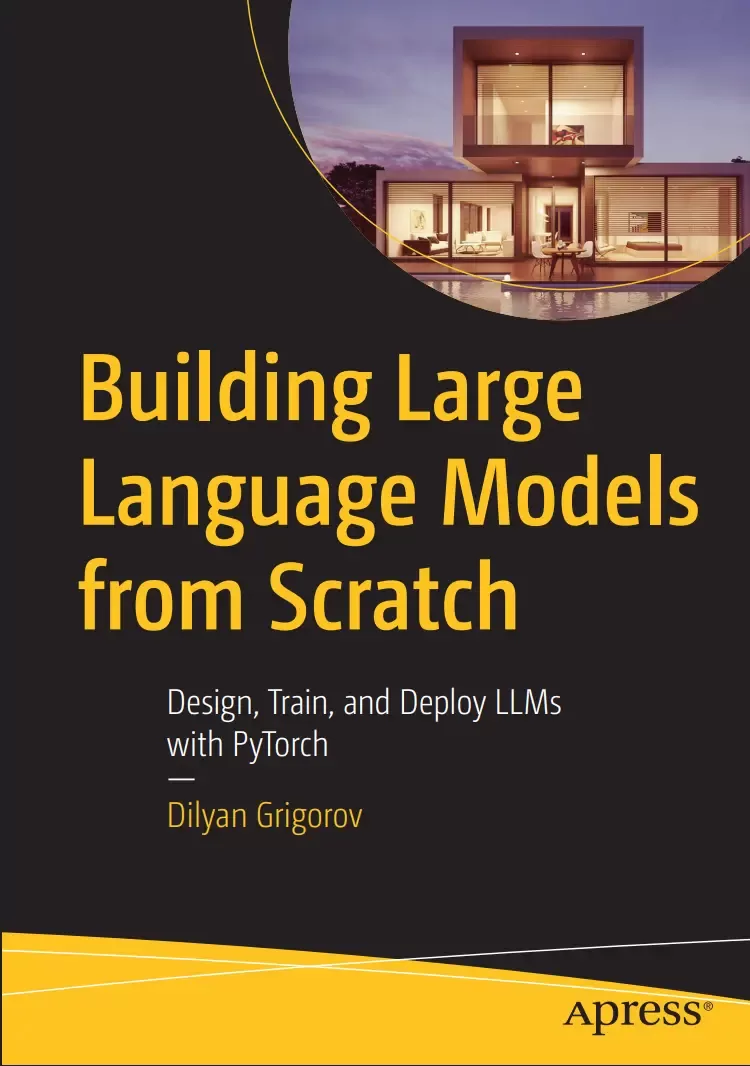
Building Large Language Models from Scratch: Design, Train, and Deploy LLMs with PyTorch
Оглавление⌄
Table of Contents....5 About the Author....21 About the Technical Reviewer....22 Introduction....23 Chapter 1: What Is a Large Language Model? Getting Started with Libraries and Environment Setup for Building an LLM from Scratch....24 Getting Started with the Foundations of Language Modeling....24 What Is a Large Language Model (LLM)?....26 The Attention MechanismCornerstone of Modern Large Language Models (LLMs)....29 What Are Attention Mechanisms?....30 Detailed Explanation About How Self-Attention Works in Transformers....30 Why Attention Is Central to LLMs....32 Variants and Innovations in Attention (As of May 2025)....33 Challenges and Limitations of Attention....34 Practical Significance in LLMs....35 The Tools We Will Use to Build a Large Language Model from Scratch....35 Why Python for Building Large Language Models?....37 Readable, Simple, and Accessible for All Skill Levels....37 Extensive Machine Learning Ecosystem and Strong Community Support....37 Integrated Tools for Visualization, Experimentation, and Full ML Pipelines....38 High Performance Through GPU Acceleration, Scalability, and Low-Level Interoperability....38 Production-Ready Deployment and Access to Pretrained Models for Transfer Learning....38 Why Jupyter Notebook for Building Large Language Models?....39 Interactive, Iterative Coding with Immediate Feedback....39 Unified Environment for Code, Documentation, and Visualization....40 Deep Debugging Transparency and Real-Time Inspection....40 Optimized for Learning, Collaboration, and Reproducible Research....40 Seamless Integration with Scientific Libraries and Scalable Environments....40 Why PyTorch for Building Large Language Models?....41 Dynamic, Flexible Execution for Fast Experimentation and Debugging....41 Pythonic Design and Deep Integration with the Scientific Ecosystem....41 High-Performance GPU Acceleration and Parallel Computing at Scale....41 Modular Architecture and a Rich, Research-Friendly Ecosystem....42 Production-Ready Deployment, Interoperability, and Future-Proof Development....42 Why CUDA for Building Large Language Models?....43 Massive Parallelism for Compute-Intensive Operations....43 Seamless Integration with Deep Learning Frameworks....44 Support for Mixed Precision Training....45 Optimized Libraries for Deep Learning....45 Scalability for Distributed Training....46 Support for Advanced Hardware Features....47 Flexibility for Custom Kernels and Optimizations....47 Rapid Prototyping and Experimentation....48 Support for Inference Optimization....48 Extensive Ecosystem and Community Support....49 Energy Efficiency and Cost Savings....50 Future-Readiness and Innovation....50 Accessibility for Diverse Developers....51 Support for Research and Custom Architectures....51 Why NumPy and Matplotlib for Building Large Language Models?....52 NumPy: Efficient Numerical Computations for Data Processing....53 NumPy: Memory Efficiency for Large-Scale Data....54 NumPy: Foundation for Preprocessing and Feature Engineering....55 NumPy: Support for Custom Algorithms and Research....55 Matplotlib: Visualization for Model Understanding....56 Matplotlib: Debugging and Interpretability....56 Matplotlib: Customizable and Publication-Ready Visuals....57 NumPy and Matplotlib: Seamless Integration with Python Ecosystem....57 NumPy and Matplotlib: Accessibility for Beginners....58 NumPy: Support for Dataset Creation and Evaluation....58 Matplotlib: Support for Experiment Tracking....59 NumPy and Matplotlib: Support for Research and Innovation....59 NumPy and Matplotlib: Lightweight and Local-First....60 NumPy and Matplotlib: Community and Ecosystem Support....60 TinyStories, Shakespeare, The Wizard of Oz, and OpenWebText....61 Four Key Datasets for Building and Understanding LLMs....61 TinyStories: Learning LLM Fundamentals Through Simple Narratives....62 Shakespeare: Stylized, Poetic, and Ideal for Demonstrations....62 The Wizard of Oz: A Compact, Coherent Narrative for Prototyping....62 OpenWebText: Large-Scale, Diverse, and Suitable for Real LLM Training....63 How These Datasets Work Together....63 Ethical and Practical Considerations....63 Why PyLZMA for Building Large Language Models?....64 Why PyLZMA Matters for LLM Development....64 Advanced Concepts....67 In Summary....69 Chapter 2: Foundational Concepts in LLM Development....70 Large Language Models Common Architecture....70 Transformer Architecture: Conceptual and Mathematical Deep Dive....71 Input Embedding....72 Positional Encoding....73 Attention Mechanism....75 Scaled Dot-Product Attention....75 Multihead Attention....76 Masked Attention (Decoder)....77 Feed-Forward Neural Network....78 Residual Connections and Layer Normalization....78 Output Layer....79 Loss Function....80 Encoder-Decoder Interaction....80 Complexity Analysis....81 Advantages of the Transformer....81 Limitations....82 Applications....83 Variants and Improvements....83 The Comprehensive Mathematics Behind Training Large Language Models....84 Explaining the Purpose and Scope....84 Defining the Goal of Language Modeling....84 Next-Token Prediction....85 Modeling Sequential Probability....85 Defining the Loss Function....85 Softmax for Probability Distribution....85 Practical Considerations....86 Masked Language Modeling....86 Bidirectional Context Modeling....86 Comparison with Next-Token Prediction....86 Optimization: Gradient-Based Learning....87 Gradient Descent....87 Iterative Parameter Updates....87 Stochastic Gradient Descent....87 Adam Optimizer....88 Adaptive Optimization....88 Why Adam Works for LLMs....88 Backpropagation....89 Computing Gradients....89 Role of Automatic Differentiation....89 Regularization Techniques....89 Preventing Overfitting....89 Dropout....90 Randomly Deactivating Neurons....90 Why Dropout Helps....90 Weight Decay....90 Penalizing Large Weights....90 Implementation in Adam....90 Label Smoothing....91 Softening Target Distributions....91 Impact on Training....91 Fine-Tuning and RLHF....91 Adapting Pretrained Models....91 Supervised Fine-Tuning (SFT)....91 Task-Specific Optimization....91 Differences from Pretraining....92 Reinforcement Learning from Human Feedback (RLHF)....92 Aligning with Human Preferences....92 Why RLHF Is Effective....93 Summarizing the Mathematical Framework....93 Modern LLM Architecture Characteristics As of the End of 2024 and During 2025....93 In Summary....96 Chapter 3: Building a Tokenizer for the Transformers Architecture Model....97 What Is Tokenization?....98 Why Is Tokenization Important?....99 Types of Tokenizers....100 Word-Based Tokenizers....100 Character-Based Tokenizers....100 Subword-Based Tokenizers....101 Rule-Based Tokenizers....101 Byte-Pair Encoding (BPE): A Deep Dive....102 Origins of BPE....102 BPE Algorithm Outline and Mathematical Formulation....103 Identify Frequent Pairs....103 Replace and Record....103 Repeat Until No Gains....104 Decompression (Decoding)....104 BPE Algorithm Example....104 Concrete Example of the Encoding Part....104 Iteration 1....105 Iteration 2....106 Iteration 3....106 Encoding New Text....108 Concrete Example of the Decoding Part....108 Optimization Objective....109 Vocabulary Size and Hyperparameters....109 Step-by-Step Process of Building a BPE Tokenizer....110 Initialize the Vocabulary....110 Count Pair Frequencies....110 Merge the Most Frequent Pair....111 Repeat Merging....111 Tokenize New Text....111 Map Tokens to IDs....112 Applications of BPE....112 Advantages of BPE....112 Limitations of BPE....113 Comparison with Other Tokenization Methods....113 Practical Considerations....114 BPE Implementation Walkthrough....115 Train Method Code BreakdownStep by Step....120 Step 1: Preprocess the Corpus....120 Step 2: Collect Base Characters....121 Step 3: Build Initial Vocabulary....121 Step 4: Map Text to Initial Token IDs....122 Step 5: Learn Merges....122 Step 6: Build GPT-2-Style Merge Ranks....123 The Encode Method....124 The Decode Method: One of the Most Important Ones....125 Step 1: Reconstruct Raw String from Tokens....127 Step 2: Normalize Unicode and Remove Control Characters....128 Step 3: Clean Up Underscore Markup....128 Step 4: Clean Up Whitespace and Punctuation....129 Why This Method Is One of the Most Important....129 Save and Load Methods....130 Helping Functions....132 Testing Our Tokenizer for Accuracy....139 Tokenizer Output....145 Analysis of the Output....149 Training the Tokenizer....149 Learned Merges....150 Encoding and Decoding Examples....151 Example A: Simple Sentence....151 Example B: Sentence with Newline....151 Example C: Special Token ....152 Example D: With BOS and EOS....152 Step-by-Step BPE Trace....152 Saving and Loading....153 Chapter 4: RMS Normalization and Model Configuration....155 Model Parameters Configuration and Mathematical Foundations....156 Mathematical Notation....157 Global Tensor Shapes and Consistency....157 num_hidden_layersThe Depth of Abstraction....158 vocab_sizeThe Universe of Symbols....158 hidden_sizeThe Resolution of Thought....159 intermediate_sizeThe Breathing Room of the Network....160 head_dimThe Grain of Attention....161 num_attention_headsThe Many Eyes of the Model....161 num_key_value_headsSharing the Burden....162 sliding_windowConstraining Attention....163 initial_context_lengthHow Far the Model Can See....164 The Geometry of Positionrope_theta, rope_scaling_factor, rope_ntk_alpha, rope_ntk_beta....164 rope_thetaThe Base Frequency....165 rope_scaling_factorStretching the Map....165 rope_ntk_alphaBalancing Long-Context Stability....165 rope_ntk_betaControlling the Rate of Growth....166 swiglu_limitTaming the Activations....166 What Is SwiGLU?....166 Background on Related Concepts....167 How SwiGLU Works....167 Advantages and Usage....167 SwiGLU Enhances FFN Expressiveness in GPT Architectures with Gated Activations....168 RMS Normalization in GPT Architectures....169 What Is RMS Normalization?....169 Why Is RMSNorm Used in GPT Architectures?....170 How Is RMSNorm Used in GPT Architectures?....171 Step-by-Step Implementation in a Transformer Block:....171 RMS Normalization for Our Custom Large Language Model....172 Comprehensive Explanation of RMSNorm Code....172 Detailed Code Explanation....173 1. Import and Class Definition....173 2. Initialization (__init__)....174 3. Forward Pass (forward)....176 Mathematical Summary....179 Implementation Details and Design Choices....179 SummaryRMS Normalization and Model Configuration....180 Chapter 5: Rotary Positional Embeddings: Integrating NTK and YaRN Scaling....183 Rotary Positional Embeddings: An In-Depth and Comprehensive Exploration....183 The Fundamental Need for Positional Embeddings in Transformers....185 Historical Evolution of Positional Encodings....185 Pretransformer Approaches: Sequential Processing....185 Early Transformer Positional Encodings....186 Sinusoidal Positional Embeddings....187 Learned Absolute Positional Embeddings....188 Relative Positional Encodings....188 Transformer-XL Relative Embeddings....189 T5 Relative Bias....189 Emergence of Rotary Positional Embeddings (RoPE)....190 Summary of Traditional Positional Embedding Approaches....191 Absolute Positional Embeddings....191 Relative Positional Embeddings....192 Absolute vs. Relative Positional Embeddings....193 Mathematical Formulation of RoPE....193 2D Intuition and Derivation....193 Starting in Two Dimensions....194 The Complex Number Perspective....194 Generalizing to High Dimensions....195 Attention Decay and Frequency Selection....195 Efficient Implementation....196 Attention Matrix Heatmap....197 Connection to Linguistic Interpretability....199 Advantages of RoPE....200 Applications in Modern Models....201 Variants and Extensions....202 Why Rotary Positional Embeddings Are Essential to Large Language Models....202 Solving Permutation Invariance....202 Superior Length Extrapolation....202 Balancing Absolute and Relative Information....203 Efficiency and Scalability....203 Natural Attention Decay....203 Training Benefits....204 Industry Adoption....204 RoPE Embeddings Implementation....204 Function Signature....205 Step-by-Step Explanation....205 1. Splitting the Embedding Tensor....206 2. Preparing Cosine and Sine Tensors....206 3. Applying Rotations....207 Output....208 Key Features and Safety Considerations....208 Example Workflow....208 Geometric Interpretation....209 RotaryEmbedding Class Definition and Methods....209 Class Structure....212 Detailed Explanation....213 1. Initialization (__init__)....213 2. Computing Concentration and Inverse Frequencies (_compute_concentration_and_inv_freq)....214 3. Computing Cosine and Sine Tensors (_compute_cos_sin)....217 4. Forward Pass (forward)....218 Key Features and Safety Considerations....219 Example Workflow....220 Geometric Interpretation....220 What Is NTK (Neural Tangent Kernel) in the Context of RoPE....221 Implementation in RotaryEmbedding....222 Key Features....223 What Is YaRN (Yet Another RoPE Extension)....223 YaRNs Scaling Approach....224 Implementation in RotaryEmbedding....225 Key Features....226 Summary....226 Chapter 6: Scaled Dot-Product Attention CoreSliding Window and Grouped Query AttentionThe Core Behind All Transformer Models....228 What Is Scaled Dot-Product Attention (SDPA)?....228 Historical Evolution and Contextual Foundations....229 Intuitive and Conceptual Underpinnings, Math Formulations....230 Masking Mechanisms....231 Causal Masking....232 Padding Masking....234 Custom Masks for Structured Data....235 Sparse Attention Masks....237 Learned and Adaptive Masks....239 Bidirectional and Cross-Attention Masks....240 Specialized Attention Forms....241 Hierarchical Attention....241 Adaptive Attention Span....243 Challenges and Limitations of Masking Mechanisms....244 Complexity of Designing Masks....245 The Risk of Over-Masking....245 Computational Overhead of Generating and Applying Masks....246 Future Directions in Masking....249 The Enduring Legacy of SDPA....250 Custom Implementation of SDPASliding Window and Grouped Query Attention for Our LLM....250 Understanding the Inputs and Outputs....253 Step 1: Shape Inference, Broadcasting, and Reshaping....254 Step 2: Computing Raw Attention Scores....255 Step 3: Constructing and Applying the Attention Mask....256 Step 4: Incorporating Sink Logits....257 Step 5: Softmax Normalization and Output Computation....258 Summary....259 Chapter 7: AttentionBlock with Rotary Embedding, GQA, Sliding Window, and Sink Tokens....261 Fundamentals of Attention....261 Self-Attention in Transformers....262 Operational Properties....263 Causal Self-Attention....264 Implementation in Transformers....265 Role in LLMs....265 Limitations and Challenges....266 Optimizations and Variants....266 Multihead Attention in Transformers....267 Operational Principles....268 Integration in Transformers....269 Positional Considerations....269 Role in LLMs....270 Limitations and Challenges....271 Optimizations and Variants....271 Advanced Considerations (up to 2025)....272 What Is Grouped Query Attention, Sliding Window Attention, and Sink Tokens?....273 Grouped Query Attention (GQA)....273 Sliding Window Attention (SWA)....274 Sink Tokens....274 Integration in the Attention Block....275 Integration of Attention Mechanism in Our Custom Large Language Model....275 Exhaustive Explanation of the AttentionBlock PyTorch Module....278 Class Definition and PyTorch Integration....279 Constructor (__init__) Method....279 Parameter Extraction and GQA Configuration....280 Validation Checks....280 Sliding Window and GQA Grouping....281 Normalization Layer....282 QKV Projection Layer....282 Output Projection Layer....283 Rotary Embedding Initialization....283 Sink Logits Parameter....284 Softmax Scaling Factor....285 Forward Pass (forward Method)....285 Input Unpacking and Residual Connection....286 Pre-attention Normalization....286 QKV Projection and Slicing....286 GQA Reshaping....287 RoPE Application....287 Core Attention Computation....288 Output Projection and Residual Addition....289 Training and Inference Behaviors....290 Performance Optimizations....290 Interpretability....292 Comparison to Other Attention Mechanisms....293 Practical Implementation Notes....294 Summary....294 Chapter 8: Multilayer Perceptron Block with Mixture of Experts (MoE) and SwiGLU....296 Mixture of Experts: A Comprehensive Overview....297 Architecture of Mixture of Experts....298 Components....299 Sparse Activation....300 Variants of MoE....300 Mathematical Foundations....301 Training Mechanisms....302 Loss Function....302 Backpropagation in MoE....302 Load Balancing....303 Optimization Enhancements....304 Challenges in Training....304 Applications of Mixture of Experts....305 Advantages of MoE....305 Limitations of MoE....306 SwiGLU: An In-Depth Exploration....307 Historical Context....308 The Basics: From Activation Functions to Gated Units....309 Activation Functions....309 Gated Linear Units (GLU)....309 SwiGLU: Definition and Structure....310 Mathematical Representation....311 Parameter Count....312 Training Mechanisms....312 Optimization Considerations....312 Challenges....313 Integration in Transformers....313 Applications of SwiGLU....314 Advantages of SwiGLU....314 Limitations of SwiGLU....315 Practical Considerations....315 Advanced Variants and Comparisons....316 Variants of SwiGLU....316 Comparisons with Other Activations....316 Multilayer Perceptron Blocks with Mixture of Experts (MoE) and SwiGLU: A Comprehensive Integration....317 Integrated Architecture: MLP with MoE and SwiGLU....318 Architecture Overview....318 Mathematical Foundations....320 Training Mechanisms....321 Forward and Backward Pass....321 Load Balancing....322 Optimization Enhancements....322 Challenges....322 Why They Work Together: Rationale....323 Scalability and Efficiency....323 Specialization and Expressiveness....323 Gradient Flow and Training Stability....323 Empirical Performance....323 Flexibility Across Domains....324 Advantages....324 High Performance....324 Computational Efficiency....324 Scalability....324 Robust Training....324 Limitations....324 Training Complexity....325 Hardware Dependency....325 Interpretability....325 Memory Requirements....325 Practical Implementation Considerations....325 Architecture Design....325 Framework Support....325 Training Workflow....326 Hardware Optimization....326 Evaluation....326 Future Directions....326 Multilayer Perceptron Block with Mixture of Experts (MoE) and SwiGLU for Our Large Language Model....327 In-Depth Analysis of the MLPBlock with Mixture of Experts (MoE) and SwiGLU....330 Overview of the MLPBlock....330 Initialization Components....331 Parameter Sharding and Memory Considerations....333 Forward Pass: Step-by-Step Execution....334 Step 1: Input and Residual Connection....334 Step 2: RMS Normalization....335 Step 3: Gating Network and Top-k Selection....335 Step 4: Gathering Expert Parameters....336 Step 5: First Projection (H 2 I_local)....336 Step 6: SwiGLU Activation....337 Step 7: Second Projection (I_local H)....338 Step 8: Tensor Parallelism....339 Step 9: Weighted Sum Across Experts....339 Step 10: Residual Connection and Output....339 Training Dynamics....340 Backpropagation....340 Load Balancing....341 Optimization....341 Numerical Stability....341 Edge Cases and Robustness....342 Summary....342 Chapter 9: Transformer Block and Full Transformer ModelIts Time to Put the Puzzle Together....344 The Role of the Transformer Block in Sequence Processing....344 The Architecture of the Transformers Block....345 Query-Key-Value Projections and Multihead Decomposition....348 Rotary Position Embeddings: Geometric Foundations....349 Scaled Dot-Product Attention: The Core Mechanism....349 The Feed-Forward Block: Position-Wise Transformations....351 Alternative Activations: SwiGLU and Gated Variants....352 Block Composition and Information Flow....353 Full Model Architecture and Training Dynamics....354 Building the Transformers Block for Our LLM from Scratch....354 The TransformerBlock Class....356 Initialization Method (__init__)....356 Forward Pass Method....358 Transformer ClassThe Complete Language Model....360 Initialization MethodBuilding the Full Architecture....360 Forward PassFrom Tokens to Predictions....362 Step 1: Embedding Lookup....363 Step 2: Processing Through Transformer Layers....363 Step 3: Final Normalization....363 Step 4: Output Projection....364 from_checkpoint Class MethodLoading Pretrained Models....364 Step-by-Step Loading Process....365 Import Necessary Modules....365 Device Handling....365 Load Configuration from JSON....366 Initialize Model Architecture....366 Load Model Weights....367 Load State Dictionary into Model....367 Error Handling and Validation....368 Set to Evaluation Mode....369 Architecture Design Choices and Modern Practices....369 Advantages, Challenges, and Broader Impact....370 Parallelism and Scalability....370 Transfer Learning and Few-Shot Generalization....371 Interpretability and Mechanistic Understanding....372 Fundamental Challenges....374 Quadratic Complexity and Context Length Limitations....374 Data Efficiency and Sample Complexity....375 Catastrophic Forgetting and Continual Learning....376 Alignment and Control....376 Robustness and Adversarial Vulnerabilities....377 Future Trajectories....377 Architectural Innovations on the Horizon....377 Toward Artificial General Intelligence....380 Summary....384 Advantages and Challenges....384 Chapter 10: Dataset Preparation, Model Training, Token Generator for Inference and PromptingThe BIG Moment....386 Dataset Preparation for LLM Training....386 The Importance of Dataset Quality....386 Data Collection and Sourcing....387 Data Cleaning and Filtering....388 Deduplication....389 Data Formatting and Tokenization....389 Dataset Composition and Mixing....390 Best Practices and Recommendations....391 Preparing Our Dataset....393 Text Characteristics and Classification of the Dataset....401 Genre and Style Identification....401 Data Preparation Pipeline for This Text....401 Dataset Balancing Considerations....402 Training Large Language Models....403 Model Architecture....404 Training Objectives....404 Optimization....404 Distributed Training....404 Infrastructure....404 Training Stages....405 Challenges....405 Hyperparameter Selection....405 Compute and Efficiency....405 Advanced Techniques....406 Post-training....406 Ethical Considerations....406 Source Code for Training Our LLM....406 Understanding the Code Step-by-Step....413 Part 1: Environment Setup and Configuration....413 Part 2: Dataset Preparation....415 Part 3: Tokenizer Training or Loading....416 Part 4: Dataset Encoding and Caching....417 Part 5: DataLoader Setup....418 Part 6: Model Configuration and Initialization....419 Part 7: Optimizer Configuration....421 Part 8: Learning Rate Scheduling....422 Part 9: Model Compilation (Optional)....423 Part 10: The Training Loop....423 Part 11: Saving the Model....426 Understanding Training Dynamics....427 What the Model Learns....427 TokenGenerator for Inference....429 What Is TokenGenerator?....429 What Is TokenGenerator?....437 Core Functionality....437 The Generation Process....438 Sophisticated Anti-repetition System....438 1. Windowed Repetition and Frequency Penalties....438 2. No-Repeat N-gram Ban....439 3. Self N-gram Ban (BigramTrigram Blocking)....439 4. Dataset Anti-Copy Ban....440 5. Self Anti-Copy Ban....440 6. Variable-Period Loop Detection....441 Advanced Sampling Strategy....441 Typical Sampling....441 Top-K Sampling....441 Top-P (Nucleus) Sampling....442 Robust Fallbacks....442 Temperature Control....442 Why So Many Guardrails?....443 Practical Usage....443 Key Differences from Training....444 The Big MomentPrompting Our Model....445 Understanding Inference Code and Model Behavior....449 Setup and Initialization....449 Building Anti-copy Indices....449 Text Cleaning Utilities....450 Loop Detection....450 Generation Function with Sophisticated Controls....451 Interactive Interface....451 Understanding the OutputAn Educational Demonstration....452 The User Query....452 The Generated OutputThree Revealing Behaviors....452 Phase 1: Accessing Learned Knowledge....452 Phase 2: Pattern Repetition Under Constraints....453 Phase 3: Exploring Low-Probability Space....454 What This Demonstrates About Language Model Design....455 Principle 1: Model Scale and Generalization....455 Principle 2: Training Data Diversity....456 Principle 3: Training Duration and Compute....457 Principle 4: Instruction Fine-Tuning and Alignment....458 The Value of This Demonstration....458 What Pretraining Alone Achieves....459 What Requires Additional Scale and Training....459 How Inference Mechanisms Work....459 Practical Lessons from This Example....460 Lesson 1: Match Model Scale to Task Complexity....460 Lesson 2: Inference Constraints Have Limits....460 Lesson 3: Training Data Determines Capabilities....460 Lesson 4: Hyperparameter Tuning Matters....460 Lesson 5: Multistage Training Is Essential....461 Exploring Even FurtherA Real Trained Model: TinyStories GPT-4 Version Implementation....461 TinyStories Dataset and Model....461 What Makes This Implementation Different....461 Learning from the Implementation....462 Key Technical Differences from the Books Code....462 Architecture and Scale....463 Tokenization....463 Dataset Management....463 Distributed Training Infrastructure....463 Advanced Training Features....464 Configuration Management....464 Generation and Inference....464 Data Loading Strategy....464 Training Metrics and Monitoring....465 Optimization Details....465 Checkpoint Management....465 Web Deployment....465 Why This Implementation Wasnt Included in the Book....466 The Reality of Training Costs....466 Accessibility and Learning Goals....466 The Scaling Gradient....467 The Value Proposition....467 When to Make the Investment....468 Appreciating What Was Achieved....468 Looking Forward....469 Chapter 11: Advanced Training and CUDA Kernels....471 The Journey from Raw Text to Intelligent AssistantThe Art and Science of LLM Training....471 PretrainingBuilding the Foundation....472 Pretraining Data....473 Next-Token Prediction....473 Architecture and Training Setup....473 Compute Budget, Duration, and Evaluation....474 Mid-TrainingTargeted Capability Development....474 What Is Mid-Training?....474 Why Mid-Training Matters....474 Limitations of Pure Pretraining....474 Benefits of Mid-Training....475 Types of Mid-Training....475 Domain-Specific Mid-Training....475 Capability-Specific Mid-Training....475 Data Quality Enhancement....476 Mid-Training Methodology....476 Data Curation....476 Training Approach....476 Preventing Catastrophic Forgetting....477 Examples of Successful Mid-Training....477 Mid-Training vs. Fine-Tuning....478 Supervised Fine-Tuning (SFT)Teaching Instructions....478 The Transition from Base to Assistant....478 SFT Data: Instructions and Demonstrations....478 Data Format....478 Data Sources....479 Dataset Composition....479 SFT Training Process....479 Objective Function....479 Training Hyperparameters....480 Data Quality in SFT....480 The Importance of Quality over Quantity....480 Quality Indicators....480 Balancing the SFT Dataset....480 Task Distribution....480 Avoiding Overfitting....481 Multiturn Dialog Training....481 The Result: An Instruction-Following Model....481 Reinforcement Learning from Human Feedback (RLHF)....482 The Alignment Problem....482 The Three Stages of RLHF....482 Reward Model Training....482 Purpose....482 Data Collection Process....483 Training the Reward Model....483 Reward Model Outputs....483 Reinforcement Learning Optimization....484 The Setup....484 The Algorithm: Proximal Policy Optimization (PPO)....484 Key Innovation: KL Penalty....484 Challenges in RLHF....484 Reward Hacking....484 Reward Model Limitations....485 Training Instability....485 Practical Considerations....486 Computational Cost....486 Human Labeling....486 Results of RLHF....486 Alternative Alignment Approaches....487 Direct Preference Optimization (DPO)....487 The Innovation....487 How DPO Works....487 Advantages of DPO....487 Limitations....487 Constitutional AI (CAI)....488 Philosophy....488 Two-Stage Process....488 Constitutional Principles Example....488 Advantages....488 Reinforcement Learning from AI Feedback (RLAIF)....489 Core Idea....489 When RLAIF Works Well....489 Limitations....489 Iterative Approaches....489 Iterative RLHF....489 Online Learning....490 Hybrid Approaches....490 Post-Training Techniques and Refinements....490 Context Distillation....490 Self-Improvement Techniques....491 Self-Critique....491 Iterative Refinement....491 Red Teaming and Adversarial Training....491 Red Teaming....491 Adversarial Training....491 Capability-Specific Fine-Tuning....492 Multiobjective Optimization....492 Evaluation and Benchmarking....492 Evaluation During Pretraining....492 Intrinsic Metrics....492 Downstream Tasks....493 Evaluation During Supervised Fine-Tuning....493 Instruction Following....493 Task Performance....493 Style and Format....493 Evaluation During Alignment Training....494 Preference Modeling....494 Safety Evaluations....494 Human Evaluation....494 Comprehensive Benchmarks....494 Knowledge and Reasoning....494 Coding....495 Safety and Alignment....495 Multilingual....495 The Limitations of Benchmarks....495 Benchmark Saturation....495 Gap Between Benchmarks and Real-World Use....495 Solutions....496 Practical Considerations and Best Practices....496 Data Is King....496 Computational Resource Management....496 Cost-Benefit Analysis....496 Strategic Decisions....497 Preventing Degradation....497 Common Pitfalls....497 Prevention Strategies....497 Scaling Laws and Efficiency....498 Compute-Optimal Training....498 Efficiency Techniques....498 Responsible AI Considerations....498 Throughout the Training Pipeline....498 Red Lines....499 The Future of LLM Training....499 Emerging Trends....499 Multimodal Training....499 Longer Context Windows....499 Continuous Learning....500 More Efficient Training Methods....500 Few-Shot and Zero-Shot Alignment....500 Self-Supervised Alignment....500 Mixture of Experts....500 Better Evaluation....501 More Robust Benchmarks....501 Automatic Evaluation....501 Democratization....501 Smaller, More Efficient Models....501 Open-Source Progress....501 Better Tools and Infrastructure....502 Theoretical Understanding....502 Why Does It Work?....502 Controllability....502 Training Neural Networks with CUDA Kernels and Modern Frameworks....502 Understanding CUDA and GPU Computing....503 What Is CUDA?....503 Why GPUs for Deep Learning?....503 The CPU vs. GPU Paradigm....503 CUDA Kernels Explained....504 What Is a CUDA Kernel?....504 Thread Hierarchy....504 Kernel Syntax....504 Memory Hierarchy....505 CUDA Kernels in Neural Network Training....505 Where Kernels Are Used....505 The Training Loop at Kernel Level....506 Why Custom Kernels Matter....507 Practical CUDA Kernel Examples....507 Example 1: Element-Wise ReLU Activation....507 Example 2: Matrix Multiplication (Naive Implementation)....509 Example 3: Optimized Matrix Multiplication with Shared Memory....510 Example 4: Softmax with Numerical Stability....511 Example 5: Custom Fused KernelLayerNorm GELU....513 Integration with Deep Learning Frameworks....516 PyTorch Custom CUDA Extensions....516 Triton: High-Level GPU Programming....518 Performance Optimization Strategies....521 Memory Coalescing....521 Occupancy Optimization....521 Kernel Fusion....521 Asynchronous Operations....522 Using Tensor Cores....522 Chapter 7: Real-World Training Performance....523 Profiling and Bottleneck Identification....523 FlashAttention Example....524 Training at Scale....524 Practical Tips for Working with CUDA Kernels....525 When to Write Custom Kernels....525 Development Workflow....525 Debugging CUDA Kernels....526 Common Pitfalls....526 Appendix: Glossary of Terms....528 Index....530
Описание
Коротко и по делу о том, что важно знать про models.
This book is a complete, hands-on guide to designing, training, and deploying your own Large Language Models (LLMs)—from the foundations of tokenization to the advanced stages of fine-tuning and reinforcement learning. Written for developers, data scientists, and AI practitioners, it bridges core principles and state-of-the-art techniques, offering a rare, transparent look at how modern transformers truly work beneath the surface.
You’ll then progress through the architectural heart of modern models, covering RMS normalization, rotary positional embeddings (RoPE), scaled dot-product attention, Grouped Query Attention (GQA), Mixture of Experts (MoE), and SwiGLU activations, each explored in depth and built step by step in code. Starting from the essentials, you’ll learn how to set up your environment with Python and PyTorch, manage datasets, and implement critical fundamentals such as tensors, embeddings, and gradient descent. As you advance, the book introduces custom CUDA kernel integration, teaching you how to optimize key components for speed and memory efficiency at the GPU level—an essential skill for scaling real-world LLMs. You’ll also gain mastery over the phases of training that define today’s leading models:
Pretraining - Building general linguistic and semantic understanding.Midtraining - Expanding domain-specific capabilities and adaptability.Supervised Fine-Tuning (SFT) - Aligning behavior with curated, task-driven data.Reinforcement Learning from Human Feedback (RLHF) - Refining responses through reward-based optimization for human alignment.The final chapters guide you through dataset preparation, filtering, deduplication, and training optimization, culminating in model evaluation and real-world prompting with a custom TokenGenerator for text generation and inference.
By the end of this book, you’ll have the knowledge and confidence to architect, train, and deploy your own transformer-based models, equipped with both the theoretical depth and practical expertise to innovate in the rapidly evolving world of AI.
What You’ll LearnHow to configure and optimize your development environment using PyTorchThe mechanics of tokenization, embeddings, normalization, and attention mechanisms.How to implement transformer components like RMSNorm, RoPE, GQA, MoE, and SwiGLU from scratch.How to integrate custom CUDA kernels to accelerate transformer computations.The full LLM training pipeline: pretraining, midtraining, supervised fine-tuning, and RLHF.Techniques for dataset preparation, deduplication, model debugging, and GPU memory management.How to train, evaluate, and deploy a complete GPT-like architecture for real-world tasks.Who this book is for:Software developers, data scientists, machine learning engineers and AI enthusiasts looking to build their models from scratch.
Если материал оказался полезен — сохраните страницу.
Поделиться
Частые вопросы
Можно ли скачать «Building Large Language Models from Scratch: Design, Train, and Deploy LLMs with PyTorch» бесплатно?
Да, «Building Large Language Models from Scratch: Design, Train, and Deploy LLMs with PyTorch» доступна для бесплатного скачивания на нашем сайте в формате PDF. Ссылка на файл находится на этой странице.
В каком формате и какого размера файл?
Книга предоставляется в формате PDF, размер файла 5,0 МБ.
Кто автор и когда вышла книга?
автор — Grigorov Dilyan, издательство Apress Media, LLC., год выпуска 2026, 547 страниц.
О чём книга «Building Large Language Models from Scratch: Design, Train, and Deploy LLMs with PyTorch»?
This book is a complete, hands-on guide to designing, training, and deploying your own Large Language Models (LLMs)—from the foundations of tokenization to the advanced stages of fine-tuning and reinforcement learning.
Похожие материалы
 GPT студентам
 ChatGPT для саморазвития
 Всё об ИИ чат-боте ChatGPT
 Modern Generative AI with ChatGPT and OpenAI Models
 ChatGPT и Революция Искусственного Интеллекта
 ChatGPT для чайников
 ChatGPT and Bard for Business Automation
 Building AI Applications with ChatGPT APIs: Master ChatGPT, Whisper, and DALL-E APIs by building ten innovative AI projects