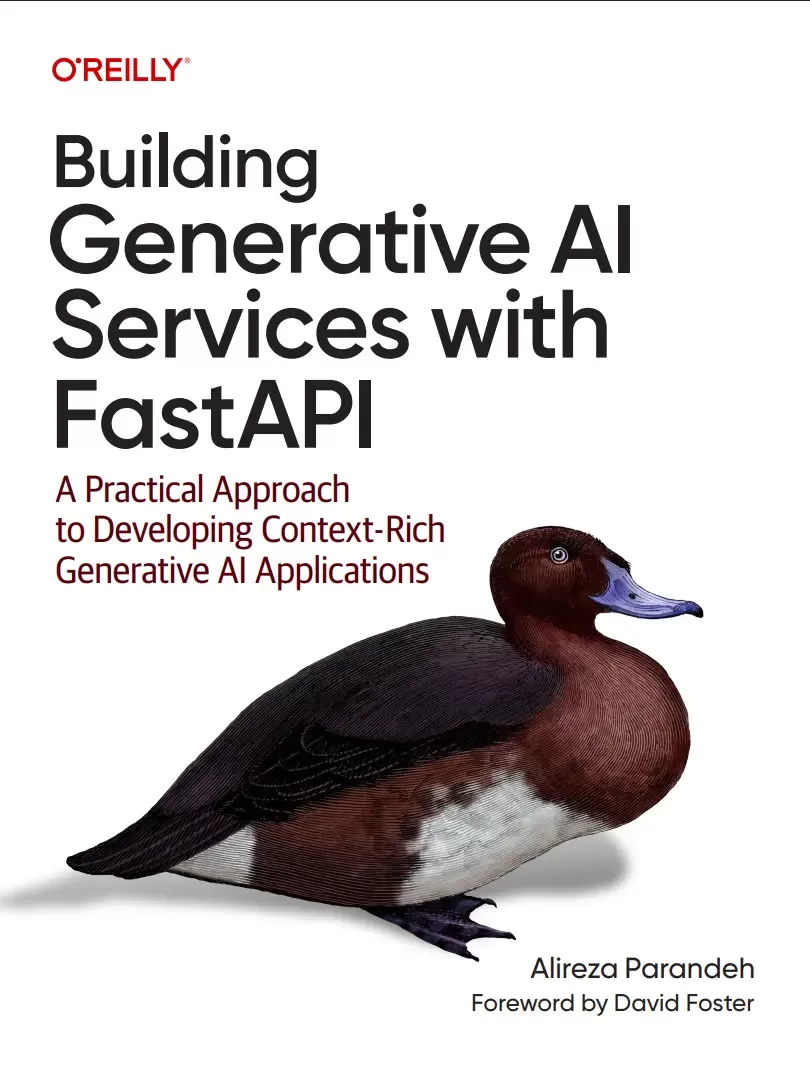
Building Generative AI Services with FastAPI: A Practical Approach to Developing Context-Rich Generative AI Applications
Оглавление⌄
Cover....1 Copyright....6 Table of Contents....7 Foreword....13 Preface....15 Objective and Approach....16 Prerequisites....17 Book Structure....17 How to Read This Book....19 Hardware and Software Requirements....20 Conventions Used in This Book....20 Using Code Examples....21 OReilly Online Learning....23 How to Contact Us....23 Acknowledgments....23 Part I. Developing AI Services....25 Chapter 1. Introduction....27 What Is Generative AI?....27 Why Generative AI Services Will Power Future Applications....30 Facilitating the Creative Process....31 Suggesting Contextually Relevant Solutions....33 Personalizing the User Experience....34 Minimizing Delay in Resolving Customer Queries....35 Acting as an Interface to Complex Systems....36 Automating Manual Administrative Tasks....37 Scaling and Democratizing Content Generation....37 How to Build a Generative AI Service....38 Why Build Generative AI Services with FastAPI?....39 What Prevents the Adoption of Generative AI Services....40 Overview of the Capstone Project....41 Summary....42 Chapter 2. Getting Started with FastAPI....43 Introduction to FastAPI....43 Setting Up Your Development Environment....44 Installing Python, FastAPI, and Required Packages....44 Creating a Simple FastAPI Web Server....45 FastAPI Features and Advantages....48 Inspired by Flask Routing Pattern....48 Handling Asynchronous and Synchronous Operations....48 Built-In Support for Background Tasks....49 Custom Middleware and CORS Support....49 Freedom to Customize Any Service Layer....50 Data Validation and Serialization....50 Rich Ecosystem of Plug-Ins....51 Automatic Documentation....52 Dependency Injection System....53 Lifespan Events....55 Security and Authentication Components....56 Bidirectional Web Socket, GraphQL, and Custom Response Support....56 Modern Python and IDE Integration with Sensible Defaults....57 FastAPI Project Structures....57 Flat Structure....58 Nested Structure....59 Modular Structure....60 Progressive Reorganization of Your FastAPI Project....62 OnionLayered Application Design Pattern....63 Comparing FastAPI to Other Python Web Frameworks....68 FastAPI Limitations....71 Inefficient Model Memory Management....71 Limited Number of Threads....71 Restricted to Global Interpreter Lock....71 Lack of Support for Micro-Batch Processing Inference Requests....72 Cannot Efficiently Split AI Workloads Between CPU and GPU....72 Dependency Conflicts....73 Lack of Support for Resource-Intensive AI Workloads....73 Setting Up a Managed Python Environment and Tooling....74 Summary....76 Chapter 3. AI Integration and Model Serving....77 Serving Generative Models....78 Language Models....78 Audio Models....97 Vision Models....103 Video Models....111 3D Models....119 Strategies for Serving Generative AI Models....126 Be Model Agnostic: Swap Models on Every Request....126 Be Compute Efficient: Preload Models with the FastAPI Lifespan....128 Be Lean: Serve Models Externally....131 The Role of Middleware in Service Monitoring....135 Summary....138 Additional References....139 Chapter 4. Implementing Type-Safe AI Services....141 Introduction to Type Safety....142 Implementing Type Safety....145 Type Annotations....145 Using Annotated....148 Dataclasses....149 Pydantic Models....152 How to Use Pydantic....152 Compound Pydantic Models....153 Field Constraints and Validators....154 Custom Field and Model Validators....157 Computed Fields....159 Model Export and Serialization....160 Parsing Environment Variables with Pydantic....161 Dataclasses or Pydantic Models in FastAPI....163 Summary....169 Part II. Communicating with External Systems....171 Chapter 5. Achieving Concurrency in AI Workloads....173 Optimizing GenAI Services for Multiple Users....174 Optimizing for IO Tasks with Asynchronous Programming....181 Synchronous Versus Asynchronous (Async) Execution....182 Async Programming with Model Provider APIs....186 Event Loop and Thread Pool in FastAPI....190 Blocking the Main Server....192 Project: Talk to the Web (Web Scraper)....194 Project: Talk to Documents (RAG)....199 Optimizing Model Serving for Memory- and Compute-Bound AI Inference Tasks....218 Compute-Bound Operations....218 Externalizing Model Serving....219 Managing Long-Running AI Inference Tasks....229 Summary....231 Additional References....232 Chapter 6. Real-Time Communication with Generative Models....233 Web Communication Mechanisms....234 RegularShort Polling....236 Long Polling....237 Server-Sent Events....238 WebSocket....240 Comparing Communication Mechanisms....246 Implementing SSE Endpoints....247 SSE with GET Request....250 SSE with POST Request....256 Implementing WS Endpoints....260 Streaming LLM Outputs with WebSocket....260 Handling WebSocket Exceptions....267 Designing APIs for Streaming....268 Summary....269 Chapter 7. Integrating Databases into AI Services....271 The Role of a Database....272 Database Systems....273 Project: Storing User Conversations with an LLM in a Relational Database....277 Defining ORM Models....279 Creating a Database Engine and Session Management....281 Implementing CRUD Endpoints....284 Repository and Services Design Pattern....288 Managing Database Schemas Changes....294 Storing Data When Working with Real-Time Streams....298 Summary....301 Part III. Securing, Optimizing, Testing, and Deploying AI Services....303 Chapter 8. Authentication and Authorization....305 Authentication and Authorization....306 Authentication Methods....307 Basic Authentication....309 JSON Web Tokens (JWT) Authentication....313 Implementing OAuth Authentication....333 OAuth Authentication with GitHub....336 OAuth2 Flow Types....343 Authorization....346 Authorization Models....347 Role-Based Access Control....348 Relationship-Based Access Control....352 Attribute-Based Access Control....353 Hybrid Authorization Models....354 Summary....358 Chapter 9. Securing AI Services....359 Usage Moderation and Abuse Protection....359 Guardrails....362 Input Guardrails....363 Output Guardrails....367 Guardrail Thresholds....368 Implementing a Moderation Guardrail....368 API Rate Limiting and Throttling....371 Implementing Rate Limits in FastAPI....372 Throttling Real-Time Streams....377 Summary....379 Chapter 10. Optimizing AI Services....381 Optimization Techniques....381 Batch Processing....382 Caching....385 Model Quantization....400 Structured Outputs....405 Prompt Engineering....408 Fine-Tuning....416 Summary....420 Chapter 11. Testing AI Services....421 The Importance of Testing....422 Software Testing....423 Types of Tests....423 The Biggest Challenge in Testing Software....425 Planning Tests....426 Test Dimensions....428 Test Data....429 Test Phases....429 Test Environments....430 Testing Strategies....431 Challenges of Testing GenAI Services....434 Variability of Outputs (Flakiness)....434 Performance and Resource Constraints (Slow and Expensive)....434 Regression....435 Bias....436 Adversarial Attacks....436 Unbound Testing Coverage....437 Project: Implementing Tests for a RAG System....437 Unit Tests....438 Integration Testing....454 End-to-End Testing....463 Summary....468 Chapter 12. Deployment of AI Services....469 Deployment Options....469 Deploying to Virtual Machines....470 Deploying to Serverless Functions....472 Deploying to Managed App Platforms....476 Deploying with Containers....477 Containerization with Docker....479 Docker Architecture....479 Building Docker Images....480 Container Registries....482 Container Filesystem and Docker Layers....484 Docker Storage....486 Docker Networking....494 Enabling GPU Driver....501 Docker Compose....502 Enabling GPU Access in Docker Compose....506 Optimizing Docker Images....507 docker init....514 Summary....515 Afterword....517 Index....519 About the Author....530 Colophon....530
Описание
В этом материале разберём тему: build.
This practical guide takes you through designing and deploying AI services using the FastAPI web framework. Ready to build production-grade applications with generative AI? Learn how to integrate models that process text, images, audio, and video while seamlessly interacting with databases, filesystems, websites, and APIs. Whether you're a web developer, data scientist, or DevOps engineer, this book equips you with the tools to build scalable, real-time AI applications.
You'll also explore best practices for testing AI outputs, optimizing performance, and securing microservices. Author Alireza Parandeh provides clear explanations and hands-on examples covering authentication, concurrency, caching, and retrieval-augmented generation (RAG) with vector databases. With containerized deployment using Docker, you'll be ready to launch AI-powered applications confidently in the cloud.
Build generative AI services that interact with databases, filesystems, websites, and APIsManage concurrency in AI workloads and handle long-running tasksStream AI-generated outputs in real time via WebSocket and server-sent eventsSecure services with authentication, content filtering, throttling, and rate limitingOptimize AI performance with caching, batch processing, and fine-tuning techniques
Файл доступен для загрузки ниже.
Поделиться
Частые вопросы
Можно ли скачать «Building Generative AI Services with FastAPI: A Practical Approach to Developing Context-Rich Generative AI Applications» бесплатно?
Да, «Building Generative AI Services with FastAPI: A Practical Approach to Developing Context-Rich Generative AI Applications» доступна для бесплатного скачивания на нашем сайте в формате PDF. Ссылка на файл находится на этой странице.
В каком формате и какого размера файл?
Книга предоставляется в формате PDF, размер файла 4,9 МБ.
Кто автор и когда вышла книга?
автор — Parandeh Alireza, издательство O’Reilly Media, Inc., год выпуска 2025, 531 страниц.
О чём книга «Building Generative AI Services with FastAPI: A Practical Approach to Developing Context-Rich Generative AI Applications»?
Ready to build production-grade applications with generative AI?
Похожие материалы
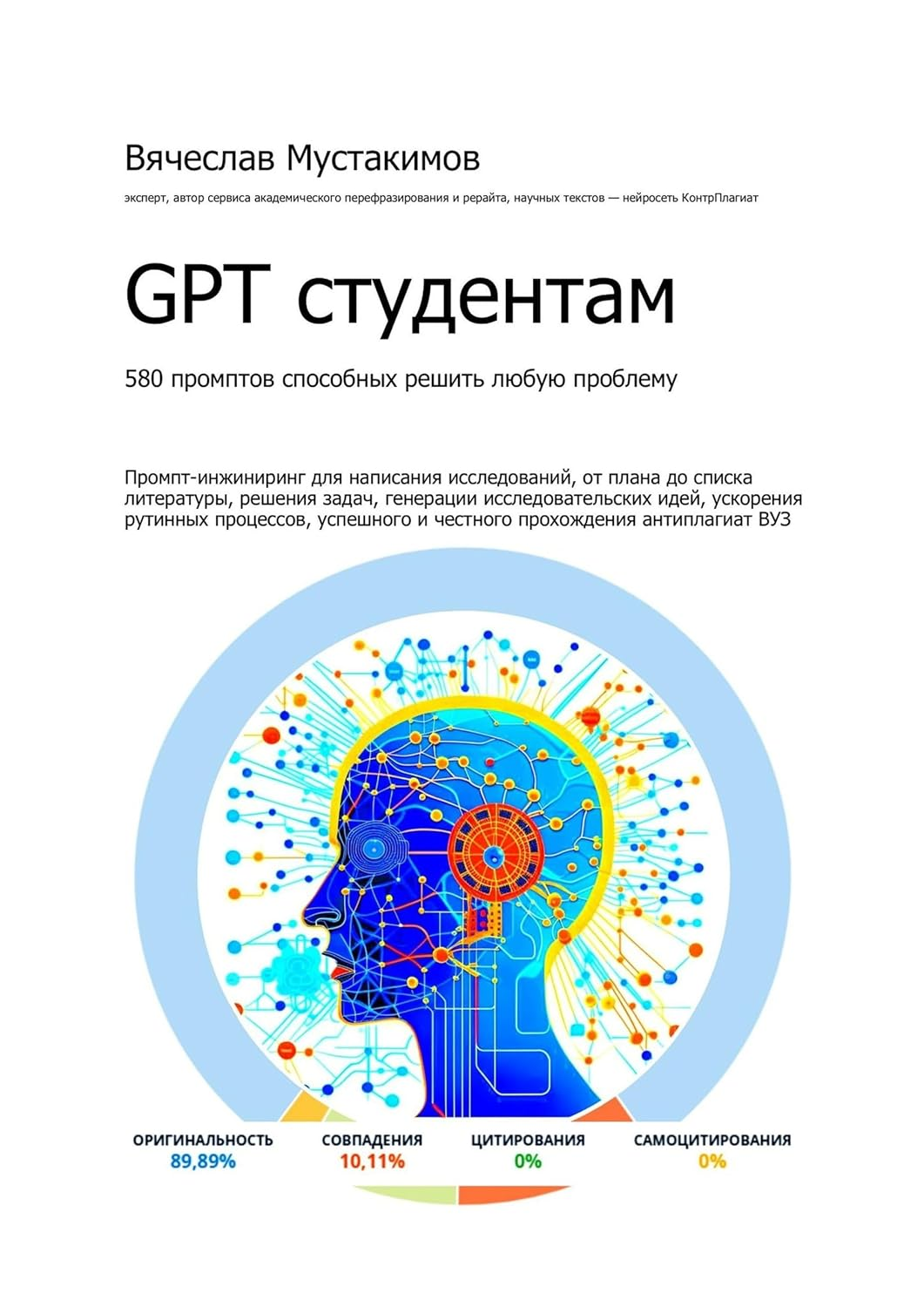 GPT студентам
 ChatGPT для саморазвития
 Всё об ИИ чат-боте ChatGPT
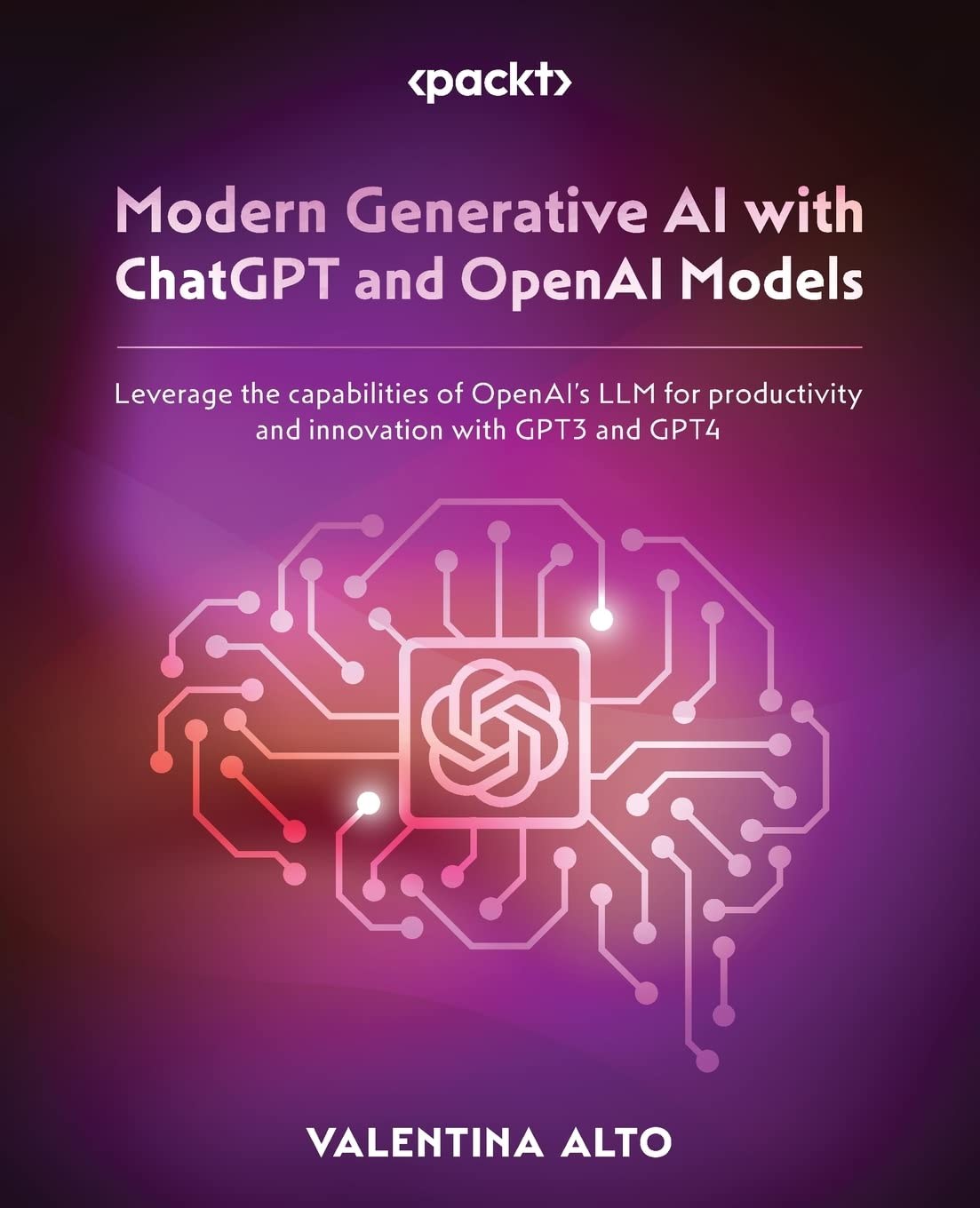 Modern Generative AI with ChatGPT and OpenAI Models
 ChatGPT и Революция Искусственного Интеллекта
 ChatGPT для чайников
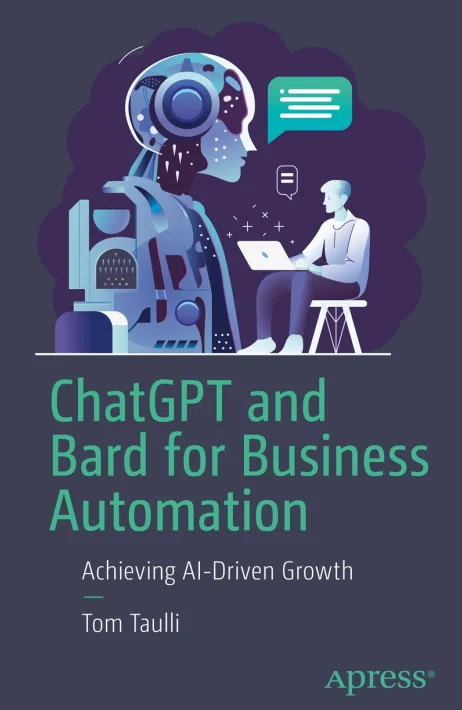 ChatGPT and Bard for Business Automation
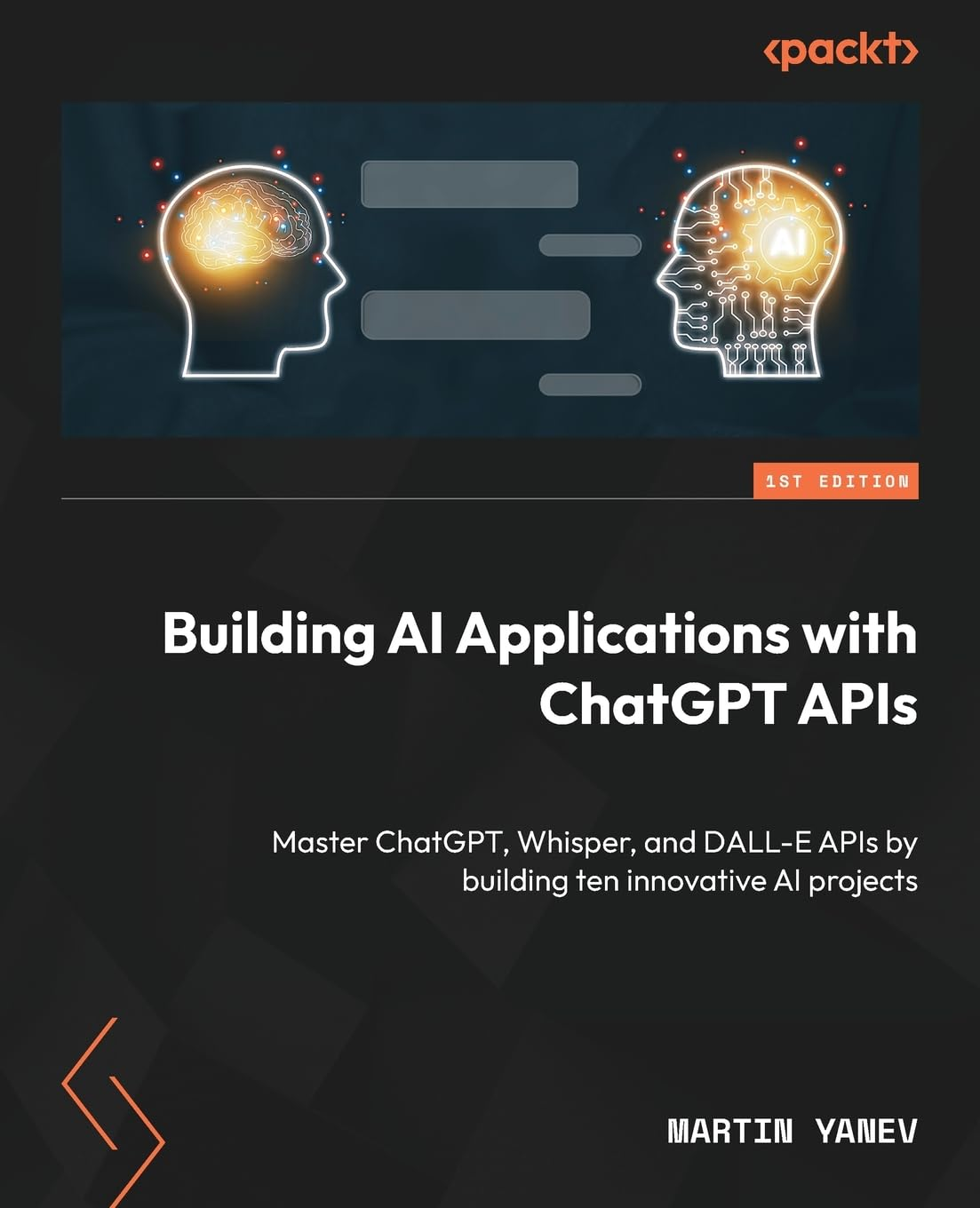 Building AI Applications with ChatGPT APIs: Master ChatGPT, Whisper, and DALL-E APIs by building ten innovative AI projects