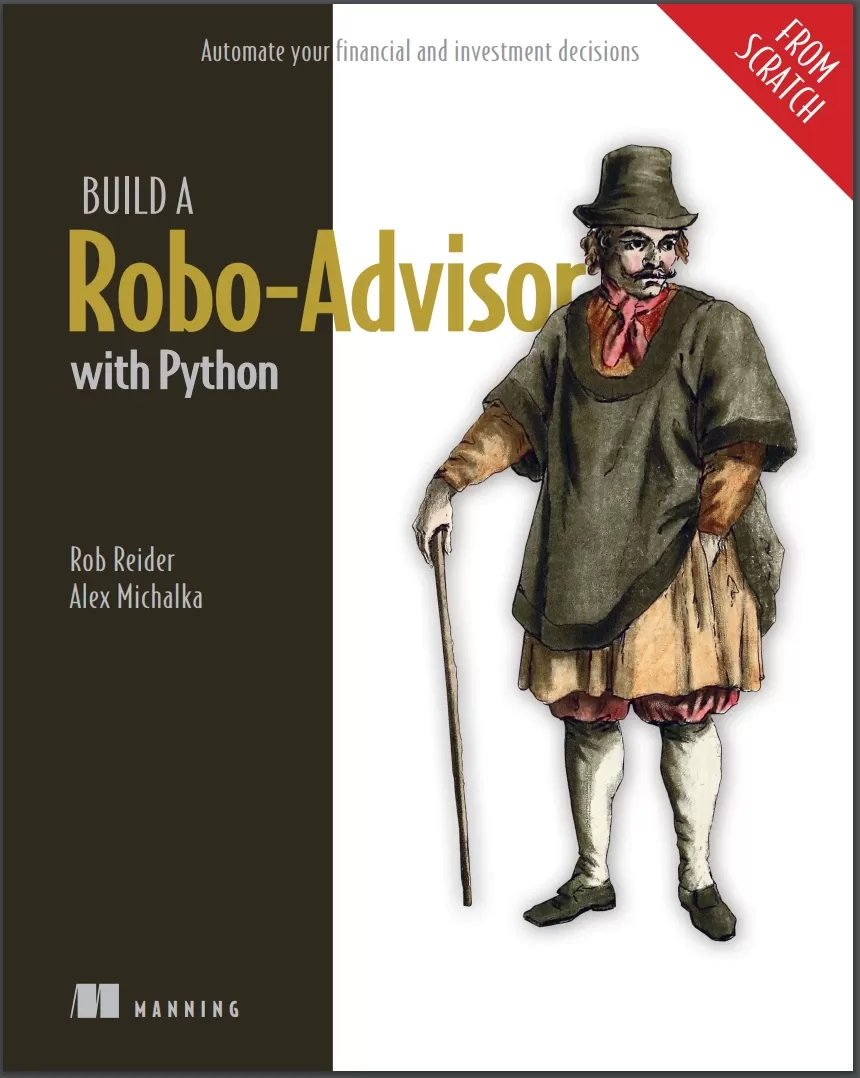
Build a Robo-Advisor with Python (From Scratch). Automate your financial and investment decisions
Оглавление⌄
Build a Robo-Advisor with Python....1 brief contents....5 contents....7 preface....12 acknowledgments....13 about this book....14 Who should read this book....14 How this book is organized: A roadmap....14 About the code....15 liveBook discussion forum....16 about the authors....17 about the cover illustration....18 Part 1 Basic tools and building blocks....19 1 The rise of robo-advisors....21 1.1 What are robo-advisors?....21 1.1.1 Key features of robo-advisors....22 1.1.2 Comparison of robo-advisors....23 1.1.3 Things robo-advisors don't do....23 1.2 Advantages of robo-advisors....24 1.2.1 Low fees....24 1.2.2 Tax savings....24 1.2.3 Avoiding behavioral biases....25 1.2.4 Saving time....26 1.3 Example: Social Security benefits....26 1.4 Python and robo-advising....28 1.5 Who might be interested in learning about robo-advising?....29 Summary....30 2 An introduction to portfolio construction....31 2.1 A simple example with three assets....32 2.2 Computing a portfolio's expected return and standard deviation....33 2.3 An illustration with random weights....36 2.4 Introducing a risk-free asset....39 2.5 Risk tolerance....41 Appendix....45 No risk-free rate....45 Adding a risk-free rate....47 Summary....48 3 Estimating expected returns and covariances....49 3.1 Estimating expected returns....50 3.1.1 Historical averages....50 3.1.2 CAPM....52 3.1.3 Adjusting historical returns for changes in valuation....57 3.1.4 Capital market assumptions from asset managers....63 3.2 Estimating variances and covariances....63 3.2.1 Using historical returns....63 3.2.2 GARCH models....65 3.2.3 Other approaches....68 3.2.4 Subjective estimates....68 Summary....70 4 ETFs: The building blocks of robo-portfolios....71 4.1 ETF basics....72 4.1.1 ETF strategies....72 4.1.2 ETF pricing: Theory....72 4.1.3 ETF pricing: Reality....74 4.1.4 Costs of ETF investing....75 4.2 ETFs vs. mutual funds....75 4.2.1 Tradability....76 4.2.2 Costs and minimums....77 4.2.3 Tax efficiency....77 4.2.4 The verdict on mutual funds vs. ETFs....78 4.3 Total cost of ownership....79 4.3.1 Cost components....79 4.4 Beyond standard indices....80 4.4.1 Smart beta....81 4.4.2 Socially responsible investing....82 Summary....84 Part 2 Financial planning tools....85 5 Monte Carlo simulations....87 5.1 Simulating returns in Python....89 5.2 Arithmetic vs. geometric average returns....92 5.3 Simple vs. continuously compounded returns....94 5.4 Geometric Brownian motion....95 5.5 Estimating the probability of success....96 5.6 Dynamic strategies....98 5.7 Inflation risk....100 5.8 Fat tails....105 5.9 Historical simulations and booststrapping....106 5.10 Longevity risk....108 5.11 Flexibility of Monte Carlo simulations....111 Appendix....112 Summary....112 6 Financial planning using reinforcement learning....114 6.1 A goals-based investing example....115 6.2 An introduction to reinforcement learning....115 6.2.1 Solution using dynamic programming....118 6.2.2 Solution using Q-learning....123 6.3 Utility function approach....126 6.3.1 Understanding utility functions....126 6.3.2 Optimal spending using utility functions....128 6.4 Longevity risk....132 6.5 Other extensions....134 Summary....135 7 Measuring and evaluating returns....136 7.1 Time-weighted vs. dollar-weighted returns....137 7.1.1 Time-weighted returns....138 7.1.2 Dollar-weighted returns....138 7.2 Risk-adjusted returns....140 7.2.1 Sharpe ratio....140 7.2.2 Alpha....142 7.2.3 Evaluating an ESG fund's performance....143 7.2.4 Which is better, alpha or Sharpe ratio?....145 Summary....146 8 Asset location....148 8.1 A simple example....149 8.2 The tax efficiency of various assets....153 8.3 Adding a Roth account....155 8.3.1 A simple example with three types of accounts....156 8.3.2 An example with optimization....157 8.4 Additional considerations....159 Summary....160 9 Tax-efficient withdrawal strategies....161 9.1 The intuition behind tax-efficient strategies....161 9.1.1 Principle 1: Deplete less tax-efficient accounts first....161 9.1.2 Principle 2: Keep tax brackets stable over time....162 9.2 Examples of sequencing strategies....163 9.2.1 Starting assumptions....163 9.2.2 Tax-sequencing code....164 9.2.3 Strategy 1: IRA first....167 9.2.4 Strategy 2: Taxable first....168 9.2.5 Strategy 3: Fill lower tax brackets....169 9.2.6 Strategy 4: Roth conversions....171 9.3 Additional complications....172 9.3.1 Required minimum distributions....173 9.3.2 Inheritance....174 9.3.3 Capital gains taxes....175 9.3.4 State taxes....178 9.3.5 Putting it all together....179 Summary....179 Part 3 Portfolio construction....181 10 Optimization and portfolio construction....183 10.1 Convex optimization in Python....184 10.1.1 Basics of optimization....184 10.1.2 Convexity....186 10.1.3 Python libraries for optimization....189 10.2 Mean-variance optimization....191 10.2.1 The basic problem....191 10.2.2 Adding more constraints....192 10.3 Optimization-based asset allocation....194 10.3.1 Minimal constraints....195 10.3.2 Enforcing diversification....200 10.3.3 Creating an efficient frontier....205 10.3.4 Building an ESG portfolio....206 Summary....207 11 Asset allocation by risk: Introduction to risk parity....209 11.1 Decomposing portfolio risk....210 11.1.1 Risk contributions....210 11.1.2 Risk concentration in a ``diversified'' portfolio....210 11.1.3 Risk parity as an optimal portfolio....211 11.2 Calculating risk-parity weights....213 11.2.1 Naive risk parity....213 11.2.2 General risk parity....213 11.2.3 Weighted risk parity....214 11.2.4 Hierarchical risk parity....218 11.3 Implementation of risk-parity portfolios....229 11.3.1 Applying leverage....230 Summary....231 12 The Black-Litterman model....232 12.1 Equilibrium returns....232 12.1.1 Reverse optimization....233 12.1.2 Understanding equilibrium....235 12.2 Conditional probability and Bayes' rule....236 12.3 Incorporating investor views....238 12.3.1 Expected returns as random variables....238 12.3.2 Expressing views....239 12.3.3 Updating equilibrium returns....240 12.3.4 Assumptions and parameters....241 12.4 Examples....242 12.4.1 Example: Sector selection....242 12.4.2 Example: Global allocation with cryptocurrencies....246 Summary....249 Part 4 Portfolio management....251 13 Rebalancing: Tracking a target portfolio....253 13.1 Rebalancing basics....253 13.1.1 The need for rebalancing....254 13.1.2 Downsides of rebalancing....255 13.1.3 Dividends and deposits....255 13.2 Simple rebalancing strategies....257 13.2.1 Fixed-interval rebalancing....257 13.2.2 Threshold-based rebalancing....257 13.2.3 Other considerations....258 13.2.4 Final thoughts....261 13.3 Optimizing rebalancing....261 13.3.1 Variables....261 13.3.2 Inputs....262 13.3.3 Formulating the problem....269 13.3.4 Running an example....271 13.4 Comparing rebalancing approaches....273 13.4.1 Implementing rebalancers....274 13.4.2 Building the backtester....279 13.4.3 Running backtests....286 13.4.4 Evaluating results....287 Summary....290 14 Tax-loss harvesting: Improving after-tax returns....291 14.1 The economics of tax-loss harvesting....292 14.1.1 Tax deferral....292 14.1.2 Rate conversion....294 14.1.3 When harvesting doesn't help....295 14.2 The wash-sale rule....295 14.2.1 Wash-sale basics....295 14.2.2 Wash sales with Python....299 14.3 Deciding when to harvest....311 14.3.1 Trading costs....311 14.3.2 Opportunity cost....312 14.3.3 End-to-end evaluation....317 14.4 Testing a TLH strategy....322 14.4.1 Backtester modifications....322 14.4.2 Choosing ETFs....323 Summary....323 index....324
Описание
В этом материале разберём тему: robo.
Automated digital financial advisors—also called robo-advisors—manage billions of dollars in assets. Follow the step-by-step instructions in this hands-on guide, and you’ll learn to build your robo-advisor capable of managing a real investing strategy.
Build a Robo-Advisor with Python (From Scratch) teaches you to develop one of these powerful, flexible tools using popular and free Python libraries. In Build a Robo-Advisor with Python (From Scratch) you’ll learn how to:Measure returns and estimate the benefits of robo-advisorsUse Monte Carlo simulations to build and test financial planning toolsConstruct diversified, efficient portfolios using optimization and other methodsImplement and evaluate rebalancing methods to track a target portfolio over timeDecrease taxes through tax-loss harvesting and optimized withdrawal sequencingUse reinforcement learning to find the optimal investment path up to, and after, retirementAutomated “robo-advisors” are commonplace in financial services, thanks to their ability to give high-quality investment advice at a fraction of the cost of human advisors. You’ll master practical Python skills in demand in financial services, and financial planning skills that will help you take the best care of your money. All examples are accompanied by working Python code, and are easy to adjust for investors anywhere in the world.
In this one-of-a-kind guide, you’ll learn how to build one of your own. About the technologyMillions of investors use robo-advisors as an alternative to human financial advisors. Your robo-advisor will assist you with all aspects of financial planning, including saving for retirement, creating a diversified portfolio, and decreasing your tax bill. And along the way, you’ll learn a lot about Python and finance!
As you go, you’ll dive into techniques like reinforcement learning, convex optimization, and Monte Carlo methods that you can apply even outside the field of FinTech. About the bookBuild a Robo-Advisor with Python (From Scratch) guides you step-by-step, feature-by-feature as you create a robo-advisor from the ground up. When you finish, your powerful assistant will be able to create optimal asset allocations, rebalance investments while minimizing taxes, and more.
What's insideAdvanced portfolio construction techniquesTax-loss harvesting, sequencing of retirement withdrawals, and asset locationFinancial planning using AI and Monte Carlo simulationsRebalancing methods to track a portfolio over timeAbout the readerAccessible to anyone with a basic knowledge of Python and finance—no special skills required.
На этом основные моменты по теме закрыты.
Поделиться
Частые вопросы
Можно ли скачать «Build a Robo-Advisor with Python (From Scratch). Automate your financial and investment decisions» бесплатно?
Да, «Build a Robo-Advisor with Python (From Scratch). Automate your financial and investment decisions» доступна для бесплатного скачивания на нашем сайте в формате PDF. Ссылка на файл находится на этой странице.
В каком формате и какого размера файл?
Книга предоставляется в формате PDF, размер файла 3,2 МБ.
Кто автор и когда вышла книга?
автор — Michalka Alex , Reider Rob, издательство Manning Publications Co., год выпуска 2025, 335 страниц.
О чём книга «Build a Robo-Advisor with Python (From Scratch). Automate your financial and investment decisions»?
Automated digital financial advisors—also called robo-advisors—manage billions of dollars in assets.
Похожие материалы
 GPT студентам
 ChatGPT для саморазвития
 Всё об ИИ чат-боте ChatGPT
 Modern Generative AI with ChatGPT and OpenAI Models
 ChatGPT и Революция Искусственного Интеллекта
 ChatGPT для чайников
 ChatGPT and Bard for Business Automation
 Building AI Applications with ChatGPT APIs: Master ChatGPT, Whisper, and DALL-E APIs by building ten innovative AI projects