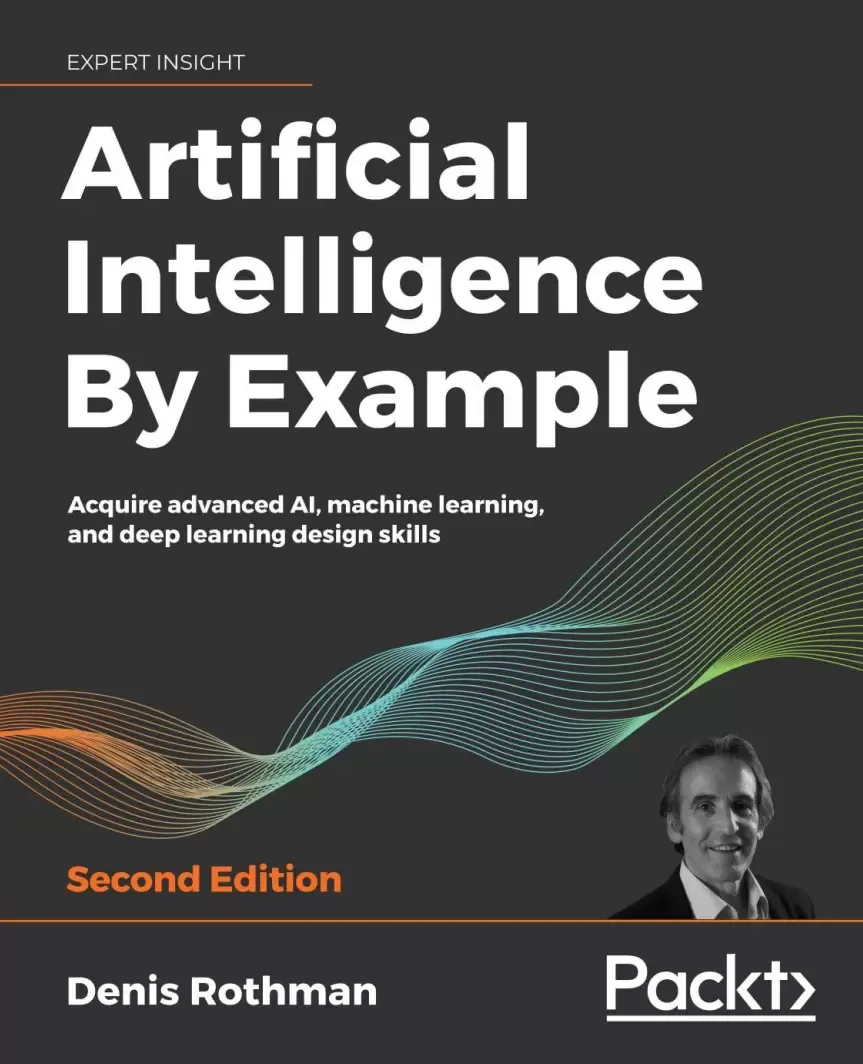
Artificial Intelligence By Example: Acquire Advanced AI, Machine Learning and Deep Learning design skills. 2 Ed
Оглавление⌄
Cover....1 Copyright....3 Packt Page....4 Contributors....5 Table of Contents....8 Preface....20 Chapter 1: Getting Started with Next-Generation Artificial Intelligence through Reinforcement Learning....30 Reinforcement learning concepts....31 How to adapt to machine thinking and become an adaptive thinker....33 Overcoming real-life issues using the three-step approach....34 Step 1 – describing a problem to solve: MDP in natural language....36 Watching the MDP agent at work....37 Step 2 – building a mathematical model: the mathematical representation of the Bellman equation and MDP....39 From MDP to the Bellman equation....39 Step 3 – writing source code: implementing the solution in Python....43 The lessons of reinforcement learning....45 How to use the outputs....47 Possible use cases....49 Machine learning versus traditional applications....52 Summary....53 Questions....53 Further reading....54 Chapter 2: Building a Reward Matrix – Designing Your Datasets....56 Designing datasets – where the dream stops and the hard work begins....57 Designing datasets....58 Using the McCulloch-Pitts neuron....58 The McCulloch-Pitts neuron....60 The Python-TensorFlow architecture....64 Logistic activation functions and classifiers....64 Overall architecture....64 Logistic classifier....65 Logistic function....66 Softmax....67 Summary....71 Questions....72 Further reading....72 Chapter 3: Machine Intelligence – Evaluation Functions and Numerical Convergence....74 Tracking down what to measure and deciding how to measure it....75 Convergence....77 Implicit convergence....78 Numerically controlled gradient descent convergence....78 Evaluating beyond human analytic capacity....85 Using supervised learning to evaluate a result that surpasses human analytic capacity....89 Summary....93 Questions....94 Further reading....94 Chapter 4: Optimizing Your Solutions with K-Means Clustering....96 Dataset optimization and control....97 Designing a dataset and choosing an MLDL model....98 Approval of the design matrix....99 Implementing a k-means clustering solution....103 The vision....103 The data....104 The strategy....105 The k-means clustering program....106 The mathematical definition of k-means clustering....107 The Python program....109 Saving and loading the model....113 Analyzing the results....114 Bot virtual clusters as a solution....115 The limits of the implementation of the k-means clustering algorithm....116 Summary....117 Questions....117 Further reading....118 Chapter 5: How to Use Decision Trees to Enhance K-Means Clustering....120 Unsupervised learning with KMC with large datasets....121 Identifying the difficulty of the problem....123 NP-hard – the meaning of P....123 NP-hard – the meaning of non-deterministic....124 Implementing random sampling with mini-batches....124 Using the LLN....125 The CLT....125 Using a Monte Carlo estimator....126 Trying to train the full training dataset....127 Training a random sample of the training dataset....127 Shuffling as another way to perform random sampling....129 Chaining supervised learning to verify unsupervised learning....131 Preprocessing raw data....132 A pipeline of scripts and ML algorithms....132 Step 1 – training and exporting data from an unsupervised ML algorithm....134 Step 2 – training a decision tree....135 Step 3 – a continuous cycle of KMC chained to a decision tree....139 Random forests as an alternative to decision trees....143 Summary....147 Questions....147 Further reading....148 Chapter 6: Innovating AI with Google Translate....150 Understanding innovation and disruption in AI....152 Is AI disruptive?....152 AI is based on mathematical theories that are not new....153 Neural networks are not new....153 Looking at disruption – the factors that are making AI disruptive....154 Cloud server power, data volumes, and web sharing of the early 21st century....154 Public awareness....155 Inventions versus innovations....155 Revolutionary versus disruptive solutions....156 Where to start?....156 Discover a world of opportunities with Google Translate....157 Getting started....157 The program....157 The header....157 Implementing Google's translation service....158 Google Translate from a linguist's perspective....159 Playing with the tool....160 Linguistic assessment of Google Translate....160 AI as a new frontier....164 Lexical field and polysemy....164 Exploring the frontier – customizing Google Translate with a Python program....166 k-nearest neighbor algorithm....167 Implementing the KNN algorithm....168 The knn_polysemy.py program....171 Implementing the KNN function in Google_Translate_Customized.py....173 Conclusions on the Google Translate customized experiment....181 The disruptive revolutionary loop....182 Summary....182 Questions....183 Further reading....183 Chapter 7: Optimizing Blockchains with Naive Bayes....186 Part I – the background to blockchain technology....187 Mining bitcoins....188 Using cryptocurrency....189 PART II – using blockchains to share information in a supply chain....190 Using blockchains in the supply chain network....193 Creating a block....194 Exploring the blocks....195 Part III – optimizing a supply chain with naive Bayes in a blockchain process....196 A naive Bayes example....196 The blockchain anticipation novelty....198 The goal – optimizing storage levels using blockchain data....199 Implementation of naive Bayes in Python....202 Gaussian naive Bayes....202 Summary....206 Questions....206 Further reading....207 Chapter 8: Solving the XOR Problem with a Feedforward Neural Network....208 The original perceptron could not solve the XOR function....209 XOR and linearly separable models....210 Linearly separable models....210 The XOR limit of a linear model, such as the original perceptron....211 Building an FNN from scratch....213 Step 1 – defining an FNN....213 Step 2 – an example of how two children can solve the XOR problem every day....214 Implementing a vintage XOR solution in Python with an FNN and backpropagation....218 A simplified version of a cost function and gradient descent....220 Linear separability was achieved....223 Applying the FNN XOR function to optimizing subsets of data....225 Summary....231 Questions....232 Further reading....232 Chapter 9: Abstract Image Classification with Convolutional Neural Networks (CNNs)....234 Introducing CNNs....235 Defining a CNN....236 Initializing the CNN....238 Adding a 2D convolution layer....239 Kernel....239 Shape....244 ReLU....244 Pooling....247 Next convolution and pooling layer....248 Flattening....249 Dense layers....249 Dense activation functions....250 Training a CNN model....250 The goal....251 Compiling the model....252 The loss function....252 The Adam optimizer....254 Metrics....255 The training dataset....255 Data augmentation....256 Loading the data....256 The testing dataset....257 Data augmentation on the testing dataset....257 Loading the data....257 Training with the classifier....258 Saving the model....259 Next steps....259 Summary....260 Questions....260 Further reading and references....260 Chapter 10: Conceptual Representation Learning....262 Generating profit with transfer learning....263 The motivation behind transfer learning....264 Inductive thinking....264 Inductive abstraction....264 The problem AI needs to solve....265 The gap concept....266 Loading the trained TensorFlow 2.x model....267 Loading and displaying the model....267 Loading the model to use it....271 Defining a strategy....274 Making the model profitable by using it for another problem....275 Domain learning....276 How to use the programs....276 The trained models used in this section....277 The trained model program....277 Gap – loaded or underloaded....278 Gap – jammed or open lanes....280 Gap datasets and subsets....282 Generalizing the (the gap conceptual dataset)....282 The motivation of conceptual representation learning metamodels applied to dimensionality....283 The curse of dimensionality....283 The blessing of dimensionality....284 Summary....285 Questions....286 Further reading....286 Chapter 11: Combining Reinforcement Learning and Deep Learning....288 Planning and scheduling today and tomorrow....289 A real-time manufacturing process....291 Amazon must expand its services to face competition....291 A real-time manufacturing revolution....292 CRLMM applied to an automated apparel manufacturing process....295 An apparel manufacturing process....296 Training the CRLMM....298 Generalizing the unit training dataset....298 Food conveyor belt processing – positive p and negative n gaps....299 Running a prediction program....303 Building the RL-DL-CRLMM....303 A circular process....304 Implementing a CNN-CRLMM to detect gaps and optimize....305 Q-learning – MDP....306 MDP inputs and outputs....307 The optimizer....310 The optimizer as a regulator....310 Finding the main target for the MDP function....313 A circular model – a stream-like system that never starts nor ends....315 Summary....320 Questions....320 Further reading....321 Chapter 12: AI and the Internet of Things (IoT)....322 The public service project....323 Setting up the RL-DL-CRLMM model....324 Applying the model of the CRLMM....326 The dataset....327 Using the trained model....329 Adding an SVM function....330 Motivation – using an SVM to increase safety levels....331 Definition of a support vector machine....332 Python function....334 Running the CRLMM....336 Finding a parking space....336 Deciding how to get to the parking lot....339 Support vector machine....340 The itinerary graph....342 The weight vector....343 Summary....344 Questions....345 Further reading....345 Chapter 13: Visualizing Networks with TensorFlow 2.x and TensorBoard....346 Exploring the output of the layers of a CNN in two steps with TensorFlow....347 Building the layers of a CNN....348 Processing the visual output of the layers of a CNN....352 Analyzing the visual output of the layers of a CNN....356 Analyzing the accuracy of a CNN using TensorBoard....363 Getting started with Google Colaboratory....363 Defining and training the model....365 Introducing some of the measurements....368 Summary....370 Questions....371 Further reading....371 Chapter 14: Preparing the Input of Chatbots with Restricted Boltzmann Machines (RBMs) and Principal Component Analysis (PCA)....372 Defining basic terms and goals....373 Introducing and building an RBM....374 The architecture of an RBM....375 An energy-based model....376 Building the RBM in Python....379 Creating a class and the structure of the RBM....379 Creating a training function in the RBM class....379 Computing the hidden units in the training function....380 Random sampling of the hidden units for the reconstruction and contractive divergence....381 Reconstruction....382 Contrastive divergence....383 Error and energy function....383 Running the epochs and analyzing the results....384 Using the weights of an RBM as feature vectors for PCA....386 Understanding PCA....391 Mathematical explanation....392 Using TensorFlow's Embedding Projector to represent PCA....396 Analyzing the PCA to obtain input entry points for a chatbot....399 Summary....401 Questions....402 Further reading....402 Chapter 15: Setting Up a Cognitive NLP UICUI Chatbot....404 Basic concepts....405 Defining NLU....405 Why do we call chatbots "agents"?....405 Creating an agent to understand Dialogflow....406 Entities....407 Intents....411 Context....416 Adding fulfillment functionality to an agent....421 Defining fulfillment....422 Enhancing the cogfilmdr agent with a fulfillment webhook....423 Getting the bot to work on your website....426 Machine learning agents....427 Using machine learning in a chatbot....427 Speech-to-text....427 Text-to-speech....428 Spelling....430 Why are these machine learning algorithms important?....432 Summary....433 Questions....434 Further reading....434 Chapter 16: Improve the Emotional Intelligence Deficiencies of Chatbots....436 From reacting to emotions, to creating emotions....437 Solving the problems of emotional polysemy....437 The greetings problem example....438 The affirmation example....439 The speech recognition fallacy....439 The facial analysis fallacy....440 Small talk....441 Courtesy....441 Emotions....444 Data logging....444 Creating emotions....447 RNN research for future automatic dialog generation....452 RNNs at work....453 RNN, LSTM, and vanishing gradients....454 Text generation with an RNN....455 Vectorizing the text....455 Building the model....456 Generating text....458 Summary....460 Questions....461 Further reading....461 Chapter 17: Genetic Algorithms in Hybrid Neural Networks....462 Understanding evolutionary algorithms....463 Heredity in humans....463 Our cells....464 How heredity works....464 Evolutionary algorithms....465 Going from a biological model to an algorithm....466 Basic concepts....466 Building a genetic algorithm in Python....469 Importing the libraries....469 Calling the algorithm....470 The main function....470 The parent generation process....471 Generating a parent....471 Fitness....472 Display parent....473 Crossover and mutation....474 Producing generations of children....476 Summary code....479 Unspecified target to optimize the architecture of a neural network with a genetic algorithm....480 A physical neural network....480 What is the nature of this mysterious S-FNN?....481 Calling the algorithm cell....482 Fitness cell....483 ga_main() cell....484 Artificial hybrid neural networks....485 Building the LSTM....486 The goal of the model....487 Summary....488 Questions....489 Further reading....489 Chapter 18: Neuromorphic Computing....490 Neuromorphic computing....491 Getting started with Nengo....492 Installing Nengo and Nengo GUI....493 Creating a Python program....495 A Nengo ensemble....495 Nengo neuron types....496 Nengo neuron dimensions....497 A Nengo node....497 Connecting Nengo objects....499 Visualizing data....499 Probes....504 Applying Nengo's unique approach to critical AI research areas....508 Summary....511 Questions....512 References....512 Further reading....512 Chapter 19: Quantum Computing....514 The rising power of quantum computers....515 Quantum computer speed....516 Defining a qubit....519 Representing a qubit....519 The position of a qubit....520 Radians, degrees, and rotations....521 The Bloch sphere....522 Composing a quantum score....523 Quantum gates with Quirk....523 A quantum computer score with Quirk....525 A quantum computer score with IBM Q....526 A thinking quantum computer....529 Representing our mind's concepts....529 Expanding MindX's conceptual representations....529 The MindX experiment....530 Preparing the data....530 Transformation functions – the situation function....530 Transformation functions – the quantum function....533 Creating and running the score....533 Using the output....535 Summary....536 Questions....536 Further reading....537 Appendix: Answers to the Questions....538 Chapter 1 – Getting Started with Next-Generation Artificial Intelligence through Reinforcement Learning....538 Chapter 2 – Building a Reward Matrix – Designing Your Datasets....540 Chapter 3 – Machine Intelligence – Evaluation Functions and Numerical Convergence....541 Chapter 4 – Optimizing Your Solutions with K-Means Clustering....542 Chapter 5 – How to Use Decision Trees to Enhance K-Means Clustering....544 Chapter 6 – Innovating AI with Google Translate....545 Chapter 7 – Optimizing Blockchains with Naive Bayes....547 Chapter 8 – Solving the XOR Problem with a Feedforward Neural Network....548 Chapter 9 – Abstract Image Classification with Convolutional Neural Networks (CNNs)....550 Chapter 10 – Conceptual Representation Learning....551 Chapter 11 – Combining Reinforcement Learning and Deep Learning....553 Chapter 12 – AI and the Internet of Things....554 Chapter 13 – Visualizing Networks with TensorFlow 2.x and TensorBoard....556 Chapter 14 – Preparing the Input of Chatbots with Restricted Boltzmann Machines (RBMs) and Principal Component Analysis (PCA)....557 Chapter 15 – Setting Up a Cognitive NLP UICUI Chatbot....558 Chapter 16 – Improve the Emotional Intelligence Deficiencies of Chatbots....559 Chapter 17 – Genetic Algorithms in Hybrid Neural Networks....560 Chapter 18 – Neuromorphic Computing....561 Chapter 19 – Quantum Computing....563 Other Books You May Enjoy....566 Index....570
Описание
В этом материале разберём тему: learning.
Understand the fundamentals and develop your own AI solutions in this updated edition packed with many new examples
Key FeaturesAI-based examples to guide you in designing and implementing machine intelligenceBuild machine intelligence from scratch using artificial intelligence examplesDevelop machine intelligence from scratch using real artificial intelligenceBook DescriptionAI has the potential to replicate humans in every field. Artificial Intelligence By Example, Second Edition serves as a starting point for you to understand how AI is built, with the help of intriguing and exciting examples.
Using some of the most interesting AI examples, right from computer programs such as a simple chess engine to cognitive chatbots, you will learn how to tackle the machine you are competing with. This book will make you an adaptive thinker and help you apply concepts to real-world scenarios. You will study some of the most advanced machine learning models, understand how to apply AI to blockchain and Internet of Things (IoT), and develop emotional quotient in chatbots using neural networks such as recurrent neural networks (RNNs) and convolutional neural networks (CNNs).
This edition also has new examples for hybrid neural networks, combining reinforcement learning (RL) and deep learning (DL), chained algorithms, combining unsupervised learning with decision trees, random forests, combining DL and genetic algorithms, conversational user interfaces (CUI) for chatbots, neuromorphic computing, and quantum computing.
By the end of this book, you will understand the fundamentals of AI and have worked through a number of examples that will help you develop your AI solutions.
What you will learnApply k-nearest neighbors (KNN) to language translations and explore the opportunities in Google TranslateUnderstand chained algorithms combining unsupervised learning with decision treesSolve the XOR problem with feedforward neural networks (FNN) and build its architecture to represent a data flow graphLearn about meta learning models with hybrid neural networksCreate a chatbot and optimize its emotional intelligence deficiencies with tools such as Small Talk and data loggingBuilding conversational user interfaces (CUI) for chatbotsWriting genetic algorithms that optimize deep learning neural networksBuild quantum computing circuitsWho this book is forDevelopers and those interested in AI, who want to understand the fundamentals of Artificial Intelligence and implement them practically. Prior experience with Python programming and statistical knowledge is essential to make the most out of this book.
Если материал оказался полезен — сохраните страницу.
Поделиться
Частые вопросы
Можно ли скачать «Artificial Intelligence By Example: Acquire Advanced AI, Machine Learning and Deep Learning design skills. 2 Ed» бесплатно?
Да, «Artificial Intelligence By Example: Acquire Advanced AI, Machine Learning and Deep Learning design skills. 2 Ed» доступна для бесплатного скачивания на нашем сайте в формате PDF. Ссылка на файл находится на этой странице.
В каком формате и какого размера файл?
Книга предоставляется в формате PDF, размер файла 4,5 МБ.
Кто автор и когда вышла книга?
автор — Rothman Denis, издательство Packt Publishing Limited, год выпуска 2020, 579 страниц.
О чём книга «Artificial Intelligence By Example: Acquire Advanced AI, Machine Learning and Deep Learning design skills. 2 Ed»?
Understand the fundamentals and develop your own AI solutions in this updated edition packed with many new examplesKey FeaturesAI-based examples to guide you in designing and implementing machine intelligenceBuild machine intelligence from
Похожие материалы
 GPT студентам
 ChatGPT для саморазвития
 Всё об ИИ чат-боте ChatGPT
 Modern Generative AI with ChatGPT and OpenAI Models
 ChatGPT и Революция Искусственного Интеллекта
 ChatGPT для чайников
 ChatGPT and Bard for Business Automation
 Building AI Applications with ChatGPT APIs: Master ChatGPT, Whisper, and DALL-E APIs by building ten innovative AI projects