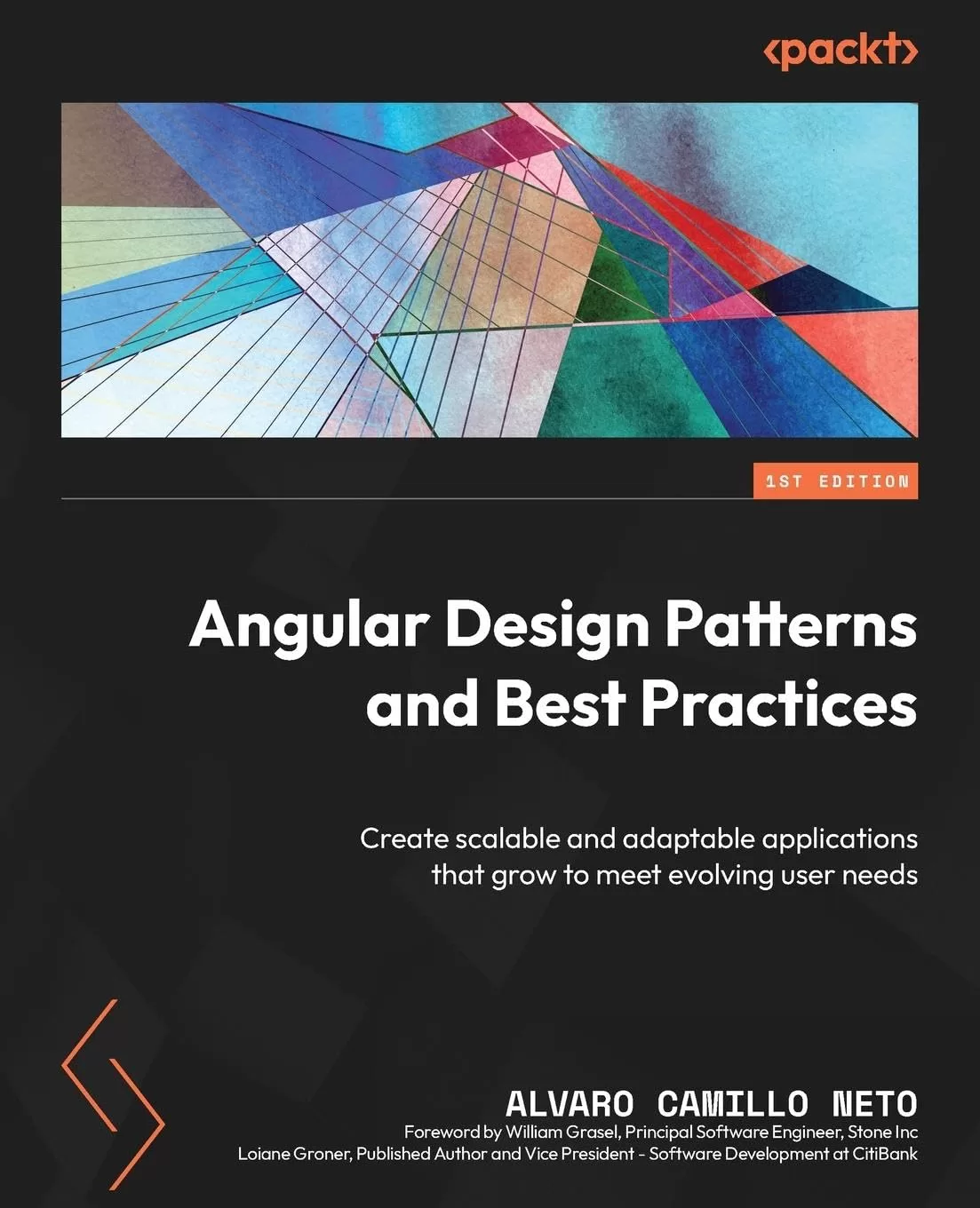
Angular Design Patterns and Best Practices: Create scalable and adaptable applications that grow to meet evolving user needs
Оглавление⌄
Cover....1 Title Page....2 Copyright and Credits....3 Foreword....5 Contributors....7 Table of Contents....10 Preface....16 Part 1: Reinforcing the Foundations....22 Chapter 1: Starting Projects the Right Way....24 Technical requirements....24 Why choose Angular?....25 Batteries included....25 Google support....25 Community....25 Tooling....26 What technologies are present in the ecosystem?....26 TypeScript....26 RXJS....27 Karma and Jasmine....27 Webpack....27 Configuring your development environment....28 VS Code....28 VS Code settings....30 Fira Code font and ligatures....30 Standardizing the extensions and settings in the project....31 Angular DevTools....32 Starting an Angular project....33 Project structure....36 Using the Angular CLI for your productivity....37 ng add....37 ng update....38 ng serve....38 ng build....39 ng deploy....39 ng generate....39 Summary....40 Chapter 2: Organizing Your Application....42 Technical requirements....42 Organizing the application with Angular modules....43 declarations....43 providers....44 imports....44 exports....44 The first module – AppModule....45 What is the difference between Angular and JavaScript modules?....45 Modules type....46 Avoiding anti-pattern – single module app....50 Optimizing the usage of common modules – the SharedModule pattern....51 Improving the size of your app – lazy loading....53 Summary....57 Chapter 3: TypeScript Patterns for Angular....58 Technical requirements....58 Creating classes and types....59 Primitive and basic types....59 Classes....61 Interfaces....64 Type aliases....66 When to use classes, interfaces, or types....67 Creating methods and functions....68 Working with null values....69 Decreasing verbosity – type inference....70 Validating types – type guards....71 Using a better alternative to the any type....73 Summary....75 Chapter 4: Components and Pages....76 Technical requirements....76 Creating components....77 Communication between components – inputs and outputs....81 Best practice – using the TrackBy property....84 Separating responsibilities – Smart and Presentation components....86 Communication from the child component – using @Output....89 Propagating events from nested components....91 Summary....95 Chapter 5: Angular Services and the Singleton Pattern....96 Technical requirements....96 Creating services....97 Understanding the dependency injection pattern....99 Using the inject() function....101 Communication between components using services....101 REST API consumption....104 Summary....108 Part 2: Leveraging Angular’s Capabilities....110 Chapter 6: Handling User Inputs: Forms....112 Technical requirements....112 Template-driven forms....113 Reactive forms....118 Data validation....122 Custom validations....125 Typed reactive forms....128 Summary....129 Chapter 7: Routes and Routers....130 Technical requirements....130 Routes and navigation....131 Defining an error page and title....134 Dynamic routes – wildcards and parameters....137 Securing routes – guards....143 Optimizing the experience – Resolve....150 Summary....152 Chapter 8: Improving Backend Integrations: the Interceptor Pattern....154 Technical requirements....155 Attaching the token to the request with an interceptor....155 Changing the request route....160 Creating a loader....162 Notifying success....165 Measuring the performance of a request....167 Summary....169 Chapter 9: Exploring Reactivity with RxJS....170 Technical requirements....170 Observables and operators....171 Handling data – transformation operators....172 Another way to subscribe – the async pipe....174 Connecting information flows – high-order operators....177 Optimizing data consumption – filter operators....178 How to choose the correct operator....180 Summary....182 Part 3: Architecture and Deployment....184 Chapter 10: Design for Tests: Best Practices....186 Technical requirements....186 What to test....187 Service tests....190 Fixing the tests and understanding TestBed....194 Component testing....198 E2E tests with Cypress....200 Summary....205 Chapter 11: Micro Frontend with Angular Elements....206 Technical requirements....206 Micro frontend – concepts and application....207 When to use a micro frontend....207 When not to use a micro frontend project....207 Slicing your application into micro frontends....208 Creating a micro frontend application with standalone components....209 Preparing a page to be loaded by the base application....214 Dynamically loading micro frontends....217 Summary....221 Chapter 12: Packaging Everything – Best Practices for Deployment....222 Technical requirements....222 Deploying the backend....223 Differentiating environments....228 Preparing the production bundle....231 Mounting a Docker image with Nginx....234 Deploying a page to Azure Static Web Apps....236 Summary....240 Chapter 13: The Angular Renaissance....242 Technical requirements....242 Updating your project with the Angular CLI....243 Using a new way to create templates – control flow....244 Improving the user experience using the defer command....247 Creating transitions between pages – view transactions....251 Simplifying application states – Angular Signals....253 Summary....258 Index....260 Other Books You May Enjoy....267
Описание
Ниже — практический обзор по теме «angular».
Angular, with its batteries-included approach, has emerged as a powerful framework for simplifying the development of these interfaces by offering a comprehensive toolbox. Single page applications (SPAs) have become the standard for most web experiences. This book guides you through the Angular ecosystem, uncovering invaluable design patterns and harnessing its essential features.
The next set of chapters will help you gain expertise in component design and architecting efficient, flexible, and high-performing communication patterns between components. The book begins by laying a strong foundation, helping you understand when and why Angular should be your web development framework of choice. You'll then delve into Angular's advanced features to create forms in a productive and secure way with robust data model typing. The book also covers micro frontend architecture in depth to effectively apply this architectural approach and concludes by helping you master the art of crafting tests and handling errors effortlessly. You'll also learn how to enhance productivity using interceptors to reuse code for common functionalities, such as token management, across various apps.
By the end of this book, you'll have unlocked the full potential of the Angular framework.
What you will learnDiscover effective strategies for organizing your Angular project for enhanced efficiencyHarness the power of TypeScript to boost productivity and the overall quality of your Angular projectImplement proven design patterns to streamline the structure and communication between componentsSimplify complex applications by integrating micro frontend and standalone componentsOptimize the deployment process for top-notch application performanceLeverage Angular signals and standalone components to create performant applicationsWho this book is forWhether you're a web developer or a tech leader engaged in frontend development, be it for small-scale projects or large, complex systems, you'll find this book useful to enhance both the quality and performance of your applications. Web architects seeking to design robust and adaptable frontend applications while leveraging Angular's extensive feature set will discover valuable insights within these pages.
Если материал оказался полезен — сохраните страницу.
Поделиться
Частые вопросы
Можно ли скачать «Angular Design Patterns and Best Practices: Create scalable and adaptable applications that grow to meet evolving user needs» бесплатно?
Да, «Angular Design Patterns and Best Practices: Create scalable and adaptable applications that grow to meet evolving user needs» доступна для бесплатного скачивания на нашем сайте в формате PDF. Ссылка на файл находится на этой странице.
В каком формате и какого размера файл?
Книга предоставляется в формате PDF, размер файла 1,9 МБ.
Кто автор и когда вышла книга?
автор — Neto Alvaro Camillo, издательство Packt Publishing Limited, год выпуска 2024, 270 страниц.
О чём книга «Angular Design Patterns and Best Practices: Create scalable and adaptable applications that grow to meet evolving user needs»?
Single page applications (SPAs) have become the standard for most web experiences.
Похожие материалы
 JavaScript. Рецепты для разработчиков. 3 изд
 Become A Ninja With Angular
 Mastering jQuery: A Beginner’s Guide
 Professional JavaScript for Web Developers. 5 Ed
 React.js Design Patterns: Learn how to build scalable React apps with ease
 Typescript and JavaScript Coding Made Simple 2 Books in 1: A Beginner’s Guide to Programming
 React. Сборник рецептов. Практические приемы работы с фреймворком React
 JavaScript. Полное руководство: Справочник по самому популярному языку программирования. 7 изд